
Artists of all kinds, and classical music composers in particular, have always been inspired by the natural world….and especially water.
From rivers to brooks to the sea itself, bodies of water have proven to be some of the most inspirational subject matter in the entire history of music.
Today, we’re inviting you on a tour of thirty of the best pieces of classical music about water. Grab an oar and a lifejacket, and we’ll get started!
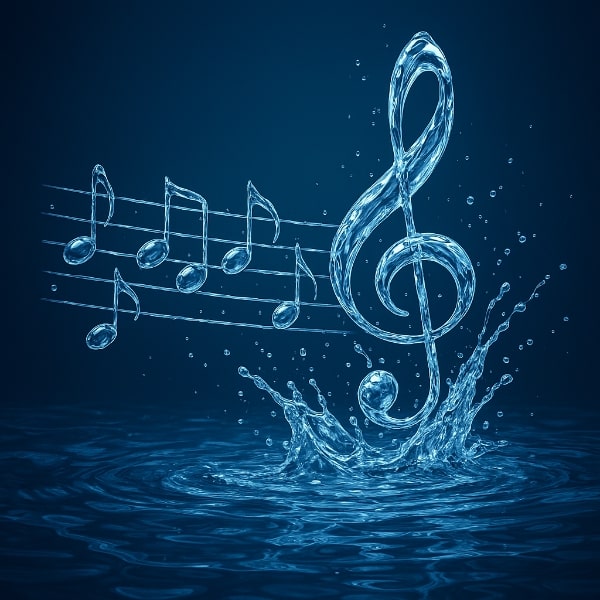
Image created by ChatGPT
George Frederic Handel: Water Music (1717)
We’re beginning with what has to be the most famous watery piece on this list: Handel’s Water Music!
It was composed in 1717 when King George I decided to take a barge voyage up the Thames to showcase his and his court’s wealth and political power.
To enhance the spectacle, he asked Handel if he could write music for a subsidiary barge of musicians who would travel alongside them.
Apparently, the king loved this “Water Music” so much, he requested it be played three times in a row!
Felix Mendelssohn: The Hebrides Overture (1830)
As a young man, composer Felix Mendelssohn went on a Grand Tour of Europe.
While in Scotland, he was incredibly taken by the uninhabited island of Staffa, which boasts a scenic sea cave.
Mendelssohn was so inspired by the power and majesty of the ocean waves crashing against the cliffs that he wrote an entire overture inspired by the sight.
Franz Liszt: Au Bord d’une Source from Années de Pèlerinage (ca 1834-38)
Au bord d’une source (“Beside a Spring”) is a charming piece for solo piano that imitates the sounds of a gurgling brook.
To imitate the sound of flowing water, Franz Liszt relies on sparkling arpeggios and frequent tinkling high notes.
Richard Wagner: Prelude from Das Rheingold (1854)
Richard Wagner’s opera Das Rheingold (literally, “The Rheine Gold”) begins at the bottom of the Rhine River, the cradle of German culture.
Three water nymphs – Woglinde, Wellgunde, and Floßhilde – play innocently in the watery depths.
Anton Rubinstein: Symphony No. 2 “Ocean” (1857)
Anton Rubinstein began his musical career as a pianist, but by his thirties, he was attempting to branch out as a composer.
In 1857, he wrote a work that he subtitled “Ocean.” The work’s massive size and majestic character do indeed call to mind the grandeur of the sea.
Johann Strauss II: On the Beautiful Blue Danube (1866)
The Blue Danube is more than just a river to the Viennese: it’s the lifeblood of Austria.
So it comes as no surprise that waltz composer Johann Strauss II – possibly the composer identified most closely with Vienna – would pay homage to this great river by naming a waltz after it.
Bedřich Smetana: Die Moldau (1874)
Just like the Rhine River is important to Germans and the Danube important to Austrians, the Vltava (known as the Moldau in German) is important to Hungarians.
The Vltava flows through the countryside and the heart of Prague.
Composer Bedřich Smetana, whose Czech identity was deeply important to him, seized upon the river as inspiration when composing a set of six symphonic poems that he called Má vlast (“My Fatherland”). Die Moldau is the second symphonic poem in that set.
Gabriel Fauré: Au bord de l’eau (1875)
Au bord de l’eau (“To sit together on the bank of a flowing stream”) is a very wistful, very French song by a young Gabriel Fauré.
The narrator sings about the simple joys of being isolated and content with your lover.
To sit together on the bank of a flowing stream,
To watch it flow…
Not to feel, while this dream passes,
The passing of time;
But feeling no deep passion,
Except to adore each other,
With no care for the quarrels of the world,
To know nothing of them…
Modest Mussorgsky: Dawn Over the Moscow River (1880)
This work was originally intended to be the prelude to Mussorgsky’s final opera, Khovanschina, but he died in 1881, leaving a mainly completed piano score, with barely any orchestration.
Dawn Over the Moscow River is meant to portray the city of Moscow in the late 1600s (the time period that Khovanschina is set in). The work includes tinges of Russian folksong and a bell motif in the horns, representing the church bells of the city.
Ernest Chausson: Poème de l’amour et de la mer (1882-90)
Ernest Chausson‘s Poème de l’amour et de la mer (“Poem of Love and the Sea”) is a heartfelt song cycle from the throes of the Romantic Era for soprano and orchestra. It had a long gestation that lasted from 1882 to 1890.
The work comes in three parts. First, La Fleur des eaux (“The Flower of the Waters”). Second, an orchestral interlude. And third, La Mort de l’amour (“The Death of Love”).
The poetry that provides the words for the first and third segments makes evocative references to water: “the sea goes forth to be all embraced by the sun’s great glow” and “rivulets that dampen her dress.”
Antonín Dvořák: The Water Goblin (1896)
The Water Goblin is a symphonic poem by Czech composer Antonín Dvořák, inspired by a horrifying legend that’s stomach-churning to read, even today.
A water spirit abducts a maiden and forces her to become his wife. They have a child together, but the goblin becomes incensed that his wife is singing to their child.
She begs to be allowed to return to the surface to visit her mother. The goblin agrees, as long as he can hold the baby hostage and that she returns when she hears the evening vesper bells.
Her mother, however, is desperate to save her daughter from this abuse and forbids her to return to the child. When she doesn’t return, the water goblin takes vengeance by leaving the child’s dead body on the doorstep.
Edward Elgar: Sea Pieces (1899)
Sea Pictures is a song cycle consisting of five songs for contralto and orchestra.
In it, Edward Elgar sweetly set poems by his wife, as well as Elizabeth Barrett Browning and three other English poets.
One fun trivia fact about this work: alto Clara Butt gave the premiere while dressed in a mermaid costume!
Maurice Ravel: Jeux d’eau (1901)
Translated into English, Jeux d’eau means “Water Games.” It has also been translated as “Fountains” or “Playing Water.”
Maurice Ravel wrote this piece for solo piano. It seems to be a musical portrait of a brook, whirlpool, fountain, or some other place where water is flowing freely and sparkling in the sunlight.
Claude Debussy: La Mer (1903-05)
La Mer (“The Sea”) is a tone poem that paints a picture of crashing ocean waves. Listeners can practically feel the salty sea spray on their faces as they listen.
Critics weren’t initially impressed by La Mer. However, modern audiences have embraced its rolling rhythms and fantastic flourishes, and today it’s one of Claude Debussy’s most popular works.
Ralph Vaughan Williams: A Sea Symphony (1903-09)
English composer Ralph Vaughan Williams composed the extravagant Sea Symphony in his thirties. It’s written for chorus, orchestra, baritone and soprano soloists.
It takes a little over an hour to perform, and is one of the first symphonies to use a chorus throughout.
Maurice Ravel: Une barque sur l’océan from Miroirs (1904-05)
Miroirs is a five-movement suite for solo piano. The second movement is “Une barque sur l’océan”, or “A boat on the ocean.”
From the very beginning of the piece, you can hear the wind and rippling waves.
Claude Debussy: Reflects dans l’eau from Images (1905)
In 1905, Claude Debussy tried his hand at composing a watery piece for solo piano.
He wrote a set of piano works he called Images, and he called the first one “Reflections in the Water.” It calls to mind the sparkly playfulness of Ravel’s Une barque and Jeux d’eau.
Anatoly Lyadov: The Enchanted Lake (1909)
Anatoly Lyadov was a Russian composer born in 1855 into a musical family full of conductors, pianists, and opera singers.
He was a noted perfectionist who published a relatively small number of pieces. (In fact, he spent much of his career teaching, and even taught Sergei Prokofiev.)
His most famous is undoubtedly the brief but magical orchestral tone poem The Enchanted Lake, which is subtitled “Fairy Tale Scene.”
Henry Wood: Fantasia on British Sea Songs (1910)
Sir Henry Wood was a British conductor famous for leading Proms concerts in London for nearly fifty years.
He also composed, and in 1910, he wrote this arrangement of various famous British songs having to do with the sea.
The narrative of the piece follows a nameless British sailor fighting in the Battle of Trafalgar, and through songs portrays taking up arms, losing a fellow soldier in battle, and returning home to “Rule, Britannia.”
Claude Debussy: The Sunken Cathedral from Préludes, Book I (1910)
In his first book of préludes for solo piano, Debussy devoted one piece to a legend of a sunken cathedral in Breton.
According to myths, the city of Ys was a city built on soil reclaimed from the sea, and a wayward princess misused the key to the dikes, drowning the residents and destroying the city.
Legend has it that the city’s cathedral rises from the sea on calm mornings, and all of its sounds – priests chanting, bells ringing, organ playing – can be heard from land.
This work is Debussy’s interpretation of that evocative myth.
Frank Bridge: The Sea (1910-11)
British composer Frank Bridge wrote The Sea, a twenty-minute-long orchestral suite
Bridge wrote program notes about the work for the benefit of his listeners. He describes the opening in these words: “Seascape paints the sea on a summer morning. From high drifts is seen a great expanse of waters lying in the sunlight. Warm breezes play over the surface.”
Armand Marsick: La Source (1912)
Armand Marsick was born into a musical family in 1877. He became a fine violinist and made a career as a performer and composer in pre-war Paris.
In 1912, he wrote La Source (“The Brook”), a lush orchestral tone poem that follows a brook from its early pastoral beginnings into a swirl of waves and romantic passion.
One fun fact is that Marsick played violin in a performance of La Mer under Debussy’s baton. You can definitely hear the influence of Debussy’s work on Marsick’s.
Granville Ransome Bantock: Hebridean Symphony (1913)
Granville Ransome Bantock was born in London to a Scottish father in 1868. He became a conductor and composer known for promoting the work of English musicians.
In 1913, he wrote a single-movement symphony inspired by the Scottish Hebrides. It combines sweeping depictions of the landscapes and seascapes of the area with orchestrated versions of regional folk songs.
Jean Sibelius: The Oceanides (1914)
Translated into English, Jean Sibelius‘s Oceanides means something like “Nymphs of the Waves.”
In this elegant tone poem, Sibelius portrays both the spirits of the winsome water nymphs and the rolling sea. The central section portrays a fierce storm.
Olin Downes, a critic from the New York Times, famously called this work “the finest evocation of the sea which has ever been produced in music.”
Amy Beach: By the Still Waters (1925)
Over the course of her career, American pianist and composer Amy Beach wrote many evocative works for solo piano.
One of them is “By the Still Waters”, in which the pianist plays a series of odd, gloriously repetitive arpeggios. It can put a listener into a trance, much like watching a river can.
Ferde Grofé: Mississippi Suite (1926)
In 1926, composer Ferde Grofé composed a four-movement orchestral suite tracing the mighty Mississippi River from its origins in Minnesota, down through the various locales portrayed in Mark Twain’s novel Huckleberry Finn…and then finally, to a Mardi Gras celebration in New Orleans!
Florence Price: Mississippi River Suite (1934)
Florence Price was one of the most extraordinary composers that America has ever produced.
She was born to a Black family in Little Rock in 1887 and faced sexism and prejudice throughout her education and career, which is a big reason why she has not been often heard until relatively recently.
Despite all this, she continued composing, and in 1933, her first symphony won a prize that resulted in its being performed by the Chicago Symphony Orchestra. In this way, she became the first Black woman to have her work played by a major symphony orchestra.
Her Mississippi River Suite, which she wrote soon after hearing her first symphony in concert, paints a heartfelt portrait of the iconic river, with musical elements borrowed from the culture of the Black people who worked along the riverbank for generations.
Benjamin Britten: Four Sea Interludes by Peter Grimes (1945)
In the 1940s, between his homosexuality and his and his partner’s status as conscientious objectors during World War II, Benjamin Britten thought a lot about the idea of being an outsider and the difficulties of being misunderstood and persecuted by the wider world.
These thoughts manifested in his opera Peter Grimes, a 1944 masterpiece set in the fictional fishing village of Aldeburgh in Britain.
Britten captured the tempestuous mood of Peter Grimes for orchestral audiences in his Four Sea Interludes for orchestra.
Luciano Berio: Wasserklavier (1965)
Intriguingly, the word Wasserklavier translates into “Water Piano.” What might this mean, exactly? It’s up to you to decide.
Over the following decades, Berio created companion pieces for Wasserklavier: Erdenklavier (Earth Piano), Luftklavier (Air Piano), and Feuerklavier (Fire Piano).
Berio ended up writing about all four of the classic elements, but Wasserklavier was where it all began.
Ludovico Einaudi: Le Onde (1996)
In 1996, pianist and composer Ludovico Einaudi wrote the piano piece Le Onde (which also became the title track to an album by the same name).
Einaudi wrote:
If it were a story, it would be set on the seafront of a long beach. A beach without beginning and without end. The story of a man who walks along this shore and perhaps never meets anyone. His gaze lingers occasionally to look at some object or fragment brought from the sea. The footprints of a crab or a solitary seagull. I always take the sand, the sky, some clouds, the sea. Only the waves change, always the same and different, smaller. larger. Shorter. Longer.
Conclusion
So there you have it: thirty pieces of classical music about water, dating from the 1700s to the present day. Which one was your favourite? Did we miss any of your favourites? Let us know!
For more of the best in classical music, sign up for our E-Newsletter






Prokofiev:The Volga meets the Don.