Engagements are often long, carefully negotiated preludes to marriage. For many composers, however, they were anything but.
Short engagements – lasting four months or less – have happened in classical music history for all kinds of reasons: desire, scandal, social pressure, pregnancy, professional dependency, or even emotional crisis.
The brief engagements of great 19th- and 20th-century composers like Tchaikovsky, Nielsen, Strauss, Debussy, Mahler, and Bartók all reveal how often composers’ fast-developing romantic relationships could tip into life-altering commitments.
Taken together, they offer a revealing lens on how love impacted classical music’s most famous figures.
Pyotr Ilyich Tchaikovsky and Antonina Miliukova (May 1877 – July 1877)
Tchaikovsky’s Symphony No. 4, written between 1877 and 1878 (New York Philharmonic, Leonard Bernstein)
Tchaikovsky’s brief engagement and then marriage to his former conservatory student Antonina Miliukova in 1877 was a notorious episode in the composer’s life.
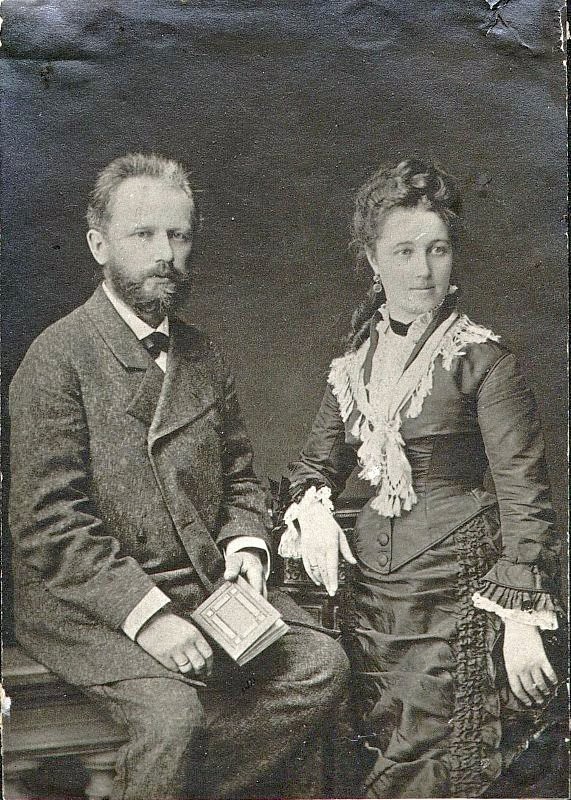
Tchaikovsky with his wife Antonina Milykova
They first met in 1872 through Antonina’s brother in Moscow, but nothing happened between them until 1877. That year, after inheriting some money that could be used as a dowry, she wrote him a love letter.
In the spring, she confessed her admiration for him, and they began a correspondence.
Antonina eventually threatened suicide if he refused to marry her. Today, scholars are split as to whether she was completely serious or using hyperbole common in love letters of the era.
Tchaikovsky didn’t turn her down automatically, but there was a fundamental problem: he was a gay man.
Nevertheless, on 23 May / 4 June 1877, Tchaikovsky agreed to marry her, provided she considered him a brother. Their wedding took place on 6/18 July 1877 in Moscow.
Almost immediately, Tchaikovsky realised he’d made a grave mistake. After about twenty days, the marriage still had not been consummated, and on 27 July / 8 August, in a panic, he left Antonina and went to Kamenka to stay with his sister.
Despite Antonina’s pleas, they never lived together again.
Carl Nielsen and Anne Marie Brodersen (March 1891 – May 1891)
Nielsen’s Symphony No. 1, written between 1891 and 1892 (Sinfónica de Galicia)
Danish composer Carl Nielsen met sculptor Anne Marie Brodersen in Paris in early March 1891.
Nielsen, then on a scholarship study trip, recorded in his diary meeting Anne Marie at a social gathering: he immediately became infatuated with her (“Miss Brodersen is really quite pretty,” he wrote).
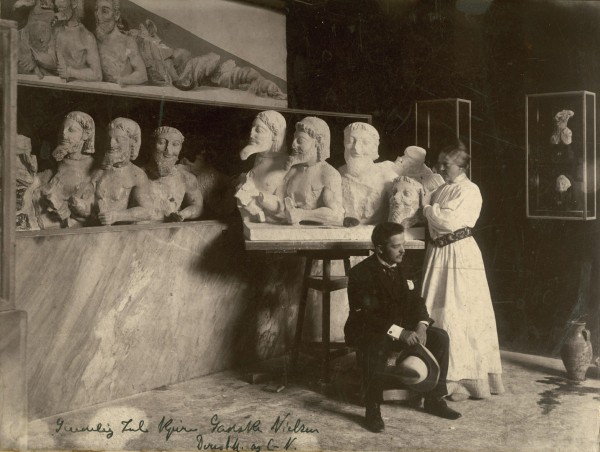
Anne Marie and Carl Nielsen photographed in front of her Typhon copy in the Acropolis Museum in Athens, 1903
Within two weeks, they were inseparable. By 20 March 1891, they were already so committed to one another that they “considered themselves married,” celebrating their union with friends on 10 April.
While touring Italy together, Anne Marie became pregnant; they would have their first child in December. They were formally married in Florence on 10 May 1891 (just over two months after they met).
After their marriage, Nielsen settled with Anne Marie in Copenhagen and began family life. He dedicated his First Symphony to his new wife, and together the two embarked on a fascinating and emotionally complex marriage.
Richard Strauss and Pauline de Ahna (May 1894 – September 1894)
Nadine Sierra Performs “Cäcilie”, written in 1894
Richard Strauss met soprano Pauline de Ahna in 1887 when she became one of his singing students in Munich. A stormy, passionate courtship ensued.
By the spring of 1894, they were engaged. One oft-told story recounts that that summer, during a rehearsal with orchestra, Pauline stormed out, and Strauss responded by declaring to the musicians that he was going to marry her.
Their wedding took place on 10 September 1894.
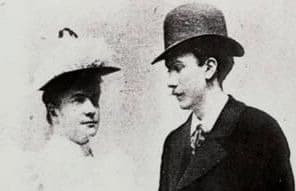
Richard Strauss and Pauline de Ahna
During the engagement and wedding week, Strauss expressed his love through his composition. On 9 September 1894 – the day before the wedding – he completed his love song “Cäcilie” (Op. 27, No. 2) as a wedding gift for Pauline.
Their short engagement led to a long marriage in which Pauline became both muse and manager, inspiring some of Strauss’s most personal music.
Claude Debussy and Rosalie Texier (June 1899 – October 1899)
Nocturnes, composed between 1897 and 1899 (Orchestre philharmonique de Radio France / Mikko Franck)
In spring 1899, Debussy met Marie-Rosalie “Lilly” Texier, a fashion model, soon after separating from his previous lover. He quickly became obsessed and proposed marriage to her.
Debussy even threatened suicide if she refused. In one letter, he wrote:
“I naturally keep my ring, wanting to be buried with it. Please welcome my last and longest kiss, of the one who was your Claude. I will wait for a word from you until tonight, and if I can no longer hope for anything, just tell me that you forgive me, your pride may well sacrifice someone who is going to die.”
She ultimately agreed, and they married on 19 October 1899.
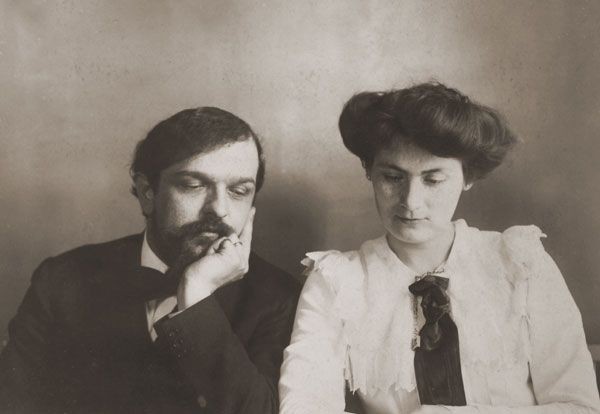
Claude Debussy and Rosalie Texier
For a few years, Lilly was devoted and loyal to her new husband, living in poverty to support Debussy.
However, he soon grew restless in the relationship. By late 1903, he’d fallen in love with another woman named Emma Bardac, leaving Lilly and causing a major scandal.
Gustav Mahler and Alma Schindler (December 1901 – March 1902)
Wiebke Lehmkuhl performs Alma Mahler’s Five Songs with WDR Sinfonieorchester
Composer Gustav Mahler – in his early forties at the time – met the 22-year-old composer and socialite Alma Schindler at a Viennese salon in late 1901.
Although Alma was still involved with her composition teacher, Alexander Zemlinsky, she and Mahler began a fast and passionate affair in November 1901.
By early December 1901, they were secretly engaged, with the official announcement going public on the 23rd.
From the early days of their engagement, Mahler began exerting control over Alma’s life.
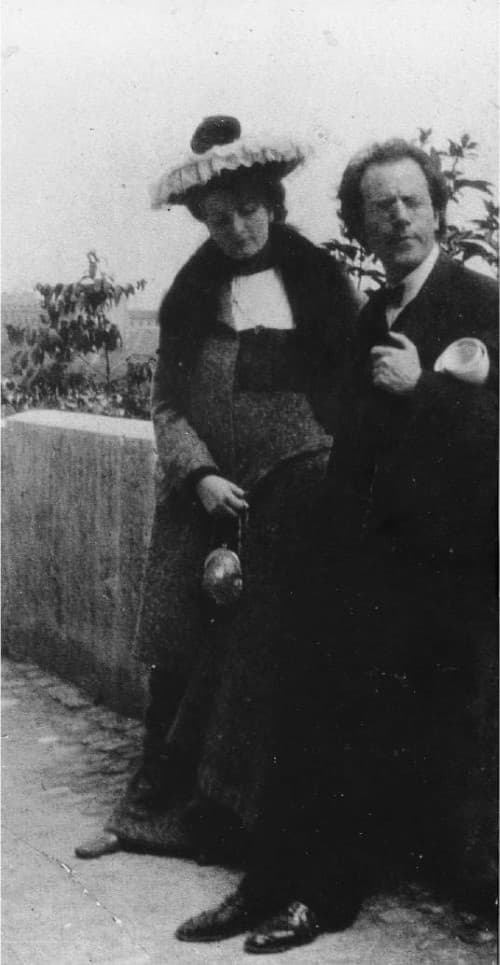
Alma and Gustav Mahler, Basel 1903 © Mahler Foundation
In a famous letter dated 19 December 1901, he told Alma she must abandon music and devote herself entirely to him.
Alma reluctantly agreed and ceased composing from that point on: a major sacrifice for her, as she’d once dreamed of becoming the first woman composer to write a great opera.
(Not surprisingly, that conflict would later return to haunt them during their marital crisis of 1910.)
The Mahlers married in March 1902. To their embarrassment, she’d gotten pregnant during the engagement. She gave birth to their first child that November.
Béla Bartók and Ditta Pásztory (August 1923)
András Schiff Performs Bartók’s Piano Concerto No. 3
By mid-1923, the 42-year-old Bartók had ended his first marriage, and he was teaching a talented 19-year-old pianist, Edith “Ditta” Pásztory, at the Budapest Academy.
One day after a lesson, Bartók casually asked Ditta to marry him. He gave her only three days to decide.
She ultimately agreed, so they obtained a special marriage licence and married on 28 August 1923 – meaning their engagement lasted only about a week.
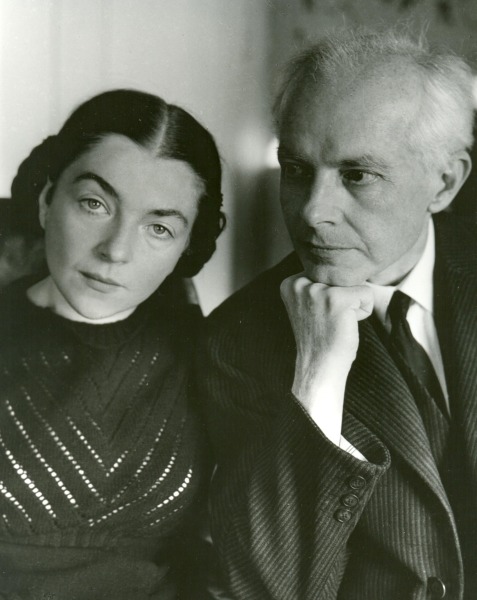
Ditta Pásztory and Béla Bartók
In the years that followed, Ditta’s life became centred around Bartók. She gave birth to their son Péter in 1924 and essentially put her solo piano career on hold to support him.
Bartók, meanwhile, found new inspiration from their union. He dedicated his Third Piano Concerto to her, and in 1938, they premiered the Sonata for Two Pianos and Percussion together.
Conclusion
Despite their relative brevity, all of these short engagements were deeply consequential.
Some of them led to happy and enduring artistic partnerships, while others hinted at the marital breakdown, scandal, or quiet resignation that was to come.
But in all six cases, the effects echoed far beyond the wedding: shaping careers, inspiring masterpieces, or otherwise impacting the composer’s output. All became catalysts of lifelong change, for better and for worse.
For more of the best in classical music, sign up for our E-Newsletter