
The Sound of the North
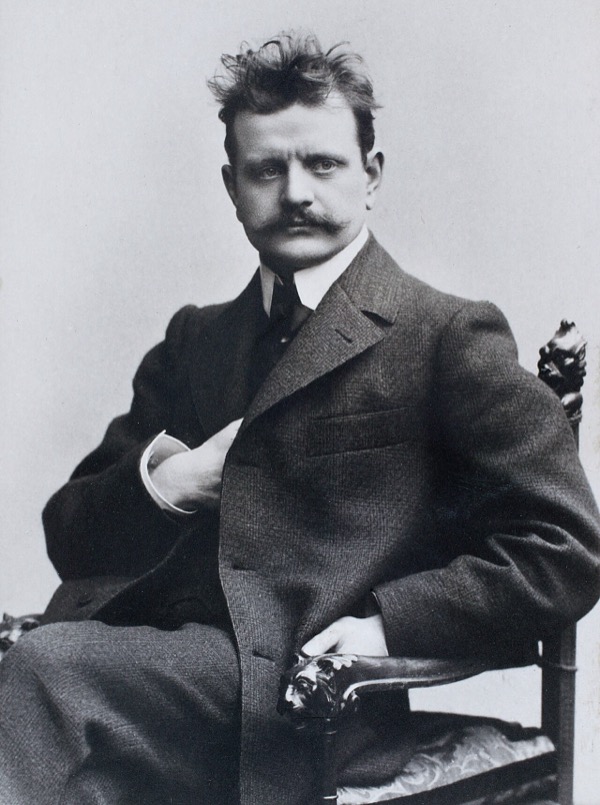
Jean Sibelius, circa 1898–1900
The music of Finnish composer Jean Sibelius (1865-1957) achieved great popularity in English-speaking countries during the first half of the twentieth century. Yet, his reception in Central Europe and France became increasingly problematic.
His music polarised along ideological lines, and while his supporters saw him as the last true successor to Beethoven and a bulwark against dissonant new music, Theodor Adorno described his music as expressing a shabbily deluded, market-driven false consciousness.
However, let’s not forget that Jean Sibelius was central to creating a Finnish voice in music, and that his most significant output was essentially orchestral.
As James Hepokoski writes, “His music evokes a range of characteristic moods and topics, from celebratory nationalism and political struggle to cold despair and separatist isolation; from brooding contemplations of ‘neo-primitive’ musical ideas or slowly transforming sound textures to meditations on the mysteries, grandeurs and occasionally lurking terrors of archetypal folk myths or natural landscapes.” (Hepokoski, Grove Music Online, 2001)
Jean Sibelius: Kullervo
From Violinist to Composer
Jean Sibelius was born in the small garrison town of Hämeenlinna on 8 December 1865. He was christened Johan Christian Julius, but as a first-year student in Helsinki, he adopted his uncle Jean’s first name as his musical name. His father, a military physician and town doctor, died in July 1868, and plunged the family into financial difficulties.
Jean began exploring the family piano at age five and received lessons from his aunt. His uncle, Pehr Sibelius, gave him a violin when he was ten, and he began formal study of music in September 1881.
Over time, Sibelius became a competent violinist, and he played second violin in a local string quartet. His first compositions date to around 1883, when he began composing chamber works in imitation of Haydn, Beethoven, and Schubert.
With a loan from his uncle, Sibelius began studying law after graduating from high school in 1885. However, he was far more interested in music, so he entered the Helsinki Music Institute, now the Sibelius Academy, as a violinist.
He received his first formal composition instruction from Martin Wegelius, a champion of Wagner and Liszt, and he formed a lifelong friendship with the young Ferruccio Busoni. Within about two years, Sibelius had composed over a dozen works and fell head over heels in love with Aino Järnefelt.
Upon graduation from the Helsinki Music Institute, Sibelius secured a state stipend to study composition in Germany for one year. He went to Berlin to study privately with Albert Becker, but Sibelius was more drawn to the city’s enticements.
A Piano Quintet in G minor aroused criticism at home and abroad, and Sibelius briefly returned to Finland for the summer. He moved to Vienna on another scholarship in 1890 to study with Robert Fuchs and Karl Goldmark, and this proved to be the turning point of his musical life.
Jean Sibelius: Piano Quintet in G minor
A Finnish Voice
He became more self-critical and turned away from classical chamber compositions toward orchestral expression. Most importantly, Sibelius began to engage systematically with Finnish-language culture, and he became enthralled by the Kalevala, the national folk epic.
The Kalevala “opened the floodgates of imagination,” and he saw it as a source of rhythm, atmosphere, and emotion. He was captivated by the poetry’s unyielding sameness and pondered the cultural implications of folk music.
Sibelius was fascinated by the recitation formulas of the Kalevala, formulas that “constitute a family of brief, constricted melodies, each a pattern for the delivery of complementary pairs of poetic lines, spun out in an endless line-by-line alternation and sometimes performed back-and-forth between two male reciters.” (Hepokoski, Groves Online, 2001)
After returning from Vienna, Sibelius actively constructed his Finnish-culture self-image by capturing the essential feeling that animated such music. He also became engaged with Finnish-language Karelianism, a political and artistic feature that swept through Finland in the 1890s.
The Karelia region, though mostly under Russian control, was praised for preserving the most authentic traditions of Finnish music and poetry. The Helsinki premiere of Kullervo established Sibelius as the musical voice of a rising generation of cultural activists.
Jean Sibelius: Karelia Suite
National Awakening
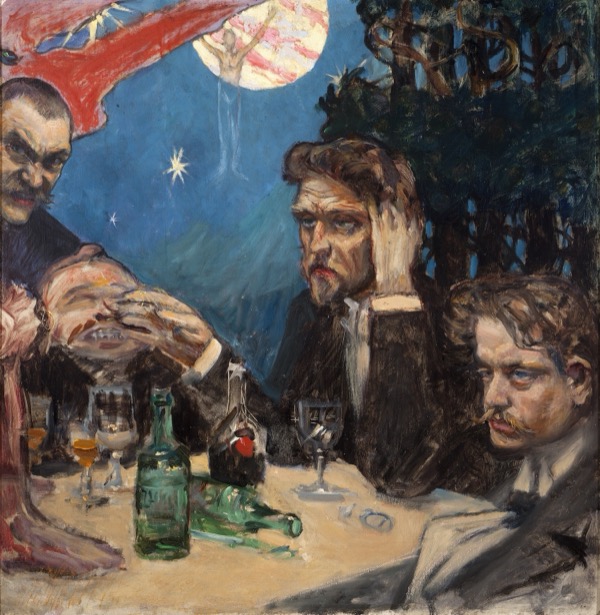
Akseli Gallen-Kallela: Problem (Symposium) (Gösta Serlachius Fine Arts Foundation)
He married Aino on 10 June 1892, and they spent their honeymoon in Karelia. Marital bliss and the stunning countryside clearly inspired his Karelia Suite. Their home, aptly named “Ainola,” was completed on Lake Tuusula in 1903, and the first of six daughters was born shortly thereafter.
Sibelius began teaching theory and violin in 1892, and he visited Bayreuth in 1894, declaring, “I am no longer a Wagnerian.” From then on, he saw himself as closer to Liszt and the symphonic poem than to Wagnerian music drama.
Sibelius composed his First Symphony in 1899, a work well received. Composed when his patriotic feelings ran high, his Song of the Athenians brought Sibelius the status of a national hero.
In 1900, Sibelius and the Helsinki Philharmonic toured northern Europe, playing 19 concerts in 13 cities. Critics were highly favourable, establishing the composer’s international recognition. A second symphony, partly inspired by Mozart’s Don Giovanni, emerged during a trip to Italy, and Sibelius also wrote some of his most overtly political music.
Russia’s policy in Finland had turned towards harsh repression, and a process of stripping Finland of its political autonomy and shutting down newspapers had begun. In response, Sibelius composed several protest pieces in a simpler style, including a call-to-action tone poem that would later become “Finlandia.”
Jean Sibelius: Finlandia
From Excess to Isolation
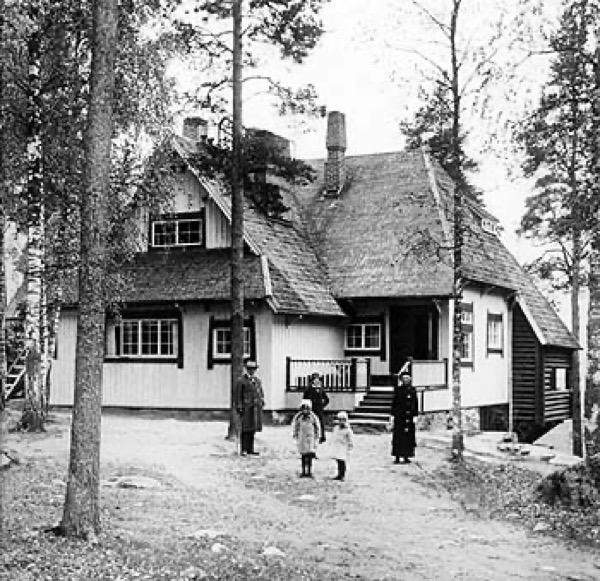
Ainola, 1915
Early in 1904, Sibelius finished his Violin Concerto, but its first public performance was not a success. Here he fused his stern neo-primitivism with the tradition of the virtuoso concerto, filled with displays of dazzling technique. Sibelius withheld the work from publication and extensively revised and condensed it. In this version, it premiered in Berlin in October 1905.
Sibelius had long excessively indulged in wine and fine dining, and his heavy drinking started to affect his health. His family decided to move permanently out of Helsinki and its temptations, and they designed a rustic villa called “Ainola.” They built it in the middle of the Finnish forest at Järvenpää, close to Lake Tuusula. Sibelius and his family moved into Ainola in September 1904, and it was to be his home for the rest of his life.
Sibelius toured Berlin in 1905, and his first visit to Britain in November brought a meeting with Henry Wood in Liverpool. This trip was pivotal to his reception, as it strengthened his English and later American ties, while his reception in Germany continued to deteriorate.
Jean Sibelius: The Oceanides
Solitude and Symmetry
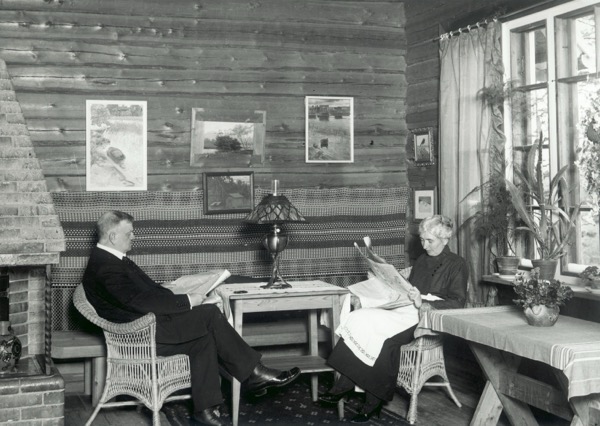
Jean Sibelius and his wife Aino reading in the dining room at Ainola
Sibelius indulged once more in excessive drinking and dining in Helsinki, and as he resolved to give up drinking, he concentrated on his Third Symphony, a work performed on 25 September 1907. Yet, his heavy drinking and smoking had become life-threatening, and he underwent a serious operation. Under the shadow of sickness, he composed his Fourth Symphony a couple of years later.
It was the climactic utterance of his modern-classical style, a piece of enormous depth and implication. Sibelius considered it a protest against present-day music. “It has nothing, absolutely nothing of the circus about it.”
Sibelius became increasingly alienated from the dominant musical trends of Central Europe. Unwilling to compete with Schoenberg, Mahler, Strauss, and Debussy, he turned towards solitude and nature. His alternative to modernism greatly appealed to American audiences during his 1914 visit.
Musically, Sibelius developed a highly personal conception of musical form. As he suggested, he wanted music to grow organically from its motifs, allowing musical ideas to determine their own form.
This approach is particularly evident in the Fifth, Sixth, and Seventh Symphonies, works that draw on an atmosphere of nature and a symphonic argument compressed into continuous movement. Sibelius composed prolifically until the mid-1920s, but after completing the Seventh Symphony and some incidental music, he stopped producing major works.
Jean Sibelius: Symphony No. 7
After the Silence
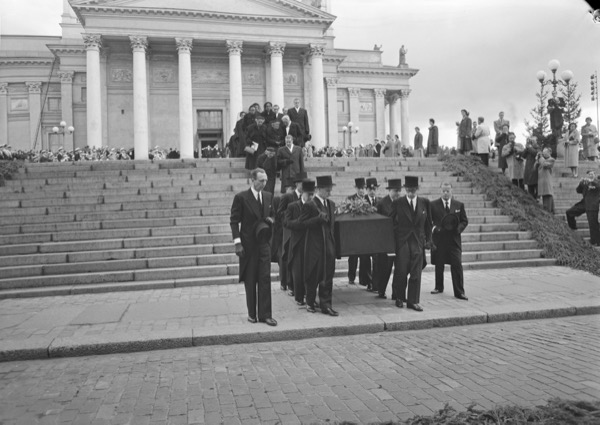
Jean Sibelius’s funeral, 1957
This so-called “Silence from Järvenpää” referenced his home, and after Tapiola, Sibelius entered a prolonged creative crisis. He did have plans for an Eighth Symphony, but he effectively stopped composing major new works after 1931.
Jean Sibelius died on 20 September 1957, and he received a state funeral at Helsinki Cathedral. After the funeral, a procession made its way back to Ainola, where the coffin was buried in a secluded corner of the garden.
By the 1950s, Sibelius’s reputation had plummeted among élite modernists, and it seemed to slump among concert audiences as well. The Second Symphony and the Violin Concerto stayed in the repertoire, but historians described him as a mere nationalist or 19th-century holdover.
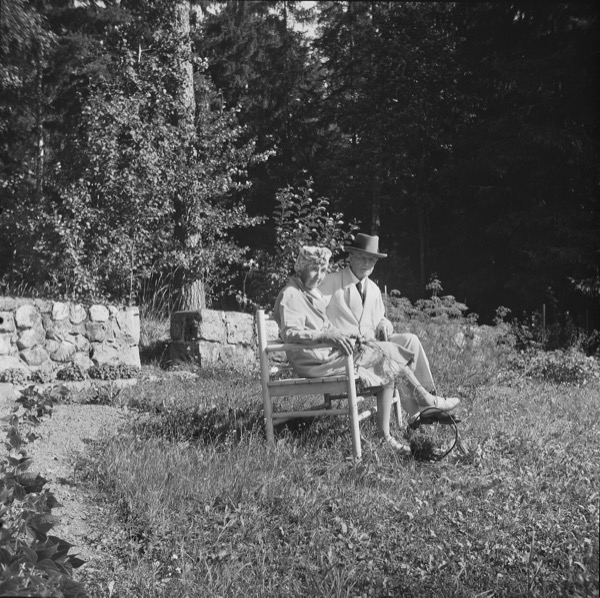
The Sibeliuses on a garden bench on a summer evening, 1940–1945 (Finnish Museum of Photography)
In the later decades of the twentieth century, Sibelius came to be seen more favourably, and research on the composer gathered steam. A five-volume biography and the availability of the composer’s manuscripts have been complemented by a BIS recording project to record Sibelius’ output, including early works, unpublished works, and long-suppressed early versions of known pieces. As James Hepokoski writes, “A substantial and long overdue reassessment of Sibelius seems to have begun.” (Hepokoski, Groves Online, 2001)
For more of the best in classical music, sign up for our E-Newsletter





Just read the Sibelius articles. Very engaging! They add lots of context because of their honesty. The one of Aino was quite lovely (but I would have added her dates: 1871-1969).
When she died, she was about to celebrate her 98th.