
The violin has a way of reaching people who don’t consider themselves classical music listeners.
Something about the sound – its closeness to the human voice, its capacity for both ache and joy – cuts through in a way that other instruments don’t always manage.
This list of 20 beautiful violin pieces spans three centuries, from Bach’s solitary meditation to the lush concertos of the 20th century. Some are famous; others are underrated.
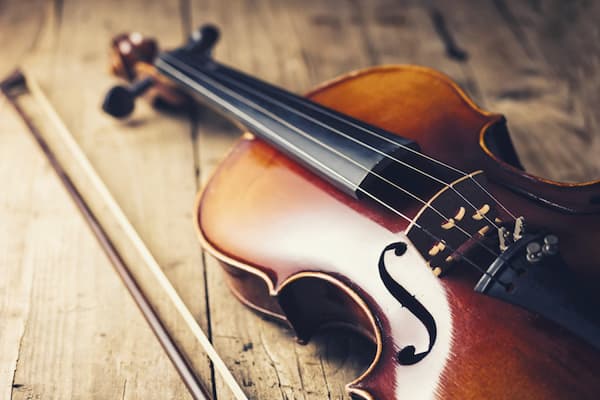
All of them show why the violin has been stopping people in their tracks for three hundred years.
Whether you’re new to classical music or want to compare your well-honed list with this one, these are our picks for the twenty most beautiful violin pieces ever written – each one paired with a recording so you can listen as you read.
Bach – Adagio from the Sonata No. 1 for Solo Violin in G minor (c. 1720)
Bach’s six sonatas and partitas for solo violin are among the greatest achievements in the entire classical music repertoire.
He writes for a single unaccompanied violin, but by using double stops, the music sounds like an entire ensemble. There are implied bass lines and inner voices layered into the texture.
This movement, in particular, has the quality of an improvisation – of a musician working through something profound in real time – yet it is meticulously crafted and notated.
It is quiet, unhurried, and utterly beautiful.
Mozart – Sinfonia Concertante for Violin and Viola (1779)
Mozart wrote this double concerto at 23, and it remains one of his most emotionally complex works.
The Sinfonia Concertante gives equal billing to violin and viola: an unusual choice at a time when the viola was largely an afterthought.
The dialogue between the two soloists is one of the most intimate and searching in the repertoire.
The slow movement, in particular, in C minor, has a quality of breathtaking grief.
Beethoven – Romance No. 2 in F-major (1799)
Beethoven wrote two Romances for violin and orchestra, and both are gorgeous – but the F major second is the one that gets played most often.
It is a single-movement work of remarkable sweetness, built around a singing, long-breathed melody that the violin carries over a gentle orchestral accompaniment.
It is not a difficult piece emotionally – there is no real conflict here; no dramatic crisis – but its gentle elegance makes it one of the most beautiful pieces ever written for the violin.
Mendelssohn – Violin Concerto (1844)
This is one of the most beloved violin concertos in the repertoire, and rightly so.
Mendelssohn wrote it over six years, in close collaboration with his friend and concertmaster Ferdinand David, who gave the premiere.
The result is a work of extraordinary elegance: the violin enters alone just two bars in (a daring structural innovation at the time), the cadenza is built into the first movement rather than bolted on at the end, and the three movements flow into each other without a break.
If you are new to classical violin music, this concerto is one of the best places to start.
Wieniawski – Légende (c. 1860)
Henryk Wieniawski was a Polish violinist who wrote primarily for his own use in concert, and most of his showpieces are incredibly technically demanding.
The Légende is the exception: a slow, lyrical, deeply romantic piece that showcases the violin’s singing quality rather than its acrobatic capabilities.
Written in the style of a sentimental narrative – a “legend” in the Romantic literary sense – it unfolds as a long, expressive song, with the violin voice sensitively supported by the piano.
Fauré – Violin Sonata (1876)
Fauré wrote this sonata at 31 and helped to establish his reputation. Camille Saint-Saëns called it the work of a master; Liszt praised it after a private run-through.
It is easy to hear why: the first movement opens with one of the most irresistible themes in chamber music, a rushing, sun-drenched melody that the violin and piano trade back and forth with infectious energy.
This is one of those works that sounds happy and light on the surface, but reveals increasing emotional complexity the closer you listen.
Tchaikovsky – Violin Concerto (1878)
Tchaikovsky wrote this concerto in a single burst of inspiration in the Swiss Alps following the collapse of his disastrous marriage – and it shows.
The first movement’s second theme is one of the most ravishingly beautiful melodies in the entire violin repertoire, and the finale is one of the most brilliantly effective concert endings ever written: a roaring, foot-stomping Russian dance that brings audiences to their feet.
The middle movement, by contrast, is a quiet canzonetta of extraordinary tenderness.
Famously, critic Eduard Hanslick wrote a devastating review calling the finale “music that stinks to the ear” – a judgment that history has thoroughly repudiated.
Brahms – Violin Sonata No. 1 (1879)
Brahms wrote three violin sonatas, and the first – nicknamed the “Rain” sonata after the Brahms song “Regenlied” whose theme is employed throughout the piece – is the most lyrical of the three.
Written during a productive summer holiday, it has an atmosphere of emotional warmth throughout: a bit wistful, but comfortable in its melancholy.
Clara Schumann, who was arguably the most perceptive musician in Brahms’s circle, wrote to him, “I always wish that last movement for myself at the passage from here to eternity.”
Bruch – Scottish Fantasy (1880)
Max Bruch was fascinated by folk music from cultures other than his own. He wrote a famous Kol Nidrei for cello and orchestra based on a Hebrew melody, and his Scottish Fantasy for violin and orchestra draws on traditional Scottish airs to magnificent effect.
The work is structured as a set of variations on folk tunes, with a harp as a constant atmospheric presence in the orchestra.
The solo violin weaves through the melodies with an improvisatory freedom that suits the material perfectly.
Sarasate – Carmen Fantasy (1883)
Pablo de Sarasate was one of the great violin virtuosos of the 19th century, and his Carmen Fantasy – based on themes from the Bizet opera – is one of the most entertaining and technically spectacular showpieces ever written for the instrument.
Sarasate takes Bizet’s most memorable melodies and transforms them into a glittering sequence of variations, each one showcasing a different aspect of the violinist’s technique.
It is unabashedly crowd-pleasing music, with no pretence of profundity. But it’s so brilliantly crafted, so ideally suited to the violin, that it has earned its permanent place in the concert repertoire.
Franck – Violin Sonata (1886)
César Franck wrote this sonata as a wedding gift for the Belgian violinist Eugène Ysaÿe, and it’s surely among the best wedding gifts in classical music history.
This work is a masterpiece of cyclic form: i.e., a form in which a single germ of melody is transformed and developed across all four movements, giving the work an extraordinary sense of cohesion.
The final movement is a canon – violin and piano imitate each other in strict counterpoint, but it does not sound academic: it sounds like two voices finishing each other’s sentences. A new husband and wife, perhaps?
Elgar – Salut d’Amour (1888)
Elgar wrote this brief, tender piece as an engagement gift for his future wife Alice, calling it “Liebesgruss” (Love’s Greeting) in the original manuscript.
It is a miniature – barely three minutes long – but perfectly formed, with a warmth and sweetness that never tips into sentimentality.
Elgar later sold the rights for a pittance, a decision he regretted after it became one of the most popular short pieces in the entire violin repertoire.
Beach – Romance (1893)
Amy Beach was the first American woman to achieve wide recognition as a composer of large-scale works, and her output deserves far more attention than it typically receives.
Her Romance for violin and piano is one of her most appealing shorter pieces: a late-Romantic lyrical work in the tradition of Brahms and Schumann, with a gracious, singing melody and a rich harmonic language entirely her own.
Beach composed it for the violinist Maud Powell, who was the first great American violinist. Powell gave the premiere, and Beach dedicated the work to her.
Massenet – Méditation from Thaïs (1894)
The Méditation is an orchestral interlude from Massenet’s opera Thaïs, played between scenes as the courtesan-heroine undergoes a religious conversion.
It has long since escaped its operatic context and taken on a life of its own as one of the most beautiful pieces in the violin repertoire.
The melody is spiritually uplifting and deeply consoling.
Chausson – Poème (1896)
Ernest Chausson wrote his Poème for violin and orchestra at the suggestion of Eugène Ysaÿe.
Chausson was intimidated by the idea of writing a formal concerto, so instead settled on writing a piece that would allow for a more rhapsodic, less formally constrained mode of expression.
Chausson obliged: the Poème is a single continuous movement, loosely structured.
The opening, with the violin entering on a single sustained note over shimmering strings, is one of the most atmospheric moments in the repertoire.
Kreisler – Caprice Viennois (1910)
Fritz Kreisler was one of the great violin personalities of the early 20th century: a charming Viennese gentleman virtuoso with an impossibly beautiful tone and an inimitable gift for interpreting and creating melody.
He wrote dozens of short pieces in the salon style, and “Caprice Viennois” is among the most beloved: a glittering, waltz-inflected showpiece that captures something essential about turn-of-the-century Vienna – its elegance, its sentimentality, its undercurrent of melancholy.
Kreisler’s violin pieces are always written in a very natural way for the violin, and this one is no exception.
Boulanger – Nocturne (1911)
French composer Lili Boulanger died at 24, leaving behind a poignant body of work that hints at what she might have achieved had she lived.
The Nocturne for violin and piano, written when she was just 18, is one of her most accessible pieces and one of the loveliest short works in the chamber music repertoire.
It is delicate, atmospheric, and harmonically adventurous in a way that recalls Fauré and Debussy while retaining her own personality and language.
Vaughan Williams – The Lark Ascending (1914)
Vaughan Williams composed The Lark Ascending in 1914, inspired by a poem by British poet George Meredith.
The work is a romance for violin and orchestra – a single continuous movement built around a solo violin that circles, climbs, hovers, and drifts like a skylark seen against an English summer sky.
The melodic material draws on English folk music, but the piece transcends any notion of folk pastiche; it exists in a world entirely its own.
There is no drama, no conflict, no development in the traditional sense – only a gradually expanding freedom, and then a quiet return to earth.
Barber – Violin Concerto (1939)
Samuel Barber‘s Violin Concerto had an unusual genesis. Commissioned by a wealthy Philadelphia businessman as a gift for his violin-playing ward, it was initially rejected because the first two movements were deemed insufficiently virtuosic.
Barber responded by writing a ferocious moto perpetuo finale that more than satisfies any technical demands.
However, the heart and soul of the concerto are contained in the first two movements, which are among the most lyrical things Barber ever wrote.
The opening movement has a long, arching melody of irresistible warmth, and the slow movement is a sustained oboe song taken up by the violin with a beauty that approaches the Adagio for Strings in emotional intensity.
Korngold – Violin Concerto (1945)
After Hitler rose to power, Viennese composer Erich Wolfgang Korngold fled to Hollywood and spent the war years writing film scores – a body of work that helped to define the genre.
When Korngold returned to concert music with his violin concerto in 1945, he even used some of the themes he’d written for his Hollywood films.
The concerto was initially dismissed by critics who found it too cinematic or too unashamedly beautiful. “More korn than gold” was one critic’s infamous judgment.
However, the concerto has seen a resurgence in popularity in recent years. The slow movement in particular – a long, wandering melody that the violin carries over shimmering strings – is one of the most beautiful things written for the instrument in the 20th century.
Conclusion
These 20 pieces represent the violin at its most expressive across three centuries of composition – from Bach’s profound soliloquies through the Romantic era’s great concertos and sonatas, to the 20th century’s more personal, searching voice.
They range from five-minute salon miniatures to 40-minute concertos, from technically accessible to fiendishly difficult, from exuberantly public to intimately private.
The violin has been making people stop and listen for three hundred years, and these twenty pieces show exactly why.
For more of the best in classical music, sign up for our E-Newsletter





Excellent. It would be great to have a selection of the most beautiful pieces for harp. Congratulations for all your presentations.
Glorious!
Thank you ….
From Dublin, Ireland
Subjective to the core.
Good choices but leaves out many pieces that could have supplanted some.
Je ne doute pas que votre sélection comporte des œuvres intéressantes, néanmoins l’absence de certaines œuvres célébrissime m’étonne : les 24 Caprices, la Campanella de Paganini, compositeur qui a incontestablement initialisé la virtuosité transcendante, l’adagio d’Albinoni, la Czardas de Vittorio Monti et surtout les Quatre saisons de Vivaldi, que vous avez relégué en bas de page hors liste. Il s’agit pourtant de l’œuvre musicale classique probablement la plus célèbre au monde et la plus interprétée. Par ailleurs, Vivaldi est reconnu en musicologie pour son importance dans le développement du concerto et du symphonisme. Auriez-vbous ostracisé les compositeurs italiens? ce qui me paraît inquiétant.