
In 1972, Jascha Heifetz – widely regarded as the greatest violinist of the 20th century – retired from the concert stage following a shoulder surgery that was only partially successful. He was 71 years old.
His career had been one of the most extraordinary in music history.
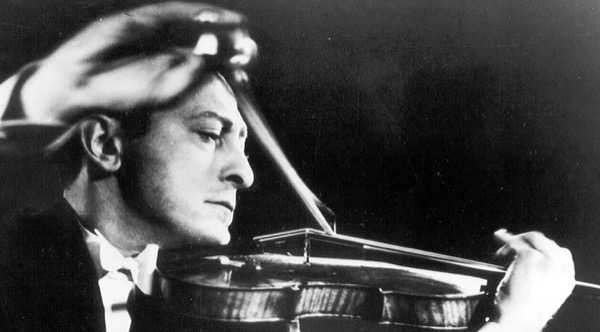
Jascha Heifetz
Concert audiences had idolised him since the age of seven. As a preteen, he was so formidable that older colleagues began to rethink their own artistic identities. When he was twelve, Fritz Kreisler famously remarked, “We might as well take our fiddles and break them across our knees.” By eighteen, Heifetz was the highest-paid violinist in the world.
Yet the cost of such early elevation may have been personal. By the time he retired, he had been divorced twice, and even those close to him found him distant and difficult to know.
One journalist, attempting to write a biography, abandoned the project after early research yielded surprisingly little insight. Instead of a narrative, he found only the outline of a tightly wound perfectionist – someone admired, but emotionally remote.
Heifetz playing Wieniawski’s Polonaise Brilliante in D major
To outsiders, Heifetz’s inner life remained opaque. It was unclear how he would fare once removed from the constant validation of the concert stage. And yet, he insisted he was content with his decision to retire.
Afterwards, he devoted himself to teaching, both privately and at the University of Southern California, where his masterclasses remain essential viewing for violin students.
He trained many successful violinists – though none replicated his singular career. In truth, no one could.
On his 80th birthday, he declined all celebrations, choosing instead to spend the day alone.
He died in 1987 after a fall, just months short of his 88th birthday.
By then, he had not performed publicly in fifteen years – but the verdict was unanimous: he had been, unquestionably, the century’s greatest violinist.
A Life of Unmatched Triumphs
How did he achieve such dominance? The answer lies in a life defined by uninterrupted, almost vertiginous success.
Heifetz was born in February 1901 in present-day Vilnius, Lithuania. His father, a violinist and teacher, quickly recognised his son’s prodigious ability. Jascha began playing under his father’s guidance before the age of two.
By five, he was enrolled in a local music school. At seven, he made his orchestral debut performing the Mendelssohn Violin Concerto.
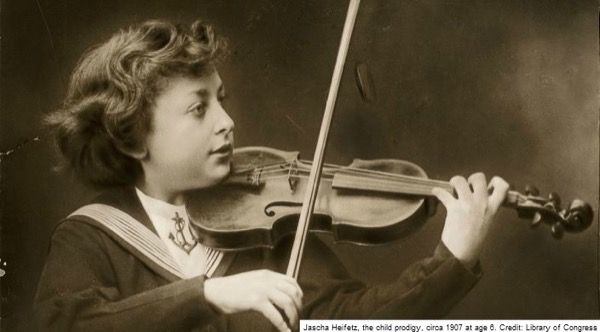
Jascha Heifetz as a child
In 1910, he entered the St. Petersburg Conservatory, where he studied with the legendary pedagogue Leopold Auer.
His rise as a performer was meteoric. In 1911, he played for 25,000 people in St. Petersburg; the crowd’s reaction was so intense that police were required to escort him to safety. In 1912, Kreisler encountered him in Berlin and made his famous remark. By 1914, Heifetz had debuted with the Berlin Philharmonic.
Following the upheaval of the Russian Revolution, Heifetz emigrated to the United States. On 27 October 1917, at just sixteen, he made his American debut at Carnegie Hall.
That evening became the stuff of legend. Violinist Mischa Elman reportedly asked pianist Leopold Godowsky, “Do you think it’s hot in here?” Godowsky replied, “Not for pianists.”
In 1920, George Bernard Shaw wrote to Heifetz:
“If you provoke a jealous God by playing with such superhuman perfection, you will die young… No mere mortal should presume to play as faultlessly as that.”
The Paradox of Jascha Heifetz
His career continued on this charmed trajectory for the next few decades. He became one of the biggest stars in the classical music universe.
Yet even at the height of his fame, audiences had a hard time grasping who he was as a person. His onstage persona was cool, calm, and collected. His movements were effortless, with not a single gesture wasted. He watched his own fingers do impossible things that nobody else on the planet could do, with a changeless expression that bordered on boredom.
Between his onstage public persona and his buttoned-up private life, it was easy to mistake him as a performer who, perhaps, was emotionally stunted.
Heifetz playing excerpts from the Tchaikovsky Violin Concerto
But when audiences listened to his performances, they heard a deeply individual emotional intensity, with an astonishingly beautiful tone.
Unfortunately, it seems that those who have never seen him live are missing out on part of his sonic presence. In many of his recordings, Heifetz employed a close mic while recording, which could result in a steely or slightly scratchy sound on his records. However, by all accounts, in a concert hall, the edge disappeared, leaving a sound with a radiant glow.
We have one especially intriguing window into his inner self and sense of humour: a satirical performance Heifetz gave during a masterclass, imitating a nervous student performing Vieuxtemps‘s fifth concerto.
Heifetz imitation
In it, he plays out of tune and out of tempo, to peals of laughter from his students – all with his famously impassive face.
It reads as cruel at first, but there’s no evidence it was actually based on any one individual student. It’s possible he used it as an icebreaker to make students feel more comfortable playing for him.
This performance suggests that there were depths to his personality, humour, and even humanity that most people never got to see or fully understand.
A Legacy That Outlasted the Concert Stage
Heifetz plays the Bach Chaconne, 1971
The shoulder surgery in 1972 may have ended Heifetz’s public performing career. But his influence didn’t stop there.
The decades of recordings that he made, spanning from 1910 to 1972, are one of the most influential outputs of any classical musician, ever.
Teaching was important to him, but those recordings arguably ended up being an even greater pedagogical influence, given that they’ve impacted every future generation of both violinists and audiences, long after he’d stopped teaching.
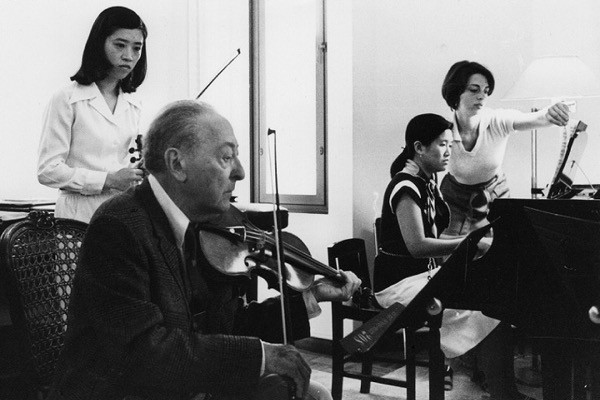
Jascha Heifetz
Another strand of his legacy is the preservation of his final violin, the 1742 ex David Guarneri del Gesù. He left it to the San Francisco Legion of Honour Museum to be played by deserving players. It has since been loaned to San Francisco Symphony concertmaster Alexander Barantschik.
Why Heifetz Still Matters
Trailer of the documentary Heifetz: God’s Fiddler
We still don’t know Jascha Heifetz fully. Even people in his own lifetime didn’t, and the mystery persists forty years after his death.
But regardless of what he was like as a person off the concert stage, the standards he set over the course of his career remain with every single violinist today.
His playing made a bulletproof technique a necessity. It paved the way for the mind-boggling technical achievements of modern soloists like Hilary Hahn, Augustin Hadelich, Leonidas Kavakos, and James Ehnes, as well as all the great violin technicians who are yet to come.
In the end, violinists didn’t break their fiddles across their knees when confronted with the art and legacy of Jascha Heifetz. They worked hard to bring themselves to his level instead – and were made better players for doing so.
For more of the best in classical music, sign up for our E-Newsletter





This was great, thank you. My mother had an LP of Heifetz playing the Tchaikovsky concerto in D minor which I listened to over and over as a child growing up in Arkansas. I was never a musician but it was (and still is) so beautiful to me I enjoy it every time I hear it and I am now 72. Thank you Tchaikovsky and thank you Jascha