Few composers have generated as many myths and misunderstandings as Richard Wagner. Depending on who you ask, Wagner either invented modern music – or ruined it.
The man redefined what opera was. He wrote some of the most harmonically radical music of the 19th century. He built his own theatre in Bayreuth. He had children with a colleague’s wife. He was an expert at PR and a horrific anti-Semite.
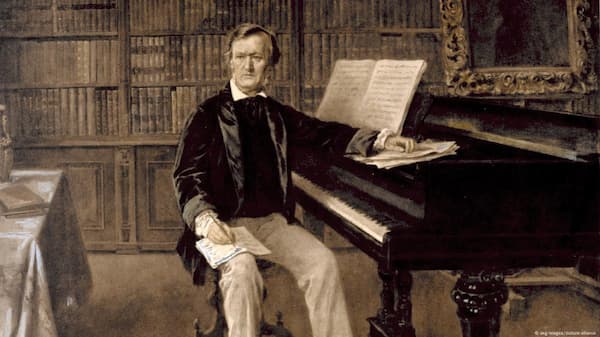
Richard Wagner at the piano
Over time, that combination has produced a set of persistent myths: some flattering, some damning, some simply inaccurate.
Today, we’re separating fact from fiction.
1. Myth: Wagner invented the “leitmotif.”
Members of the Metropolitan Opera Orchestra describe leitmotifs
Wagner did not “invent” the leitmotif (“leading motif”), i.e., the idea of ascribing dramatic meaning to recurring musical material.
Composers before Wagner – such as Carl Maria von Weber in his 1821 opera Der Freischütz – had also used recurring themes associated with characters or ideas. In fact, operas dating back to the 1600s employed thematic recall for dramatic cohesion.
However, what changed with Wagner was the technique’s scale and integration, as well as how it was continually transformed and recombined.
In works like Wagner’s Der Ring des Nibelungen cycle, leitmotifs were employed over the course of fifteen hours across four operas.
The technique had never been applied on that scale before, and over time, many listeners came to believe that Wagner was the creator of the technique rather than its master.
Interestingly, the word leitmotif was first used by a German critic named Friedrich Wilhelm Jähns in 1871, and he was talking about Weber’s music, not Wagner’s.
It’s also worth noting that Wagner himself didn’t like the word leitmotif. He preferred terms like Grundthema (“basic idea”), Motiv (“motif”), and Hauptmotiv (“principal motifs”).
2. Myth: Wagner single-handedly killed Italian opera.
An animation comparing Wagner and Verdi’s work
Many people think of Wagner as the revolutionary who remade the tradition of opera, thereby contributing to the demise of generations-long bel canto and lyric opera traditions.
However, that perception is not entirely true. While Wagner was pursuing his own ideas in Germany, his contemporary Giuseppe Verdi was doing the same in Italian opera. Verdi’s later works – Otello (1887) and Falstaff (1893) – show an accelerating integration of music and drama, without ever abandoning Italian identity or tradition.
What Wagner did was just develop one particular style: one that embraced continuous music, extravagant orchestration, mythic subject matter, and philosophical density.
He wasn’t destroying competing traditions; he was creating and advancing his own.
However, the “Wagner killed Italian opera” narrative still survives today because Wagner was controversial even in the 19th century.
Pro- and anti-Wagnerians viewed music as a battleground in an ideological war known as the War of the Romantics. Rightly or wrongly, they pinned the blame for the destruction of a number of traditions on Wagner and his allies.
3. Myth: Wagner was universally admired in his lifetime.
An exploration of the ideological war between Brahmians and Wagnerians
Wagner was a deeply divisive figure.
He had devoted supporters – many of them cultishly devoted, actually – but he also had many fierce detractors.
Influential Brahms supporters such as Clara Schumann and critic Eduard Hanslick thought of Wagner as excessive, structurally incoherent, and dangerously modern.
And on a personal note, Wagner was a famously prickly and belligerent individual. His egomaniacal personality alienated patrons and colleagues alike. He even spent years in political exile after participating in the 1849 Dresden uprising.
The polarisation around Wagner during his lifetime was so intense that it shaped generations of musical thought. Admired? Yes. Universally admired? Not by a long shot.
4. Myth: Wagner wrote only loud, bombastic music.
“The Ride of the Valkyries”
Yes, Wagner is famous for his massive orchestral climaxes; “The Ride of the Valkyries” from Die Walküre is one of the most famous examples.
But he also composed some of the most intimate, translucent orchestral writing of the 19th century: the “Forest Murmurs” from Siegfried, the Act III Prelude to Parsifal, and, most famously, the quiet, unresolved opening harmony in the Prelude to Tristan und Isolde.
Vorspiel und Liebestod from Tristan und Isolde
The “bombastic only” myth persists because excerpts most frequently heard in pop culture tend to be the loudest ones. Hollywood and advertising don’t often license his quiet music.
But Wagner’s wide dynamic range is one of the defining traits of his work.
5. Myth: Wagner was a Nazi.
A documentary about Wagner and Hitler
Wagner died in 1883. Adolf Hitler was born six years later. Consequently, Wagner was not a Nazi.
However, there are a number of reasons why Wagner has become so closely linked to Nazism.
First, Wagner was openly and virulently antisemitic. His 1850 essay “Das Judenthum in der Musik” attacked Jewish composers and cultural figures. He also wrote about embracing German nationalism.
After his death, his wife Cosima Wagner ran the Bayreuth Festival, ushering her husband’s legacy well into the 20th century. She was famously antisemitic, too.
Meanwhile, Richard and Cosima’s daughter Eva ended up marrying a philosopher named Houston Stewart Chamberlain, who was a mentor to Hitler, forever linking Nazism and the Wagners. Then their son Siegfried married a woman named Winifred, who was a close friend of Hitler.

Richard Wagner and his daughter Eva in 1867
We explored that multigenerational family drama in more detail here: https://interlude.hk/what-happened-to-richard-wagners-children/
Combined with the Nazi regime’s later embrace of his writings – and Hitler’s personal admiration for his music – the association became entrenched.
These distinctions matter historically. Of course, Wagner was not a card-carrying member of a political movement that didn’t yet exist. But that certainly doesn’t minimise the toxicity of Wagner’s views – or how they were later weaponised by the Nazis.
Conclusion
Wagner’s artistic ambitions were enormous. His personality was equally outsized.
He cultivated his own legend, wrote theoretical essays to justify his aesthetics, and built a theatre in Bayreuth to control how his works were experienced.
When a composer reshapes the fields of composition, opera, and cultural politics all at once, a certain amount of myth-making becomes inevitable.
Some myths exaggerate his innovation. Others oversimplify his politics. Many flatten complexity into tidy narratives.
As usual, the reality is more complicated – but also more interesting.
For more of the best in classical music, sign up for our E-Newsletter