When we think of the great revolutions in classical music history, we might think about the premiere of Beethoven’s Ninth Symphony, Wagner’s Ring Cycle of operas, or Igor Stravinsky’s Rite of Spring.
But not every revolution happens on such a massive scale. Frédéric Chopin, for instance, transformed classical music with something far more intimate: short works for piano alone.
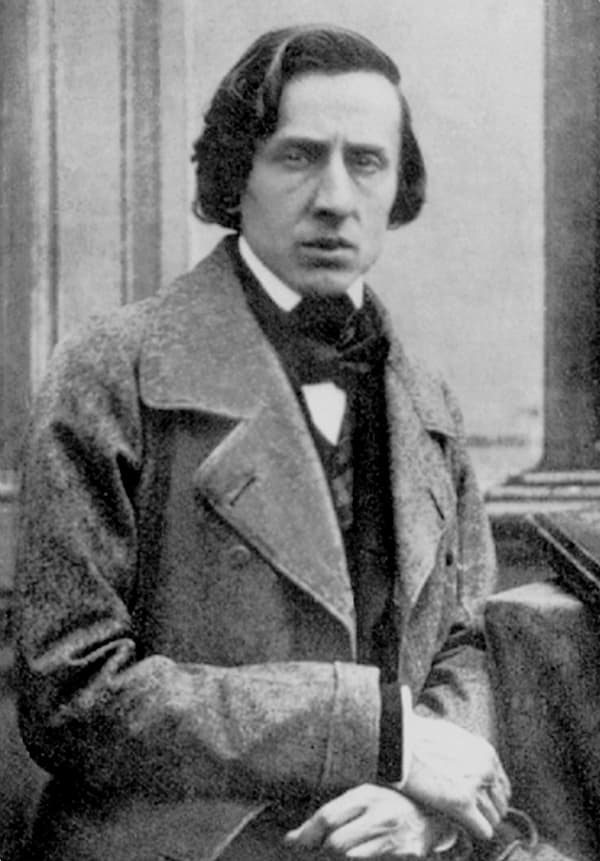
Frédéric Chopin
In an age when composers were judged by the scale of their orchestral works, Chopin proved that short, lyrical pieces could be just as powerful and enduring.
He invented new genres like the piano ballade, redefined existing ones such as the nocturne and prelude, and infused them all with daring harmonies, poetic rubato, and a uniquely Polish spirit.
Today, we’re looking at how the quietly revolutionary work of Frédéric Chopin reshaped classical music forever.
1. Chopin focused on writing primarily for solo piano.
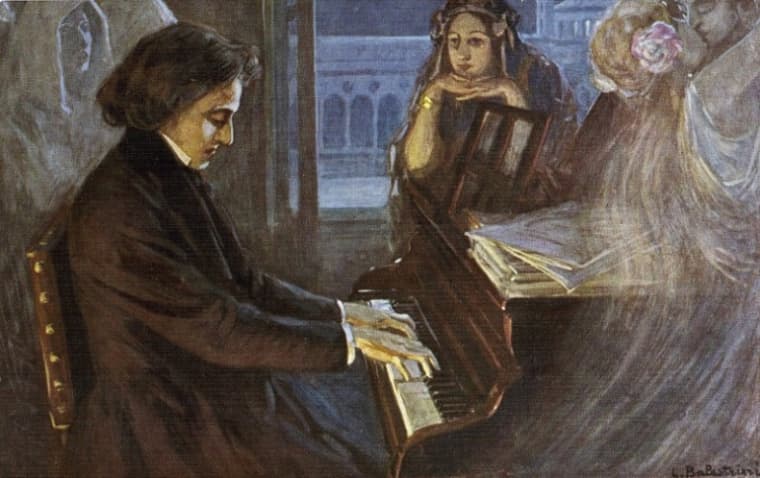
Chopin playing the piano
In the nineteenth century, composers believed that they had to compose large orchestral works like concertos, symphonies, or operas to be taken seriously.
Chopin began his career by writing works for piano and orchestra, but once he reached creative maturity, he focused almost exclusively on works for solo piano.
Liszt approved, writing in his Chopin biography:
In limiting himself absolutely to the pianoforte, we think Chopin has proved that he possessed one of the most essential qualities of a composer, viz., a first appreciation of the form in which he felt he could excel…
Chopin’s success in small-scale forms didn’t singlehandedly erase the stigma of avoiding concertos, symphonies, or operas. But it helped to legitimise Romantic Era composers who focused on chamber music.
French composer Gabriel Fauré is an example of a Chopin-inspired composer who spent most of his career writing chamber music. He never wrote a symphony or concerto; he didn’t mind delegating orchestration to the relatively few orchestral works he did write; and his one opera, Pénélope, is rarely performed today.
Fauré’s Piano Quintet No. 1
2. Chopin created the genre of ballade.
Chopin used the word ballade to describe his dramatic single-movement works for solo piano, writing four between 1831 and 1842.
The word ballade, as Chopin employed it, has at least two different connotations.
The first is a reference to dance music (the Italian word balletta means “ballet”).
The second is a reference to the musical and literary genre of ballad, “a poem or song narrating a story in short stanzas” (definition courtesy of Oxford English Dictionary). This genre was especially popular in the medieval era.
So, to sum up, these are works that are meant to combine elements of storytelling and dance music.
Other composers took up the new genre after Chopin.
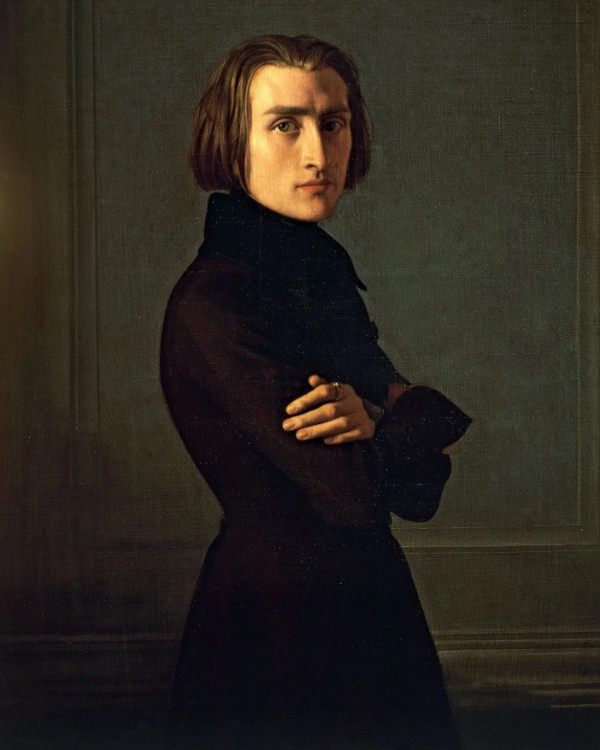
Franz Liszt
For instance, Franz Liszt wrote two ballades, dating from 1845 and 1853. In addition, rhapsodies grew in part out of ballades, and Liszt wrote nineteen of those for solo piano.
Johannes Brahms wrote four ballades in 1854, publishing them as his Op. 10. Decades later, he included a ballade in his Op. 118 from 1893.
Clara Schumann, Grieg, Fauré, and Debussy also wrote ballades.
Liszt’s Hungarian Rhapsody No. 2
Brahms’s Ballade No. 1
Fauré’s Ballade
3. Chopin updated the nocturne for the Romantic Era and beyond.
Chopin did not invent the piano nocturne. Irish composer John Field (1782–1837) wrote his first few piano nocturnes back in 1812, and Polish composer Maria Szymanowska wrote a piano nocturne around 1830.
However, it was Chopin who refined and perfected the genre. He wrote twenty-one piano nocturnes between 1827 and 1846.
Composers who followed in his footsteps included Gabriel Fauré, Clara Wieck Schumann, Erik Satie, Francis Poulenc, and others.
Find out why Russian composers like Glinka, Rubinstein, Tchaikovsky, and Scriabin were also especially attracted to the Nocturne.
Clara Schumann’s Nocturne
4. Chopin reimagined what preludes could be.
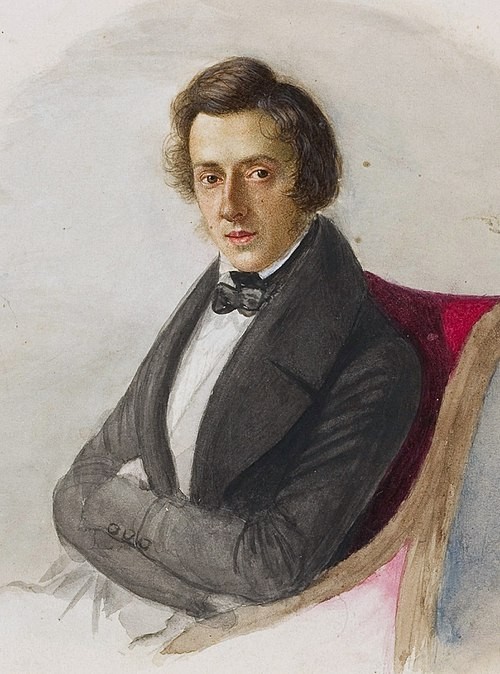
Maria Wodzińska: Chopin, 1836 (National Museum in Warsaw)
The most famous early set of keyboard preludes is Johann Sebastian Bach’s The Well-Tempered Clavier, which consisted of two sets of preludes and fugues in all 24 keys.
Chopin decided to write his own set. He spent four years writing the twenty-four Preludes, Op. 28, finishing them in 1839.
Claude Debussy followed his lead, writing twenty-four preludes between 1909 and 1912. Some of these are his most beloved pieces, including The Girl with the Flaxen Hair and La cathédrale engloutie.
Dmitri Shostakovich also paid tribute to Bach and Chopin in a set of preludes and fugues dating from 1932 and 1933.
After Chopin, many other composers also wrote preludes, paying tribute to both his landmark set and Bach’s. Those composers include Rachmaninoff, Messiaen, Kapustin, and others.
Debussy’s “The Girl With the Flaxen Hair”
5. Chopin helped to lay the groundwork for later nationalist composers.
A hallmark of Chopin’s music is how Polish it is.
Chopin was born in Warsaw in 1810. Growing up, he was fascinated by the folksongs he heard on vacations in the countryside.
As a teen, he began studying with Józef Elsner, one of the first composers to incorporate Polish folksong into his music.
Chopin wrote in a few specifically Polish genres, including polonaises and mazurkas. Other works, such as the Revolutionary Etude, hinted at the violence of the nineteenth-century struggle between Polish revolutionaries and Russian oppressors, and, more broadly, at his personal feelings of displacement and exile.
After Chopin, composers drew on local folk music inspirations more frequently.
- Franz Liszt and Béla Bartók’s compositions were inspired by Hungarian folk music.
- Bedřich Smetana, Leoš Janáček, and Antonín Dvořák’s Czech and Bohemian heritages influenced the character of their music.
- Edvard Grieg became known as a uniquely Norwegian composer.
- Manuel de Falla’s music became famous for its Spanish flair.
- Ralph Vaughan Williams was fascinated by English folksong and hymns.
Fellow Polish composer Karol Szymanowski began his career by writing in some of the same uniquely Polish forms that Chopin did, including mazurkas.
Although Szymanowski eventually found his own creative voice, jumping off from the inspiration that Chopin provided was hugely important to his development.
This trend toward nationalism didn’t necessarily begin with Chopin, but he was one of the first composers to codify and legitimise the trend.
Szymanowski’s 20 Mazurkas, Op. 50, No. 3
6. Chopin experimented with harmony and chromaticism in new ways.
Chopin enjoyed experimenting with non-traditional harmonies, dissonances, and chromaticism for emotional effect.
Future composers took notice. Fauré’s music is famous for its surprising modulations between keys. So is Debussy’s.
Chopin’s approach to the function of harmony – seeing it as a means to evoke colour or emotion, rather than a set of prescribed academic rules to follow – was profoundly influential.
Fauré’s La chanson d’Ève
7. Chopin used rubato in a new way.
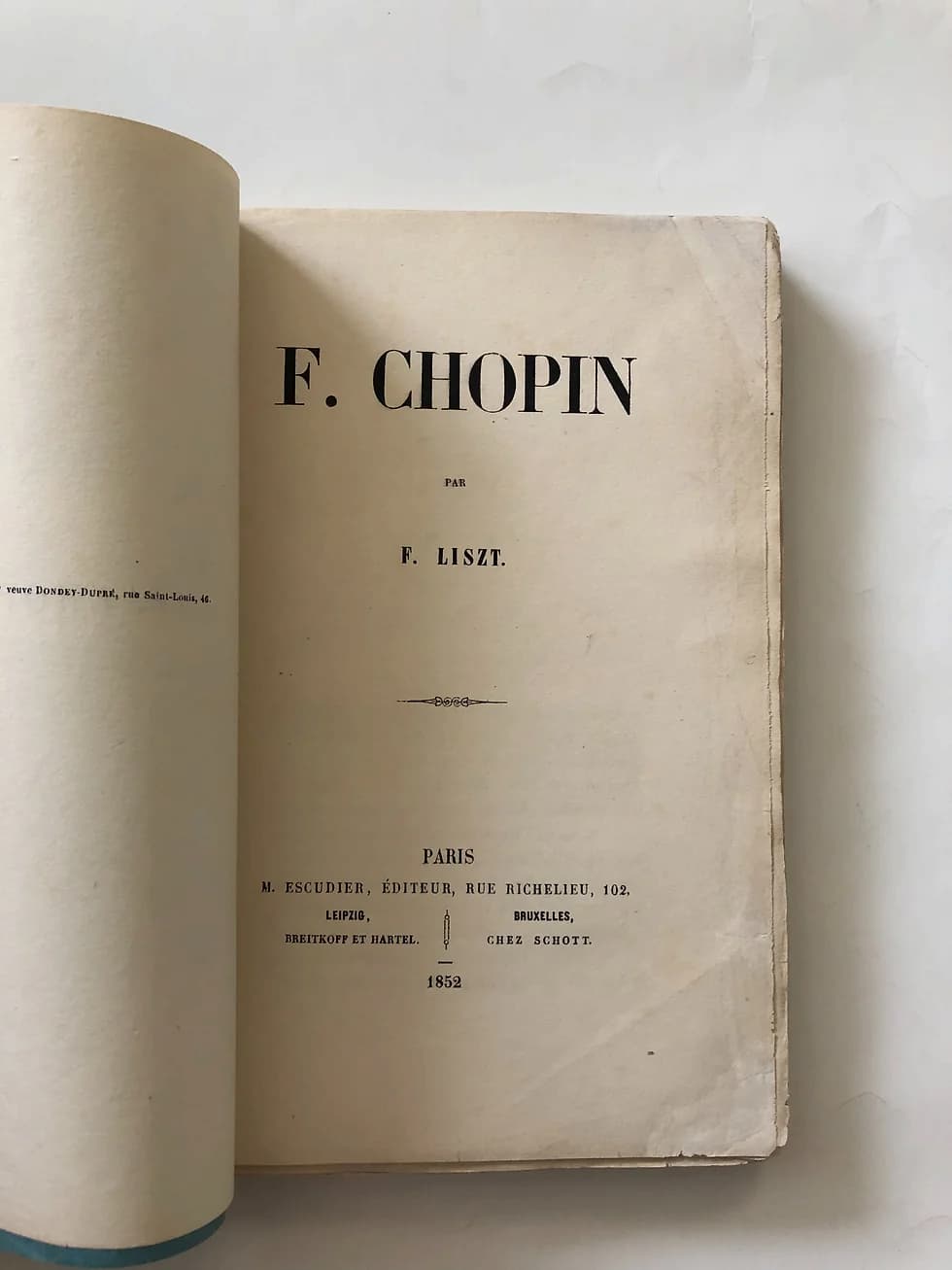
F. Chopin by F. Liszt
In his biography of Chopin, Liszt wrote:
By his peculiar style of playing, Chopin imparted with the most fascinating effect this constant rocking, making the melody undulate to and fro like a skiff driven over the bosom of tossing waves…
All his compositions ought to be played with this accentuated and measured swaying and rocking, though it is difficult for those who never heard him play to catch hold of this secret of their proper execution.
When it came to rubato, Chopin’s example gave Romantic Era composers more interpretive tools that hadn’t existed in the same way before.
8. Chopin’s music evoked a new kind of introspection, melancholy, and emotional expression.
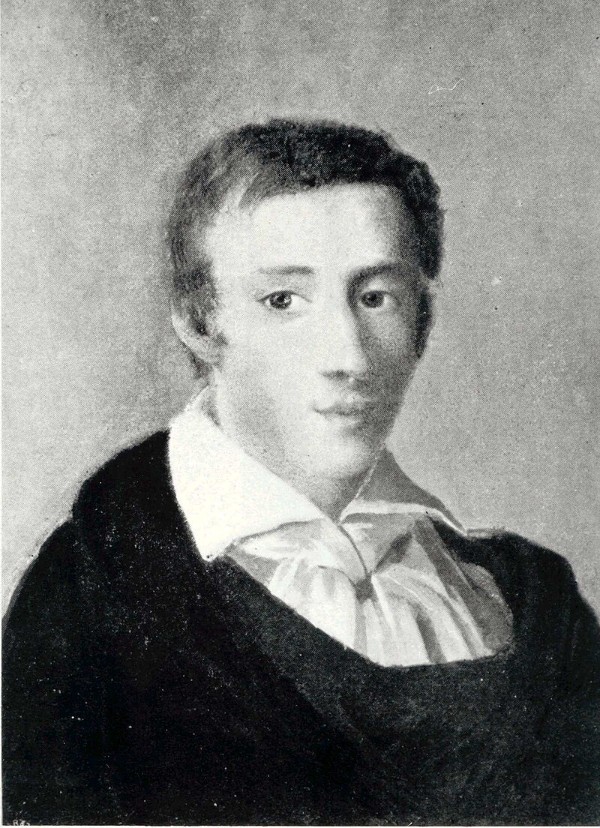
Frédéric Chopin
Robert Schumann, a composer always fascinated by the intersection of music and literature, hailed Chopin as a poet, given his ability to trigger strong emotions of yearning and melancholy. Schumann famously wrote that Chopin’s works were “cannons concealed among flowers.”
Liszt wrote of him:
“Music was his language, a divine language by means of which he expressed a whole range of feelings which could be appreciated only by the few.”
Although in person Chopin often came across as courtly or repressed, his music became famous for its depth of emotion.
In his work, Chopin modeled an intensity of emotion that other composers would search for, for generations to come.
Selections from Chopin’s Ballade No. 1, used in the movie The Pianist
For more of the best in classical music, sign up for our E-Newsletter