Evoking German Romanticism, the Trio Wanderer was founded in 1987 by three French musicians: pianist Vincent Coq, cellist Raphaël Pidoux, and violinist Jean-Marc Phillips-Varjabédian. Nearly four decades of collaboration have produced a substantial Harmonia Mundi discography and outstanding concerts, earning the ensemble a reputation as the “true heir to the Beaux Arts Trio.” 2026 marked the 120th anniversary of Shostakovich’s birth. The group also performed and recorded the composer’s works.
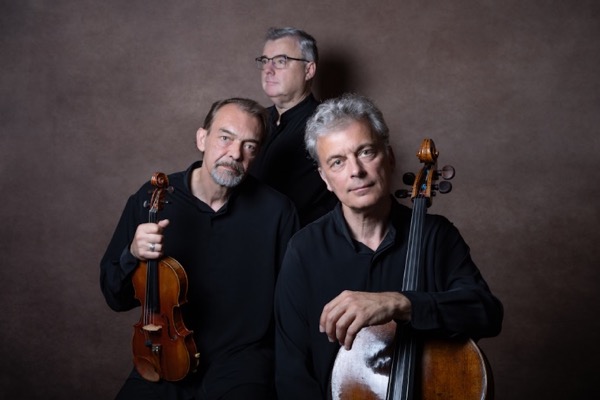
Trio Wanderer
Vincent Coq, a founding member on piano, admires Artur Schnabel, Sviatoslav Richter, and Walter Gieseking, and also enjoys the paintings of Pieter Bruegel the Elder, Vincent van Gogh, Pablo Picasso, and Édouard Manet. Schubert’s Death and the Maiden, the D.960 Piano Sonata, and Maria Callas’s recordings would be among his “Desert Island Discs.” Interviewed on behalf of the ensemble, Coq described the unique appeal of the piano trio as a genre, as well as the trajectory of Shostakovich’s compositional style from his early works through his late period.
You used the “Holy Trinity” as a metaphor for the piano trio. Or do you prefer the “journey” metaphor suggested by the very name of the Trio Wanderer?
Indeed, the comparison with the Christian Trinity was somewhat iconoclastic. But it was meant to show that, in a piano trio, the ensemble’s unity must not come at the expense of each individual’s personality. Both aspects are equally important and inseparable.
As for the Wanderer, a central theme in Franz Schubert’s music and, more generally, in German Romanticism, it is the idea of always moving toward an undefined, unknown ideal through the discovery of the world and of oneself. This idea should always be present in an artist. One should never stop going further and deeper in one’s art.
Trio Wanderer plays Schubert’s Trio Op. 100 – Andante con moto
You cited the Suk–Katchen–Starker, Cortot–Thibaud–Casals, and Istomin–Stern–Rose trios as among the greats. What do you particularly admire about their playing?
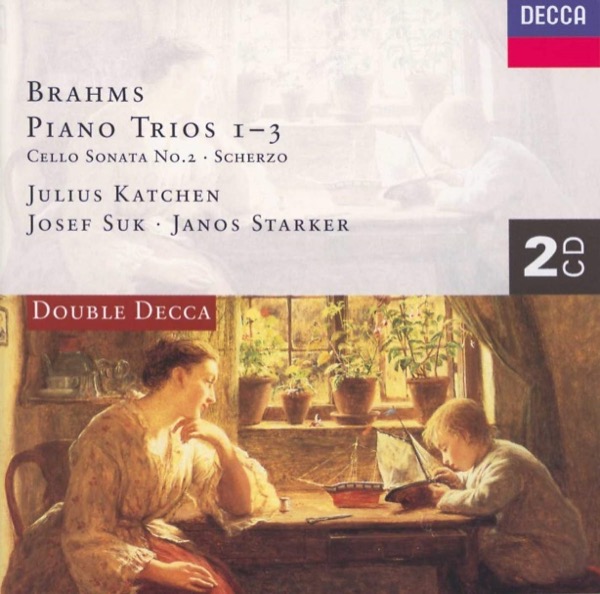
I would mainly speak about the first two, because I feel somewhat less close to the third, although of course they are wonderful artists. Suk–Katchen–Starker recorded only the Brahms trios because Katchen died young, at 43, making it impossible for them to complete the planned recording of Brahms’s complete chamber music with piano. It is a sublime version by three great soloists, each with a distinctive sound, united in service of the music and sharing the same aesthetic approach. My colleague, the cellist Raphael, was fortunate enough to work with Starker, and I had the opportunity to accompany his class for a year.
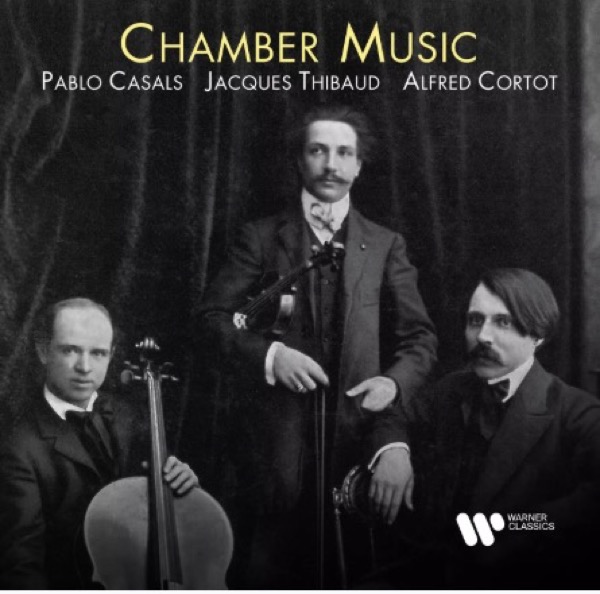
Cortot–Thibaud–Casals were, in a sense, pioneers of piano-trio recordings. Although the sound quality of recordings from the 1930s is, of course, imperfect, their interpretations contain some real gems. They are so closely connected to the 19th-century tradition, and they also knew Fauré, Debussy, Ravel… A musician needs to know where we come from and what shaped today’s music. Transmission is at the heart of our profession, and each generation contributes its own piece to the edifice.
Are there any teachers who deeply influenced you? I’m thinking, for example, of Menahem Pressler, Leon Fleisher, György Sebők, Geneviève Joy-Dutilleux, among others.
All the people you mention, to whom I would add the magnificent French pianist Jean-Claude Pennetier, helped shape the musician I am today. But perhaps, if I had to choose just one, it would be Norbert Brainin, the first violinist of the Amadeus Quartet. I don’t know whether he was a great teacher, but he was above all a tremendous artist, a poet with his violin, devoted to music and composers, without ever compromising to please. Being around him left a lasting mark on me.
What particular qualities do Shostakovich’s piano trios embody for you?
Shostakovich’s music is not merely “intellectual” music, but rather “physical” music, full of real images. The historical context in which these works were written is essential to understanding them properly. Tragedy, death, destruction, and war are present everywhere; where some people see humour, there is actually biting irony; and even when more tender moments appear, the drama is never far away.
We were fortunate enough to work on the Piano Trio Op. 67 with Rostislav Dubinsky, who was the first violinist and founding member of the Borodin Quartet. He knew Shostakovich well and had even played with him. He passed on his knowledge of these works and that dark period, which was deeply engraved in his own being.
Dmitri Shostakovich: Piano Trio No. 2 in E Minor, Op. 67: I. Andante – Moderato (Trio Wanderer)
Speaking of imagery, the early Piano Trio No. 1 in C minor, Op. 8 (1923), subtitled “Poème,” feels almost cinematic.
This first trio is one of the composer’s lighter works. He was very young, just over 17; the story goes that he was in love at the time. It is more sentimental and romantic, with moments of fantasy reminiscent of Prokofiev that give it its charm.
Dmitri Shostakovich: Piano Trio No. 1 in C Minor, Op. 8 (Trio Wanderer)
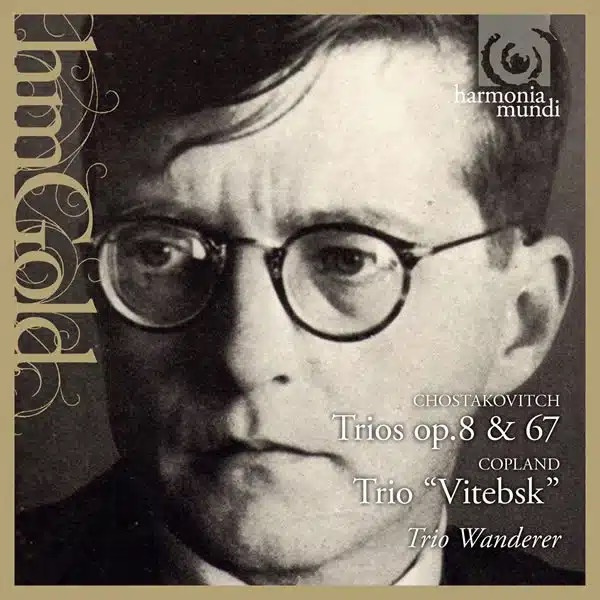
You recorded an album bringing together Shostakovich’s Trios Op. 8 and Op. 67, as well as Copland’s Vitebsk. Was that partly because of their shared connection to Jewish music?
Absolutely. Like the Op. 67 Trio, Vitebsk, named after the Ukrainian city, centres on a Jewish theme. This was a period when Copland’s compositions were more experimental and innovative—he uses quarter tones here, in 1928. Its dark, violent, and tragic atmosphere seemed to us a perfect counterpart to Shostakovich.
Aaron Copland: Vitebsk – Study on a Jewish Theme (Trio Wanderer)
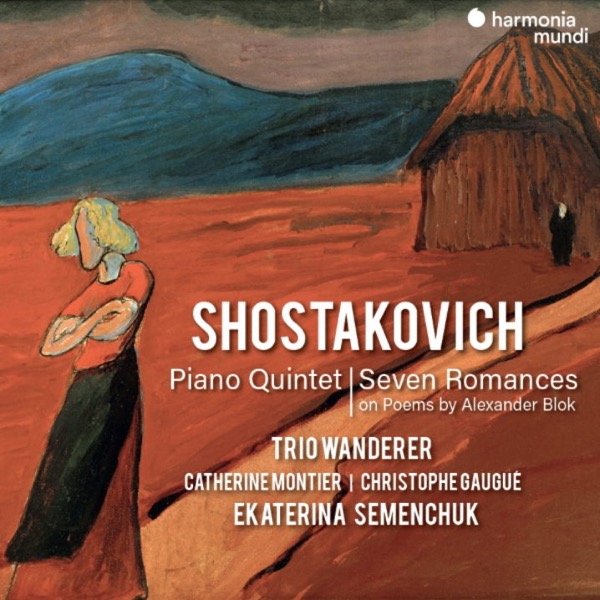
On your 2019 album, you also recorded the Seven Romances on Poems by Alexander Blok, Op. 127 (1967). This late work has a very different colour and musical language.
The Op. 127 Romances, written for Rostropovich, Oistrakh, and Galina Vishnevskaya, mark a key stage in the evolution of Shostakovich’s music and life. Despair and resignation take precedence over revolt, as demonstrated by the increasing number of slow movements in his compositions. It is a very dark work, in which anxiety, destruction, and death are omnipresent. Calm serenity and peace arrive only in the final piece, called “Music”. Music is Shostakovich’s redemption.
Dmitri Shostakovich: 7 Verses, Op. 127: No. 7. Music (Ekaterina Semenchuk; Trio Wanderer)
Could you help us understand why it is technically more difficult to write a piano trio than a string trio or quartet?
Indeed, Tchaikovsky hesitated a great deal before writing his, and even Ravel, despite being so skilful at blending instruments, found it quite difficult. The problem is that, unlike a string quartet, where the textures are similar, you have two string instruments combined with a percussion instrument, and balance issues often arise. That said, both Tchaikovsky and Ravel ultimately produced masterpieces in their trios.
You once mentioned the French philosopher Vladimir Jankélévitch. Do you make time for non-musical interests, too?
I have many interests. All our life experiences enrich our art. They range from gardening and cooking to the history of ceramics… But of course, the visual arts and literature are essential for understanding the intellectual and emotional content of the works we perform.
I mentioned Jankélévitch because he was a French philosopher who took a great interest in music; his books on Fauré, as well as his writings on Liszt and virtuosity, are essential references. More broadly, I think it’s important to immerse oneself in the everyday world of composers—to know the political, religious, cultural, and artistic context of their respective eras—to understand and convey what they had to say.
See Trio Wanderer’s CDs: https://www.triowanderer.fr/discography/.
For more of the best in classical music, sign up for our E-Newsletter