Multitalented violinist Yury Revich will give the world premiere of his own composition, OCEAN, a new work for solo violin and orchestra, at Carnegie Hall in New York on November 12. Hailing from a four-generation musical family, Yury has built a multifaceted career as a soloist, composer, and interdisciplinary artist, bringing together classical music, visual art, choreography, and technology.
I asked Yury about the inspiration behind OCEAN, which reflects his love of poetry and deep connection to nature, and his album Peace, which explores inner peace and music’s power to unite people. Balancing respect for his musical heritage with a drive to push artistic boundaries, Yury has found in the violin not only a way to interpret others’ works but also an intimate partner in expressing his own creative vision.
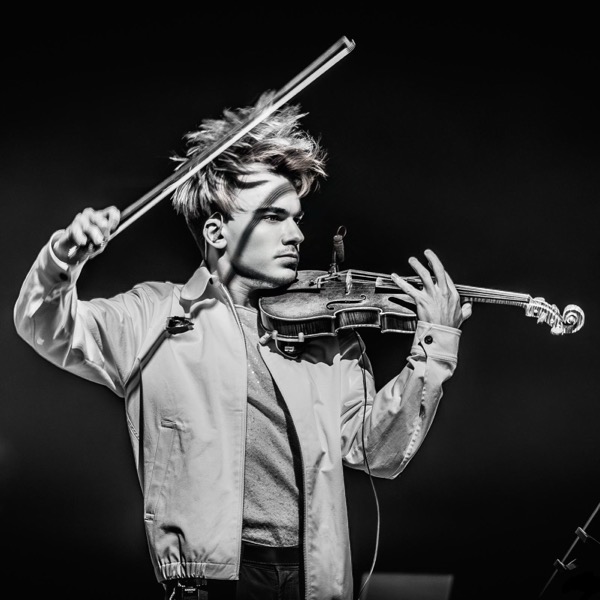
Yury Revich (© Association Quatre Colours)
Can you share with us the origin and process behind composing OCEAN? Why do you call it a symphonic poem, perhaps in the tradition of Liszt, Strauss, or Sibelius?
I call OCEAN a poem because I love poetry and literature. Music lets me tell stories and share emotions with an audience. It’s a way of speaking to people without words: a poem to nature, and specifically, a poem to the ocean. Nature has been a recurring theme in my work. My violin concerto is called Awakening; one movement of my First Symphony is titled Magic Forest; and I’ve written pieces such as Choriner Wald, Violet, and Morning Shine. For me, composing OCEAN is another connection to my passion for environmental protection and my humanitarian work.
As you mentioned, I’m inspired by the tradition of Liszt and Strauss. More broadly, I’m drawn to the tradition of performers composing their own music. Many violinists of the past—Tartini, Kreisler, Sarasate, Paganini, and others—were extraordinary performers who also wrote beautiful music. By the end of the twentieth century, that tradition had become less common. I’m happy to see that changing, with more violinists writing their own pieces, even if they start with shorter works or cadenzas. Instead of playing the same concerti year after year, composing is like writing a book or painting a picture.
Yury Revich plays Choriner Wald
What is the difference between interpretation and composition?
The distinction is quite simple. When I perform another composer’s music, I act as a translator, interpreting their musical language for the audience. My own feelings and interpretation inevitably shape the performance, but I’m communicating someone else’s language. When I write my own music, I’m speaking in my own language and connecting with people directly through it. That’s an incredible feeling.
Can you share your new album Peace?
My album Peace is not only about world peace; it’s also about inner peace and human connection. I hadn’t recorded a solo album for some time, and I wanted to create something special—something I felt deeply connected to and artistically inspired by.
The album includes two of my poems, as well as several pieces called Impressions. These were improvised live in the studio and serve as links between some of the other compositions. During post-production in my home studio, I added recordings of natural sounds that I had captured myself. I also collaborated with contemporary composers and created additional sound design and soundscapes. It was an incredible process.
At its heart, Peace is about finding yourself and cultivating inner peace. Nature can be a powerful source of support in that process. When we find peace within ourselves, we can help create peace around us. Given the conflicts and aggression we see around the world today, I feel we need more peace—and more music in people’s lives.
Research in neuroscience, along with many historical examples, shows how profoundly music can affect us and connect us. I wanted the album to reflect that potential. I also wanted to work with living composers—my colleagues. I researched their work and reached out to several whom I hadn’t previously known. They were delighted to take part, and I was very happy to bring the project together with them.
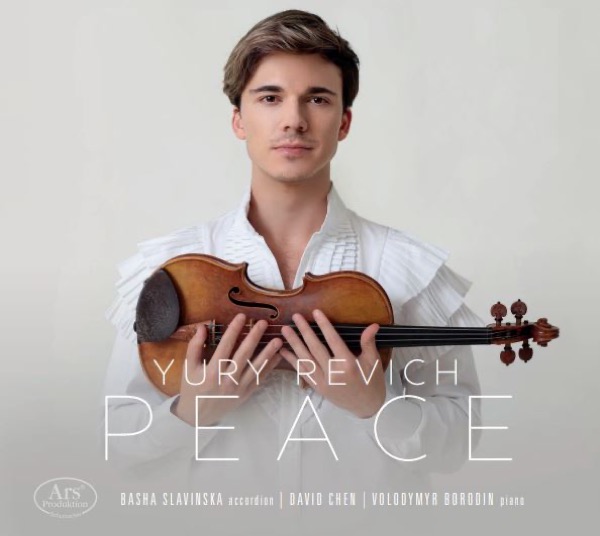
Yury Revich’s Album Peace (© Ursula Vavrik)
Your work has expanded beyond the traditional concert format. What do you think these multimedia collaborations reveal about classical music?
I see myself—and strive to be—a Renaissance artist. I don’t believe artists should confine themselves to a single discipline; different art forms can inspire and connect with one another. One of my mottos is “hearing art and seeing music.” Around the age of twenty-four or twenty-five, I began working closely with visual art, movement, dancers, actors, theatre, and film. More recently, I’ve explored technology, including AI, in response to the rapid changes around us. I’m interested in how technology can enrich human and emotional experiences without replacing human connection. How can it complement us, deepen our connections, and make us value human emotion even more?
I also believe classical music should not be elitist. Visual art, dance, and movement can help us reach new audiences, including those intimidated by traditional classical concerts. Over the decades, concert etiquette has created expectations that audiences must sit perfectly still and silent, and that applauding between movements might invite judgment. Interdisciplinary work can make classical music more democratic and accessible while preserving its sophistication.
Yury Revich: Interdisciplinary Creator
I’ve participated in many such projects. Just last week, I performed in an experimental work during Art Basel’s Art Week in Paris, collaborating with a dancer and a live photographer. Together, we explored movement, sound, and audience interaction.
Another project I particularly loved was Human, an interdisciplinary triptych commissioned by Thaddaeus Ropac last year. The first part features me alone on the violin. The second is entirely silent, taking the form of a choreographed ensemble performance. The third draws on Chinese Taoist and Buddhist traditions, as well as ideas of reincarnation and recognition, culminating in the creation of a human sculpture.
This was one of my first major projects choreographing musicians, including myself. I developed it from beginning to end, composing the music and curating the costumes, among other things. Generally musicians are used to keep their bodies stiff while performing, almost as if glued to the floor.
The freedom to move, perform, connect with fellow musicians, and interact physically opens up countless possibilities. Even in traditional concertos and recitals, we develop bodily control, timing, and spatial awareness. My classical career has taught me a great deal, while interdisciplinary work has broadened that learning. Timing, visual awareness, imagination, movement, and the ability to inhabit a space are essential to my practice, and working across art forms continually strengthens these skills.
Yury Revich’s Untitled (Constructed by Others)
Could you share what you learned from the challenges of creating your projects?
Creating new work—as a composer, director, or artist—always brings challenges. You’re making something that didn’t exist before, rather than repeating what has already been done. Often, the greatest challenge comes from within. You may feel confident about a piece, only to revisit it a week later and think, “There are so many things I would do differently.”
Part of the process is accepting that every work belongs to a particular moment. If something feels right when you create it, then it’s right for that point in time. That’s why I don’t think we should focus too much on mistakes. Challenges and mistakes are different, and mistakes are often subjective: what one person considers a mistake, another may not.
Sport offers an interesting contrast. Performance can often be measured objectively through speed, strength, or results. Music competitions may seem similar, but I see a fundamental difference between sport and music as an art form. Both require discipline and hard work, but sport is largely measured through numbers, whereas music is deeply subjective. Music is a form of emotional expression, and each of us responds to it differently.
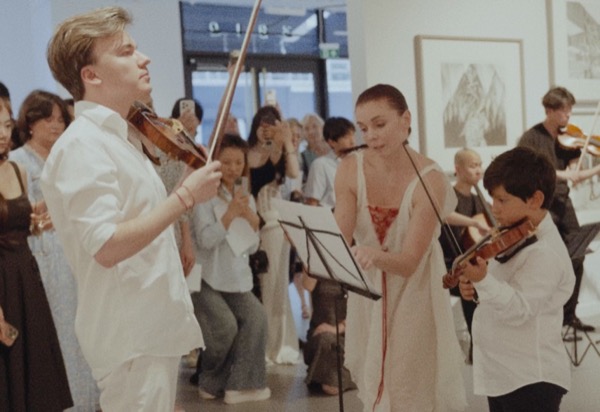
Yury Revich’s Dreamland Performance on Memory and (Un)consciousness joined by Prima Ballerina Natalia Osipova
What does inheriting the depth of musical tradition give you as an artist? And are there things you have had to consciously unlearn?
My father’s side of the family has played the violin since the nineteenth century. People often ask whether this legacy created pressure for me, but honestly, it didn’t. My father is my teacher, and I’ve also had wonderful teachers at school and at the conservatory. I began studying the violin at five with my grandfather and father, and my father has remained my principal teacher.
He comes from a strong violin tradition but is also open-minded and creative. I share my music with him, including my electronic and interdisciplinary work, and I’m fascinated by how he continues to learn and discover new things. He has always been a major inspiration, both as an artist and throughout my childhood, without ever putting too much pressure on me.
I don’t feel I had to unlearn anything so much as open myself up artistically. In my mid-twenties, I began exploring other art forms and developing my own projects. My mother has also been very supportive, attending my concerts and offering feedback that I always appreciate. In that sense, I feel fortunate. I didn’t need to unlearn much; I simply needed to keep learning.
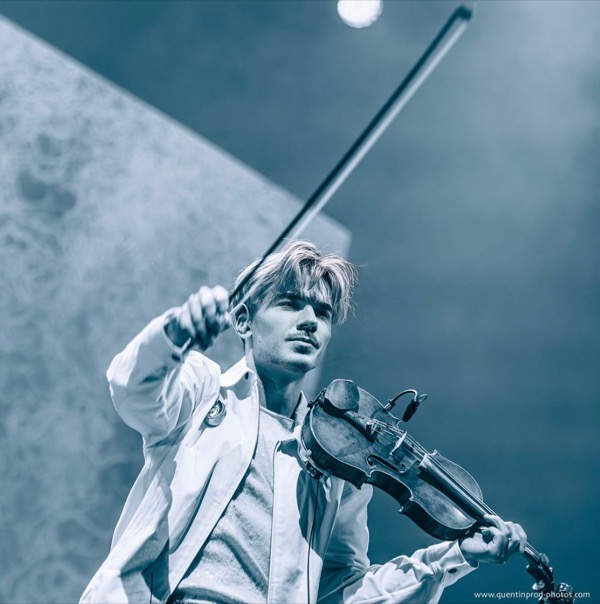
Yury Revich (© Quentin Prod)
As a violinist, are there aspects of the instrument that you find yourself discovering anew through composition?
The violin has been part of my family’s tradition since the nineteenth century, so I’ve known the instrument closely for a long time. But when I began composing, I discovered another side of it: the violin became an extension of myself and a partner in creating new music.
I realised that I could use it not only to learn other composers’ works and communicate their emotions through my own interpretation, but also to find melodies and improvise. I can pick up my violin at any moment and start playing; I don’t need to prepare in advance. If I’m with friends and someone starts playing guitar or piano, for example, I can simply take out my violin and improvise.
In that sense, my violin is like my best friend. It’s always with me, and it allows me to express what I’m feeling in a particular moment. Composing and improvising have shown me how close and intuitive a creative partnership with the instrument can be.
See Yury’s site: https://yuryrevich.com/
For more of the best in classical music, sign up for our E-Newsletter