What happens when we return to something we once loved passionately but, for whatever reason, set aside? Can we recover the pleasure and fulfilment it once gave us, or does time, with all its accumulated experiences and expectations, significantly shift our relationship with it?
These questions lie at the heart of Nadia Beard’s The Melody of Things, an engaging and perceptive account of the author’s return to serious piano study after a decade away from the instrument. Part memoir, part practice diary, part travelogue, it also explores musical identity, ambition, performance anxiety, and the often uncomfortable distinction between amateur and professional musicianship.
As a “returner” myself, I was inevitably drawn to a book about someone coming back to the piano after a long absence. For journalist Nadia Beard, an unexpected encounter with a Bösendorfer piano in Berlin sparked her return.

Nadia Beard
“In a single moment, the relief of re-encounter is cut by a realisation of what has been lost” (Nadia Beard).
After that impromptu performance for friends, Beard says she thought it would be “fun” to “spend a year studying the piano”.
As a teenager, Nadia Beard was a talented and committed musician who considered a professional career. But the pressures of performance, particularly the debilitating effects of stage fright, eventually took her away from music and into journalism. But that encounter with the piano in Berlin rekindled something she thought lost, prompting her to return to serious study and apply for a one-year course at the Conservatoire in Tbilisi, Georgia. She prepares her audition pieces, earns a place, and moves to Tbilisi to begin lessons with the formidable pianist and teacher Manana Gotsiridze.
Ludwig van Beethoven: Piano Sonata No. 8 in C Minor, Op. 13, “Pathétique”: I. Grave – Allegro di molto e con brio (Alfred Brendel, piano)
Returning to an instrument after a lengthy absence is rarely as simple as picking up where you left off. Musical knowledge and understanding may remain unexpectedly intact, but the physical mechanisms of playing, the coordination, dexterity and stamina required to translate musical thought into sound, often need patient rebuilding. And then there are the psychological obstacles: the frustration of discovering that passages once played with ease are now awkward, the tendency to compare one’s present abilities with those of one’s younger self, and the nagging suspicion that perhaps the intervening years have made the task impossible.
Beard writes candidly about these challenges, and the sometimes dispiriting business of technical rehabilitation. Her accounts of lessons and practice reveal the painstaking work of rebuilding technique, refining touch, and recovering confidence. There is no suggestion that enthusiasm alone will suffice: musical progress calls for discipline, repetition, concentration and a willingness to confront one’s weaknesses. Yet it is precisely through this demanding work that Beard begins to rediscover the pleasure of making music.
Running alongside this is the persistent question of what all this effort is for.
Beard encounters attitudes familiar to anyone who has pursued an artistic activity seriously without necessarily intending to make a profession of it. Friends and colleagues question her motivation, as an amateur musician: will she give recitals? Is she planning a music career? If not, why devote so much time, energy, and emotional commitment to the piano?
Such questions reveal a curious assumption about artistic endeavour: that serious study must lead to some publicly recognised achievement, preferably a professional one. We live in a culture that values outcomes, qualifications, careers, and measurable success. The idea that someone might undertake something difficult and demanding simply because they love it, because the activity itself is rewarding and meaningful, can, to some people, seem incomprehensible.
This leads Beard to consider the distinction between amateur and professional musicians. The word ‘amateur’, derived from the Latin amare, meaning ‘to love’, has acquired unfortunate connotations of inadequacy or inferior accomplishment. Yet, in its original sense, amateurism implies no lack of seriousness, commitment or artistic integrity. An amateur musician may practise with extraordinary dedication, possess considerable technical skill and musical insight, and approach repertoire with the same intellectual curiosity and emotional engagement as a professional.
Franz Schubert: 4 Impromptus, Op. 90, D. 899: No. 3 in G-Flat Major (Lars Vogt, piano)
One of the most engaging aspects of Beard’s story is the possibility that returning to music without the expectation of a professional career could help her build a healthier, more rewarding relationship with the instrument. Freed from the need to succeed in conventional terms, she can begin to discover what music offers beyond public recognition and external approval.
But the freedom to play for oneself does not automatically dispel performance anxieties. Performance anxiety, which had contributed to Beard’s earlier abandonment of music, remains a significant presence. Her descriptions of the physical and psychological manifestations of performance anxiety are especially revealing, not least because they show how stubbornly such responses can persist, even when the rational mind recognises that little is at stake beyond the performance itself. Beard’s experiences suggest that overcoming performance anxiety is not necessarily a matter of eliminating fear, but of finding ways to accommodate it without allowing it to dominate the musical experience.
If The Melody of Things were solely an account of returning to the piano, it would still be interesting. What gives the book an additional richness, however, is its setting. Tbilisi emerges as far more than a picturesque backdrop to Beard’s musical studies. Georgia has a distinguished musical culture, moulded by its geographical position between Europe and Asia, its complex history and the legacy of Soviet rule. Beard’s journalistic experience serves her particularly well here. She has a journalist’s eye for telling detail, an ear for revealing anecdotes, and the ability to place individual experiences within a broader cultural and historical context.
The result is a vivid portrait of a city and its musical life, in which the daily routines of lessons and practising sit alongside encounters with people whose memories reach back into the Soviet era. Anecdotes about musicians, teachers, and the conditions of artistic life under Soviet rule illuminate an environment where music could offer both prestige and privilege, but also face political pressure and institutional constraints.
Among the book’s memorable episodes is Beard’s experience of playing a piano once owned by the great Soviet pianist Sviatoslav Richter. Such encounters with musical history are particularly compelling. A piano is, after all, an ordinary physical object made of wood, metal, and felt, yet its association with a great artist can give it an almost talismanic significance. The instrument becomes a tangible connection to another musical life, another time, another pair of hands.
Underlying it all is a question of music’s place in a life. For Beard, returning to the piano is not simply an attempt to recover a skill or fulfil an abandoned ambition. It is a way to reconnect with an essential part of herself, something that remained present, if dormant, during the years when music was no longer central to her daily existence. For Beard, music also triggers memories.
Music has a remarkable capacity to summon memories. A familiar melody can transport us to another time or place, recalling people, experiences and emotions which we thought long forgotten. Sometimes these associations are comforting; at other times they may be unsettling or painful. Music can also offer solace in difficult times, providing refuge when words seem inadequate.
These connections between music, memory and emotional experience run through Nadia Beard’s book. Part memoir, part practice diary, and part travelogue, the book explores not only the challenges and pleasures of rediscovering the piano, but also music’s enduring significance in a life.
The Melody of Things is an absorbing, intelligent and often moving account of what it means to return to something one loves. It will resonate particularly with musicians, both professional and amateur, whose musical lives have been interrupted. Still, its broader reflections on ambition, achievement, and the value of doing something for its own sake give it appeal beyond the musical world.
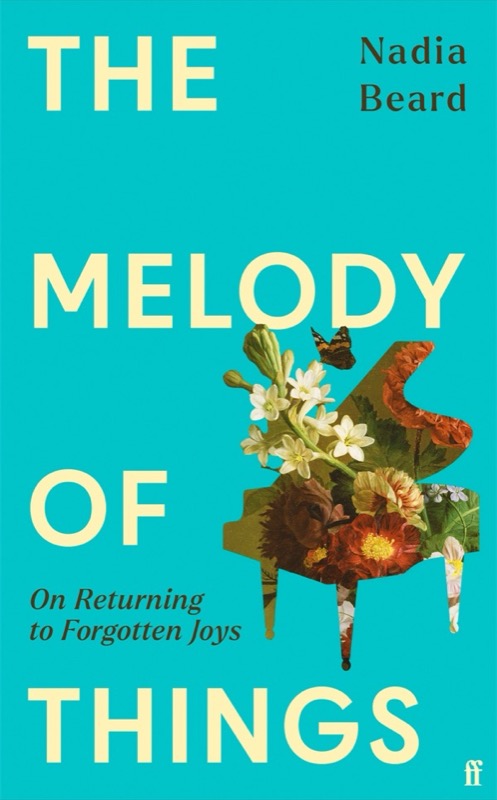
The Melody of Things
Faber & Faber publishes The Melody of Things in the UK.
For more of the best in classical music, sign up for our E-Newsletter