The excitement is palpable in Chicago and New York. Both the Chicago Symphony and the New York Philharmonic are welcoming their new maestros this fall, and the atmosphere is euphoric.
By now, you may recognise the curly mop of hair, and you’ve heard about the firebrand Gustavo Dudamel. He has already made a big splash as conductor of the Simón Bolívar Symphony Orchestra of Venezuela, the apex of El Sistema—the country’s system of youth orchestras—and longtime music director of the Los Angeles Philharmonic.
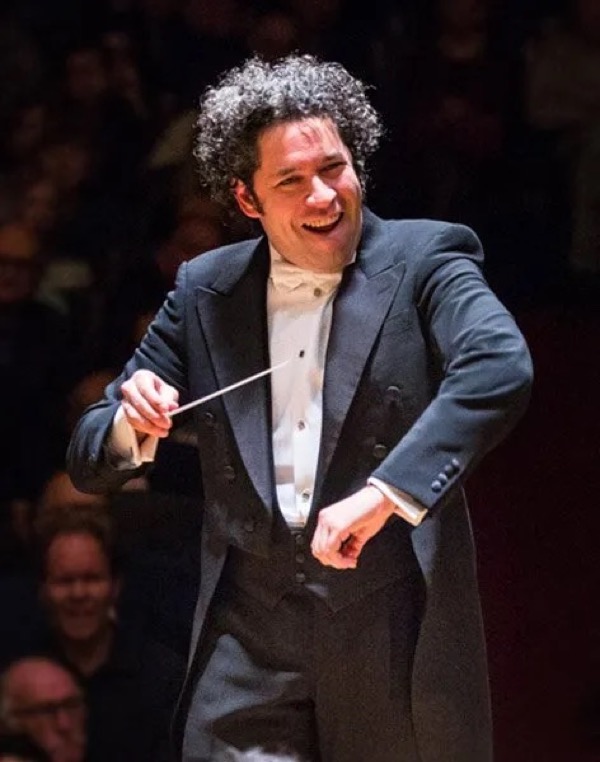
Gustavo Dudamel conducts the Los Angeles Philharmonic (Photo by Robert Torres)
Like Mäkelä, Dudamel was appointed in 2007 to the Los Angeles Philharmonic at a young age, 26, beginning with the orchestra’s 2009–2010 season after having made his mark conducting internationally. His electrifying conducting style, brilliant personality, belief in music’s power to drive social change, and dedication to young people have catapulted him to stardom.
This short video describes his vision.
Gustavo Dudamel leads us into our new era!
The new Tang Music & Artistic Director kicked off the season just a few weeks ago with a black-tie affair, concerts in Radio City Music Hall and the New York Philharmonic home at David Geffen Hall, followed by a ten-concert European tour with performances in Paris, Barcelona, Berlin, and Madrid.
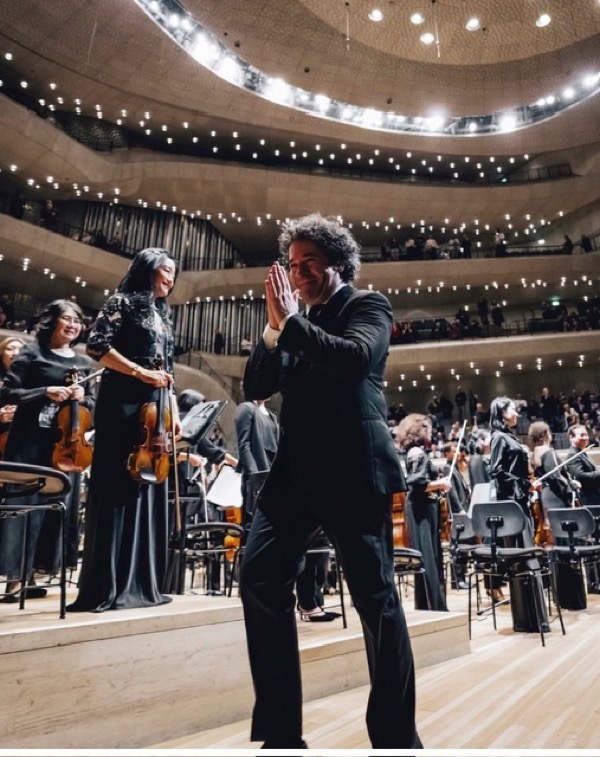
Gustavo Dudamel and the New York Philharmonic on tour (Photo by Todd Rosenberg)
Alternating Gustav Mahler Symphony No. 5 and Sergei Prokofiev Symphony No. 5, the programs feature premieres by Cuban composer and multi-talented conductor, pianist, and educator Tania Leon of Imágenes Mestizas and Canadian composer Zosha Di Castri’s Invisible House, respectively—a “composer of riotously inventive works.” (The New Yorker)
The program with the Prokofiev Symphony also includes John Adams’s On the Transmigration of Souls, his haunting reflection on the terrifying events of September 11, 2001, a co-commission of the Philharmonic, premiered in 2002.
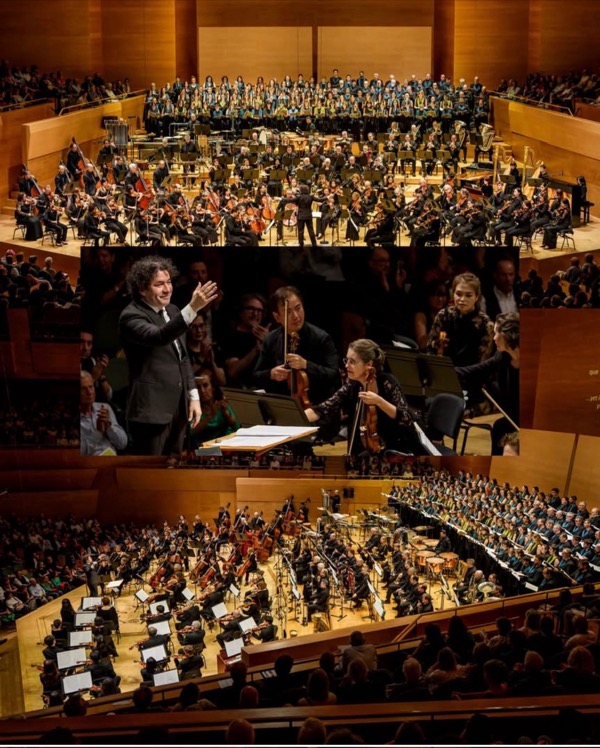
Gustavo Dudamel and the New York Philharmonic (Photo by Todd Rosenberg)
The season looks epic, and the Philharmonic is pulling out all the stops—no wonder the musicians and the audience are buzzing with excitement. The programs will feature soloists Jean-Yves Thibaudet, Bruce Liu, Joshua Bell, Maxim Vengerov, Víkingur Ólafsson, Yefim Bronfman, Mitsuko Uchida, Emanuel Ax, and Hilary Hahn, to name a few, and will present exceptional programs such as Sound On: Steve Reich at 90; An entire program of John Adams including new and older works, After the Fall, Chairman Dances, and Harmonielehre. There will be world premieres of Gustavo Santaolalla’s El Payado perseguido (The Hunted Minstrel); Gonzalo Grau’s new song cycle set to texts by Rafael Cadenas, a World Premiere and a New York Philharmonic Commission; and the US premiere of Missy Mazzoli’s Piano Concerto with Leif Ove Andsnes. Other mustn’t-miss concerts include Adès’s The Exterminating Angel Symphony and Manuel de Falla El Amor brujo with Marina Abramović, performance art pioneer, who brings her visionary style to musical tales.
I am extremely excited to see that Leonard Bernstein’s MASS is also programmed. It will be an exceptional undertaking, heard in a World Premiere production conceived by Kaneza Schaal.
Jacqueline Kennedy Onassis approached Leonard Bernstein to compose the inaugural work for the opening of The John F. Kennedy Centre for the Performing Arts in Washington, D.C. The premiere occurred on September 8, 1971, to assorted responses—some vehement and disapproving, others passionate and enthusiastic.
The nearly two-hour ‘Theatre Piece for Singers, Players and Dancers’ with text from the liturgy of the Roman Mass and additional texts by Stephen Schwartz and Leonard Bernstein is scored for the Celebrant (tenor), three choirs, street chorus, solo singers, including countertenors and boy soprano, and two orchestras (one in a pit). In all, over 200 performers are featured, with choreography and costumes, performing in a multitude of musical styles. The musical extravaganza has something for everyone—blues, rock, gospel, folk, Middle Eastern dances, jazz, lush chorales, and marches.
I hope this sampling of the piece is tantalising.
Leonard Bernstein: Mass: Devotions before Mass: Hymn and Psalm, “A Simple Song” (Jubilant Sykes, baritone; Baltimore Symphony Orchestra; Marin Alsop, cond.)
Leonard Bernstein: Mass: Confession: Trope, “I Don’t Know” (Morgan State University Choir; Baltimore Symphony Orchestra; Marin Alsop, cond.)
Leonard Bernstein: Mass: Offertory (De profundis, Part 2) (Peabody Children’s Chorus; Morgan State University Choir; Baltimore Symphony Orchestra; Marin Alsop, cond.)
Eventually, all hell breaks loose during the piece with a schism.
Leonard Bernstein: Mass: Agnus Dei (Jubilant Sykes, baritone; Morgan State University Choir; Baltimore Symphony Orchestra; Marin Alsop, cond.)
Bernstein himself arranged the Three Meditations from Mass for Solo Cello and Orchestra, which we, with the Minnesota Orchestra and others, have recorded as a stand-alone piece. Rostropovich premiered this version with the composer conducting and the National Symphony in 1977. The piece is a wonderful addition to the repertoire.
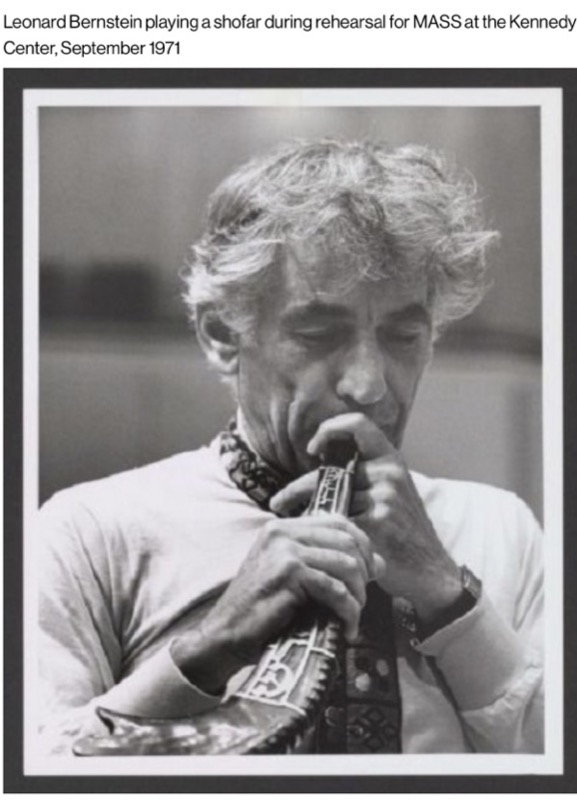
Leonard Bernstein playing a shofar during a rehearsal for MASS at the Kennedy Center, September 1971
The second Meditation is a set of four variations with a coda, based on an eleven-note sequence from the finale of Beethoven’s Ninth Symphony. It leads to the great outburst of “Brüder!” (“Brothers!”) in the Mass. Incidentally, the cello meditations received 55 performances by over 20 cellists and 29 orchestras across Asia, Europe, and North and South America during the centennial year celebrating Leonard Bernstein’s birth in 2018. (from notes by © Jack Gottlieb) I find this meditation very stirring. I hope you do too.
Leonard Bernstein: 3 Meditations from Mass: No. 3. Presto (various artists)
Mass is an extraordinary and visionary work, ahead of its time. Its assortment of musical styles and irreverent attitude explores complex issues that continue to plague us—the angst of political malaise, existentialism, violence and war, questioning religious belief, and searching for brotherhood. The piece ends with a hushed Amen and seeks to reaffirm belief in, and hope for, universal peace. These performances will be quite the occasion and a culmination of Dudamel’s first season with the New York Philharmonic.
For the classical music lovers among us, both maestros Mäkelä and Dudamel will make the year ahead thrilling. I hope to somehow travel to both cities to experience the new eras personally, and perhaps you can too.
For more of the best in classical music, sign up for our E-Newsletter