Pianist Steven Osborne’s latest release, OK by me – A life in encores, is far more than a collection of attractive miniatures brought together by a distinguished pianist with a large catalogue of acclaimed recordings. Rather, it is a musical autobiography, a highly personal selection of pieces that have accompanied Osborne throughout his life as a pianist, student, colleague, husband, teacher and listener.

Steven Osborne © Ben Ealovega
Osborne himself describes the album as creating “a line through my musical life”, and his unusually extensive and candid liner notes are integral to understanding the recording. The repertoire is delightfully eclectic: Bach and Grieg sit alongside Rachmaninoff, Schumann, Prokofiev and Poulenc, while Keith Jarrett, Meredith Monk and Joni Mitchell rub shoulders with Peter Maxwell Davies and James Clapperton. There are also Osborne’s own arrangements and improvisations, and the album opens with his own OK by me, a simple melody that emerged, apparently fully formed while improvising.
The real thread running through the album is not repertoire but memory. Liadov’s delicate A Musical Snuffbox recalls his mother’s musical jewellery box and its twirling ballerina; Bach’s Sheep may safely graze evokes childhood evenings spent listening to his parents play piano duets; Grieg’s Butterfly belongs to his earliest repertoire and to childhood performances. Later pieces carry other associations: Poulenc’s Novelettes are bound up with the chance encounter that led to Osborne’s long relationship with Wigmore Hall, while his arrangement of Schumann’s Widmung is associated with his wife, Jeannie, for whom he played it as an encore on their first wedding anniversary.

Young Steven Osborne
OK by me explores something more interesting than the conventional idea of the encore as a charming musical afterthought. These pieces become repositories of experience and memory. Hearing or playing them can collapse time, reconnecting the adult musician with the child reaching up to the family piano, the student discovering new repertoire and new ways of thinking about music, or the performer encountering colleagues and teachers whose ideas have subtly altered his own.
There is another, deeper narrative here too: the evolution of a musician. Osborne writes revealingly about moving away from a youthful concern with getting things “right” towards something freer and more instinctive – what he describes as a movement “from perfectionism to engagement”. Improvisation played an important part in that change, teaching him to experience music not as something fixed but as something that unfolds in real time, “moment by moment”.
Perhaps most interesting of all is Osborne’s discussion of what it means to communicate through music. For him, interpretation ultimately depends on finding personal meaning in the music and on having the confidence to trust one’s own response to it. As a teacher, he values “honest immaturity far above fake profundity”, encouraging young musicians to discover what a piece actually feels like to them rather than reproducing received ideas about how it ought to go.

Steven Osborne © Ben Ealovega
That desire for honesty seems to lie at the heart of this deeply personal album. Osborne admits that introspection is his “natural territory” and that he particularly values the communion with an audience which intimate music can create. So this is not really an album about encores at all: it is about the music we carry with us, the people, experiences and memories attached to it, and the way our relationship with certain pieces changes as we ourselves change. Above all, it is about music as connection – between performer and listener, certainly, but also between our present and former selves.
As Osborne observes towards the end of his notes, at its most powerful, music can meet some of our deepest needs: “for safety, for connection, for stories, for transcendence”. OK by me feels like a particularly generous expression of that idea: a pianist opening his musical memory box and inviting us to listen.
Joni Mitchell: A case of you (arr. Osborne) – Steven Osborne
And as one would expect from a pianist of Osborne’s pedigree, each piece on this strikingly original album is beautifully presented, with fine attention to detail in dynamics, musical colour, texture, melody, character, and so much more within pieces which last only a few minutes in most cases. There’s great delicacy and tenderness in some of the pieces – for me, Osborne’s arrangements of Joni Mitchell’s A Case of You and Keith Jarrett’s My Song are particular gems. Gershwin’s Three Preludes combine upbeat rhythmic vitality in the first and third with a more introspective, almost brooding atmosphere in the second. There are many delights here to suit all tastes, and as a pianist myself, I find myself wanting to explore more miniatures like these, rather than wrestling with middle-period Beethoven or one of Schubert’s late sonatas! A very personal treasure trove of musical gems, Osborne has, in his own words, “allowed the orders to diverge”, so there is no coherent track order; the pieces simply lead on from one another. Thus, it becomes an album which can be dipped into or listened to as a whole, depending on one’s mood or the time of day.
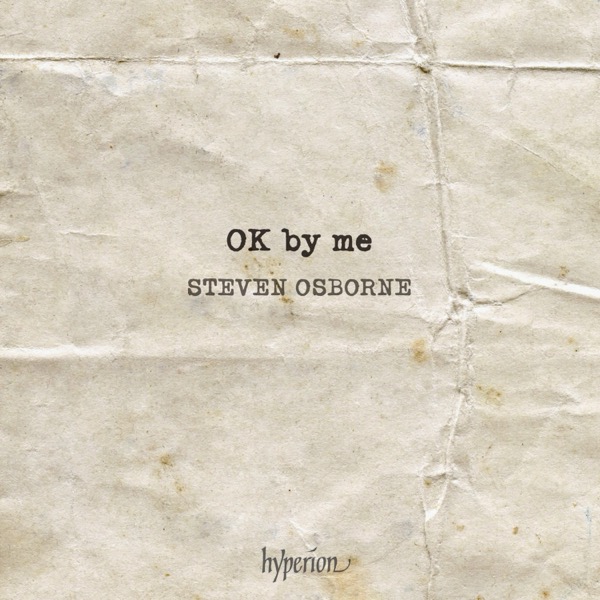
OK by Me – A Life in Encores is released on the Hyperion label on 13 November 2026.
For more of the best in classical music, sign up for our E-Newsletter