The young Japanese violinist Himari (b. 2011 as Himari Yoshimura) made her American concert debut with Henryk Wieniawski’s Violin Concerto No. 1 in F sharp minor with the Santa Fe Symphony in 2023, aged 11, and then made her European debut with the work in 2025, age 13. That debut with the Berlin Philharmonic is captured on her debut recording on Decca Classics, appropriately called Debut.
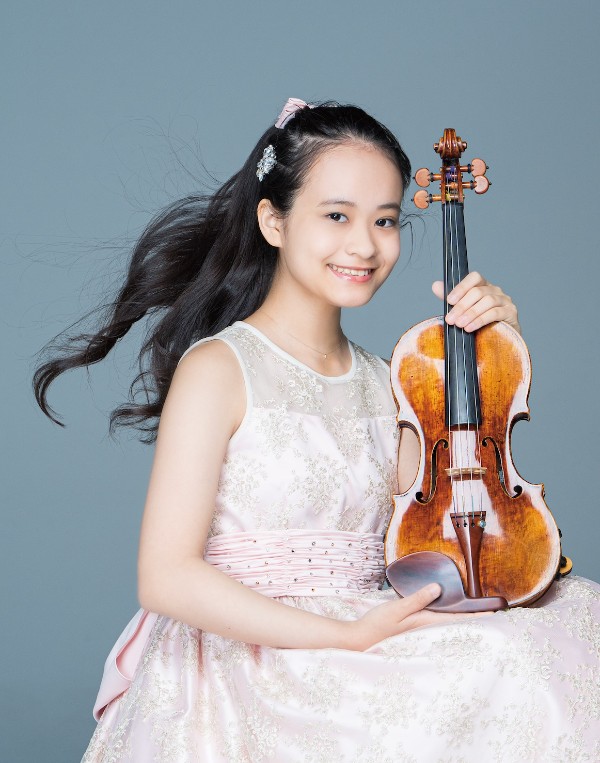
Himari © himari-info.com
Himari started her violin study at age 3, working with Koichiro Harada and Machie Oguri. She made her debut with a professional orchestra at age 6, and at age 11 she was admitted to the Curtis Institute of Music in Philadelphia, where she studied with Ida Kavafian. At age 13, she signed an exclusive contract with Decca Classics, becoming the label’s youngest female artist.
In competition, Himari has been awarded grand prizes at the Arthur Grumiaux Competition in Belgium (2019) and the International Competition for Young Violinists in Honour of Karol Lipinski and Henryk Wieniawski, Lublin, Poland (2021), as well as the 26th Andrea Postacchini International Violin Competition in Italy and the Kogan International Violin Competition in Belgium. She plays the 1717 ‘Hamma’ Stradivari on loan from Mr Yusaku Maezawa. Her bow is on loan from the Munetsugu Collection.
Henryk Wieniawski (1835–1880) wrote his first violin concerto in 1851 while on tour in Russia with his brother. After returning to give concerts in Leipzig, Paris, and London, he returned to Russia in 1860 at the invitation of Anton Rubinstein. He spent the next 12 years there, variously as solo violinist to the Tsar, leader of the opera Orchestra, and professor of violin at Rubinstein’s conservatory. When he returned to his touring career in 1872, he extended his travels to North America with Rubinstein. When he returned to Europe in 1875, he was appointed professor of violin at the Brussels Conservatory. His health was increasingly frail, and he had to leave the stage during a performance of his Violin Concerto No. 2 in Berlin. Joseph Joachim was in the audience and took his place on stage, replacing the concerto with a performance of the Bach Chaconne on Wieniawski’s violin. Despite this setback, Wieniawski continued his tour out of financial need, but he was often forced to leave the stage, unable to perform. Wieniawski died on 31 March 1880 in the house of Tchaikovsky’s patroness, Nadezhda von Meck.
In the first movement, after a first subject in the clarinet and a more lyrical second subject, the violin enters in a technically demanding solo entry in 10ths. The first subject follows, played only on the G string. The rest of the movement includes a brief cadenza, followed by a lyrical passage that gives the violinist a chance to display technique, complete with triple-stopped chords and difficult but dazzling arpeggios. The final coda brings back the first subject.
Henryk Wieniawski: Violin Concerto No. 1 in F sharp minor, Op. 14 – I. Allegro moderato
Himari plays with authority and assurance, and even her own teacher remarks on her maturity: ‘If you’re listening to Himari and you close your eyes, you wouldn’t realise her age. Inside Himari, there is an older person and a wise musician… she’s immensely talented.’
After this brilliant orchestra debut, Himari fills the rest of the album with recital material of the highest quality, including Frédéric Chopin’s Nocturne No. 16 in E-Flat Major, Op. 55, No. 2 (transcribed by Jascha Heifetz); Leopold Godowsky’s Triakontameron: XI. Alt Wien (transcribed by Jascha Heifetz); Jean Sibelius’ Mazurka, Op. 81, No. 1; and Chopin’s Nocturne No. 20 in C sharp minor (transcribed by Nathan Milstein). These are works by the virtuosos of their day, and even Sibelius’ Mazurka is technically demanding, with a cadenza-like opening, double stopping, and huge leaps in the melodic line, requiring a virtuoso hand.
Jean Sibelius: Five Pieces for Violin and Piano, Op. 81, No. 1 – Mazurka
She closes the album with more Henryk Wieniawski, with his Fantasia on Themes from Gounod’s ‘Faust’, Op. 20.
With its mix of orchestral and recital material, Himari’s debut recording gives us an exceptional view of her skills. Sometimes, as happens on live recordings, her leaps may fall a hair short, but that’s the excitement of live performance. In the piano and violin works, where Chelsea Wang, who made her own orchestral debut at age 6, ably accompanies her, we have a more traditional format. Still, again, Himari’s choice of works distinguishes her. In Wieniawski’s Faust Fantasia, she has the vision to create a coherent storyline amid all the virtuoso fireworks.

Himari: Debut (Wieniawski, Chopin, Sibelius, and Godowsky)
Himari, violin; Berlin Philharmonic with Sebastian Weigle, conductor; Chelsea Wang, piano
Decca Classics 00028948722099
Release date: 25 September 2026
For more of the best in classical music, sign up for our E-Newsletter