Gabriel Fauré died of pneumonia in Paris on 4 November 1924, at the age of 79. His last words appeared to question what kind of legacy he would leave behind. As if to underscore his uncertainty, organising a state funeral did not go smoothly.
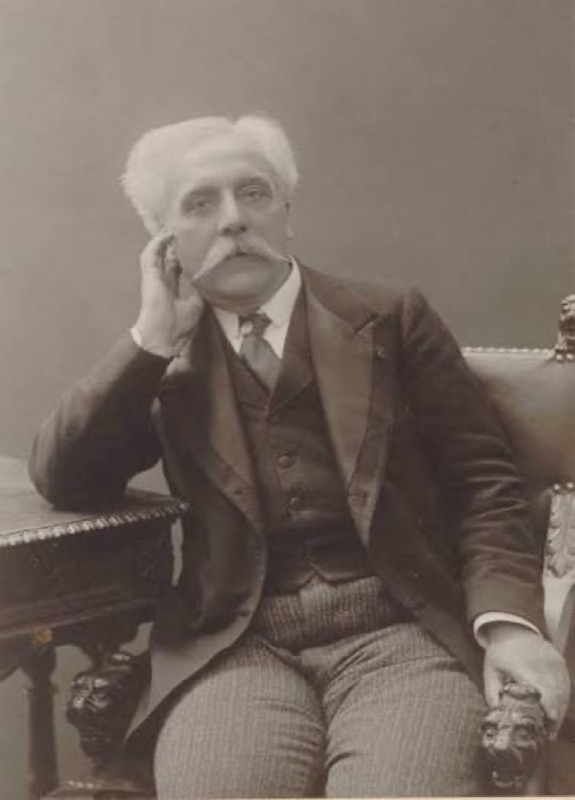
Gabriel Fauré
It took several days of heated discussion before ministers were finally convinced that a state funeral was indeed called for. Fauré’s former workplace, the Église de la Madeleine, was eventually chosen, and his Requiem, in its full orchestral version, was performed.
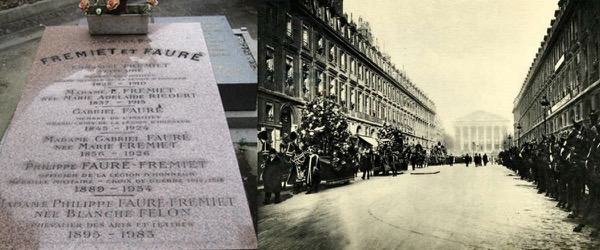
Gabriel Fauré’s grave and funeral
The Requiem in D minor, Op. 48, is the best-known of Fauré’s large works, but it underwent several revisions. To commemorate the anniversary of Fauré’s passing, let us explore the performance history of a work that enjoyed immediate success.
Gabriel Fauré: Requiem, Op. 48 (1900 version): Introit – Kyrie (Françoise Pollet, soprano; François Le Roux, baritone; South German Radio Choir; Württemberg State Theatre Chorus Stuttgart; Stuttgart Radio Symphony Orchestra; Georges Prêtre, cond.)
A First Hearing
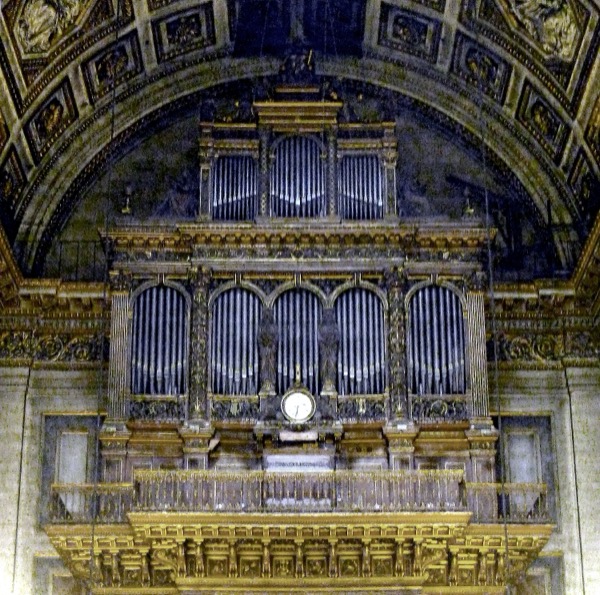
Gallery organ of the Église de la Madeleine, Paris
The first performance took place in the Church of the Madeleine in Paris on 16 January 1888 for the funeral of the architect Joseph Lesoufaché. The critic Camille Benoit, under the pseudonym of Balthazar Claes, reported on the performance in the weekly publication Le Guide musical.
“I have just returned from my first hearing of the Requiem Mass of Gabriel Fauré… The impression that this magisterial work by a young composer made on the elite group of musicians and artists who attended the performance was profound… A work of this importance and worth, the most striking proof of the great talent of its author, merits a full discussion.”
Gabriel Fauré: Requiem, Op. 48 (1900 version): Offertory (Françoise Pollet, soprano; François Le Roux, baritone; South German Radio Choir; Württemberg State Theatre Chorus Stuttgart; Stuttgart Radio Symphony Orchestra; Georges Prêtre, cond.)
Pleasure, Faith, and Eternal Rest
The reason Fauré composed the work is unclear, but some suggest it relates to his father’s death in 1885 and his mother’s death two years later. However, Fauré later declared that the work wasn’t “written for anything—for pleasure, if I may call it that.”
Of course, he eventually qualified this statement by telling an interviewer, “Everything I managed to entertain by way of religious illusion I put into my Requiem, which, moreover, is dominated from beginning to end by a very human feeling of faith in eternal rest.”
Camille Benoit, writing from the Madeleine in January 1888, would have heard the first version of the work, which Fauré called “un petit Requiem.” It included five movements: the Introit and Kyrie, Sanctus, Pie Jesu, Agnus Dei and In Paradisum.
Gabriel Fauré: Requiem, Op. 48 (1900 version): Sanctus (Françoise Pollet, soprano; François Le Roux, baritone; South German Radio Choir; Württemberg State Theatre Chorus Stuttgart; Stuttgart Radio Symphony Orchestra; Georges Prêtre, cond.)
Where is the Dies irae?
The majority of the text is in Latin, except for the Kyrie, which is in Koine Greek. Fauré did not set the Gradual and Tract sections of the Mass, and he suppressed the Requiem sequence, the Dies irae. That omission stemmed from a distinctive French Catholic liturgical tradition.
The Dies irae (Day of Wrath) is the medieval sequence describing the Last Judgment, and it was not a standard component of the local liturgical tradition. That practice, associated with the Gallican tradition, the historical form of Catholic worship particular to France, did not include that particular text.
Fauré is also thought to have rejected this aspect of the liturgy of the dead, as it didn’t correspond to his way of thinking. As the composer wrote, “It has been said that my Requiem does not express the fear of death and someone has called it a lullaby of death. But it is thus that I see death: as a happy deliverance, an aspiration towards happiness above, rather than as a painful experience.”
Gabriel Fauré: Requiem, Op. 48 (1900 version): Pie Jesu (Françoise Pollet, soprano; François Le Roux, baritone; South German Radio Choir; Württemberg State Theatre Chorus Stuttgart; Stuttgart Radio Symphony Orchestra; Georges Prêtre, cond.)
From Five Movements to Seven
Fauré continued to work on the Requiem, gradually expanding the composition by adding two movements. The Offertoire developed from the Hostias section, which was initially composed in 1889. The composer subsequently expanded it with the choral O Domine Jesu Christe.
In 1877, Fauré composed an independent Libera me for baritone and organ. He subsequently revised the piece and incorporated it into the larger work, now unfolding in seven movements.
Gabriel Fauré: Requiem, Op. 48 (1900 version): Agnus Dei (Françoise Pollet, soprano; François Le Roux, baritone; South German Radio Choir; Württemberg State Theatre Chorus Stuttgart; Stuttgart Radio Symphony Orchestra; Georges Prêtre, cond.)
1893 Version
Fauré also expanded the work’s distinctive orchestration, featuring divided violas, cellos, and double basses, as well as harp, timpani, and organ, without a conventional woodwind section. He now judged the work ready for publication and offered this version to Julien Hamelle.
Hamelle had reservations about the unusual instrumentation of the 1893 version but agreed to take the work under his wing if Fauré produced a new version with woodwind instruments and a conventional violin section.
Several attempts have reconstructed the 1893 score, including versions by Jean-Michel Nectoux and a first edition prepared by John Rutter. The Nectoux edition benefited from important sources unavailable to Rutter, as a set of orchestral parts was discovered in 1968. Ultimately, there was broad agreement that the Nectoux edition was superior.
Gabriel Fauré: Requiem, Op. 48 (1900 version): Libera me (Françoise Pollet, soprano; François Le Roux, baritone; South German Radio Choir; Württemberg State Theatre Chorus Stuttgart; Stuttgart Radio Symphony Orchestra; Georges Prêtre, cond.)
From the Church to the Concert Hall
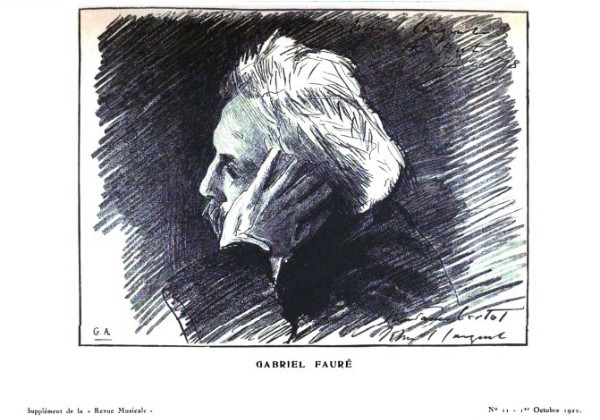
Aubert: Gabriel Fauré
At the turn of the century, publisher Julien Hamelle suggested that the composer re-score the Requiem for concert hall performance, as the earlier versions were better suited to liturgical settings.
The newly scored version was performed at the Trocadéro in Paris on 12 July 1900, with the vocal score published that year and the full orchestral score and parts following in 1901. Yet the autograph of the 1900 version does not survive, and scholars now believe Fauré’s student Jean Roger-Ducasse undertook much of the orchestration and preparation of the vocal reduction.
Gabriel Fauré: Requiem, Op. 48 (1900 version): In paradisum (Françoise Pollet, soprano; François Le Roux, baritone; South German Radio Choir; Württemberg State Theatre Chorus Stuttgart; Stuttgart Radio Symphony Orchestra; Georges Prêtre, cond.)
A Gentle Farewell
Fauré’s Requiem broke with a tradition espoused by the many Requiem compositions that preceded it. In contrast to what are commonly seen as more overt and theatrical pieces intent on depicting the anger of the Last Judgment, Fauré composed a work that conjures a peaceful and consolatory sense of rest.
Fauré described the work as being “of a sweet nature, like the composer himself.” And in his Requiem, “I have also instinctively sought to escape from what is thought proper, after all the years of accompanying burial services on the organ! I know it all by heart. I wanted to write something different.”
For more of the best in classical music, sign up for our E-Newsletter