The excitement is palpable in Chicago and New York. Both the Chicago Symphony and the New York Philharmonic are welcoming their new maestros this fall, and the atmosphere is euphoric.
Finnish whiz, conductor and cellist Klaus Mäkelä comes by his talent honestly. Born in Helsinki, his family are all musicians—his father a cellist, his mother a pianist, his grandfather a violinist and violist. Mäkelä studied conducting at the Sibelius Academy with the famed teacher Jorma Panula, and his interest in conducting was sparked at age twelve after he sang in a choir for the Finnish National Opera.
He has been Music Director of the Orchestre de Paris since September 2021 and served as Chief Conductor of the Oslo Philharmonic from 2020 to 2026. Mäkelä has been leading concerts with the Royal Concertgebouw Orchestra, and in 2027 he’ll take on the title of Chief Conductor.
As the eleventh music director of the Chicago Symphony in their 136-year history, Klaus Mäkelä is now in the driver’s seat as the Zell Music Director Designate of the Chicago Symphony. The orchestra is shouting from the rooftops of Orchestra Hall: Mäkelä is Bäckelä.
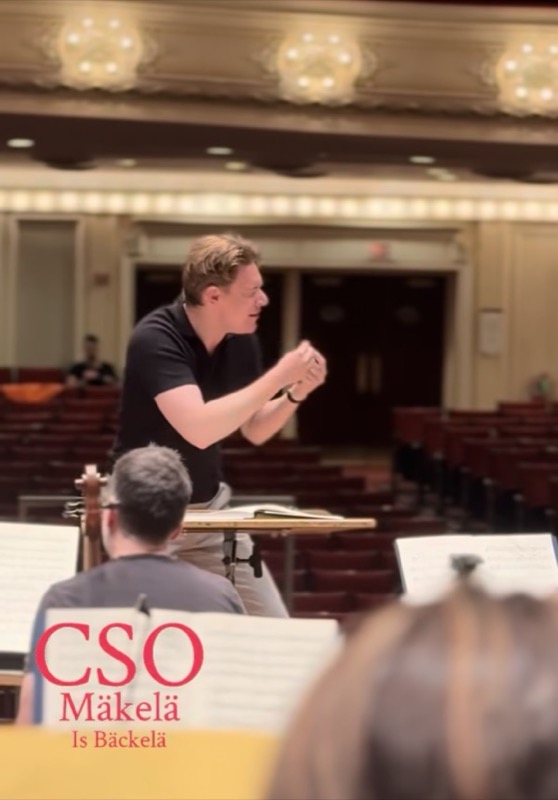
Klaus Mäkelä in rehearsal with the Chicago Symphony Orchestra
When the Chicago Symphony began looking for a new music director after Riccardo Muti’s tenure ended, very few names were being floated. In 2022, the then-twenty-six-year-old conducted the orchestra for the first time. It’s a great story:
“The first rehearsal ended on Tuesday morning. The CSO Association president Jeff Alexander decided to go backstage to check in with Mäkelä. Still, he could barely fight his way down the long hallway to Mäkelä’s dressing room because musicians kept stopping Mäkelä as they came off the stage. After just one single rehearsal, their message was clear: He’s the one! In two and a half hours, Mäkelä had demonstrated supreme confidence without a hint of arrogance, total physical mastery of his craft, humour, deep musical intelligence, interpretive flair, respect for the letter of the score, a keen ear for colour and texture, and the kind of magnetism that leaps for the stage—the makeup of a conductor generations older but rare at any age.” CSO program annotator and scholar-in-residence Phillip Huscher. (An excerpt from the recently released book from the University of Chicago Press: Passing the Baton, the first comprehensive history of the Chicago Symphony Orchestra in over 100 years)
My colleagues say they knew in ten minutes! When you know, you know. It’s a thrilling time for the orchestra, and I must say the marketing department is having a field day.
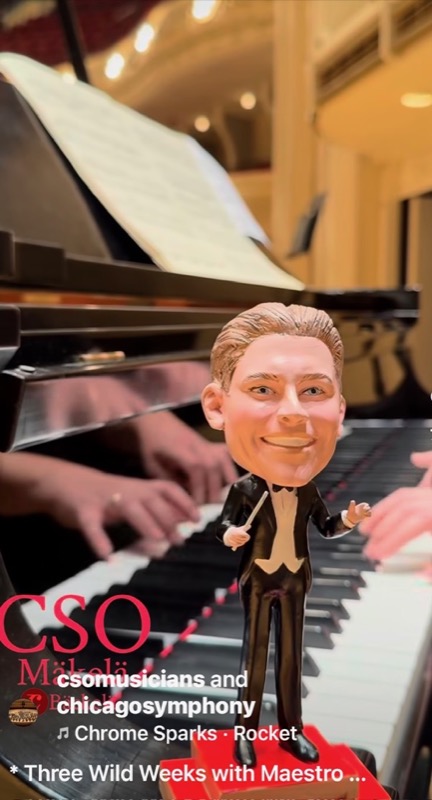
A Klaus Mäkelä bobblehead from the Chicago Symphony Orchestra
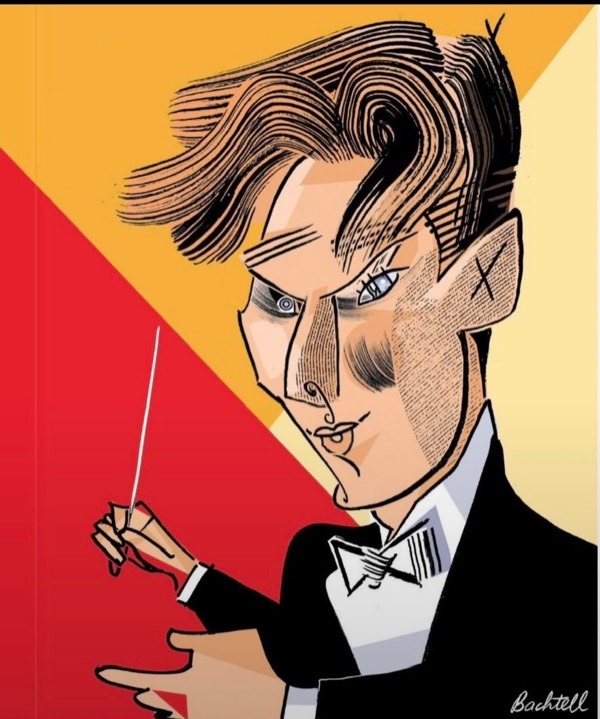
Caricature of Klaus Mäkelä by Tom Bachtell
Here’s a short video with Mäkelä.
Klaus Mäkelä on Sibelius: Complete Symphonies & His Vision for the Orchestre de Paris
Magnetic Mäkelä opened the season with three weeks featuring unusual and fascinating works—Sibelius Symphony No. 7 in C Major, a one-movement work, and Shostakovich’s wild and audacious Symphony No. 4 in C Minor. The Presto second movement is especially hair-raising. Listen to it with Mäkelä and the Oslo Philharmonic. (He’s recorded Symphonie No. 4, No. 5, and No. 6 with them.)
Dmitry Shostakovich: Symphony No. 4 in C Minor, Op. 43: II. Presto (Oslo Philharmonic Orchestra; Klaus Mäkelä, cond.)
Mahler Symphony No. 9, the composer’s last, was also featured, along with a program of two Gabrieli works, Igor Stravinsky’s colourful Petrushka, and British composer Sir William Walton’s massive and dramatic cantata Belshazzar’s Feast, with double chorus, two brass bands, organ, and legendary baritone Thomas Hampson.
Mäkelä has recorded Petrushka with Orchestre de Paris. Here’s a short excerpt.
Igor Stravinsky: Petrushka (1947 version): Tableau I: Russian Dance (Orchestre de Paris; Klaus Mäkelä, cond.)
The Leeds Festival Chorus with the London Symphony Orchestra under the baton of Sir Malcolm Sargent premiered the work in 1931. Walton’s rarely performed Biblical tale from the Book of Daniel and Psalm 137 depicts Babylon, the king’s irreverent debauchery, and his ultimate divine judgement.
Walton’s dramatic 35-minute work is played without pause.
William Walton: Belshazzar’s Feast: Praise ye (Bryn Terfel, baritone; BBC Singers; BBC Symphony Chorus; BBC Symphony Orchestra; Andrew Davis, cond.)
I’m sure it was a riveting concert!
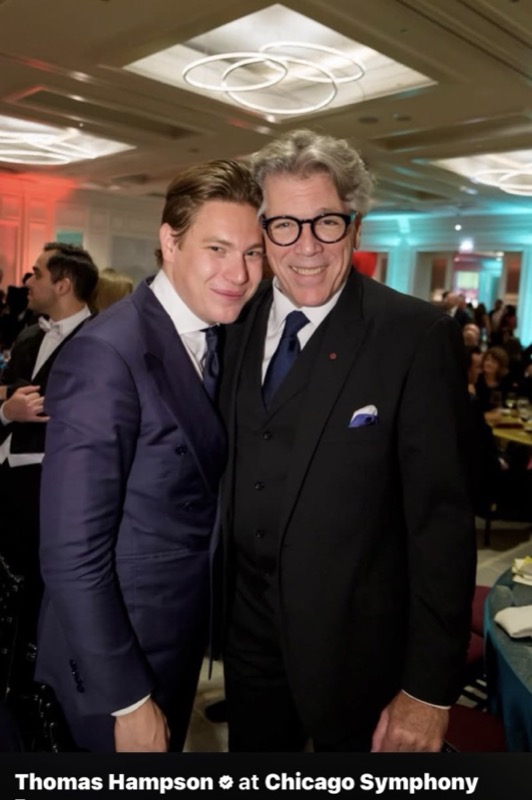
Klaus Mäkelä with baritone Thomas Hampson
If you have time for the work in its entirety, here it is again with the Leeds Festival Chorus and the London Symphony Orchestra in a vivid, beautifully filmed performance from 1999, conducted by Sir Andrew Davis.
Walton “Belshazzar’s Feast” – Andrew Davis conducts
In January, it’ll be time to present the new partnership with the CSO abroad. Mäkelä will take the orchestra to Europe to eight cities in major centres, including Cologne, Hamburg, Vienna, and Paris.
In spring, he’ll return to Chicago to conduct two weeks featuring Sibelius Symphony No. 1 and two pieces by fellow Finn, Magnus Lindberg—a US premiere and his Violin Concerto No. 1 with violinist Lisa Batiashvili.
The following week Mäkelä interprets Beethoven Symphony No. 9, which is paired with Boulez Le soleil des eaux for solo soprano, chorus, and orchestra in two movements.
Meanwhile, the thirty-year-old is quite busy with the Orchestre de Paris. This is his final season as Music Director of the Orchestre de Paris, and he will present some great programs including Berlioz’s Roméo et Juliette and Mahler’s Symphonies Nos. 3 and 8. There will be a world premiere of a new work by Thomas Larcher, and quite a cast for Beethoven’s Triple Concerto with Martha Argerich, Renaud Capuçon and Gautier Capuçon. The final gala concert at the Philharmonie de Paris includes Stravinsky Le Sacre du printemps. We can only hope he’ll bring some of these works to Chicago soon.
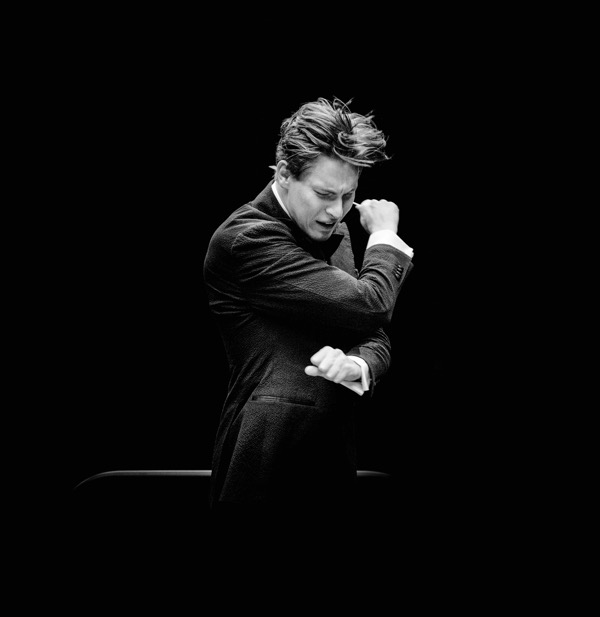
Klaus Mäkelä
The 2026–2027 season in Chicago and in subsequent years will indeed be an exciting new era for the orchestras and their community. Next, we’ll look at the Dudamel era in New York.
For more of the best in classical music, sign up for our E-Newsletter