When discussing European festivals, we often forget how old they can be, even if we know them in modern garb. In a sense, the Lucerne Festival can trace its roots back to the 15th century, with the beginnings of an Easter Festival at the Wine Market (Weinmarkt) in 1453.
If we jump forward to the 19th century, when Richard Wagner was in residence in the city (1866–1872), composing Die Meistersinger von Nürnberg and beginning The Ring Cycle, he envisioned a festival set on the shores of Lake Lucerne, but it was not to be. His son Siegfried revived the idea around 1930. Richard Strauss and Max Reinhardt also considered a festival in Lucerne before they moved over to the Salzburg Festival.
Finally, Swiss conductor Ernest Ansermet, working with Walter Schulthess, the director of the Zurich Concert Society, developed plans that would work. The festival would be based around the Lucerne Kursaal Orchestra, to be expanded with musicians from Ansermet’s Orchestre de la Suisse Romande (founded in 1918).
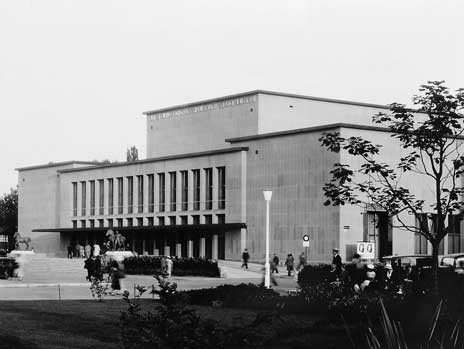
The old Kunsthaus in Lucerne in the 1930s (photo by Armin Meili / Archives Lucerne Festival)
A performance by Arturo Toscanini on 25 August 1938, conducted what is considered the ‘opening concert’ of the Festival. Initially called the Internationale Musikfestwochen Lucerne (IMF), it changed its name later simply to the Lucerne Festival in the 21st century.
Felix Mendelssohn: Violin Concerto in E Minor, Op. 64, MWV O14: III. Allegro molto vivace (Yehudi Menuhin, violin; Lucerne Festival Orchestra; Wilhelm Furtwängler, cond.)
The 1938 concerts included not only orchestral concerts but also chamber music concerts and lieder recitals. Toscanini was joined by other conductors, Fritz Busch, Bruno Walter, and Willem Mengelberg. Lucerne was in a fortunate position because the big festivals in Germany and Austria (including Bayreuth and Salzburg) no longer let Toscanini, Busch, or Walter perform due to their religion or political opinions. They took advantage of their neutral position to get the best musicians.
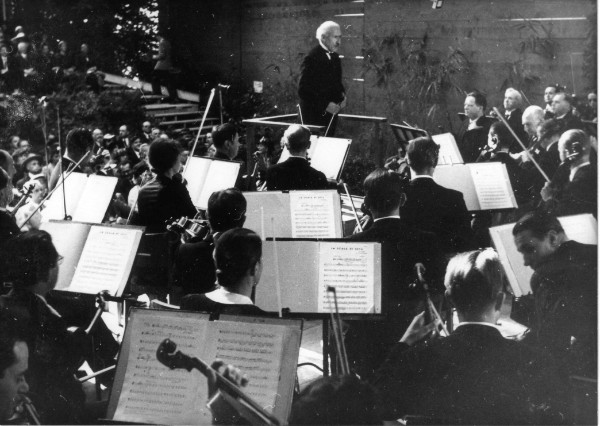
Toscanini in 1938 (photo by Jean Schneider/Archives Lucerne Festival)
The 1939 Festival takes place in the summer, between July and September. Toscanini conducts six concerts, and soloists including Vladimir Horowitz, Pablo Casals, and Sergei Rachmaninoff appear. When WWII broke out, the festival ceased in 1940, the only pause in its history until COVID in 2020.
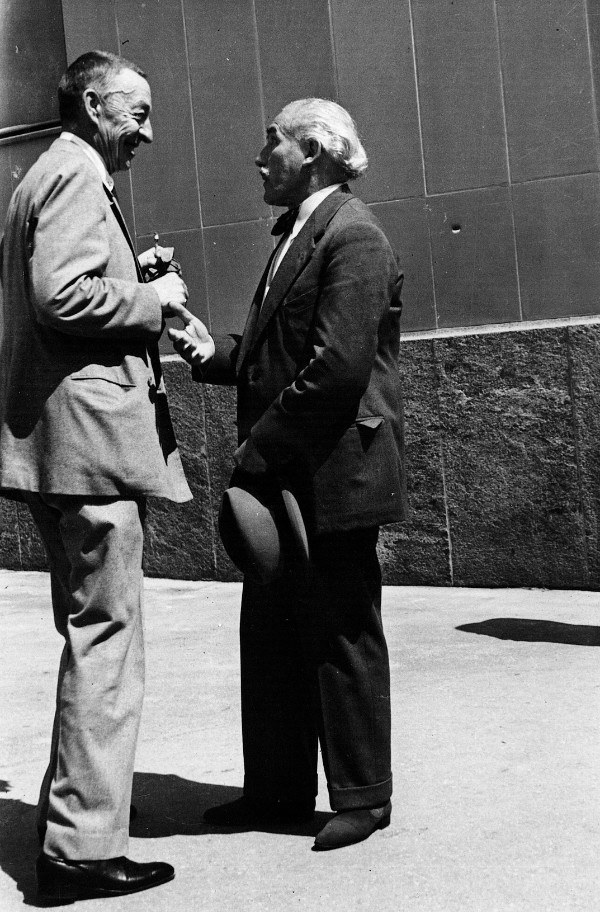
Sergei Rachmaninoff and Arturo Toscanini, 1939 (Archives Lucerne Festival)
During the war, Milan’s La Scala Orchestra was in residence in 1941, and the Swiss Festival Orchestra (Schweizerische Festspielorchester) was founded in 1943; it was dissolved only in 1993. The program expands to include master courses taught at the Lucerne Conservatory, and in 1945, Ansermet led the first course in conducting. Over the years, his baton has been taken up by Herbert von Karajan (1955), Rafael Kubelík (1982), Pierre Boulez (2003–2012), and Bernard Haitink (2011–2017).
Remo Giazotto: Adagio in G Minor (attrib. to Albinoni) (Lucerne Festival Strings, Ensemble; Rudolf Baumgartner, cond.)
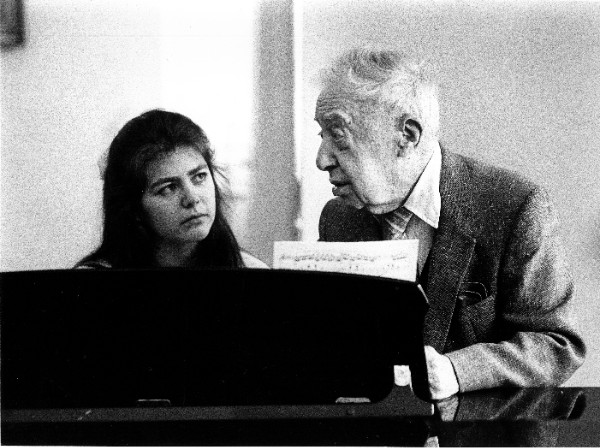
Masterclass with Mieczysław Horszowski (photo by Stephan Wicki)
In 1944, Wilhelm Furtwängler conducted the Swiss Festival Orchestra and returned in 1947 to become a central figure in the Festival until his death in 1954. A serenade concert, under the direction of Paul Sacher, is established, which remains a popular evening event until 1996.
Toscanini leading the La Scala Orchestra in 1946 marked his last appearance in Lucerne, but it was also the year of the Swiss Festival Orchestra’s first studio recording.
Through the end of the 1940s, as travel restrictions were lifted and German musicians and conductors cleared their names politically, the festival became increasingly international. 1949 saw the first performance of Mahler at the Festival with Das Lied von der Erde, conducted by Paul Kletzki.
Through the 1950s, the festival continued to grow, with the Swiss Festival Orchestra being led by Igor Markevitch, André Cluytens, and Leopold Stokowski. Demands for more modern programs by the press are matched by a lack of support from the ticket-buying audience, creating a problem familiar to many festivals. In addition, the Orchestra wants a bigger say in the programming, but the organisers, since they hold chief responsibility, don’t want to share that decision-making process. As the festival approaches with no resolution, the Swiss Festival Orchestra is suspended, and the London Philharmonia Orchestra comes in for the 1954 summer season.
Watch Claudio Abbado conducts the Lucerne Festival Orchestra with soloist Alfred Brendel in 2005.
By 1956, the Swiss Festival Orchestra was back, and the London Philharmonic became the guest orchestra, setting the pattern for the Festival Orchestra to share the stage with top international orchestras. Everyone wins: the Orchestra gets a break, and the audience has even more offerings.
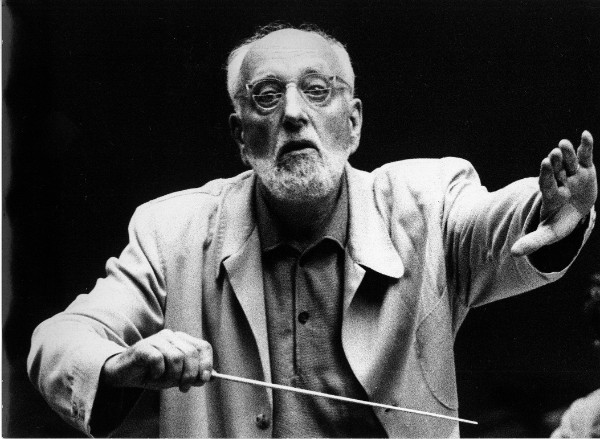
Ernest Ansermet in rehearsal, 1961 (Archives Lucerne Festival)
Orchestras such as the Vienna Philharmonic (1957) and the Berlin Philharmonic (1958). The NHK Symphony Orchestra (1960), the Pittsburgh Symphony Orchestra (1964), the Bavarian Symphony Orchestra (1965), and the New York Philharmonic (1968) point to the future and the growth of international programming.
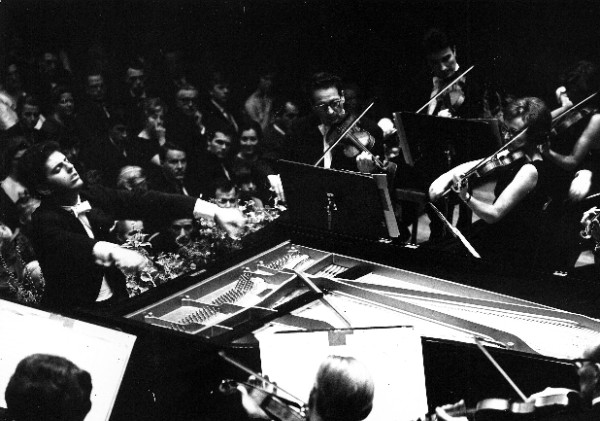
Daniel Barenboim directing the English Chamber Orchestra, 1966 (photo by Paul Weber / Archives Lucerne Festival)
In 1970, as part of an examination and reanalysis of the programming, it was decided to have a thematic focus upon which to base the Festival programming. At the same time, modern music is given a greater stage. For example, during the Beethoven Year in 1970, his 9 symphonies were juxtaposed with works from the 20th century. At first, the thematic focus is on countries, such as Music by Swiss Composers (1973) and Spain as a Musical Country (1976), and on composers, including Beethoven (1970), Igor Stravinsky (1972) and Maurice Ravel (1975), but this was later expanded.
Watch Simon Rattle and the Berlin Philharmonic at the Lucerne Festival in 2013.
The Musica Nova concerts, founded in 1956, expanded into a ‘Perspectives’ series focusing on a single modern composer, beginning with Mauricio Kagel, Iannis Xenakis, Karlheinz Stockhausen, Klaus Huber, György Ligeti, and Witold Lutosławski.
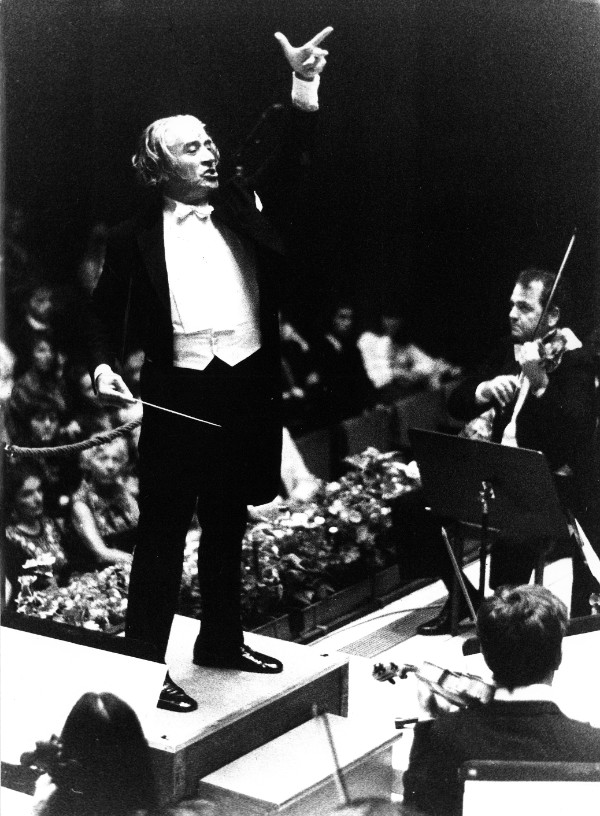
Sergiu Celibidache conducts the Swiss Festival Orchestra, 1974 (Archives Lucerne Festival)
An expansion of the Young Artists series in 1973, which became a platform for launching young careers, sees appearances by the 13-year-old Anne-Sophie Mutter, Maria João Pires, Christian Tetzlaff, Thomas Zehetmair, Frank Peter Zimmermann, and the Hagen Quartet over the next few years.
The succeeding years see changes in administration, changes in concept, and demand for a new concert hall. In the mid–1980s, there was a commitment, driven by Claudio Abbado, to include youth orchestras. In 1985, Abbado conducted the European Community Youth Orchestra in Mahler’s Resurrection Symphony.
In 1988, at the 50th anniversary of the Festival, Vladimir Ashkenazy, leading the Orchestre de la Suisse Romande, repeated the program of the first Festival concert under Ernest Ansermet in 1938. There’s also a repeat of Toscanini’s gala concert held in Tribschen 50 years earlier.
To return to what we mentioned at the beginning, and a festival’s connection with Easter, an Easter Festival was added to the programming in 1988. The second Easter Festival, scheduled for 1991, had to be cancelled because the New York Philharmonic couldn’t travel due to the First Gulf War. The Easter Festival became firmly established in 1992, and the performing venues expanded all over the city to include concerts in Lucerne’s churches.
On its own 50th birthday in 1988, the Swiss Festival Orchestra came to an end. The composer portrait series, integral to the New Music series, changed to have a composer-in-residence, starting with Alfred Schnittke and continuing with Klaus Huber, Luciano Berio, Beat Furrer, Michael Jarrell, Wolfgang Rihm, and Heinz Holliger.
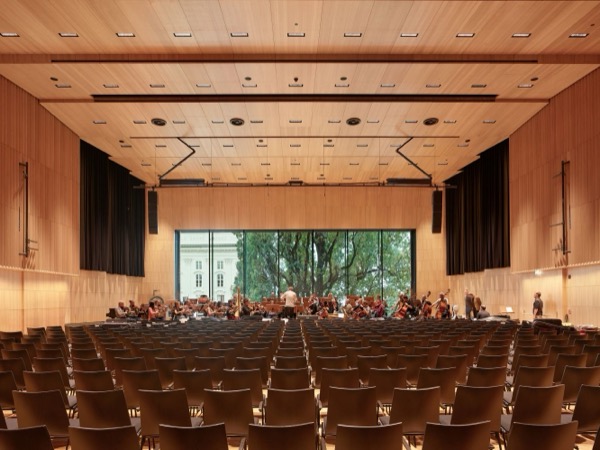
1996 saw the final performance in the old Kunsthaus, which had opened in 1933, but by festival season in 1997, the new KKL Luzern (designed by Jean Nouvel) was unfinished. The 1997 season is held in the former factory hall of the von Moos Steel company, now transformed by architect Max Schmid into an acoustically outstanding concert hall. To reach the hall, you had to take a special train from Lucerne’s main station.
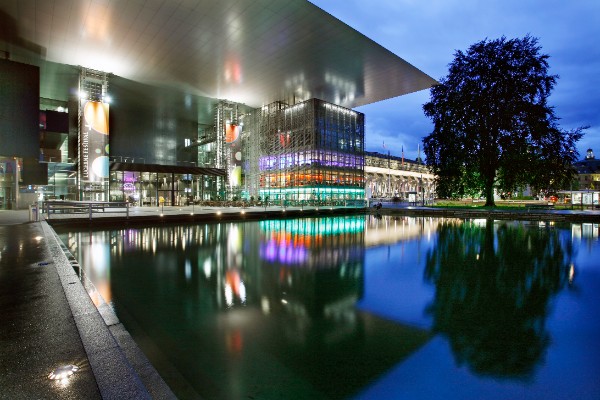
KKl Luzern (photo by Luzern Tourismus AG)
The new KKL Lucerne concert hall opened on 19 August 1998, and the entire KKL complex was completed by 2000. Other festivals came to call, such as the Bayreuth Festival with parts of Götterdämmerung (under James Levine) and Die Meistersinger von Nürnberg (under Daniel Barenboim) and the Salzburg Festival with Messiaen’s Saint François d’Assise (under Kent Nagano). With the new spaces available at the KKL, the Piano Festival has started, taking place in November.
The violinist and cultural manager Michael Haefliger became Executive and Artistic Director of the Festival in 1999, and he expanded the Festival’s commitment to contemporary music and expanded its projects in education. He set up the international Circles of Friends of the festival in the US and Japan. With Claudio Abbado, he began planning for a Lucerne Festival Orchestra, and planned the Lucerne Festival Academy with Pierre Boulez. He will hold this position until 2025, with a 26-year tenure, when he will be succeeded by Sebastian Nordmann.
Opening Lucerne Festival Forward
The Forward Festival
Finally, in 2001, the Internationale Musikfestwochen Lucerne became the Lucerne Festival, consisting of the Summer Festival, the Piano Festival (November), and the Easter Festival (Spring).
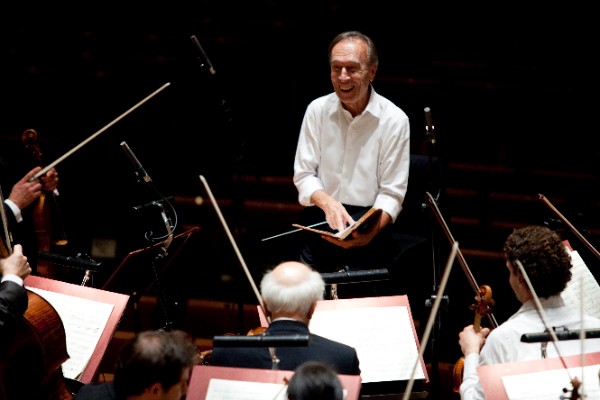
Claudio Abbado and the Lucerne Festival Orchestra, 2011 (photo by Fred Toulet/Archive Lucerne Festival)
In 2003, the Lucerne Festival Orchestra made its debut. In 1938, Toscanini had conducted an ‘elite orchestra’, an ad hoc orchestra comprising the finest musicians of the era, and in the same way, the Lucerne Festival Orchestra was created, to be made up of internationally acclaimed soloists, chamber musicians, music professors, and members of the Mahler Chamber Orchestra.
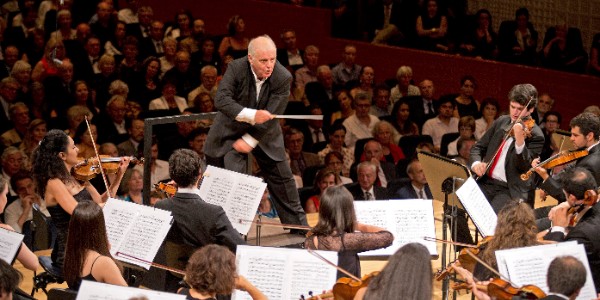
Daniel Barenboim leading the West-Eastern Divan Orchestra, 2013 (photo by Georg Anderhub/Lucerne Festival)
2020 saw the world close itself away, and so the three festivals were cancelled. This did not mean that all music stopped.
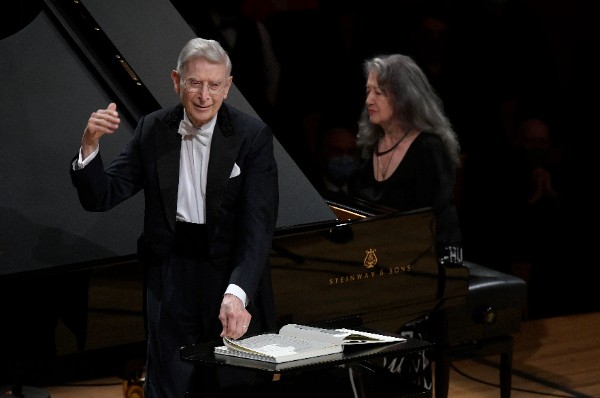
Herbert Blomstedt conducting the Lucerne Festival Orchestra with Martha Argerich, 2020 (photo by Peter Fischli / Lucerne Festival)
A 10-day alternative festival, Life is Live, was held in August, with Herbert Blomstedt conducting the Lucerne Festival Orchestra for the first time and, together with Martha Argerich, offering two all-Beethoven concerts. Igor Levit continued his cycle of the Beethoven sonatas. Other guest artists included Cecilia Bartoli, Mauro Peter, the Credit Suisse Young Artist Award winner Valentine Michaud, and an ensemble of the Lucerne Festival Alumni. Peter Conradin Zumthor created a sound installation using the church bells of Lucerne.
The cancellations continued through 2021. The Easter Festival was outright cancelled, and the Summer Festival had to be rescheduled several times. The concerts that were held were short, all without intermission, and using smaller orchestras that were spatially separated. The Lucerne Festival Contemporary Orchestra (LFCO) saw its debut; its focus is new and contemporary music.
Through its nearly 90-year life, the Lucerne Festival has responded to the demands of the world around it, changing from a traditional festival to one that serves the needs of its audience. It has expanded from its concert-hall home to include more of the city around it – both its churches and its jazz clubs.
The Lucerne Festival now consists of The Spring Festival in March, The Pulse festival in May, The Summer Festival in August and September, and the Forward Festival in November. You can hear works by the greatest composers in the Spring and Summer festivals and by contemporary composers in the Pulse and Forward festivals.
The Summer Festival remains the leading festival of the series, and the other festivals, by providing concerts throughout the year, give listeners a chance to experiment, try smaller ensembles, and listen to what’s new.
The 2026 Lucerne Festivals:
Spring 2026 27.03.-29.03.2026
Pulse 2026 08.05.-17.05.2026
Summer 2026 13.08.-13.09.2026
Forward 2026 20.11.-22.11.2026
https://www.lucernefestival.ch/en/
For more of the best in classical music, sign up for our E-Newsletter