Baroque instruments meeting electronic techno? While “crossover” has become a buzzword, the audience’s threshold for surprise is higher than ever. Yet, the Belgian B’Rock Orchestra recently managed to shatter the last remnants of their “early music” label. In their production of A Last Supper at the Elbphilharmonie’s recital hall, they invited the audience into an immersive ritual of desire and excess that felt more like a startling sensory takeover.
The Blurring of Space and Identity
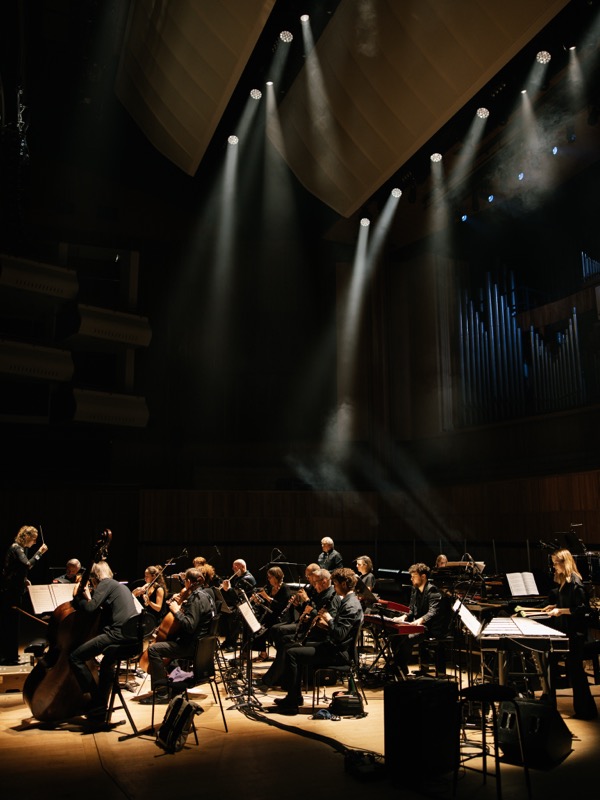
B’Rock Orchestra in A Last Supper © Daniel Dittus
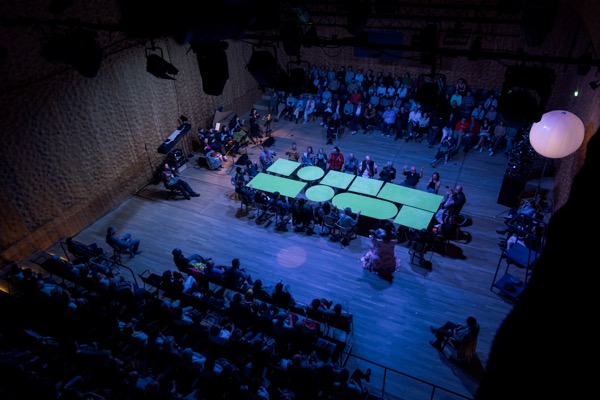
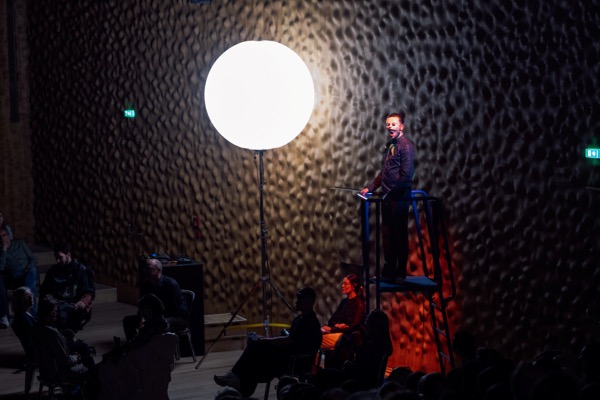
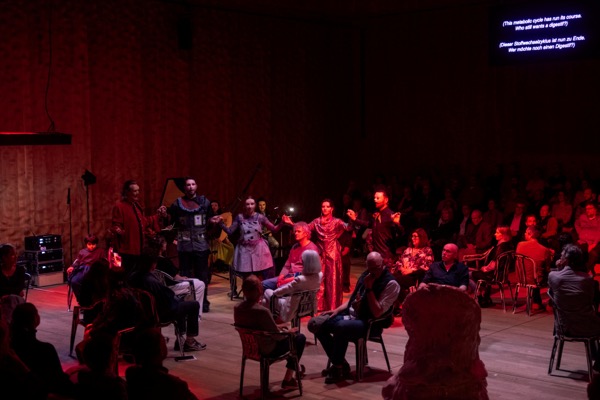
Before the show even officially began, the traditional boundaries of the theater were broken. Masked actors were already in place, greeting the audience in various grotesque poses—some sitting on Styrofoam seats, others standing high atop construction scaffolding. Even the ticket check at the entrance felt strange due to the presence of metal chains. The atmosphere felt more like entering an underground disco bar (despite lines in the script claiming we were boarding an airplane) than a traditional concert. The usual stage had been removed, replaced by a massive central performance area filled with tables and chairs.
This was more than just a visual change; it was a reconstruction of identity. Like many immersive theatres, some audience members were invited to sit at the central banquet table. Actors moved through the crowd, using overly formal gestures to constantly rearrange people’s seats, even separating couples who had come together.
During the performance, the actors switched between German, English, and French, throwing metaphysical and vaguely defined questions at the audience in English. Strangely, despite this constant interaction, there was a persistent sense of detachment between the actors and the audience’s responses. This coldness created the production’s main tension: we were part of a crowd, yet completely isolated within a vast ocean.
From Film Inspiration to Sensory Exploration
B’Rock Orchestra in A Last Supper © Daniel Dittus
As the title suggests, the work was inspired by Marco Ferreri’s 1973 cult classic film La Grande Bouffe (The Great Feast). However, director Aïda Gabriëls did not attempt to recreate the movie’s raw, bloody self-destruction. Instead, she turned it into a dynamic, sociological look at “over-consumption.”
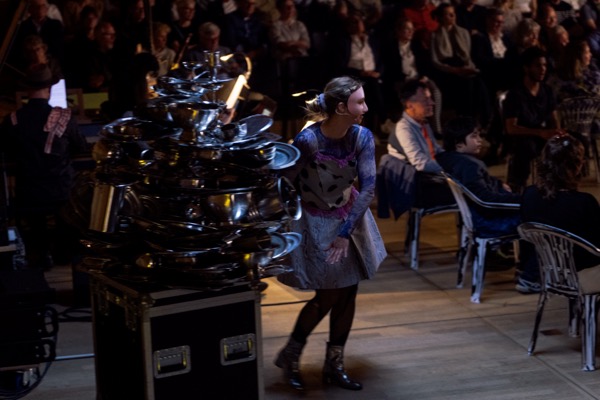
The play’s structure was undeniably thin in terms of plot. Even if you tried hard to follow the dialogue, you could only roughly identify the different roles: the perfectionist chef, the self-doubting critic, the depressed performance artist, and the Opera diva, who seemed lost in her own world. There was no real story progression; instead, these characters functioned more as symbolic figures circling an empty center. The physical stage remained remarkably sparse; although the set design featured an installation-like heap of pots and pans, the table at the center of the stage stayed completely bare throughout the night. The grand spectacle of a “buffet” was never materialised, leaving the audience to fill in the opulence with their own imagination.
However, the sensory impact was incredibly direct. It started with actors crawling on the dining table and groaning questions, before the theme shifted toward “excessive intake.” The actor playing the Chef showed off impressive vocal skills, chanting trivial recipes in French at a frantic speed, pushing the feeling of food as a mere “object” to the limit. Here, language was just another surplus product to be consumed.
The Frenzied Resonance of Baroque and Techno
B’Rock Orchestra in A Last Supper © Daniel Dittus
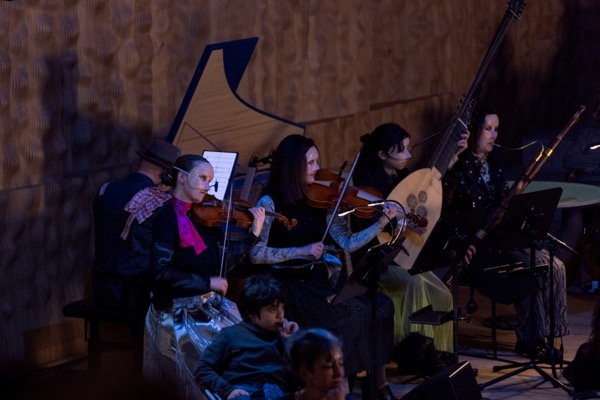
The musicians of the B’Rock Orchestra also wore masks; they stayed largely in sync with the actors’ expressions and movements. Their ability to handle such different styles was amazing. Baroque music naturally is their speciality, but here it had an added sharpness never heard before. The dance pieces by Lully were played with a piercing tension, and the choreography had a rough, rustic feel—like an ancient sacrificial ritual.
B’Rock Orchestra in A Last Supper © Daniel Dittus
The climax came near the end with a long section of electronic music. This was perhaps the most rebellious moment for an early music group. Equipped with individual amplifiers, the historical instruments of the orchestra were transformed, their delicate textures rubbing violently against modern electronic pulses in that small space. Under the high-frequency beat of the techno, the actors shook and vibrated with the same intensity. They constantly shifted their positions, moving through the hall to encircle the audience, effectively trapping us within a sonic and physical ring. This direct sensory pull pushed all the talk of sociology and philosophy aside, driving the atmosphere to a peak of absolute madness and leaving nothing but a deafening sense of “being there.”
The Finale: Emotional Intensity in a Gaze
B’Rock Orchestra in A Last Supper © Daniel Dittus
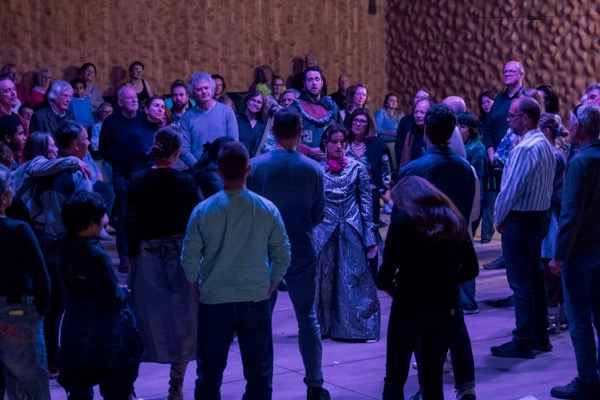
After the chaos of the electronic music, however, the show ended in an extremely serene way. The finale was Monteverdi‘s Lamento della ninfa. In that moment, because the audience and actors were literally mixed on the stage, the distance between us vanished. The stage featured only a lute accompaniment and a few voices taking turns.
Standing face-to-face with the singers at a very close distance, the audience stared at them, and the performers stared back. In that moment, vocal technique ceased to matter; it achieved an emotional intensity rarely encountered in conventional concert settings. The scene recalled the Renaissance period, when people sat together to sing madrigals and the line between performer and listener dissolved. In such moments, music is no longer a product to be bought or consumed; it becomes a shared experience of breathing together.
Conclusion: A Feast Without Set Answers
B’Rock Orchestra in A Last Supper © Daniel Dittus
Looking at the evening as a whole, A Last Supper avoided the trap of acting like an intellectual authority, providing easy answers about consumerism. While the plot was undeniably thin and eccentric, the production achieved a gripping artistic adventure through its radical reorganisation of space and its bold clash of styles. It relied heavily on the music’s opulence and the raw energy of the performances to forge an almost tactile emotional connection; however, the detachment between the dramaturgy and the rest of the production remained a glaring inconsistency.
Fri, 8 May 2026 – B’Rock Orchestra: »A Last Supper« – Elbphilharmonie Hamburg – Elbphilharmonie
For more of the best in classical music, sign up for our E-Newsletter