Georges Bizet (1838–1875) never had the success he wanted in his lifetime. He had two hits in the operas Les pêcheurs de perles and La jolie fille de Perth, but both operas came in for criticism. The Pearl Fishers for its uneven and unoriginal music (the composer was only 25) and the second for its improbable plot twists. They were immediately successful with audiences, but the critics made their point, and the works vanished from the stage.
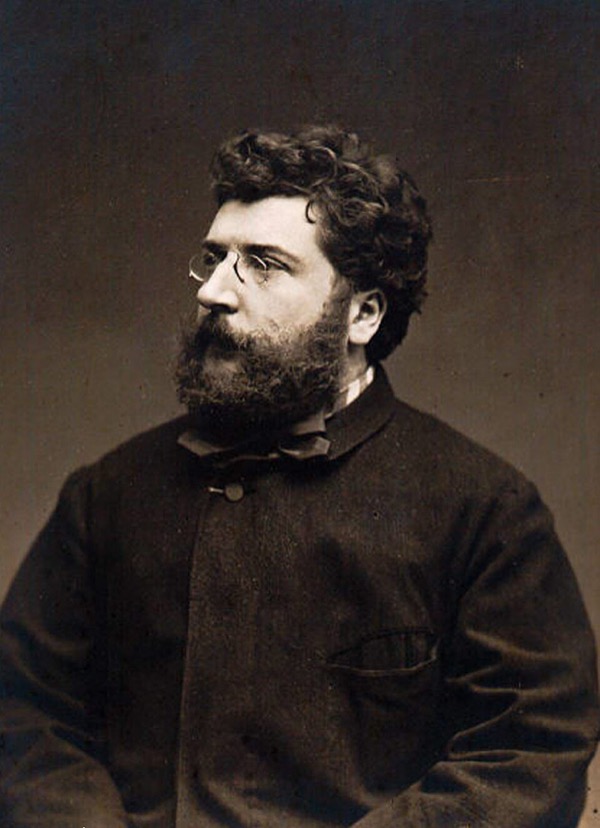
Étienne Carjat: Georges Bizet, 1875
And then there was Carmen. Initially delayed in its premiere because of fears about the themes of betrayal and murder, it was given its premiere on 3 March 1875. Bizet died three months later, at age 36, convinced it, too, had failed. As predicted, audiences were shocked and scandalised, but fascinated. Carmen has continued as a staple on the stage and, more to the point, songs from the opera have escaped into popular culture. Carmen’s Habanera, the Seguidilla from the first act, and the Toreador song in the second act continue to find fans.
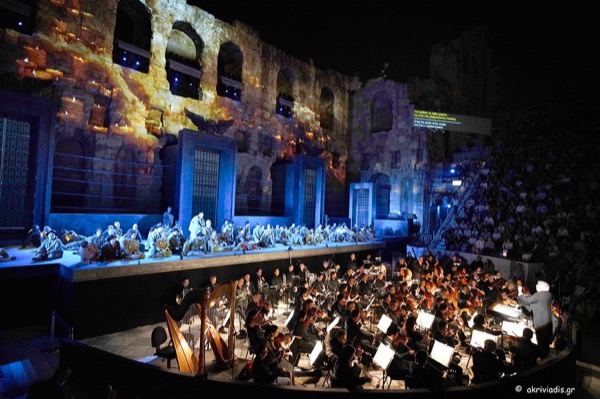
Greek National Opera, in coordination with the Palazzetto Bru Zane, recently staged the Fondation’s 1875 Carmen. This is a historical staging of the opera as presented in 1875. There is ample documentation of the stage scenery, the costumes, and even the ‘staging manuals’ to enable a modern production to move back in time. But, as Alexandre Dratwicki, the Artistic Director of the Palazzetto Bru Zane, says in his notes in the programme book, this is not a slavish reconstruction: there’s no requirement for period instruments in the orchestra, the October 1875 version with recitatives is being used rather than the March 1875 one with spoken dialogue; some of the musical cuts made over time have been retained, etc. The point of this reconstruction is to show that even 150 years later, a modern opera house can use this version. Even if their house orchestra only knows the later versions or the singers only know the standard version, the Bru Zane version has relevance for a modern production.
Georges Bizet: Act I: Prelude (Sadlers’ Wells Orchestra; Colin Davis, cond.)
The key to the reconstruction of the past has been the staging manuals, or livret de mis-en-scène, which were initially designed to capture all the elements for the stage manager: who had entrances stage right or stage left, where the scenery was to be placed, etc. Not only a reminder for the current production, the livret was invaluable for any revivals. The researchers at Bru Zane found out that some of the original 1875 livrets were still being used as late as the 1930s.
Some elements of the opera at the premiere, such as the spoken dialogue, were dropped when the opera was staged later in 1875 outside France. It was feared by the French that foreign language speakers wouldn’t be able to speak the dialogue correctly, and so they were replaced by more standard recitatives (one can, of course, sing French, but speaking it was clearly a different thing entirely!).
The story started with a novella by Prosper Mérimée, Carmen, first published in the Revue des deux mondes in October 1845; parts 1-3 appeared in the magazine, a final part of scholarly remarks on the gypsies only appeared in the book version in 1846. The opera comes entirely from part III of the original story. This tale of the liar and thief, who was Carmen, was cleaned up to be the story of a free-spirited character who declares more than once in the opera that she never lies. Don José, in Mérimée’s story, is no good boy from the village either. He joined the Seville dragoons when he fled Navarre after having killed a man in a fight. Other murders he commits, such as of his lieutenant and later of her husband, are removed from the opera storyline. After he kills her husband, Carmen marries Don José – again, not in the opera. In the original story, the matador Escamillo is only the picador Lucas, much lower in the bullfighter ranks.
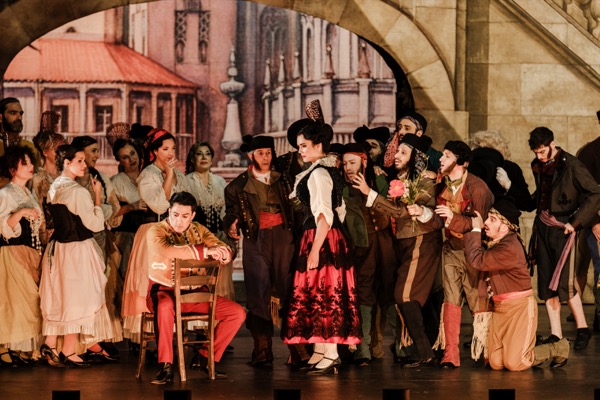
Carmen (Gaëlle Arquez) attracted by the uncaring José (Charles Castronovo) who is thinking of Michaëla, 2026 (Greek National Opera)
(Photo by Giannis Antonoglou)
No matter what was removed from the original story, the libretto created by Ludovic Halévy and Henri Meilhac was still going to be a difficult sell to the Opéra-Comique. Their chorus was used to standing still and singing, filling in the background. This opera required that they enter…gasp…smoking….and joking with the men in the square, and fight. They have to get physical with the dragoons in the square. And Carmen, who gets killed at the end, would be the first heroine to die on the Opéra-Comique stage. If you want to compare the two heroines, the Opéra-Comique would be Michaëla: innocent, chaste, and ignorant of the rougher ways of the world. Carmen, as a character, was the shocker. She changed lovers at will and was faithful only to herself.
One of the nice discoveries was the source of Bizet’s Habanera. The source was already known – the song El arreglito (The Little Arrangement) by Sebastián de Iradier – and Bizet thought it was a folksong, so he used it as the basis for his heroine’s song.
This song is a dialogue between Pepito and his girlfriend. She says she doesn’t trust him. He says, ‘If you want me, softly say it, and in a little while, I will be your little arrangement’. She responds that she will adore only him if he’s faithful. Which, of course, he swears to be.
Sebastian de Iradier: El arreglito (The Little Arrangement) (Shudong Braamse, soprano; Robert Phillips, guitar; Teresa Ancaya, piano)
Once you hear where he started, it gives a new appreciation for what Bizet brought to the opera stage. The addition of the strong habanera rhythm, the change of direction of the song to be more direct, and it’s a statement and a warning from Carmen: L’amour est un oiseau rebelle / Love is a rebellious bird that cannot be tamed. She likes strong, silent men. Next, Love is a gypsy child who can be held to no laws. Her key line comes in here: If I love you, be on your guard!
Georges Bizet: Act I: Habanera: L’amour est un oiseau rebelle (Alexandrina Milcheva, Carmen; Sofia National Opera Chorus; Sofia National Opera Orchestra; Ivan Marinov, cond.)
When Bizet learned that his claimed ‘folksong’ was actually written in 1863 by a composer who had died in 1865, he added a note about its source in the first edition of the vocal score. Although the libretto as a whole is credited to Meilhac and Halévy, the words for this song were written by Bizet.
The production at the Greek National Opera, with such an amazing amount of research and work behind it, was astonishing. In a sense, the audience didn’t quite know what to do with the amazing scenery and how the curtain comes up on a set piece, everyone in place, rather than a gradual buildup of people on stage. Unexpected elements were the use of footlights (lights placed on the front edge of the stage to cast light back), as they would have had in the 19th century. At times, this had the effect of lighting everyone in front from below, so it looked quite like a melodrama at some points.
The role of Carmen on opening night was taken by Gaëlle Arquez (Anita Rachvelishvili and Marina Viotti have it on other nights). Her Carmen wasn’t high-spirited as much as vicious. She seemed to enjoy picking on the men in the first scene too much. This made it difficult to see why Don José was willing to throw over everything for her. She was mean! When the final act arrives, however, the character goes from strength to someone who’s powerless. She awaits her fate, rather than fighting it as she has through the entire opera, and it was a disappointing come-down.
The role of Michaëla was sung by Vassiliki Karayanni as a lovely ingenue (Maria Mitsopoulou sang it later). She was particularly effective in the third act, when she ventures up into the mountains to tell José that his mother was not only mourning his departure from the straight life, but (shades of melodrama again) was dying and wanted to see her boy one last time. Michaëla wears her pretty light coloured best village clothes while surrounded by the rough and ready smugglers, and the contrast between the life José could have had and the one he chose couldn’t be more evident.
Don José always has a hard character to define. He has to be adamant and changeable, desired and reviled, desirous and murderous all over the course of the opera. The role was sung by Charles Castronovo (Andrea Carè later) who put all the inconsistencies of the character to fine show. In the final act, when he decides to demand Carmen return to him, he has to have an uncharacteristic strength we haven’t seen before.
The toreador, Escamillo, played by Dionysios Sourbis on opening night and by Tassos Apostolou and Nikos Kotenidis on other nights, also carried off the role well. On two different occasions, he has to insert himself into the middle of the bad guys to get Carmen’s attention, and both times he is successful. In his final appearance before the bullfight, he’s triumphant. He’s gotten the girl, and his boys will help him get the bull. As played on a different night by one of GNO’s leading stars, the bass Tassos Apostolou, he was even more triumphant. Apostolou stands a good head and shoulders above the rest of the cast and, from that vantage point, carries a greater presence and sense of command.
Georges Bizet: Act II: Toreador Song: Votre toast, je peux vous le rendre (Nicola Ghiuselev, Escamillo; Sofia National Opera Chorus; Sofia National Opera Orchestra; Ivan Marinov, cond.)
The children’s choir had two appearances, in the first and fourth acts, and was just the perfect noisy, imitative, annoying presence.
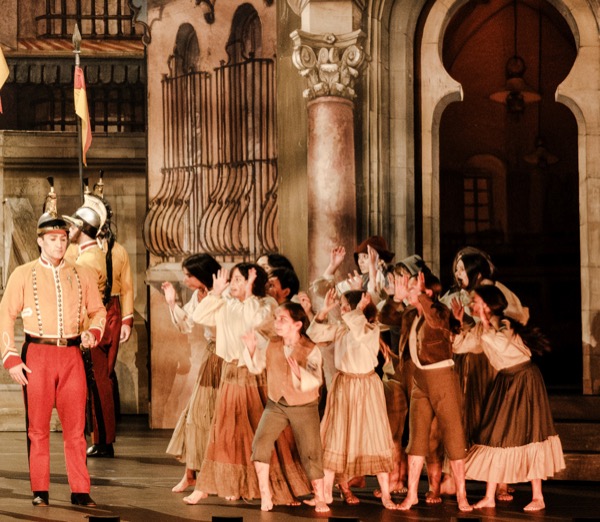
Carmen, Act I: Children’s chorus teasing a dragoon, 2026 (Greek National Opera) (Photo by Giannis Antonoglou)
The pieces you didn’t expect were the funny business that has largely been cut from or downplayed in modern productions. In the first act, the dragoons comment on the problems of an old man with a young wife, and we watch the notes her young lover passes to her, and it’s like a whole commentary on love going on through the whole act.
In the second act, there’s a scene with Carmen and her two girls, Frasquita and Mercedes, with Le Remendado and Le Dancaïre of the smugglers about the indispensability of women when planning deceitful acts. This comes back again in the third act in the smuggler’s hideout when some sentries need to be seduced away from their posts, and the women smugglers say, in essence, ‘leave them to us’.
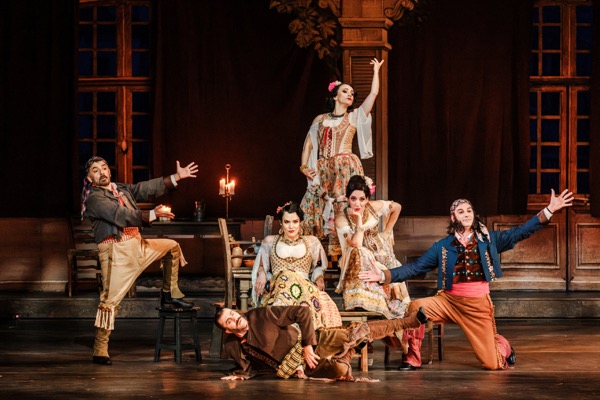
Carmen, Act I:’Women are indispensable’ with Le Remendado and Le Dancaïre and the innkeeper, and Carmen (centre front) with Frasquita and Mercedes, 2026 (Greek National Opera) (Photo by Giannis Antonoglou)
The final scene is, of course, where all the drama, melodrama, and action come together. A point is made in the notes by Étienne Jardin (Director of Research and Publications, Palazzetto Bru Zane) that the imagery of that last scene was always regarded as important.
Georges Bizet: Act IV: Viva! Viva! La course est belle! (Sofia National Opera Chorus; Alexandrina Milcheva, Carmen; Nikola Nikolov, José; Sofia National Opera Orchestra; Ivan Marinov, cond.)
In the black and white poster created by Prudent-Louis Leray for the premiere, Carmen lies dead in Don José’s arms while Escamillo approaches from the bull ring. The fatal knife lies on the ground.
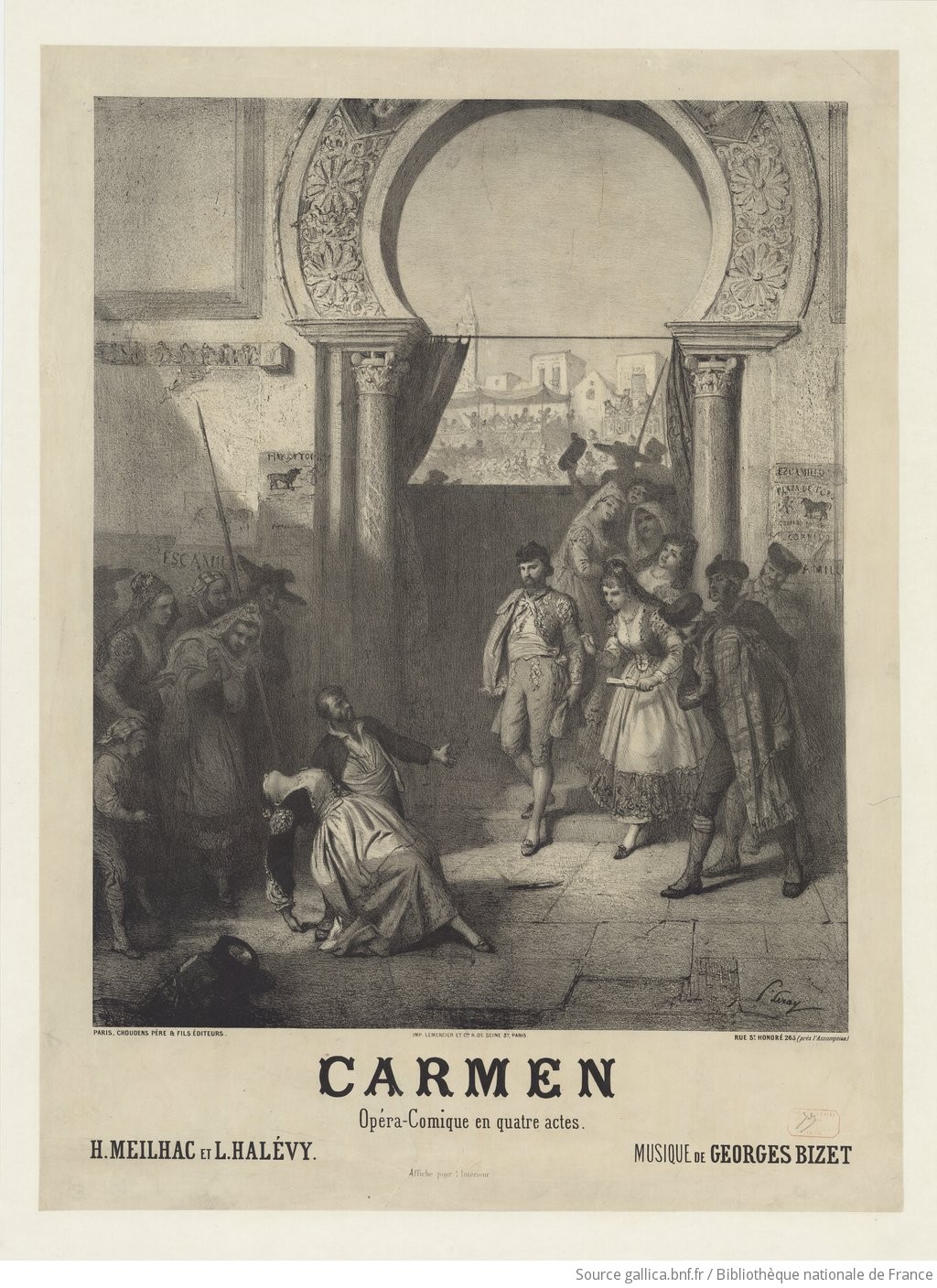
Prudent-Louis Leray: Carmen. Opéra-comique en quatre actes de H. Meilhac et L. Halévy. Musique de Georges Bizet (Gallica: btv1b53187276q)
Matching this image with what happen on stage is interesting.
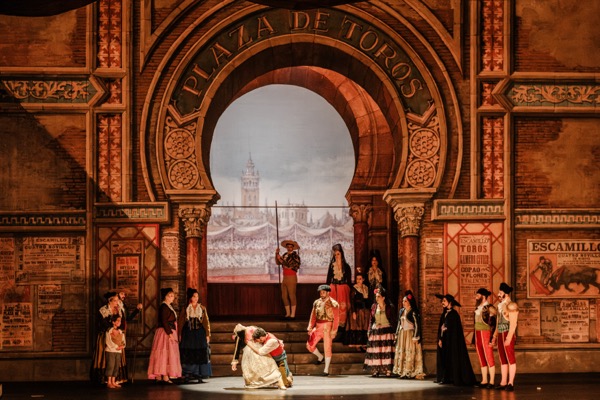
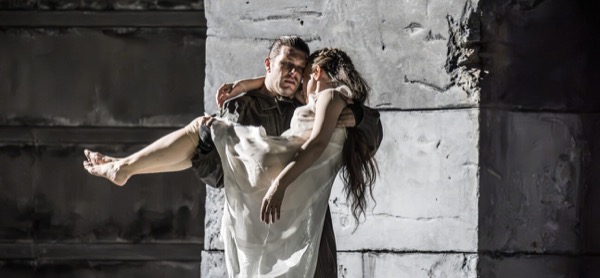
Carmen, Act IV, final scene: Carmen (Gaëlle Arquez) lies dead in the arms of José (Charles Castronovo) while Escamillo (Dionysios Sourbis) approaches, 2026 (Greek National Opera) (Photo by Giannis Antonoglou)
When we return to the concept of the livret, we discover that all of this is choreographed.
Carmen, frightened, takes a few steps backwards and rushes towards the entrance to the bullring. José seizes her on the steps and stabs her, with his back to the audience, and she falls close to the curtain, her head stage right. José kneels beside her.
At the end of the offstage reprise of the chorus, the curtains of the bullring open again, and the crowd rushes onto the stage, mostly going stage right.
Since the chorus is singing at this point, this last entrance is only made by the minor characters and extras.
The dragoons line the back of the stage, and the Alcade and his two alguazils are on the steps.
Escamillo enters last.
And so, the audience of the Opéra-Comique had their nice middle-class ending. The bad girl gets hers in the end, and the man she’s led astray will die for her murder (José’s prison story formed parts I and II of Prosper Mérimée’s original Carmen novella). But yet we know that with the death of Carmen, all life has gone out of the world.
Throughout the whole opera, characters are concerned with Love – do you love me? Do I love you? I don’t love you! Or even, how can you love him when you said you loved me? For everyone, it seems to have a different meaning. Michaëla’s caught by José in a fervent kiss, and then he’s pursuing Carmen. If you fall in love with Carmen, it will be the death of you. José’s last words couldn’t be more ironic: ‘Ah! Carmen! My beloved Carmen!’
GNO Carmen
Co-production: Bru Zane France / Opéra Royal – Château de Versailles Spectacles / Opéra Orchestre Normandie Rouen / Palazzetto Bru Zane – Centre de musique romantique française
Greek National Opera, Stavros Niarchos Hall,
30 Apr 2026
02, 03, 05, 07, 14, 17, 20, 24, 26, 28, 31 May 2026
04 Jun 2026
For more of the best in classical music, sign up for our E-Newsletter