In our last episode on forgotten Romantic piano concertos, we discovered unexpected and wonderful music by Balakirev, Rubinstein, Arensky, Glazunov, and Medtner.
These much-neglected nineteenth- and early twentieth-century piano concertos and concertante works have been brought to light in 87 volumes of recordings by the Hyperion label, released between 1991 and 2023.
This musical treasure trove holds plenty of musical riches, and it’s time to continue our exploration with the Austrian Thalberg.
Sigismond Thalberg: Piano Concerto in F Minor, Op. 5 (Howard Shelley, piano; Tasmanian Symphony Orchestra; Howard Shelley, cond.)
Sigismond Thalberg
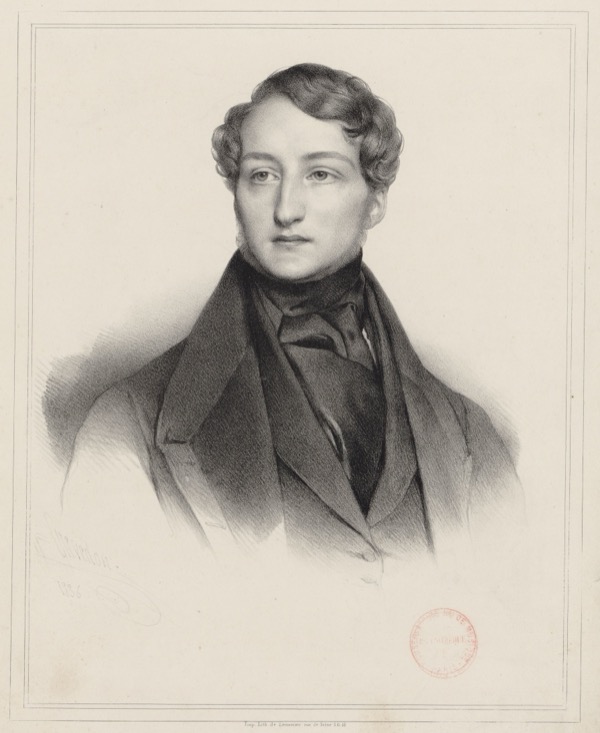
Sigismond Thalberg (by Grevedon)
Sigismond Thalberg (1812-1871) claimed to be from a family of Hungarian lower nobility. While his claim is not verifiable, he did become one of the most distinguished virtuoso pianists of the 19th century. In fact, in his day he was just as famous as Chopin and Liszt, both in concert fame and publishing success.
After a concert in Leipzig, Clara Schumann wrote, “On Monday, Thalberg visited us and played beautifully on my piano. An even more accomplished mechanism than his does not exist, and many of his piano effects must ravish the connoisseurs. He does not fail a single note; his passages can be compared to rows of pearls, and his octaves are the most beautiful ones I ever heard.”
Even Chopin admitted that Thalberg played excellently, and Mendelssohn followed suit. And Hector Berlioz conceded that Thalberg was the creator of a new art, “which I do not know how to compare to anything that existed before.” In turn, Thalberg admitted upon hearing a performance by Liszt that he “was stupefied; I have never heard anything like this before.”
His contemporaries greatly respected Thalberg, yet music history has not been kind to him. Maybe it objected to Thalberg getting extremely rich by playing concerts as far as North Africa and South America.
Thalberg wrote his Piano Concerto around 1830 for use in his first major concerto tour through Germany. Because Thalberg studied with Nepomuk Hummel in Vienna, his concerto continues the Viennese style. It highlights the pianist, but for a teenage composer, it offers wonderful craftsmanship.
Frédéric Kalkbrenner: Piano Concerto No. 3 in A Minor, Op. 107 (Howard Shelley, piano; Tasmanian Symphony Orchestra)
Frédéric Kalkbrenner
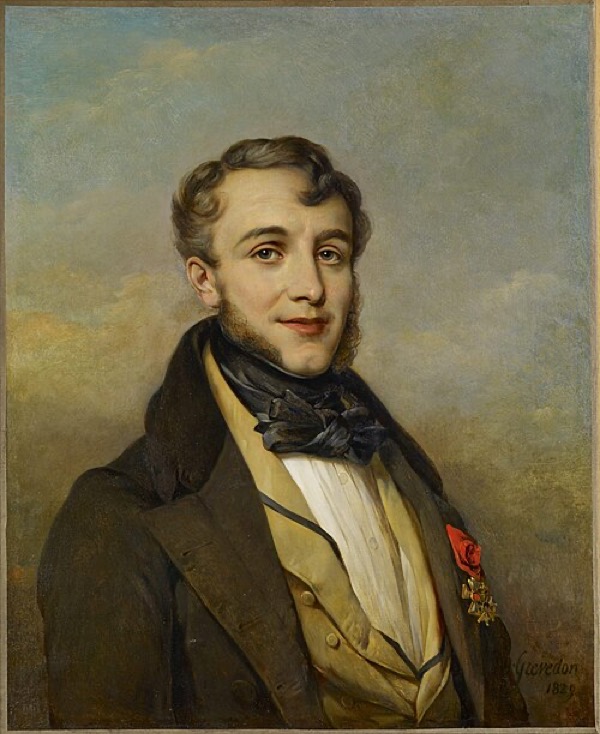
Friedrich Kalkbrenner, 1829
Friedrich Wilhelm Michael Kalkbrenner (1785-1849) was born somewhere between Kassel and Berlin, but he would make his permanent home in Paris. A child prodigy who studied at the Paris Conservatoire and in Vienna, he befriended Hummel and spent time in the company of Beethoven and Clementi.
If music history was unkind to Thalberg, it was downright vicious when it came to Kalkbrenner. A 1886 Dictionary of Musicians writes, “This pianist brought the mechanical part of his art to a perfection never previously known in his period.”
A different entry in 1899 states, “Externally a fine gentleman and artistic man of the world, he is inwardly hollow and vapid. It is hard even to give an idea of his extreme emptiness.” Yet in his day, he was hailed as the pre-eminent pianist. Famously, when Chopin arrived in Paris, he sought out Kalkbrenner for piano lessons, but Kalkbrenner’s offer of a three-year study programme was turned down.
However, Kalkbrenner introduced Chopin to Paris, and since he was a partner in the Pleyel piano firm, he sponsored the famous concert at the Salle Pleyel on 26 February 1832. Chopin played his F-minor Concerto and the “La ci darem” Variations.
As a composer, Kalkbrenner wrote four piano concertos, and his piano writing “made distinct advances in details of piano technique such as the equality and responsiveness of the finger, octave playing and use of the pedals.” His playing was described as having “a special kind of sensuously charming touch.” His Piano Concerto No. 3 in A minor dates from 1829 and features constantly varying etude-like passages derived from opening motifs.
Johann Peter Pixis: Piano Concerto in C Major, Op. 100 (Howard Shelley, piano; Tasmanian Symphony Orchestra)
Johann Peter Pixis
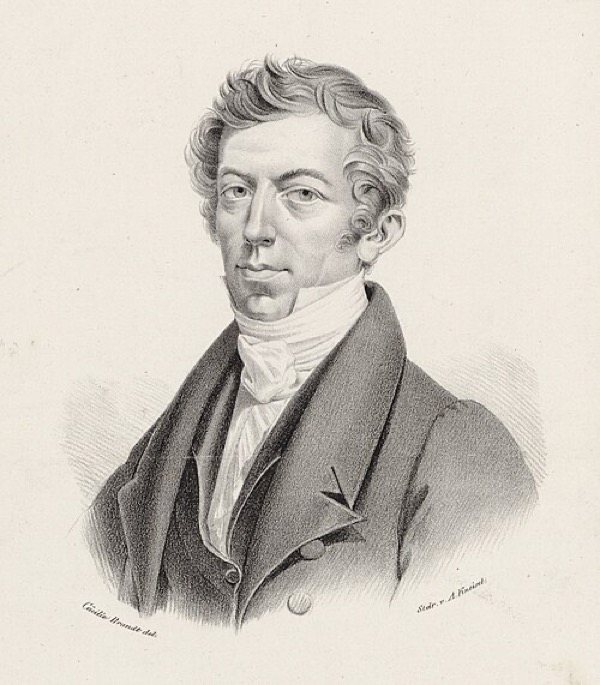
Johann Peter Pixis, lithograph by August Kneisel after Cäcilie Brand
The city of Paris also attracted Johann Peter Pixis (1788-1874), a German pianist and composer born in Mannheim. He came from a family of musicians, and once he established himself in Paris in 1825, he became a much-respected pianist and teacher.
Sigismond Thalberg took a couple of piano lessons from Pixis, but the young Franz Liszt was turned down. A decade or so later, however, Liszt and Pixis enjoyed a friendly relationship, and Pixis was invited to contribute to Liszt’s Hexaméron.
Commissioned by the Princess Belgiojoso, Liszt was in charge of assembling a set of variations on a march theme from Bellini‘s opera I puritani. Thalberg, Czerny, Liszt, Chopin, and Pixis contributed to the project.
At the height of his career, probably around 1830, Pixis was regarded as one of the best and most influential pianists of his time. According to Chopin, it was Pixis who introduced him to the publisher Schlesinger, whose request for a composition on Meyerbeer‘s “Robert” resulted in the Grand duo concertant sur des thèmes de Robert le diable, published in 1832.
Pixis wrote two unsuccessful operas for Wilhelmine Schröder-Devrient, and he composed his Piano Concerto in C Major, Op. 100 in 1829. Dedicated to “His Imperial Majesty of Austria,” the work follows a conventional form and features lovely nocturne-like themes and a brief “Adagio” in the unusual time signature of 12/8.
Henri Herz: Piano Concerto No. 1 in A Major, Op. 34 (Howard Shelley, piano; Tasmanian Symphony Orchestra)
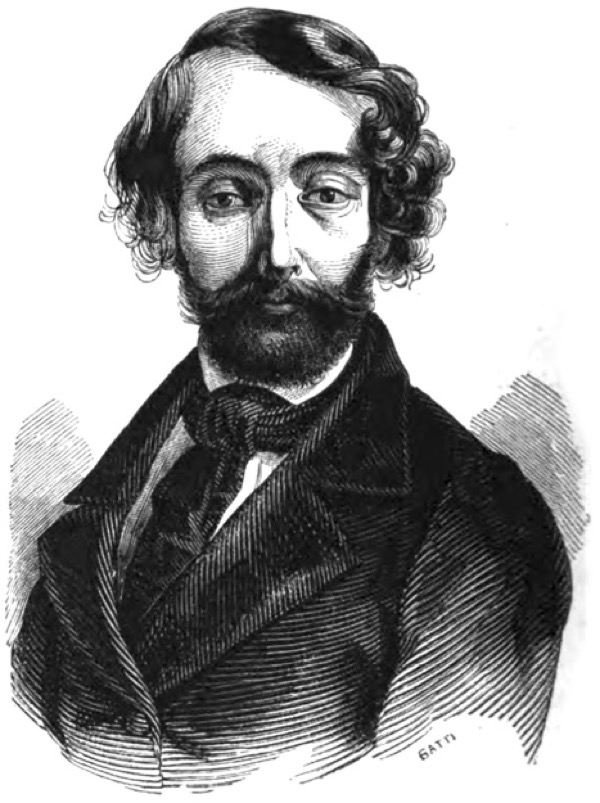
Henri Herz
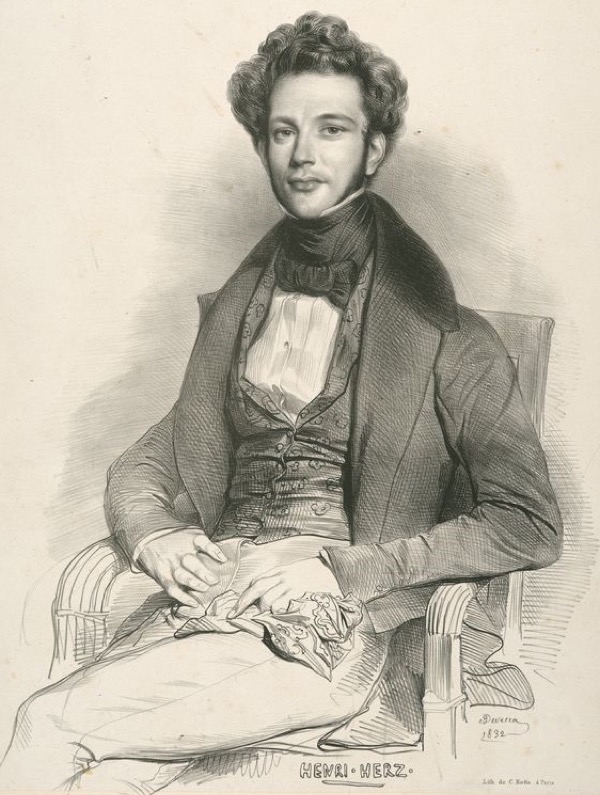
Henri Herz by Achille Devéria, 1832
Henri Herz (1803-1888) was born in Vienna and entered the Paris Conservatoire in 1816. His playing style was strongly influenced by Ignaz Moscheles, and he won first prize in piano in 1818. After extended concert tours taking him as far as Mexico and South America, Herz became a professor at the Paris Conservatoire for more than thirty years.
For about ten years, Herz enjoyed an immense reputation in Paris beyond anything that Liszt, Chopin or Thalberg had achieved. In fact, he was vying with Kalkbrenner for the title of most fashionable and sensational pianist of the age.
What is more, Herz founded his own piano factory in 1839, and alongside Erard and Pleyel, it became one of the three most important factories in France. Among the important developments as a piano maker was the change from a single-layer hammer to one that was multi-layered. Chopin owned several Herz pianos, and the special hammers made a distinctive contribution.
Herz also composed prodigiously, writing eight piano concertos, sonatas, rondos, nocturnes, paraphrases, and fantasias. He published more than two hundred works over the years, and a set of variations commanded up to four times the price of his contemporaries. Until the late 1830s, no other composer could outsell him.
Herz died in 1888, and his music, as one writer suggested, “predeceased him by several decades.” Yet, audiences greatly enjoyed his playing as much as his compositions. There is no pretence of depth or intensity in his concertos, but there are many graceful arpeggios, titillating repeated notes, and provocative octave leaps.
Ferdinand Hiller
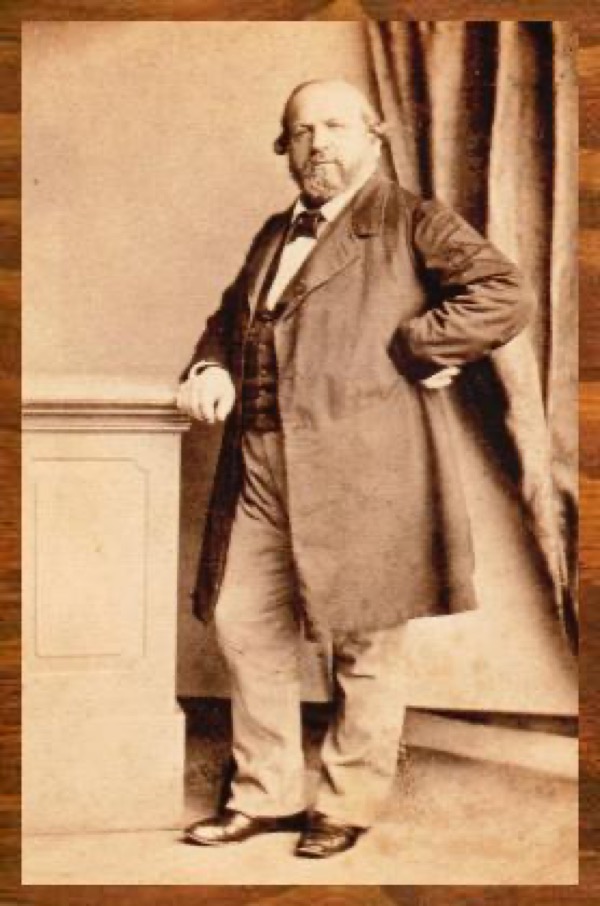
Ferdinand Hiller
Ferdinand Hiller (1811-1885) was born in Frankfurt am Main and quickly identified as a musical prodigy. Over time, he became a celebrated piano virtuoso, successful composer, conductor, music writer, and impresario. He studied with Johann Nepomuk Hummel, and between 1828 and 1835 he based himself in Paris.
Glowing letters of recommendation gained him entry into the great salons, where he quickly met musicians and writers. He struck up close relationships with Chopin and Liszt, and his friendship with Berlioz was particularly close and lifelong.
Financially independent, Hiller devoted himself exclusively to composing, teaching, and giving concerts. His artistic legacy is extensive, as he left behind countless writings and more than two hundred works. He was praised as a promising composer, but for one reason or another, he struggled to make his mark.
One thing is certain: he was praised as a pianist of perfect technique, and he composed his Piano Concerto No. 1 during his time in Paris. Dedicated to Ignaz Moscheles, the work features an exceptionally brilliant solo part, yet he also took great care to make it highly musical.
Hiller’s vast musical output is now largely forgotten. It contained works in virtually every genre. Musically, he is perhaps best remembered as the dedicatee of Schumann‘s Piano Concerto, and he is also the dedicatee of the three Nocturnes, Op. 15, by Chopin. I hope you enjoyed our musical excursion to Paris; next time, we will look at some forgotten piano concertos connected with London.
For more of the best in classical music, sign up for our E-Newsletter
Ferdinand Hiller: Piano Concerto No. 1 in F Minor, Op. 5 (Howard Shelley, piano; Tasmanian Symphony Orchestra)