
In the early nineteenth century, many girls and women were discouraged from playing the violin.
A few talented female violinists attempted to shatter that glass ceiling, and many put cracks in it.
But it took a Czech violin prodigy named Wilma Norman to become the first woman violinist who was widely believed to be the equal of her male contemporaries.
Today we’re looking at her extraordinary biography and career, and how she changed violin playing forever.
Wilma Neruda’s Family
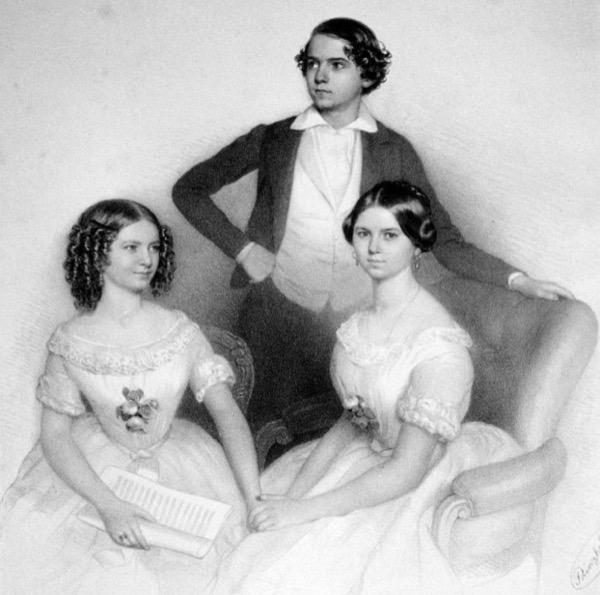
Wilhelmina Norman-Neruda and siblings
Wilhelmina (known as Wilma) Neruda was born on 29 March 1838 in Brno, now in the Czech Republic but at the time a part of the Austrian Empire.
Her father was the organist at the Brno Cathedral, and her great-great-grandfather was Konzertmeister of the Dresden court orchestra in the eighteenth century.
She was one of six prodigiously talented children, all of whom became professional musicians.
Starting to Play the Violin
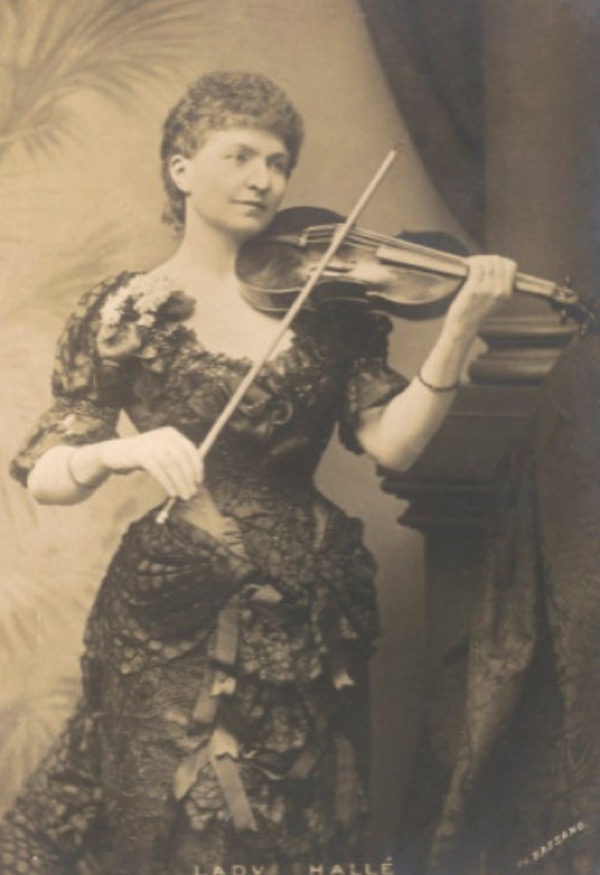
Wilhelmina Norman-Neruda
Wilma began her musical studies on the piano just before her fourth birthday.
However, what she really wanted to do was play the violin.
She told an interviewer in 1894:
In those days there was rather a strong prejudice against violin-playing among our sex; it was not considered a graceful accomplishment nor a womanly one, but I found it impossible to crush the desire within me to draw the bow across the strings of my brother’s violin; so I lay in watch for the moment when he would go out, and then stole to his room to shut myself up and indulge in the sweet notes of the instrument.
Contemporary critics were deeply leery of women playing the violin in public.
For one, the instrument had a devilish reputation, rooted in its history as a portable dance instrument and the fact that virtuoso Niccolò Paganini was such a macabre figure.
For another, many people felt that the physicality required of violinists while bowing was unsightly. Pianos and harps required more demure movements, focusing on finger movement rather than arm movement.
Of course, a three-year-old didn’t care about any of that. One day, her father passed a closed door and was delighted to hear the progress that his son Viktor was making on the violin. He opened the door and, shocked, discovered that Wilma had been the one playing.
To her father’s credit, he allowed her to keep playing. Viktor took up cello instead.
Wilma’s Early Violin Studies
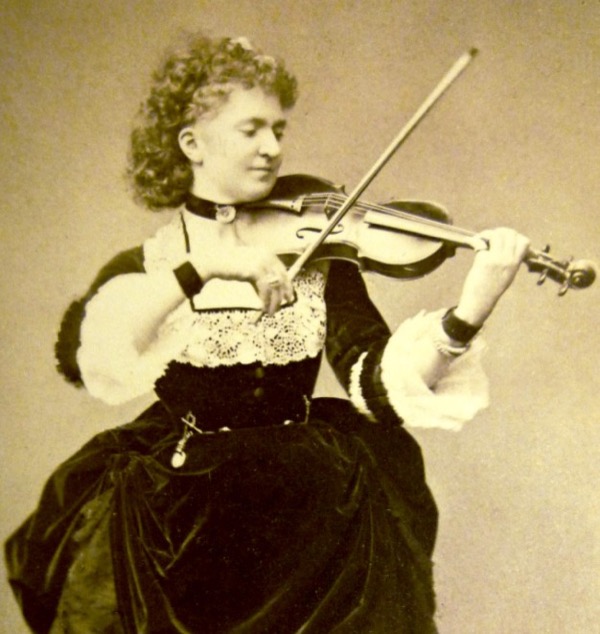
Wilhelmina Norman-Neruda
When Wilma was six, Leopold Jansa, one of Vienna’s most respected violin pedagogues, came to visit her father.
Jansa overheard her playing and was so impressed that he asked to teach her in Vienna, under the condition that he be her only teacher. Her father agreed.
When she was seven, she made her debut in Vienna, playing a Bach sonata.
One critic wrote:
The voice of the critics has decidedly spoken out against the breeding of the Wunderkinder for artistic and moral reasons…[but] the small 7-year-old Wilhelmina appears to us to be a talent that develops without tyrannical dressage… The girl surprised me and the whole audience, delighted; why shouldn’t I confess it, even moved.
The Neruda Family Tours to Britain
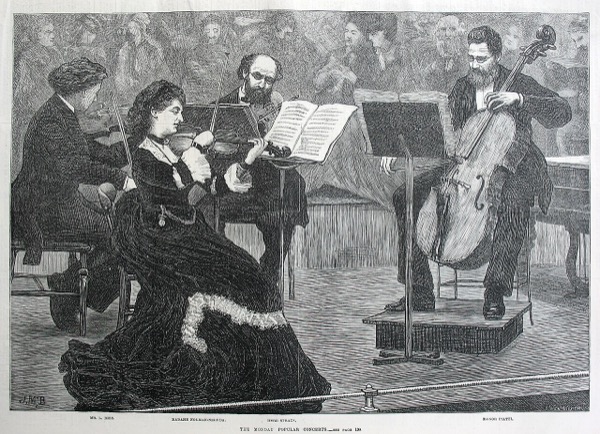
Wilhelmina Norman-Neruda and the Joachim Quartet
The family began touring as a chamber music ensemble, a bit like a nineteenth-century Bohemian von Trapp family. At these concerts, Wilhelmina was often singled out and praised for her playing.
They travelled through Germany, Belgium, and France on their way to England.
Wilma made an unexpected orchestral debut with the London Philharmonic Orchestra, after Joseph Joachim was forced to cancel a concert appearance. She was eleven and a sensation.
Joachim wrote to his friend, conductor and pianist Charles Hallé: “I recommend to your attention this young lady. Mark my word, when people have heard her, they will not think so much of me.”
Years later, Hallé would reappear in Neruda’s life.
Getting Into a Scuffle With Wieniawski
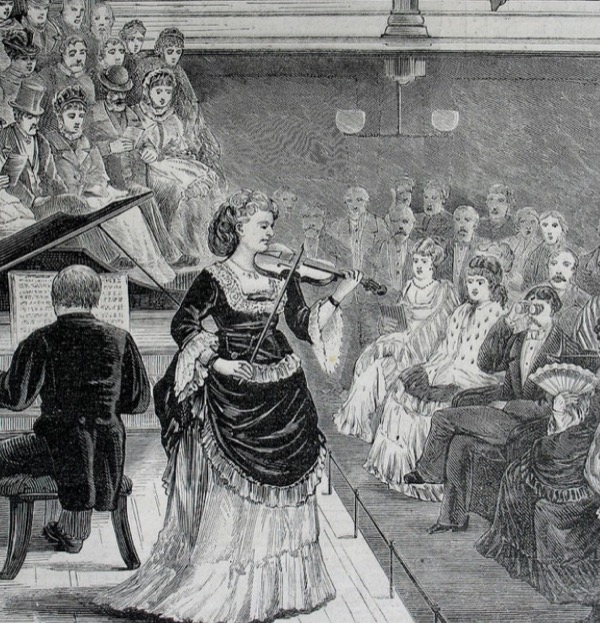
Wilhelmina Norman-Neruda
In 1852, at the age of 14, she played on the same program in Moscow as 17-year-old prodigy Henryk Wieniawski. Violinist Henri Vieuxtemps came onstage to present her with a bouquet after she earned a standing ovation.
Unable to handle the idea of Wilhelmina enjoying such a major triumph, Wieniawski made a scene, elbowing his way forward and loudly declaring that he was the better violinist and that he would prove it.
He stuck his bow in the chest of a Russian general who came to reason with him and was ordered to leave Moscow within twenty-four hours.
Despite the disrespect, Wilhelmina continued programming his music throughout her career.
The Death of Viktor
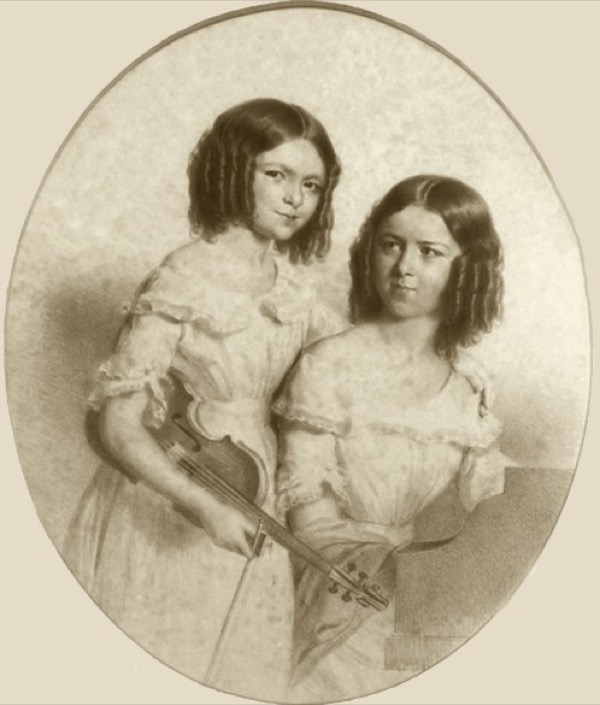
Wilhelmina Norman-Neruda and her sister Amalie
Tragedy struck later that year when her cellist brother Viktor became ill. The family returned to Brno, but Viktor died. He was just fifteen.
Another sibling, Franz, also a cellist, joined the family ensemble when the Nerudas went back on the road.
Their hard work was starting to pay off financially. Around this time, the children were able to buy a home for their parents in Brno.
One of their tours brought them to Stockholm, Sweden, where Wilma met composer, conductor, and pianist Ludvig Norman.
Wilma’s Marriage
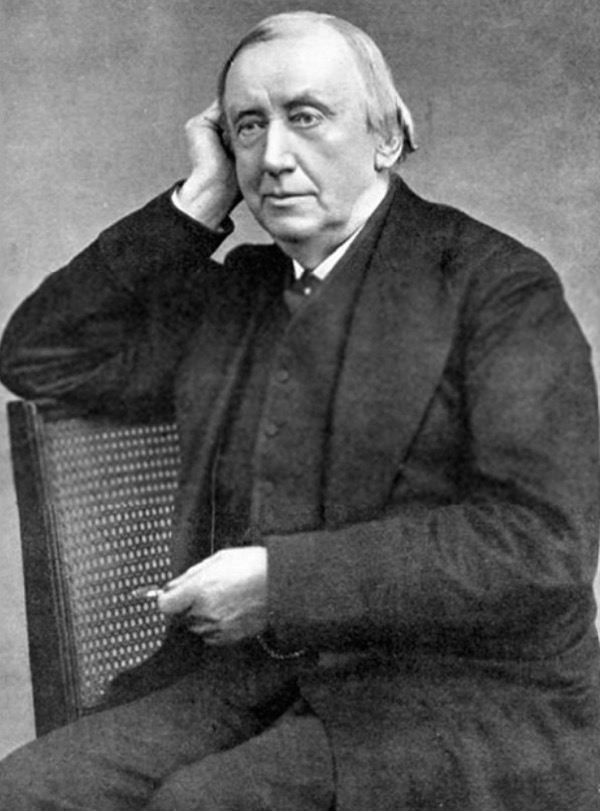
Wilhelmina Norman-Neruda’s husband, Charles Hallé
In January 1864, when she was in her mid-twenties, Wilhelmina married Ludvig Norman, eight years her senior.
Norman had attended the Leipzig Conservatory, befriending Robert Schumann there.
He became a well-known symphonist in Sweden, and by 1864 he had been appointed Kapellmeister at the Royal Swedish Opera.
Ludvig Norman: Symphony No. 3 in D Minor, Op. 58 (Oulu Symphony Orchestra; Johannes Gustavsson, cond.)
Wilhelmina and Ludvig had two sons together: Franz Ludvig in November 1864, and Felix Wilhelm Waldemar in May 1866.
Despite her marriage and the two pregnancies close together, she continued her career.
A few years later, her marriage to Norman failed, and in 1869, she left Stockholm to resume her old lifestyle of touring.
Being a devout Catholic, she never divorced Norman, but the couple also never reconciled.
The press was open about their separation, but it never impeded her popularity.
Settling in London
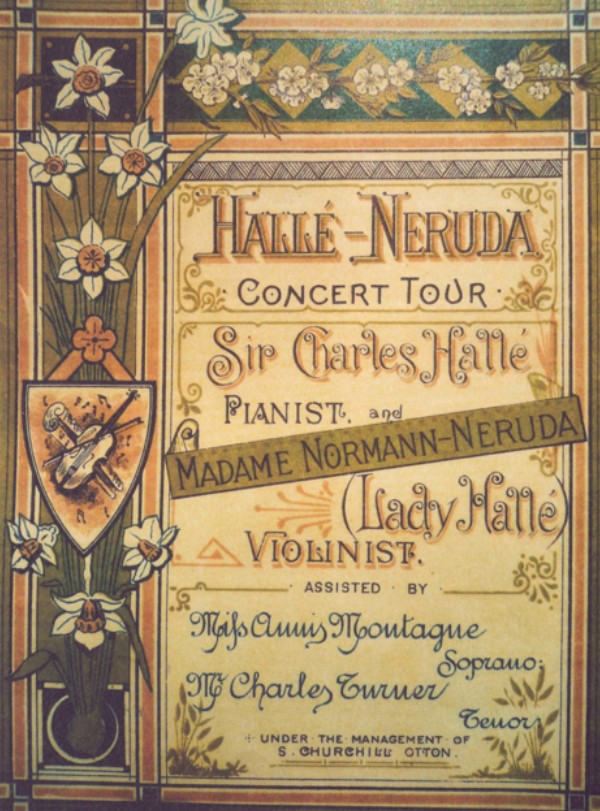
Wilhelmina Norman-Neruda advertisement
In the 1870s, Wilhelmina settled in London and embraced the city as her adopted home. She appeared there regularly as both an orchestral soloist and a chamber musician.
Before her, few women publicly performed chamber music with male musicians. Gender-segregated ensembles were much more common.
But Wilhelmina was determined not to let her gender dictate her chamber music partners. She became the first woman to play professional chamber music with men at the St. James’s Hall.
She also began working with conductor Charles Hallé, twenty years her senior, who had established the renowned Hallé Orchestra in 1857 in Manchester. A deep friendship blossomed between the two.
She became such a vital part of the fabric of British musical life that in the novel A Study in Scarlet, published in 1887 but set a half-decade earlier, author Arthur Conan Doyle had his protagonist, detective Sherlock Holmes, go to one of her concerts and exclaim:
Her attack and her bowing are splendid. What’s that little thing of Chopin’s she plays so magnificently: Tra-la-la-lira-lira-lay.
In the late 1870s, violinist Pablo de Sarasate – who was the subject of a Sherlock Holmes cameo himself – dedicated two of his most popular works, Romanza Andaluza and Jota Navarra, to Wilhelmina.
Augustin Hadelich plays Sarasate’s Romanza Andaluza (2021)
Remarrying and Becoming Lady Hallé
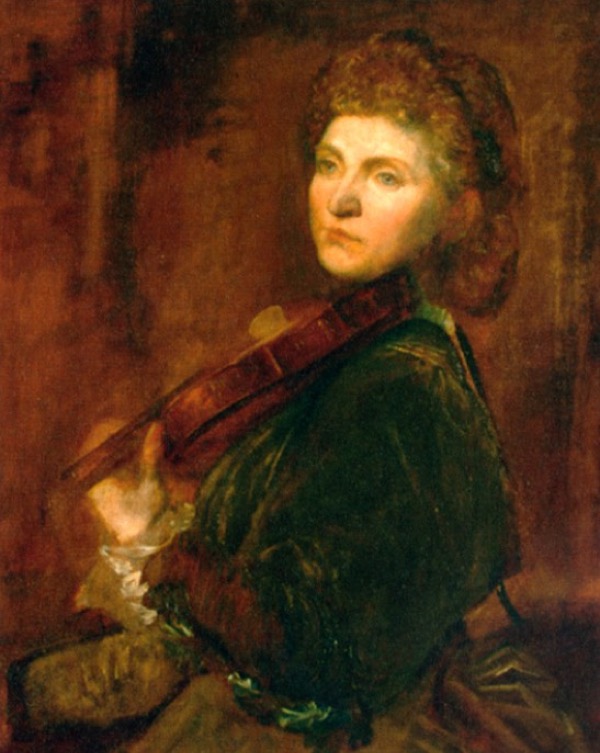
Wilhelmina Norman-Neruda
Ludvig Norman died in the spring of 1885, making Wilhelmina a widow.
In the summer of 1888, she married Charles Hallé, who had just been knighted by Queen Victoria a few weeks before, making her Lady Hallé. The two immediately became a power couple of British classical music.
Touchingly, he wrote about her at this time:
The unbounded admiration which I have felt for so many years for this lady, who is my wife now, made the idea that perhaps some time or other our paths might run in different directions perfectly unbearable to me; all my artistic aspirations have centred so long in her that my life would have been a blank without her.
After their marriage, Wilhelmina and Charles continued their ambitious touring schedule, often collaborating onstage.
They took several extraordinary trips in the 1890s, travelling to both South Africa and Australia.
After they returned to Europe from South Africa, Wilhelmina set off for Denmark. During that trip, Charles died suddenly on 25 October 1895.
A Second Tragedy
In recognition of their contributions to British musical life, the British government granted Wilma a residence in Italy.
She moved there with her eldest son Ludvig, who had become a mountaineer.
In honour of his mother, Ludvig had adopted the name Ludvig Norman-Neruda. He married a woman named May, who gave birth to a daughter in 1893. They named her Wilma after her famous grandmother.
Tragically, Ludvig’s life came to a violent end in 1898, when he was just 34, in a mountaineering accident.
Her Late Career
Ludvig had been Wilma’s favourite child, and the combined losses of her husband and son hit her hard.
Despite her grief, she undertook an extensive American tour in 1899, appearing in all black to mourn her son and husband.
After this tour, she announced her retirement from performance. She moved to Berlin and focused on teaching.
Although she made intermittent public appearances over the following years, her extraordinary performing career had drawn to a close.
Wilma died of pneumonia in Berlin in 1911. She was seventy-three years old.
Wilma’s Death and Legacy
Wilhelmina’s international triumphs were a major reason why so many women began to take up the violin in the 1880s and 1890s. It is fair to say that without her, the next generation of violinists would have looked very different.
In 1890 she told the British magazine Woman’s World:
Whenever in society I hear a young lady tuning a violin I think of…the reproachful curiosity with which the people at first regarded my playing.
Today that reproachful curiosity is nowhere to be seen – a change Wilhelmina helped bring about.
For more of the best in classical music, sign up for our E-Newsletter





Marvelous biographical sketch. Out of obscure annals, delightful discovery.