There were a few years left of Ravel’s most productive compositional spurt before the havoc of the First World War – let’s see what he made of them…
Maurice Ravel: Daphnis et Chloé – Part III: Lever du jour (Spirito; Lyon National Orchestra; Leonard Slatkin, cond.)
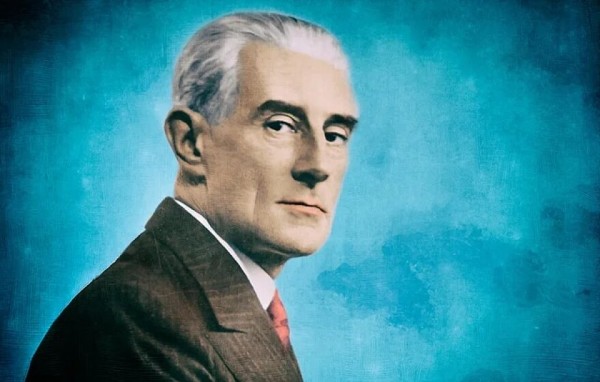
Maurice Ravel
In our last piece on Ravel, we ended our history with L’heure espagnole, poised to move on to Gaspard de la nuit, a piece intended by Ravel to be more difficult than Balakirev’s infamous Islamey. Each movement of the Gaspard set embodies a prose poem from Aloysius Bertrand’s collection of the same name. The first movement, Ondine, depicts a mischievous water nymph; the second, Le Gibet, a morose desert scene, for the illustration of which Ravel took inspiration from Edgar Allan Poe’s The Raven, with a reiterated B flat as an allegory for the repetitive “Nevermore” (American pianist Charles Rosen calls the resulting effect “Chinese water-torture”). The third movement, Scarbo, depicts a devilish dwarf or gnome. As a whole, the works err on the side of the macabre, the nocturnal, and the tricksy – fittingly, as Bertrand claimed the poems were given to him by the devil himself one night. In what might have been a touching full-circle moment, it was Ricardo Viñes, who had introduced the poems to Ravel, who gave the premiere of Gaspard de la nuit. Unfortunately, his refusal to adhere to Ravel’s exacting tempo and phrasing specifications permanently altered the friendship between the two men, and Ravel henceforth began to favour Marguerite Long as interpreter of his piano works.
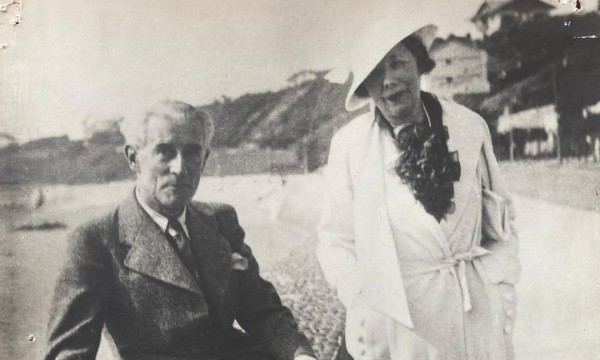
Marguerite Long with Maurice Ravel
At the same time as penning this work of fearsome pianistic virtuosity, Ravel was also writing Ma mère l’Oye (meaning “mother goose”) for piano four hands, a work evoking the magic of childhood and intended for children – and therefore far less technically demanding than Gaspard. The premiere of this playful work was given at the newly formed Société musicale indépendante (SMI), created by the pupils of Gabriel Fauré as a direct response to the institutionally entrenched, traditionally minded Société Nationale, which Ravel biographer Burnett James describes as a “stronghold for [Vincent] d’Indy and the Schola Cantorum.”
Maurice Ravel: Ma mère l’oye Suite (Mother Goose Suite) (version for piano 4 hands) (Martin David Jones, piano; Clara Park, piano)
In these final peaceful years before the war, Ravel enjoyed a performance tour to London and a pleasant stay with former student Ralph Vaughan Williams and his wife, experiencing the “taste and charm and magnificence of London,” as he wrote in a letter to the latter. Ravel also composed a few other small works, some from earlier sketches, including the Menuet sur le nom d’Haydn, Tripatos for voice and piano, and a Chanson écossaise.
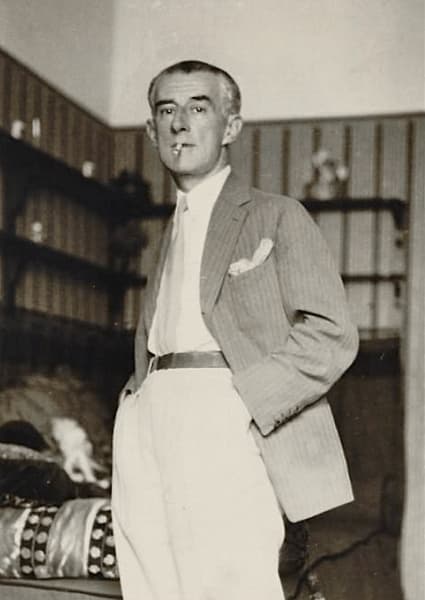
Maurice Ravel
His relationship with London and Scotland only deepened, and he embarked on another concert tour in those countries in 1911. Building on his work with Gaspard and Ma mère l’Oye, Ravel wrote the seven-part Valses nobles et sentimentales for piano, a work whose title references Schubert, but in musical terms is centred on concision of form and Ravel’s “nouvelles harmonies” rather than Schubertian reference. Written in a simpler style closer to Ma mère l’Oye than Gaspard, moments of concentrated virtuosity were still to be found in Valses. In a surprising turn, the work was premiered anonymously at the SMI as part of an attempt to defy expectation. When the guests were asked to attribute the work to a composer by ballot, only a minority put Ravel’s name forward.
Maurice Ravel: Valses nobles et sentimentales (version for solo piano) (Abbey Simon, piano)
In the meantime, Ravel had also been slowly and surely working on the music for Daphnis et Chloé, a custom commission by Diaghilev’s Ballet Russes in the wake of their successful Parisian debut with Mussorgsky’s Boris Godunov. The story of Daphnis and Chloe was originally a Greek pastoral narrative from the 4th or 5th century AD, but was later recapitulated and adapted to cultural mores in various retellings in the 16th and 17th centuries. Ravel had no designs for faithful historical authenticity, and wrote that he wished to create “the Greece of my dreams, which is very similar to that imagined and painted by the French artists at the end of the eighteenth century.” Ravel’s score was hailed by Stravinsky as “one of the most beautiful products of all French music,” but the road to the ballet’s realisation was not simple. Diaghilev preferred a more archaic, authenticity-focused vision of Greece than Ravel did, which he insisted be represented in the décor; the music’s rhythmic complexity confused the ballet corps, and quarrels abounded at every turn. The ballet would have been cancelled entirely were it not for the advocacy of Jacques Durand. Luckily, the work went ahead. Burnett James calls Daphnis et Chloé “Ravel’s most impressive single achievement… [and his] most opulent and confident orchestral score.”
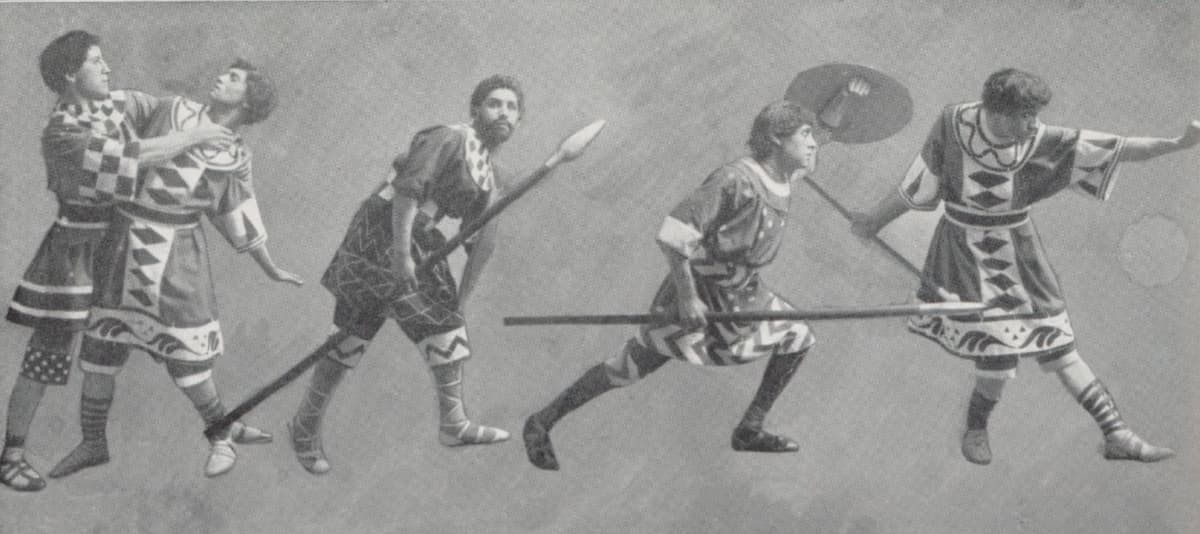
A band of pirates from the Ballets Russes premiere of Ravel’s Daphnis et Chloé, Scene II
The intensity of Ravel’s work on the ballet necessitated a total change, rest, and travel in 1912. By 1913, he was mostly recovered and enjoyed exchanging ideas with Stravinsky during an extended sojourn near Lake Geneva. He eventually returned to Paris, and was present supporting Stravinsky at the uproar and physical riots of the premiere of The Rite of Spring, having been shown an early score by Stravinsky and correctly predicting that it would be a seminal and generation-defining work. Still somewhat exhausted by the intensity of the ballet project, Ravel worked in 1913 and 1914 on smaller-scale creations: a set of songs to poems by Stéphane Mallarmé and piano works À la manière de… Borodine and Chabrier, and the Deux mélodies hébraïques for soprano Avlina-Alvi. He toyed with the idea of a Basque-focused piano concerto, but ultimately decided against it, and took on odd journey work, such as some orchestration of Schumann and Chopin at the request of Nijinsky.
However, the rising tensions of Europe had finally reached an apex from which violence seemed inevitable. In our next instalment, we ask: how did the war years impact Ravel, both as a composer and as a human being?
For more of the best in classical music, sign up for our E-Newsletter