On a seriously rainy and gloomy afternoon in Hong Kong, I decided to finally read a book that’s been on my bucket list for quite a while. It’s a 1997 biography titled The Last Prodigy: A Biography of Erich Wolfgang Korngold, and author Brendan G. Carroll immediately draws us in with a wonderfully detailed account of Erich Korngold’s life.
To tell you the truth, once I started, I couldn’t put the book down. It’s wonderfully written and doesn’t have all that deep-level technical stuff that so many musicology books tend to feature.
Of course, I already knew Korngold from his musical activities in Hollywood, but I had never fully realised just what an astonishing child genius he really was. In fact, he might have been the most phenomenal musical prodigy of all time.
Erich Wolfgang Korngold: Piano Sonata No. 1 in D Minor: I. Allegro non troppo, ma con passione (Geoffrey Tozer, piano)
The Boy Genius Nobody Believed
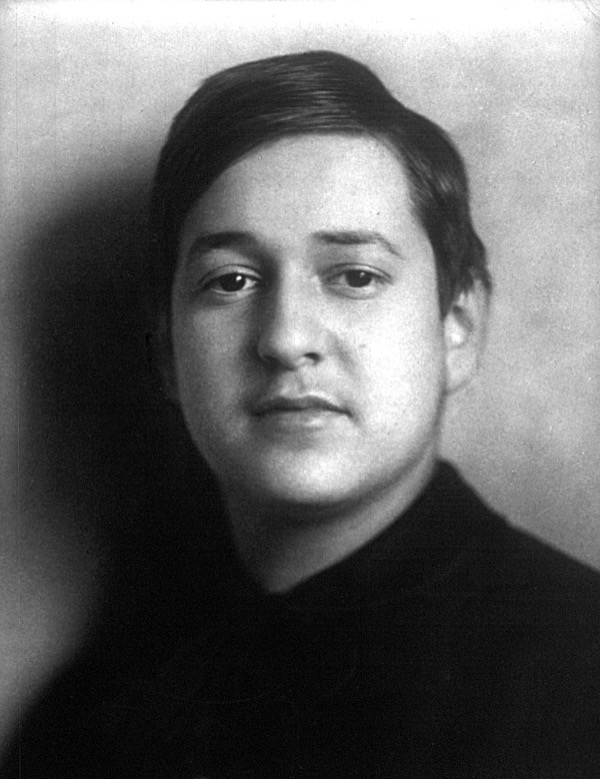
Erich Wolfgang Korngold, 1912
That claim is made rather frequently, but how many musical prodigies composed a ballet for the Vienna Court Opera at the age of 11? Korngold’s authorship was highly suspect in Vienna, as it was claimed that it was impossible for a child of his age to compose such ravishing music.
Carroll writes, “A sceptical populace concluded that this music could not have been written by an eleven-year-old boy”, and suggested it must be by his father, the music critic Julius Korngold. “If I could write such music,” apparently explained Julius Korngold, “I would not be a critic.” (Carroll, The Last Prodigy, 1997)
To celebrate Korngold’s birthday on 29 May 1897, let’s highlight his three piano sonatas. The first was written at age 11, the second a couple of years later, and the third dates from his thirties.
Erich Wolfgang Korngold: Piano Sonata No. 1 in D Minor: II. Scherzo: Schnell (Geoffrey Tozer, piano)
The Earliest Signs of Genius
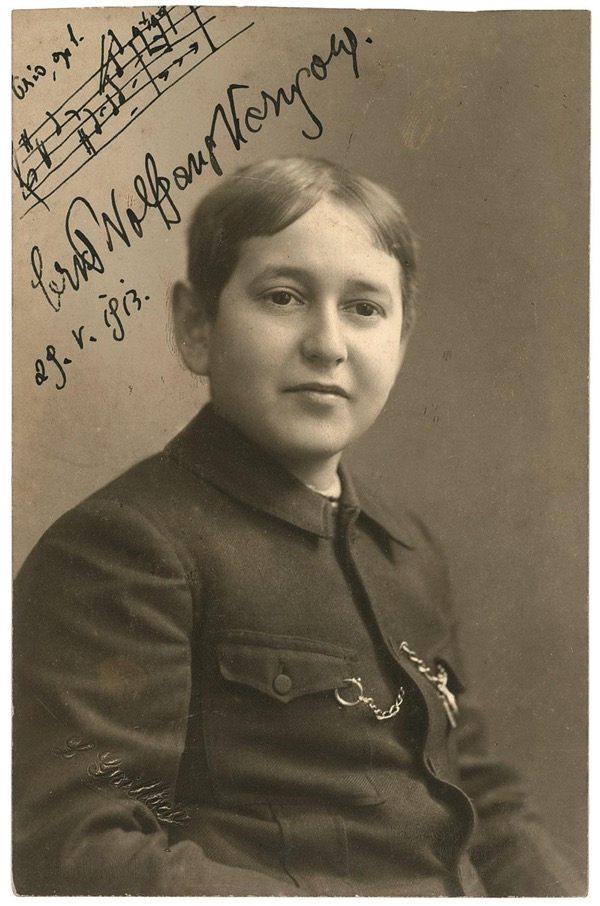
Erich Wolfgang Korngold as a young child
I think it is still unclear when Erich actually began composing, but he had remarkable talent at an early age. He supposedly beat time with a wooden kitchen spoon at the age of three, and picked out tunes from Don Giovanni at the piano by five.
By the age of six, he started jotting down musical ideas in a small notebook, and fascinatingly, he seemed to have had his own musical universe in his head from his earliest years.
He took keyboard lessons from a distant relative, and his father quickly determined that the boy needed more systematic training.
Erich Wolfgang Korngold: Piano Sonata No. 1 in D Minor: III. Finale: Moderato (Geoffrey Tozer, piano)
From Laughter to Amazement
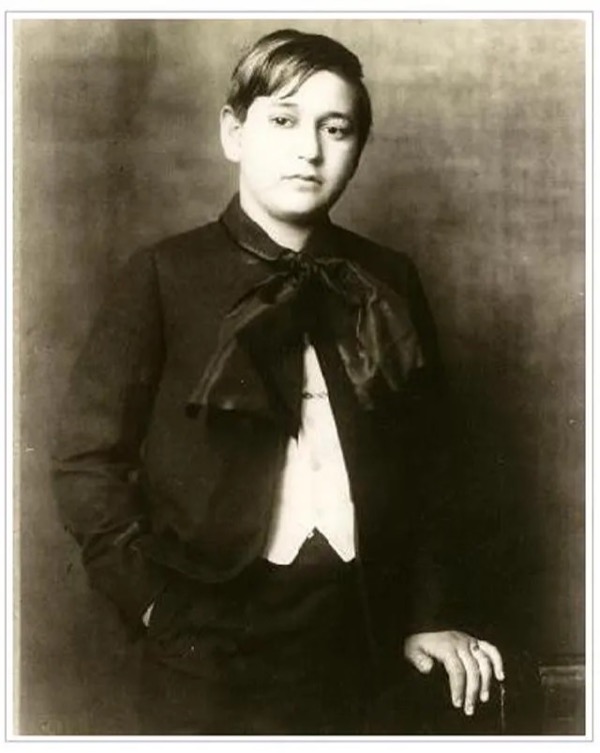
Erich Wolfgang Korngold, 1910, age 12
Initially, Julius Korngold got laughed at when he presented his boy to Robert Fuchs, a composer, conductor, and professor of music at the Vienna Conservatory, who had instructed Schreker, Wolf, Zemlinsky, Schmidt, and Gustav Mahler.
Within a week or two, Fuchs realised he had been seriously mistaken, and he told Julius that his son would put to shame any pupil of twenty years of age. Some small works emerged during these lessons, but Julius had not shown Fuchs any of his son’s more modern compositions.
Luckily, Julius Korngold was well-connected, and he was a champion of Gustav Mahler. When Erich played for Mahler, he pronounced him a genius and recommended that Alexander von Zemlinsky should take over his creative instruction.
Erich Wolfgang Korngold: Piano Sonata No. 2 in E Major, Op. 2: I. Moderato (Lara Downes, piano)
Orchestra at the Keyboard
When Erich’s mother was asked when her wunderkind first played the piano, she apparently answered that Erich had always played the piano. Carroll writes that Korngold’s style of playing was extremely unorthodox, and he could play the most complex orchestral scores from memory.
He would often say that he actually played two instruments, the piano and the orchestra. As such, when Korngold played the piano, it sounded like he was playing an orchestra.
When he worked on his first piano sonata, completed in 1909, Korngold had not yet assumed his full orchestral character, and the work remains rooted in a traditionally pianistic world.
Erich Wolfgang Korngold: Piano Sonata No. 2 in E Major, Op. 2: II. Scherzo: Allegro impetuoso – Trio (Lara Downes, piano)
The Sound of the Future
However, the Piano Sonata No. 1 in D minor, written at the age of eleven, already features the unmistakable harmonic language of much later works, such as the operas Violanta and Die tote Stadt.
In addition, the work is already amazingly well developed in terms of form, and the third movement might be the most remarkable. This passacaglia, which Korngold played to Gustav Mahler in 1909, greatly pleased the great composer.
The first two movements had already been written, and Mahler suggested placing the passacaglia as the final movement.
Erich Wolfgang Korngold: Piano Sonata No. 2 in E Major, Op. 2: III. Largo: Con dolore (Lara Downes, piano)
Richard Strauss Was Stunned

Richard Strauss, 1910
When Richard Strauss was asked for his unbiased opinion of the work, he famously replied: “To learn that this music was composed by an eleven-year-old boy fills me with shock and fear, and I do hope that even such a mature young genius will be able to develop normally, as one would wish him to.”
“His confident style, his knowledge of form, and his unusual expression are really extraordinary… I look forward to making the personal acquaintance of this brilliant musician.”
Korngold’s second sonata, actually carrying the opus number 2, was premiered on 13 October 1911. It was dedicated to his teacher, Alexander von Zemlinsky, and was played by none other than Artur Schnabel himself.
Erich Wolfgang Korngold: Piano Sonata No. 2 in E Major, Op. 2: IV. Finale: Allegro vivace (Lara Downes, piano)
Virtuosity and Viennese Dreaming
Throughout his prolific career, Schnabel always spoke highly of the work, and it presents a formidable challenge to pianists. Cast in four movements, this sonata still bears traces of late Viennese Romanticism mingled with gestures towards modernity.
The first movement opens with euphoric double octaves, but we soon hear fascinating and uniquely chromatic twists. In the lyrical secondary subject, we already hear some of Korngold’s ingenious melodic operatic voice.
The stormy Scherzo is fantastically difficult to play, but the slower middle section unfolds like a wonderful and dreamy Viennese trio in waltz time. For some commentators, Korngold taps into the Weltschmerz of his time in this movement.
Erich Wolfgang Korngold: Piano Sonata No. 3 in C Major, Op. 25: I. Allegro molto e deciso (Alasdair Beatson, piano)
A Personal Style
We find plenty of opulent romantic gestures in the slow movement, as well as many flamboyant pianistic gestures. With rather grand and tragic gestures, Korngold still holds our attention by taking harmonic roads less travelled.
For the finale, we return to the energy of the first movement and the upbeat mood of the home key. In fact, we do hear the principal theme from the first movement again, but it soon gets modified.
Korngold was only in his 14th year when he wrote this second sonata, and we sense that he was beginning to digest and transform the styles of his contemporaries and predecessors to create his own voice.
Erich Wolfgang Korngold: Piano Sonata No. 3 in C Major, Op. 25: II. Andante religioso (Alasdair Beatson, piano)
Twenty Years Later
Twenty years passed before Korngold composed his third and last piano sonata. In the intervening years, Korngold had made a name for himself as a composer of major operas, including Die tote Stadt, and Das Wunder der Heliane.
He had also written a large body of orchestral and chamber music. He probably began composing Piano Sonata No. 3 in C major in 1929, as a direct reaction to the birth of his second son, Georg, a year earlier.
He completed the sonata in the summer of 1931, dedicating it to his friend Julius Bittner. It was first performed in public by Paul Weingarten in Vienna in March 1932.
Erich Wolfgang Korngold: Piano Sonata No. 3 in C Major, Op. 25: III. Tempo di menuetto molto comodo (Alasdair Beatson, piano)
A Familiar Voice
In a way, this sonata initially sounds like it might have been written a couple of years rather than a couple of decades later. I hear musical ideas that have become a bit more angular and disjunct, but we find plenty of skilful thematic transformation and imaginative piano sonorities.
Korngold’s style had certainly matured, specifically in his songwriting and operatic projects. Yet in the sonatas, the style stays somewhat consistent, and some of the block chords almost sound like a piano reduction of an orchestral score.
We find wonderful lyrical sentiment in the slow movement, but there is still a tendency to embellish musical ideas with florid ornaments. In all, we find two rather showy movements, a rather meek intermezzo, and a showy moto perpetuo as a finale.
This sonata never really established itself in the contemporary repertoire, and it eventually disappeared completely. It has only been rediscovered in recent years.
Child Genius and Romantic Master
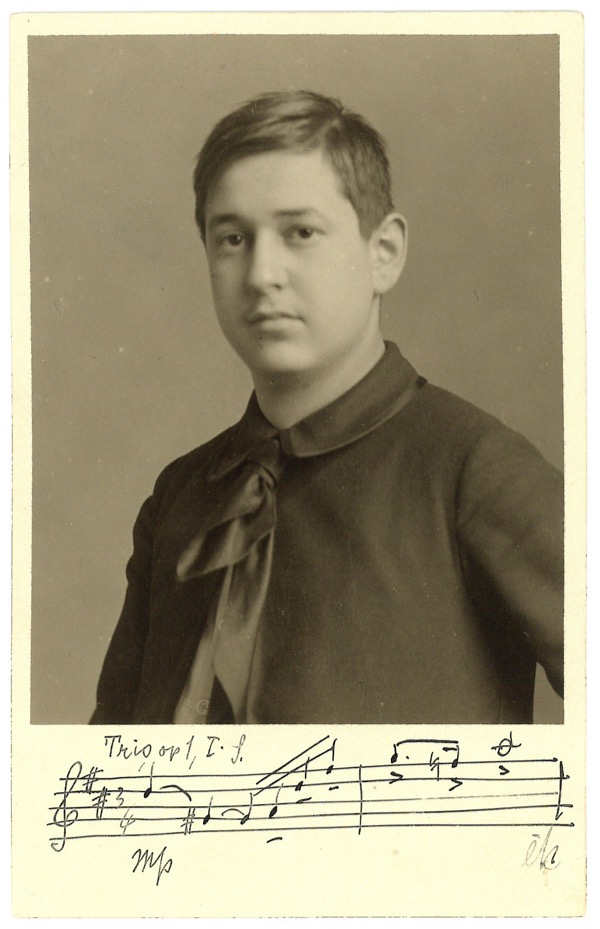
Erich Wolfgang Korngold
Although his music was not always met without controversy, Erich Wolfgang Korngold was highly successful during the 1920s and was sometimes called one of the “last Romantics.”
He was viewed by followers of the Schoenberg school as an anachronism, but Die tote Stadt was highly popular. Things changed dramatically in the 1930s when his works were banned, and he had to emigrate.
Above all, I am personally struck by the extraordinary musical talent of Erich Wolfgang Korngold, as we can trace how a child genius matures into one of the last great Romantic voices of the twentieth century.
I have liberally interwoven reflections on the wonderful biography by Brendan G. Carroll, a book that is worth reading and rereading many times. Korngold’s three piano sonatas offer a fascinating musical portrait of a composer whose musical imagination seems to hear the world in glorious orchestral colours.
For more of the best in classical music, sign up for our E-Newsletter
Erich Wolfgang Korngold: Piano Sonata No. 3 in C Major, Op. 25: IV. Rondo: Allegro giocoso (Alasdair Beatson, piano)