Classical music has given us some of history’s most complicated fathers. Some were domineering, some were absent, some were both – and a few managed, despite everything, to be genuinely devoted.
From Leopold Mozart, who shaped one of the greatest careers in music history while nearly smothering it, to Johann Sebastian Bach, who quietly raised four professional composers while grieving an absent wife, the fathers on this list left marks on their children that music history is still reckoning with today.
Johann Strauss I
Johann Strauss I’s “Lorelei Rhein Klänge”
Composer Johann Strauss I was born in Vienna in 1804. After his parents died when he was young, he apprenticed to a bookbinder, but his heart wasn’t in it, and he dreamed of becoming a musician instead.
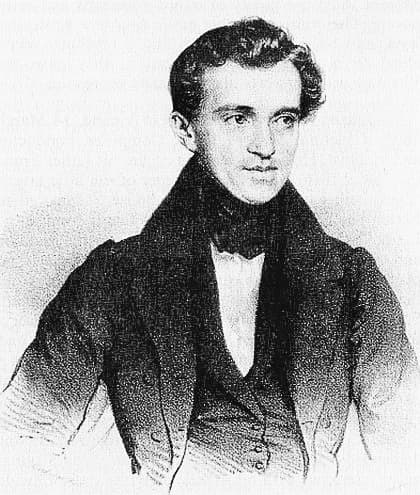
Johann Strauss I, 1835
In 1824, he expanded his string quartet into a string orchestra that specialised in dance music, and soon he was in demand across Europe.
The following year, he got married. He and his wife had six children, but he was largely absent as a father due to his touring. (He was also fathering eight additional children with his mistress.)
When he was home, he ruled his family with an iron fist, forbidding his sons to pursue a music career.
His eldest son, Johann Strauss II, didn’t listen, and started learning the violin in secret. Eventually he began a rival orchestra that competed with his father’s.
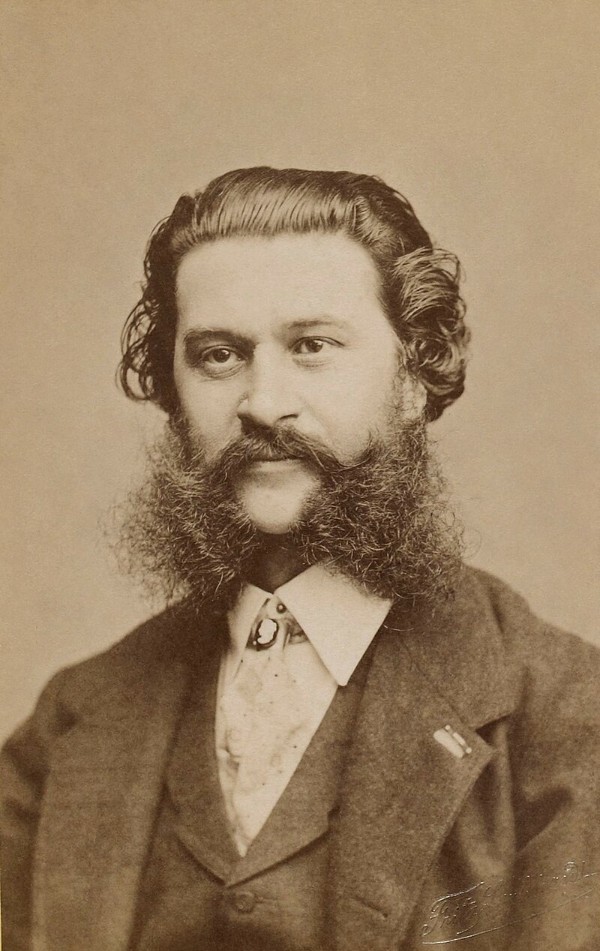
Fritz Luckhardt: Johann Strauss II
Their rivalry came to an end in 1849, when Johann Strauss the Father died of scarlet fever – an illness he had picked up from one of his mistress’s children.
This article from our archives talks about this flashy (and tragic) nineteenth-century father-son rivalry: Show Me the Money: Johann Strauss Jr..
Franz Liszt
Liszt’s transcription of Wagner’s Liebestod from Tristan und Isolde
In 1833, when he was 22, pianist and composer Franz Liszt began an affair with the married Countess Marie d’Agoult.
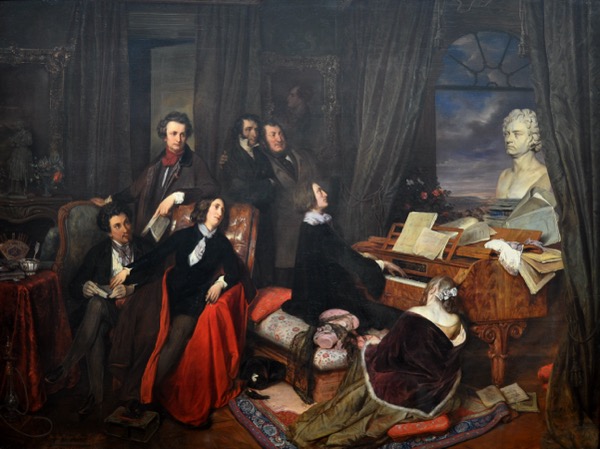
Liszt at the piano, d’Agoult sitting on the ground
They moved in together and had three children: Blandine in 1835, Cosima in 1837, and Daniel in 1839.
By late 1839, Liszt and the countess’s relationship was fraying, and they separated. The countess returned to Paris to raise the children there.
By 1845, hostilities had escalated to the point that Liszt tried to halt communication between the countess and their children.
Neither parent was particularly present for the children as they grew up. Liszt, in particular, focused on his musical career, which took him all across Europe.
In 1855, Cosima began rooming with the family of Liszt’s student, Hans von Bülow, and fell in love with him. Liszt granted his approval for their marriage, and they wed in 1857.
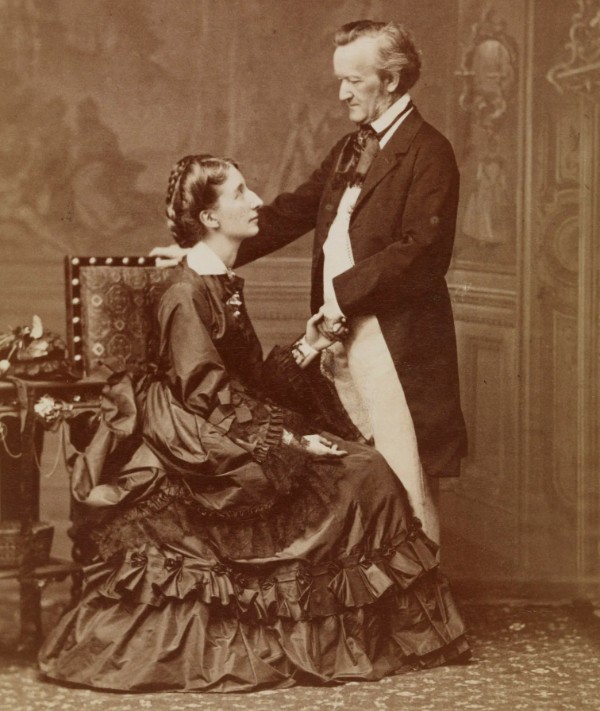
Richard Wagner and Cosima von Bülow Wagner
A few years later, Cosima fell in love with composer Richard Wagner. Wagner was a composer both her father and her husband had championed – a fact that made the affair all the more charged.
Ultimately, Cosima divorced von Bülow and married Wagner, making Liszt Wagner’s father-in-law…arguably the most consequential father-in-law in classical music history.
Claude Debussy
Debussy’s Children’s Corner
Claude Debussy was a newlywed when he began an affair with a married singer, Emma Bardac.
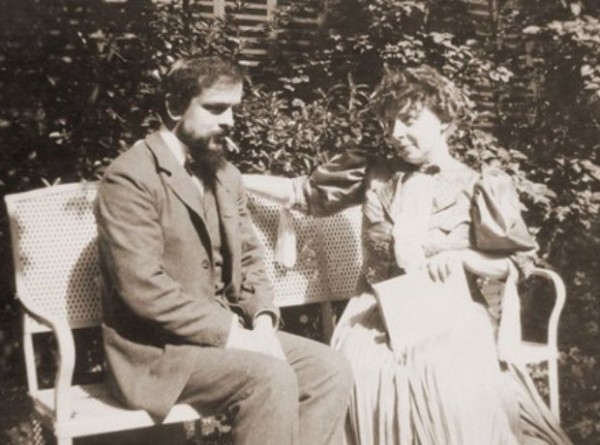
Claude Debussy and Emma Bardac
After Emma got pregnant in early 1905, Claude and Emma divorced their respective spouses and married each other. The scandalous fallout was considerable.
The baby arrived in the fall of 1905, two weeks after the premiere of La Mer. Her parents named her Claude-Emma Debussy, but she soon earned the tongue-in-cheek nickname Chouchou (“Little Cabbage”).
In many respects Debussy was a horrible husband – his affairs and emotional volatility made him exhausting to love – but he was a doting father.
He wrote to his musicologist friend Louis Laloy, “I have been, for a few days, the father of a little girl – the joy of which has somewhat knocked me over and leaves me a bit fearful.”
Several of his works from this time were inspired by Claude-Emma and childhood. The most famous example is his piano suite The Children’s Corner.
In 1915, when Debussy was diagnosed with cancer, he was 53, and Claude-Emma was ten.
He died in 1918, and Claude-Emma died of diphtheria in 1919. She had only been sick for a few days. Between the two losses, Emma was crushed by grief.
Gustav Mahler
Mahler’s Kindertotenlieder
Gustav Mahler got engaged to Alma Schindler in December 1901, a few weeks after formally meeting her. She was a great beauty, half his age. The two were married in March; she was already pregnant.
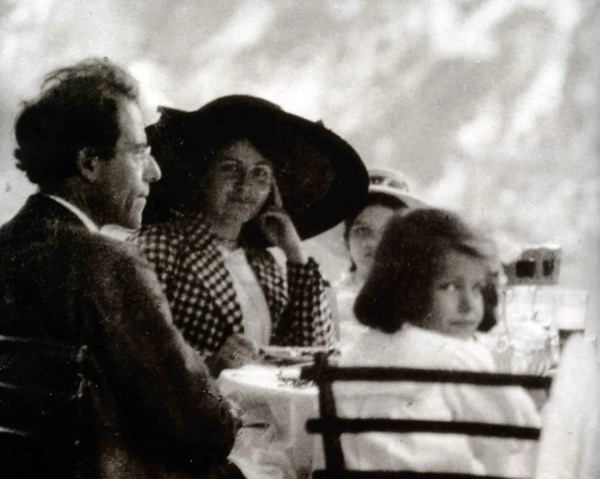
Alma and Gustav Mahler with their children
They had two daughters, Maria Anna (nicknamed Putzi), born in November 1902, and Anna (nicknamed Gucki), born in June 1904.
Two weeks after Gucki’s birth, Gustav returned to work on an orchestral song cycle called Kindertotenlieder (Songs on the Death of Children) that he’d begun in the months before meeting Alma. He’d been drawn to the work of poet Friedrich Rückert, who wrote many poems about child loss. Alma was horrified at his choice of subject matter, feeling that it tempted fate.
Her worry proved prescient. Putzi died in 1907 of scarlet fever and diphtheria. The death devastated her parents, and soon after, due in part to Putzi’s death, the Mahler marriage began deteriorating.
Gustav Mahler died in May 1911, just before Gucki’s seventh birthday.
She retained few memories of her famous father, saying in an interview later in life, “I was nearly seven when he died. But my memories are not anecdotal. I have nothing to say. They are that I remember his voice, I remember his hands, I remember his walk. It was a very strange walk – I know exactly what it was because I walked with him.”
Joseph Haydn
Haydn’s Surprise Symphony
Classical-era composer Joseph Haydn is nicknamed “Papa Haydn” for his influence on the development of forms such as the string quartet and the symphony. He was also believed to be childless – but the reality may have been more complicated.
While his wife kept house in Vienna, Haydn worked at the rural Esterházy palace. Their marriage was unhappy, and throughout his life he pursued relationships with other women.
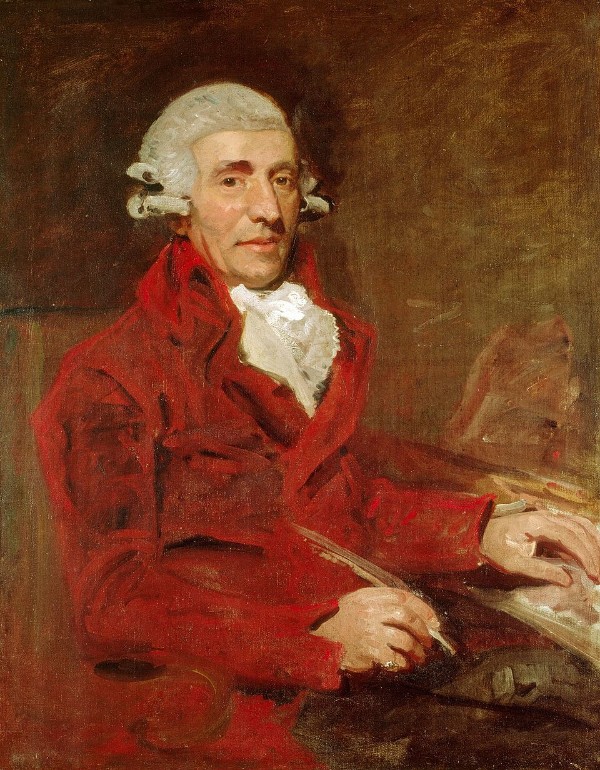
John Hoppner: Haydn, 1791 (Royal Collection)
In 1779, when he was 48, he met a 19-year-old singer named Luigia Polzelli. She was hired with her violinist husband.
Apparently neither of the Polzellis were particularly talented, but Haydn found Luigia attractive, so the prince agreed to keep the couple on the payroll.
In 1783, she gave birth to a son named Antonio – and given the timeline, the baby may have been Haydn’s.
Although he never confirmed paternity, Haydn made sure that Antonio and his older brother were financially supported. In 1803, Antonio was granted a job in the court orchestra.
Leopold Mozart
Leopold Mozart’s Trumpet Concerto
Leopold Mozart is among the most famous fathers in the history of classical music; nowadays we’d label him a stage parent.
He was born in Augsburg, Germany, in 1719, and in 1743 he joined the court of the Prince-Archbishop of Salzburg as a violinist.
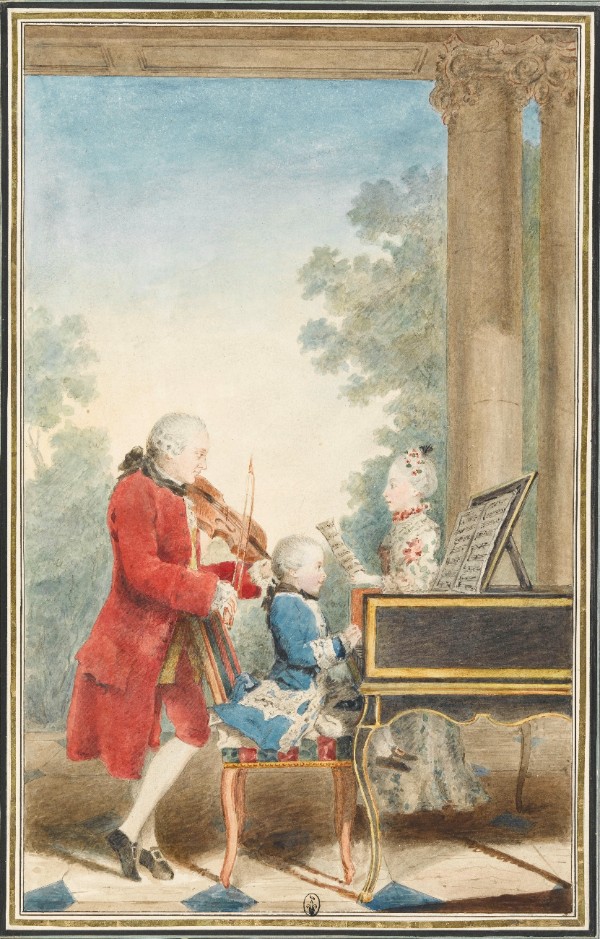
Leopold Mozart and his kids on tour
In 1756 his wife gave birth to a little boy named Wolfgang Amadeus Mozart, who turned out to be one of the great prodigies in music history.
Wolfgang wasn’t the only great musician Leopold fathered. His first surviving child, Maria Anna, was a prodigy in her own right. She spent years touring Europe with Wolfgang as a child, but when she reached marriageable age, she was prevented from continuing her career; professional success on the stage was considered an obstacle to making a suitable marriage.
Leopold and Wolfgang had a volatile relationship. Although they loved each other deeply, Leopold’s perfectionism and ambition sparked several conflicts between them.
One of the defining moments of Wolfgang’s life happened in 1781, when, driven by ambition, Wolfgang openly clashed with the new Archbishop and lost his position.
Leopold wanted him to apologise and return, or at the least find another prestigious court appointment. But instead of crawling back to the Archbishop, Wolfgang decided to make his living as a freelance composer and performer in Vienna.
Leopold died in 1787, and the relationship never really had an opportunity to heal. Just four years later, Wolfgang died, too.
Johann Sebastian Bach
Bach’s Chaconne
Famously, composer Johann Sebastian Bach fathered twenty children over the course of two marriages.
He became a single father of his four surviving children in 1720, when he was 35. That year, his first wife Maria Barbara died unexpectedly while travelling with his employer, who was taking a spa holiday.
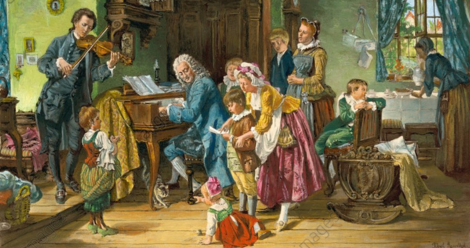
The Bach Family © Oxford Bach Soloists
Tradition holds that one of the works he wrote in response to her death was the tragic, monumental Chaconne for solo violin.
Unfortunately, relatively little information survives about his inner life, aside from what we can glean from his music. But we know that he acted as a music teacher to his children, and that four of them became professional composers in their own right.
Find out what happened to the Bach children in this article from our archive: What Happened to Bach’s Twenty Children?
Conclusion
Fatherhood, it turns out, looks much the same across the centuries: full of ambition, absence, love, and the occasional catastrophic miscalculation.
What sets these men apart is that their children’s lives – and in many cases their own – are inseparable from the music they left behind. The Chaconne, the Kindertotenlieder, The Children’s Corner: some of the most extraordinary works in the repertoire were inspired by the experience of fatherhood, in all its grief and joy.
For more of the best in classical music, sign up for our E-Newsletter