Brass instruments started as simple tubes. They didn’t have holes like woodwinds, but their length determined the pitches they could play. It wasn’t until the 19th century that instruments like the trumpet were fitted with valves.
Let’s explore some of the more unusual forms of brass instruments.
One of the most striking brass instruments was the schediphon. Named after its maker, Josef Josefovich Schediva, the schediphon consists of two mirror-imaged instruments: one with a narrow cylindrical bore (like a trombone) and one with a wider conical bore (like a euphonium).
This was one of several double instruments Schediva developed in the 1880s, combining brass instruments such as the cornet/trumpet, alto horn/alto trombone, and tenor horn/tenor trombone, as pictured here.
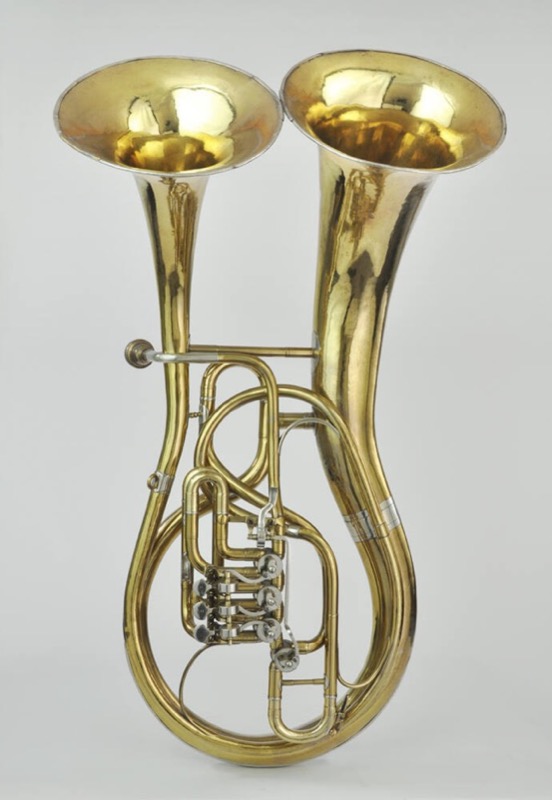
Schediphon, ca. 1901 (National Music Museum)
The player couldn’t play both instruments at the same time, but could switch as needed from the bright, trombone-like sound to the softer, euphonium-like sound. They were generally used in Russian military bands because they let bands double personnel, with one player covering two different sounds.
Another combo instrument is the valved trombone. The valves make fast runs easier because you don’t have to move the slide. Composers such as Verdi and Rossini valued it for its agility. Most valve trombones do not have working slides, but some retain the dual flexibility. They were especially useful in mounted cavalry bands where the slide could get caught.
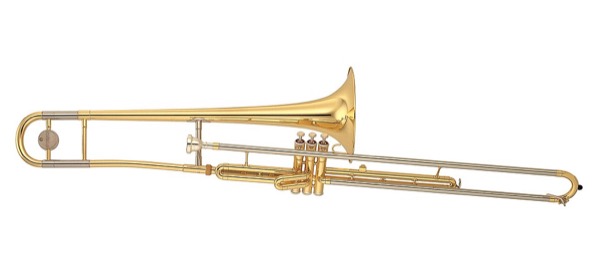
Yamaha valve trombone.
Cornets and trumpets have different bore ratios between cylindrical and conical bore. A cornet has a mostly conical bore, starting very narrow at the mouthpiece and widening toward the bell. The conical bore gives the instrument a warmer and mellower tone than the trumpet. The cornet emerged in the 19th century when valves were applied to post horns.
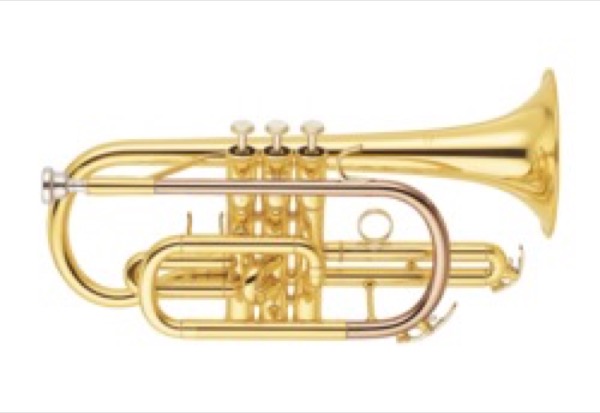
Yamaha: Cornet
Although valves were first applied to the cornet, the natural (valveless) trumpet existed for about 100 more years before technology took over. In playing, cornets played melodic passages, while the brighter, sharper-sounding trumpets took the fanfare-like passages.
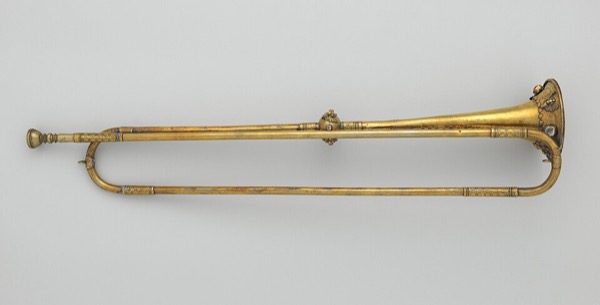
Natural trumpet, 1790 (Metropolitan Museum of Art)
The trumpet has a cylindrical bore until it expands to become the bell. It has always played a role in ceremonial occasions, but in orchestral music it was gradually downgraded in the Classical and Romantic periods because of its limitations. It came back into favour at the start of the 19th century when it had valves like the cornet.
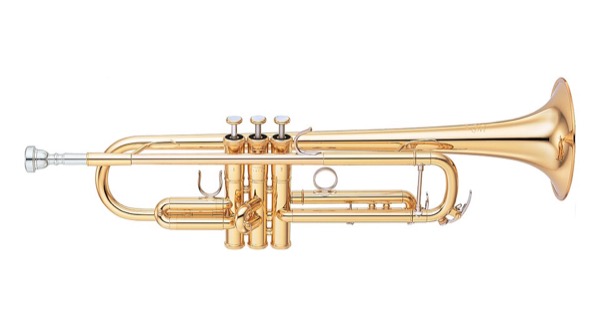
Yamaha: Trumpet
If we take the cornet and trumpet as orchestral normal, what other instruments come into the brass family?
French musical-instrument maker Adolphe Sax developed the saxhorn in the mid-to-late 1830s and patented it in 1845. As part of a larger scheme to develop patent instruments for the French military (he also invented the Saxophone), Sax designed the saxhorn to provide a unified brass sound, no matter the instrument’s size. The saxhorn originally came in up to 10 different sizes, from the small sopranino to contrabass and lower. Hector Berlioz was a friend of Sax and used choirs of saxhorns in significant parts of his mega-opera Les Troyens. For the Trojan March in the Act I finale, Berlioz used an off-stage ensemble of 9 different-sized saxhorns.
Hector Berlioz: Les Troyens: Act I: Finale (Trojan March): Du roi des dieux (Régine Crespin, mezzo-soprano; Paris National Opera Chorus; Paris National Opera Orchestra; Georges Prêtre, cond.)
He also used the saxhorn ensemble in Act IV of the opera for the Royal Hunt and Storm section.
Hector Berlioz: Les Troyens: Act IV Scene 1: Royal Hunt and Storm (Pantomime) (London Symphony Chorus; London Symphony Orchestra; Colin Davis, cond.)
In his mid-19th-century catalogues, Sax declared that Saxhorns could be used for military music, theatre music, and the concert stage.
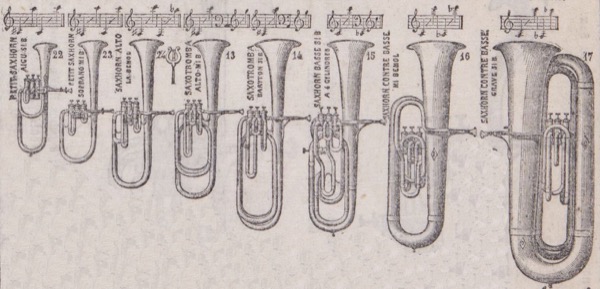
Page from Sax’s catalogue, ca 1845–1869 (Gallica: bpt6k325222h)
They have stayed in the modern concert stage, but under different names: the B♭ soprano saxhorn is now known as the flugelhorn, the E♭ alto or tenor saxhorn is now called the tenor horn, the B♭ bass saxhorn is known as the euphonium, and the B♭ contrabass saxhorn is now the B♭ contrabass tuba.
During the American Civil War, which involved a lot of marching and traditionally placed the band at the front of the march, a distinctive reverse saxhorn developed. Instead of facing forward, the bells on these military instruments faced backwards so that the army following the band could march to its music. They were known as ‘over-the-shoulder’ saxhorns.
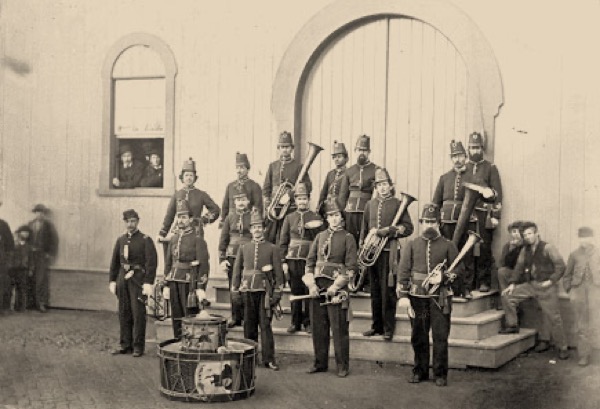
Band of the 10th Veteran Reserve Corps. Washington, D.C., April 1865
We saw earlier (in Unusual Instruments: Winds) that Richard Wagner was behind the creation of the Heckelphone. He also commissioned a brass instrument needed to play his operas. The Wagner tuba combines features from the French horn and the tuba to ‘bridge the acoustical and textural gap between the French horn and trombone’. To bring back the sound of the ancient world of Wotan and the Valkyries, Wagner was trying to find an instrument with the sound of the ancient Nordic lur but with valves added so it could play 19th-century music.
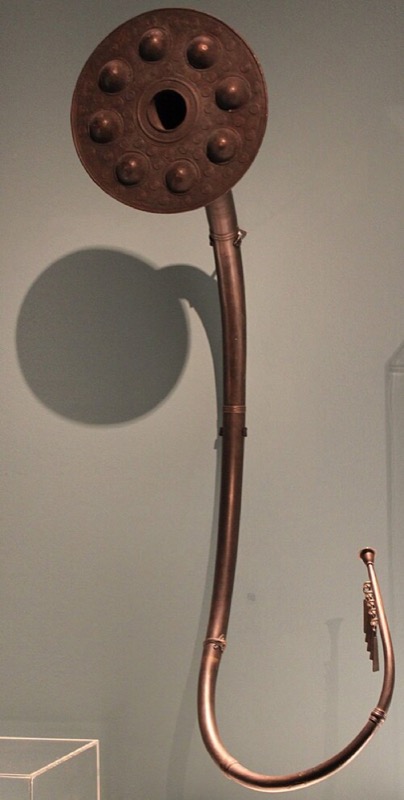
Danish Bronze Age Lur, 13th-5th Century B.C.
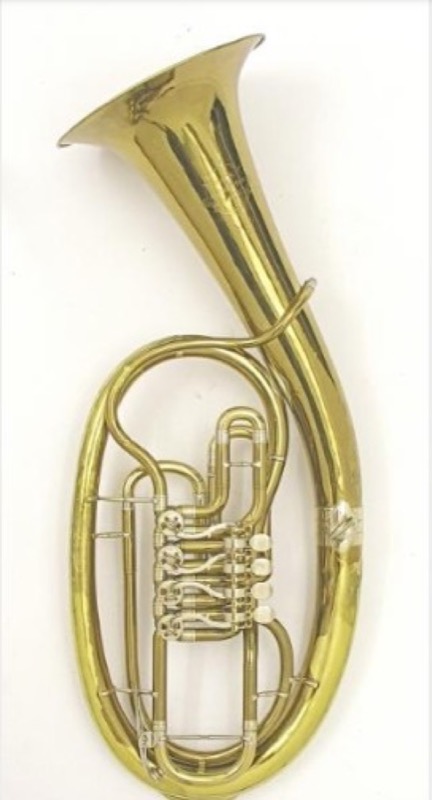
Wagner Tuba by the Alexandre brothers, Mainz, Germany, 1930s (University of Edinburgh: Musical Instrument Museum)
Although composers including Richard Strauss, Anton Bruckner, and Béla Bartók wrote for the instrument, it became increasingly difficult to find when needed, and it has largely dropped from the concert stage…unless you’re putting on a Wagner opera, of course!
Another brass instrument still in use today, and one that includes the name of the commissioner, is the Sousaphone, created around 1893 for bandleader John Philip Sousa. It was based on an earlier instrument called the helicon, which was a bass instrument that wrapped around the body.
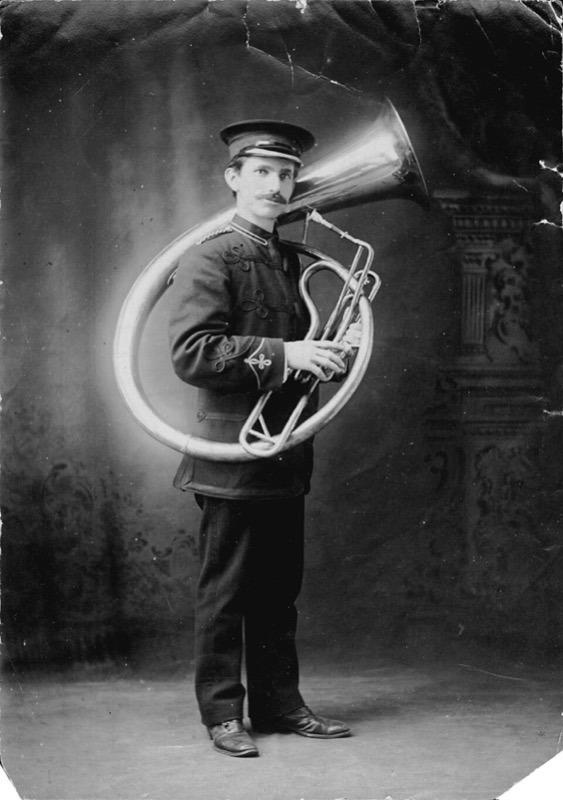
Philip Timms with his E♭ bass helicon, 1909
The new Sousaphone turned the bell upward and projected above the band. Philadelphia musical instrument maker J.W. Pepper created it.
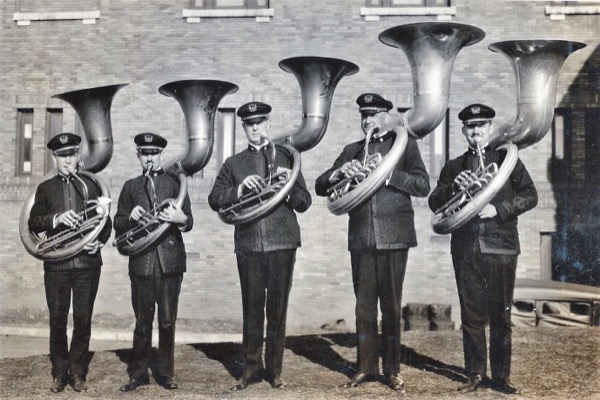
5 Sousaphonists from the Sousa Band, 1923.
The upright bell imitated a regular upright bass tuba, which didn’t wrap around the body. For obvious reasons, the bell-upward model was known as a rain-catcher. Sousa didn’t like that the helicon’s forward-facing bell made it too loud in concert settings. The rain-catcher Sousaphone toned down the sound.
Wrapping the instrument around the body made it more stable and easier to hold. The next development was to turn the bell forward, which is how we have it today.
This was created by the instrument maker C. G. Conn in 1908 and wasn’t called the ‘Sousaphone’ but rather the ‘Wonderphone Helicon’. It still bears Sousa’s name, but Sousa wanted nothing to do with this bell-front instrument, still believing that the bell-forward design was too loud for his concert performances.
John Philip Sousa: March: King Cotton (Royal Artillery Band; Keith Brion, cond.)
It was perfect, however, for marching bands. In the US, marching bands, which started as military bands, became part of the university band world. The University of Illinois, for example, boasts a brass lineup with 5 forward-facing silver sousaphones. The bell angle may have changed, but the instrument still takes its name from the most famous American band leader.
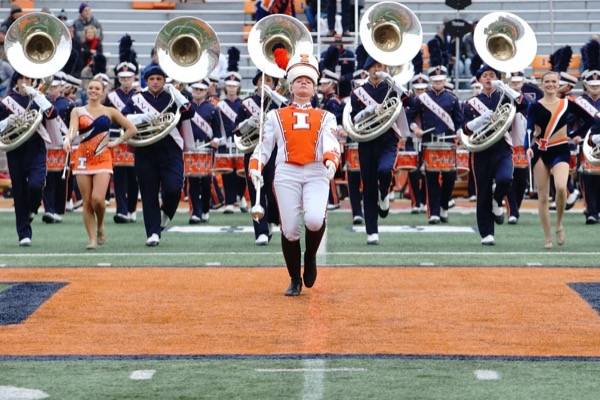
University of Illinois’ Marching Illini’s sousaphone section
Another instrument that was created to serve the needs of the marching band was the Mellophone. It replaces the French horn, which has a bell that faces backwards. By creating something like a large trumpet, the designers made an instrument that could be used in marching bands without violating the copyrights Adolphe Sax held so tightly over his saxhorns.
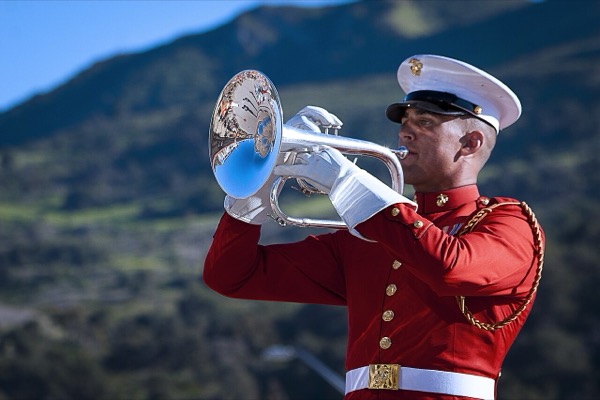
A U.S. Marine Drum & Bugle Corps mellophone bugle player, 2012 (U.S. Marine Corps).
Give a musical instrument maker something established, and immediately invention is in the air.
For more of the best in classical music, sign up for our E-Newsletter