If you’ve ever had a dog, you know firsthand the devotion, affection, and companionship they provide to humans.
Turns out, many of the great composers knew the joys of canine companionship, too!
Today, we’re looking at the amazing true stories of the great composers’ dogs…and the creative inspiration they provided.
Wolfgang Amadeus Mozart (1756-1791)
Pimperl
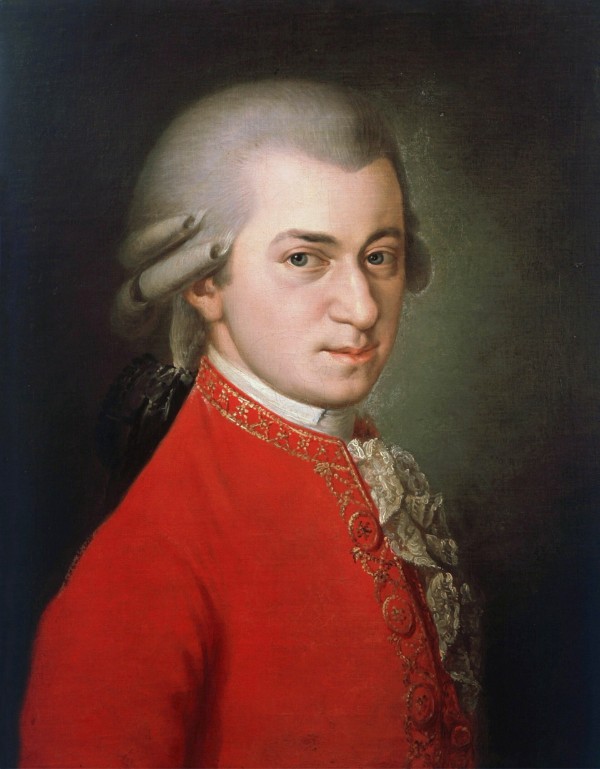
Wolfgang Amadeus Mozart
In the 1770s, the Mozart family kept a terrier they named Pimperl.
Pimperl went by a number of names, including Pimpes, Bimpes, and Bimperl. (Just like modern dog owners, the Mozarts bestowed a number of nicknames on their beloved pets.)
One time when Mozart was traveling, his sister Nannerl wrote to him with an update on Pimperl:
“Miss Pimpes too is living in hopes [of your return], for she stands or sits at the door whole half-hours on end… All the same, she is quite well, eats, drinks, sleeps, shits, and pisses.”
In 1775, Mozart wrote in a letter to his mother, “A thousand kisses for Pimperl.”
And in April 1778, Mozart’s father wrote in a letter:
Whenever [Pimperl] stands on the table, she very gently scratches the rolls with a paw so that somebody will give her one, then [scratches] the knife so someone will slice it for her. And if there are 4 or 5 snuffboxes lying on the table, she scratches the one with Spanish tobacco in it until someone takes a pinch and lets her lick their fingers.
Frédéric Chopin (1810-1849)
Mops, Marquis, Dib
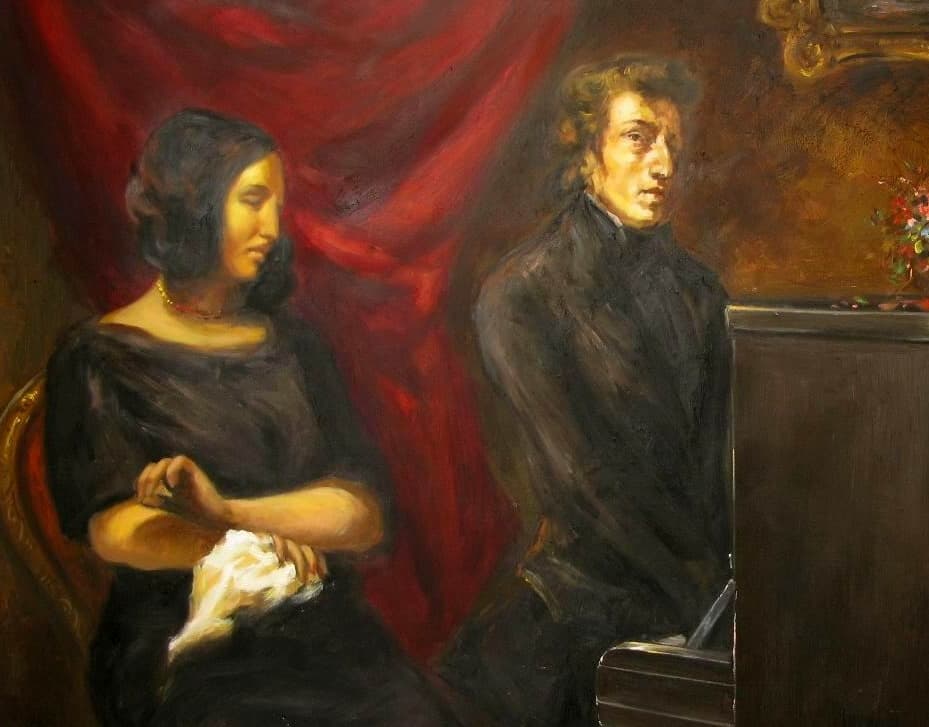
Portrait of Frédéric Chopin and George Sand by Eugène Delacroix
In September 1840, a stray puppy with fleas followed Chopin home.
His partner, George Sand, wrote to her son:
This morning we have acquired a delightful little puppy, no bigger than a fist, dark brown, with a white waistcoat, white stockings in front and white shoes on the hind legs.
This gentleman followed Chopin in the street and simply would not leave him.
Then, oh miracle, Chopin took the little dog in adoration and has spent the whole day looking after it, even though it did its “something” in the drawing room and gave us all fleas.
Chopin finds this charming, mainly because the dog is all over him and cannot stand Solange [Sand’s 12-year-old daughter]. Solange is fiercely jealous.
At this moment, the little thing is sleeping at my feet. It has been called Mops, which is, quite simply, the Polish for Pug.
The historical record is unclear as to Mops’s ultimate fate or whether it stayed with Chopin.
A few years later, Sand adopted two additional dogs, Marquis and Dib. Sand and Chopin didn’t always live together, so it’s an open question of whether the dogs were ever truly Chopin’s, but apparently, Marquis liked him.
In 1846, Chopin wrote to his family in Poland:
The little dog Marquis (you remember) is staying with me and is lying on my sofa.
He is an extraordinary creature: he has a soft, fluffy white coat which Mme Sand herself brushes every day, and he is as intelligent as can be.
I can’t begin to tell you all his original tricks. For example, he will neither eat nor drink from a gilt vessel: he pushes it away with his nose and upsets it if he can.
Marquis and Dib continued appearing in Chopin’s correspondence for as long as he dated Sand.
According to legend, the sight of Marquis chasing his tail inspired the Minute Waltz.
F. Chopin – Minute Waltz Op. 64 No. 1
Franz Liszt (1811-1886)
Rappo
According to Liszt biographer Alan Walker, when Liszt lived in Weimar in the 1850s, he kept a guard dog named Rappo who had free reign of his home and would bark under his window while he composed.
Richard Wagner (1813-1883)
Robber, Fafner, Fasolt, Pohl, Kos, Branke, Peps, Fips, Russmuck, Marke
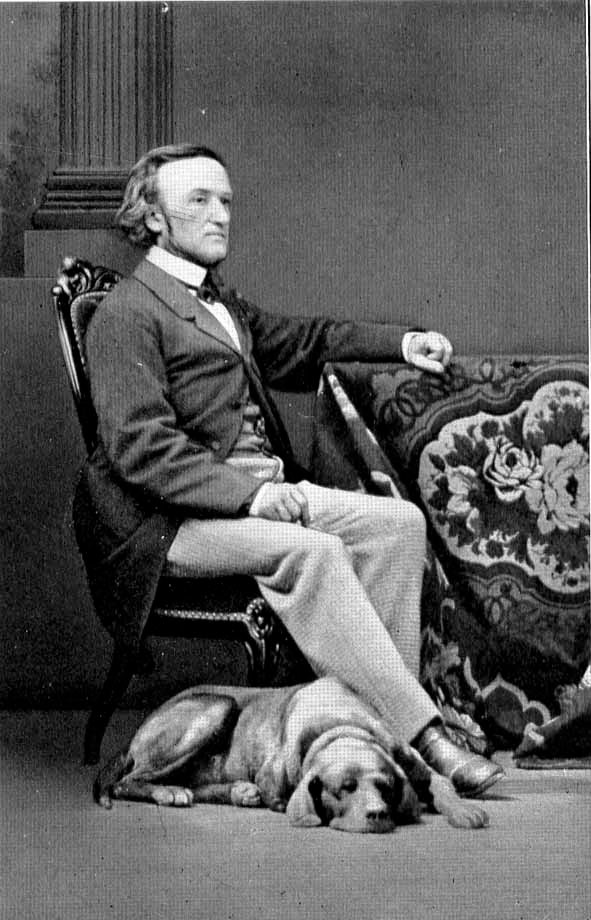
Richard Wagner and Pohl
Richard Wagner was famous for his adoration of animals. He was vegetarian and advocated against antivivisection. He also kept a number of dogs throughout his life.
The first dog, Robber, was a 160-pound Newfoundland. Robber originally lived in a shop in Riga in present-day Latvia, the city where a twentysomething Wagner worked as a conductor. Robber adored Wagner so intensely that Wagner adopted him.
Before long, Wagner found himself deeply in debt and had to flee to Paris to escape his creditors. He brought Robber with him. Unfortunately, Robber either ran away or was stolen a few weeks into their stay.
In Dresden, Wagner acquired a dog named Peps. He wrote to his sister:
As we still have no prospect whatever of human young, we have to make up with dogs still. We have another now, just 6 weeks old, a droll little beast; his name is Peps, or Striesel (because he looks as if he had come from the gingerbread market).
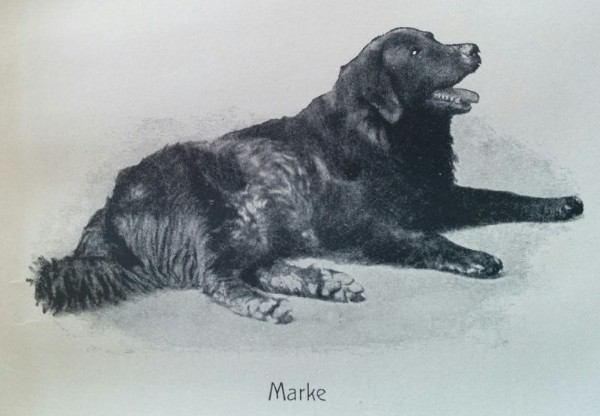
Richard Wagner’s dog Marke
Wagner’s dog Marke howled at his coffin when he died (and a few days later died of grief), and Wagner was buried next to his Newfoundland Russ.
Giuseppe Verdi (1813-1901)
Lulu, Blach
Giuseppe Verdi kept a number of dogs during his life.
One of his favourites was a tiny white Maltese named Lulu. (Despite what his name suggests, Lulu was a male dog.)
Verdi walked around with Lulu in his jacket, with nothing but Lulu’s nose sticking out. When Lulu died, Verdi was despondent.
Verdi also adored his black hunting dog, Blach. He even wrote letters from Blach’s point of view. “Blach” once wrote in a letter to a fellow canine:
“My beloved brother, you were very wrong not to come to see me, for I would have received you with open paws and open jaws and my four teeth in your wooly cheeks; I would have shown you all the tenderness I, a dog, can muster.”
When Blach got sick, Verdi wrote in a letter to a friend:
“My poor Blach is quite sick. He barely moves and will not live long. I have ordered another Blach to be manufactured in Bologna, because if it came into my head to write another ‘Don Carlo,’ I could not do it without a collaborator of that species.”
Verdi’s “O Don Fatale” from Don Carlo
Johannes Strauss II (1825-1899)
A Newfoundland dog
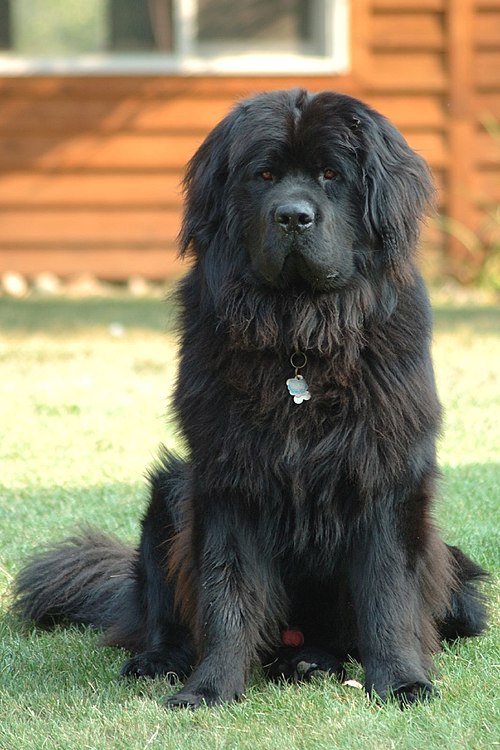
A Newfoundland dog
Legend has it that, like Wagner, Johannes Strauss II kept a black Newfoundland dog. When women wrote to him asking for locks of his hair, Strauss’s valet would send clippings from the dog.
Arthur Sullivan (1842-1900)
Tommy
Sir Arthur Sullivan’s collie was obsessed with playing fetch and went around to all visitors and household employees to get them to play.
Actor and writer George Grossmith once asked Sir Arthur Sullivan, “That dear dog is very attractive, but has he any other qualities besides fetching sticks? Is he, for instance, a good house-dog?”
Sullivan replied, “A splendid house-dog! If burglars were to enter this place and throw a stick for him to fetch, he would show them all over the premises.”
Leoš Janáček (1854-1928)
Čipera
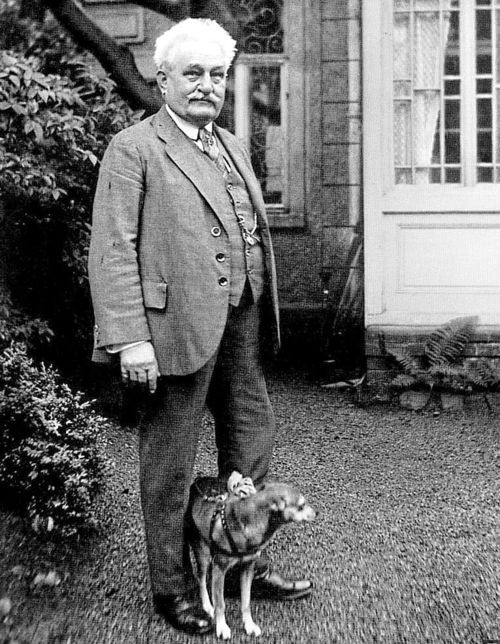
Leoš Janáček with his dog Čipera
Janáček’s daily routine included eating breakfast every morning with his dog Čipera.
His wife Zdenka wrote in her memoirs that Čipera would growl at those who were untrustworthy.
Edward Elgar (1857-1934)
Meg, Mina, Marco
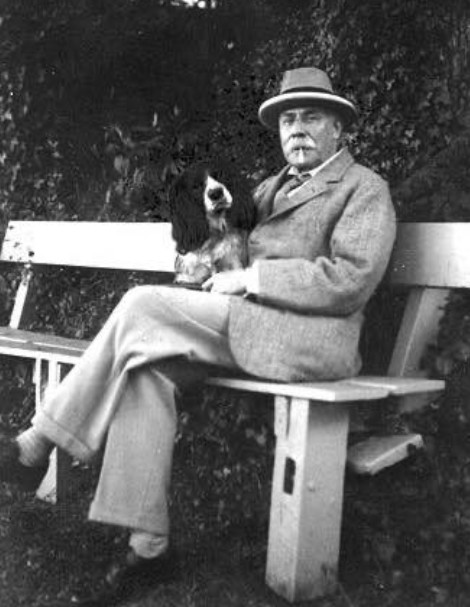
Edward Elgar with his dog Marco
Sir Edward Elgar loved dogs; his wife did not. He kept two Cairn Terriers named Marco and Mina at his sister’s home, but after his wife died in 1920, Elgar moved the dogs to live with him. He also had a Scottie named Meg.
When the dogs lived with Elgar, they ate off the dinner table with him. And when he’d perform on live radio broadcasts, he would give a greeting to Marco over the airwaves (and Marco would recognise him!).
His final orchestral work, Mina, was named after his dog.
Footage of Edward Elgar and his dogs, to the audio of Mina
Ethel Smyth (1858-1944)
Marco, Pan
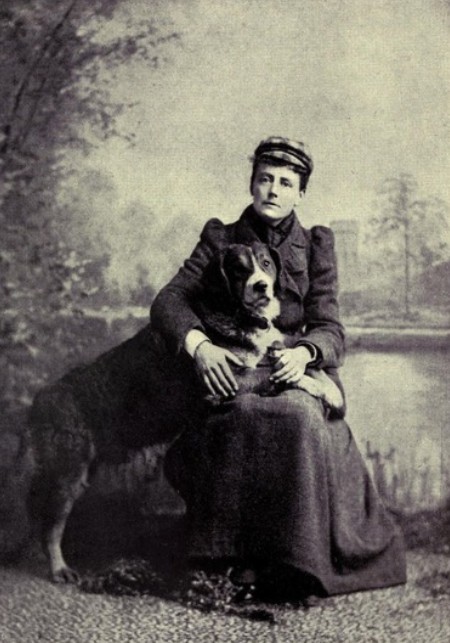
Ethel Smyth with her dog Marco
Ethel Smyth was a strong-willed woman born in England in 1858. Against the wishes of her family, she moved to Leipzig when she was nineteen to study music.
A friend went on a trip to Vienna and came back with a dog that was half St. Bernard, “and the rest, what you please.” Smyth ended up adopting the dog herself and naming him Marco.
She later remembered, “For twelve years, that dog was the joy of my life.”
One time when Smyth was at a rehearsal, turning pages for Johannes Brahms, Marco was left out on the street. Somehow, he found his way indoors and bounded into the rehearsal, knocking over the music stands. Brahms burst out into laughter, delighted at the interruption.
Tchaikovsky once wrote in a letter to Smyth, “P.S. – I hope that your dear dog is faring well!!”
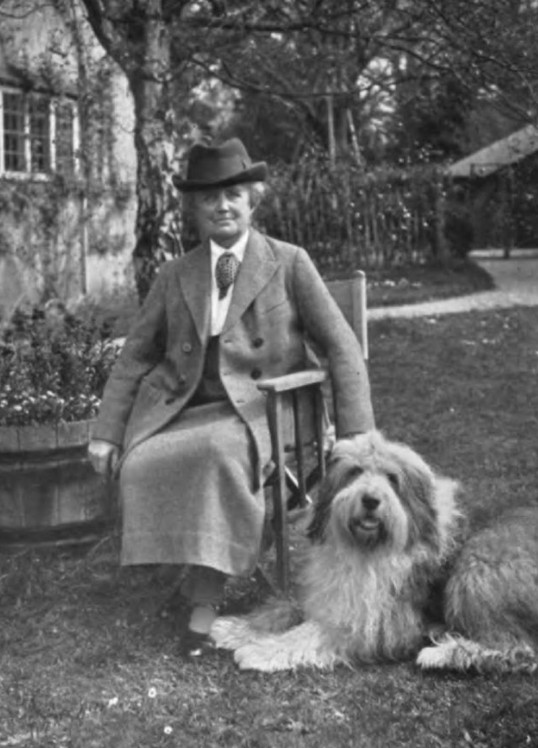
Ethel Smyth with her dog Pan
Later in life, Smyth kept a succession of Old English Sheepdogs, all named Pan.
Toward the end of her life, she wrote a book called Inordinate (?) Affection: A Story for Dog Lovers.
Claude Debussy (1862-1918)
Pip, Boy, Xanto
Claude Debussy with his dogs Boy and Xanto
Debussy had two terriers named Pip and Boy, as well as a collie named Xanto.
Ferruccio Busoni (1866-1924)
Lesko, Giotto
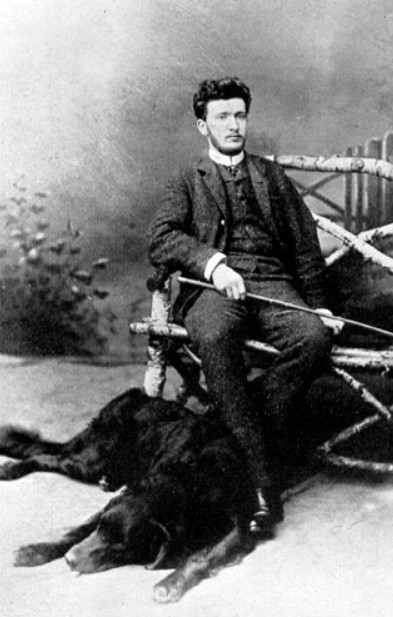
Ferruccio Busoni with his dog Lesko
When he was in his early twenties, traveling through Europe working as a touring pianist, Ferruccio Busoni adopted a Newfoundland dog for companionship. He named him Lesko.
He settled in Helsinki in 1888 and befriended various artistic types living there, including Jean Sibelius. Their circle became known as the Leskovites because Lesko was always present at their meetings.
In 1890, Busoni wrote his Geharnischte Suite, op. 34a. Each movement portrays one of the Leskovites.
Busoni’s Geharnischte Suite, op. 34a
Years after Lesko died, Busoni adopted a St. Bernard named Giotto.
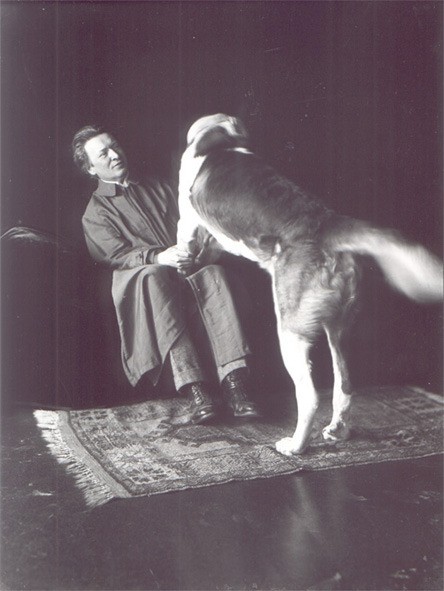
Ferruccio Busoni with his dog Giotto
Elias Canetti wrote in his memoirs about the absent-minded Busoni:
Busoni had a St. Bernard dog, which he often called to: ‘Dschoddo, come to Papa!’ Sometimes the St. Bernard came, sometimes it ran further away; that was what Papa was looking for. But no sooner had he found it than he forgot it again and was as absent-minded as before.
For more of the best in classical music, sign up for our E-Newsletter