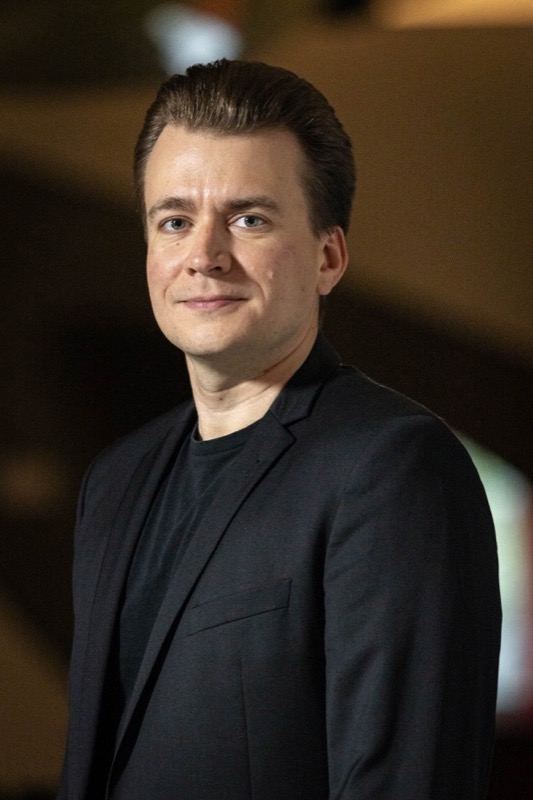
Conductor Christian Thielemann is selective with interviews, but has published three German books in conversation form: My Life with Wagner, My Journey towards Beethoven, and Richard Strauss: Our Contemporary. In November 2026, he leads Staatskapelle Berlin in the Asian premiere of Der Rosenkavalier during the Shanghai Grand Opera House’s opening season. I read with considerable interest his 260-page book on Strauss, published in 2024 and not yet translated into English.
I was curious why Thielemann, a self-described Prussian, is so fascinated by Strauss, a beer-drinking, Skat-playing Bavarian bourgeois. Mozart and Wagner are “two hearts beating within Strauss,” he observes. The hugely popular Der Rosenkavalier exemplifies the book’s exploration of libretto, composition, and conducting practices. Thielemann writes that “Strauss brought extraordinary female figures (Überfrau) into the new century,” dedicating the book “to all the women singers who have given these roles life.”
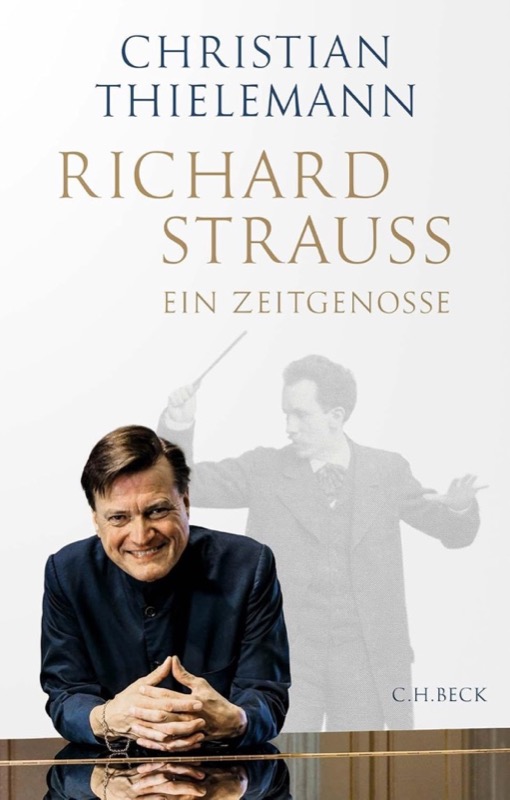
Christian Thielemann’s Book on Richard Strauss
1. From Young Listener to House Guest
As a student, Thielemann switched on the radio in his bedroom and was captivated by the lyrical trombone passage in Strauss’ An Alpine Symphony. He was so spellbound that he “had to listen to the entire work.” He regularly bought student tickets for performances at the Deutsche Oper and the Berlin Philharmonic, hearing Karajan conduct Metamorphosen and Birgit Nilsson sing Die Frau ohne Schatten. Before becoming a conductor, Thielemann spent many years working as an opera répétiteur. “I played the celesta in the pit for Salome,” he recalls, “and during rehearsals for Elektra, I had to play and hum all six of the maids’ scenes.”
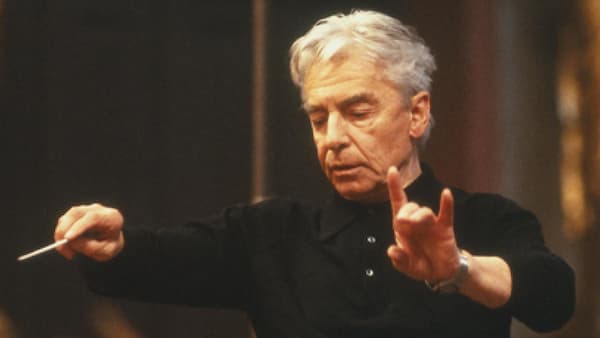
Herbert von Karajan © Siegfried Lauterwasser
Coincidentally, Teatro La Fenice in Venice, which presented Tosca at the Shanghai Grand Opera House in October, was also where Thielemann first conducted Strauss, beginning with Tod und Verklärung, Till Eulenspiegel, Heldenleben, and Zarathustra. He subsequently conducted Der Rosenkavalier in Düsseldorf, Hamburg, Berlin, Baden-Baden, and elsewhere. “People always seemed to like it musically, but I was never satisfied. In fact, I was usually utterly miserable. My tempi were too slow and too sentimental—until I finally realised that the emotion that pervades the score can only emerge if I conduct in an unsentimental manner. That is the Straussian contradictio in adiecto.”
During his time as music director of the Munich Philharmonic (2004–2011), Thielemann often visited the Strauss family home after Sunday performances. “The dishes would already be laid out, steaming hot, and I would dine with the composer’s family members at the very seat where Richard himself had once sat.” The handprints on the writing desk, hundreds of personal letters, a calendar still open to the day of his death, and the precious manuscript of Four Last Songs, kept in a supermarket plastic bag—all these details made him exclaim: “I would really love to meet Richard Strauss in person.” For Thielemann, Strauss was no Romantic prophet, sacrificing himself at the altar of metaphysical ideals, but a “normal genius”: a contemporary man of our time, deeply interested in everyday life, fond of card games and fine cuisine.
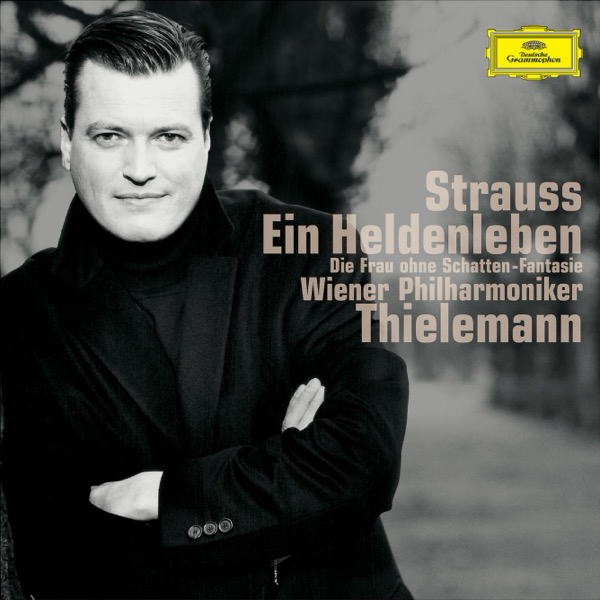
Thielemann’s Strauss Album Cover
2. Wagner and Strauss
“There are two composers who have been crucial to my musical life: Wagner and Strauss.” Listeners familiar with Thielemann will naturally be curious about his understanding of the two Richards. Strauss’ father, a horn player, regarded Wagner as “poison” and did his best to shield his son from his influence. The young Strauss, however, secretly studied Wagner’s scores in depth, developing his own “poetic counterpoint” from Wagner’s daring modulations. In 1889, Strauss served as an assistant at Bayreuth, accompanying Parsifal on the piano. Strauss’ record as a Wagner interpreter was remarkable. Over the course of his life, he conducted 424 performances of Wagner’s operas, including 75 performances of Tristan und Isolde, a work particularly close to his heart.
In Thielemann’s view, Strauss consciously emulated Wagner and ultimately became the undisputed “Richard II.” “Strauss was an enlightened man (Aufgeklärte), whereas Wagner was an expert manipulator.” Thielemann goes on to explain how Wagner drew audiences into the “mystical abyss” of Bayreuth, casting a hallucinatory spell through weighty lower registers and an enigmatic belief in redemption. Strauss, by contrast, pursued soaring high registers, eliciting crystal-like clarity, and refused to sanctify tragedy. As Theaterkapellmeister, Wagner would insist that a particular harpist play a passage even when it was virtually impossible to perform. The pragmatic Strauss, however, would rewrite a passage if he found that it failed to achieve the desired effect.
Thielemann once discussed the subject with the veteran conductor Daniel Barenboim. Both acknowledged that Bayreuth’s “abyss” had shaped their musicality, providing what they called a “pit compass” (Grabenkompass). “Unfortunately, that ‘abyss’ is no place to perform Strauss…his meticulous orchestration would simply dissolve into mush.” Strauss’ orchestras were generally larger than Wagner’s, which meant that conductors had to exercise more careful control over dynamics and layers. As Thielemann puts it: “Strauss’ large, modern orchestral forces taught me how to become a good conductor, just as Wagner sharpened my sensitivity through the pit.”
Christian Thielemann talks about Wagner’s Tristan und Isolde
3. Mozart and Strauss
Thielemann points out that, for Richard Strauss, Mozart was a more enduring “guiding star” than Wagner. As one of the co-founders of the Salzburg Festival in the 1920s and a former president of its organising association, Strauss drew heavily on Mozart in his major works: Die Frau ohne Schatten and Der Rosenkavalier, which refer to The Magic Flute and The Marriage of Figaro, respectively. Thielemann observes: “Wagner constructed monumental architectures, whereas Strauss, like Mozart, always put human beings first.”
In Thielemann’s view, Strauss brought the female characters of Mozart’s operas into the twentieth century. Unlike Wagner’s often victimised heroines, Strauss’s women are vivaciously self-affirming, closer in spirit to Mozart’s Countess or Queen of the Night. Strauss himself once summed up his style as “Mozart’s melodies with Wagner’s orchestra.” Thielemann believes that Strauss’ ideal female voice was likewise Mozartian: a lyrical soprano “with a solid core, but without excessive vibrato or undue saturation.”
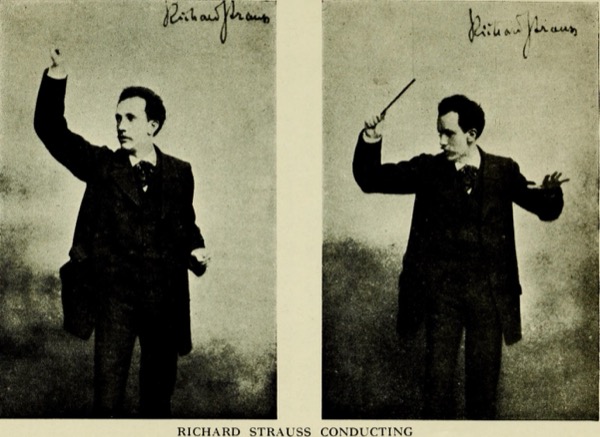
Richard Strauss conducting c. 1900 (Photo from Wikipedia Open Source)
How, then, can we “find the Mozart we have overlooked in Strauss”? Thielemann proposes in his book that conducting Strauss requires a clean, decisive beat (einen klaren Schlag), rather than exaggerated or repetitive gestures. In his youth, he found the conducting style of the great Karl Böhm too understated and felt it needed more emphasis. Only after stepping onto the podium himself did he come to appreciate Böhm’s mastery: a few restrained, Mozartian classical gestures could inspire the orchestra to unleash a torrent of passionate sound.
Take, for example, the Marschallin’s monologue about the passage of time in Der Rosenkavalier. If the singer indulges excessively in self-pity and melancholy, the effect can become almost ridiculous. Thielemann cautions that Strauss’ music, for all its surface sensuality and opulence, can even verge on what conductor Otto Klemperer once denounced as “sugar-water saccharine sentimentality.” The interpreter’s task is therefore to rediscover the Mozartian qualities beneath the surface: simplicity, humour, and lightness.
Christian Thielemann conducts Strauss: Arabella
4. Time Warp
The production of Der Rosenkavalier at the Shanghai Grand Opera House relocates the story, originally set in Mozart’s era, to an imaginary charity performance in Strauss’ own time. Its aristocratic setting incorporates paintings by Gustav Klimt, the Fin-de-siècle Secessionist artist. It features cameo appearances by the writer Stefan Zweig and the sponsor for the poet Rainer Maria Rilke, among others.
Hugo von Hofmannsthal, the librettist of Der Rosenkavalier, once wrote: “At first glance, this seems to be the picture of a bygone age… Yet there is far more of the past in the present than one might imagine.” Thielemann describes Strauss as a “master of untenable situations” (Meister der unhaltbaren Zustände). In Der Rosenkavalier, Strauss brings together yesterday’s world on the verge of disintegration before WWI with artistic ideas that are modern, contemporary, and even avant-garde.
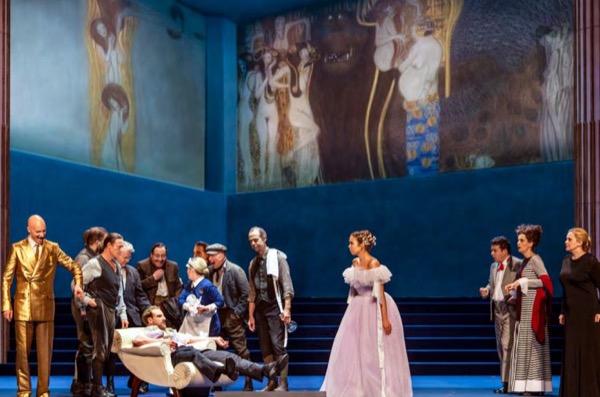
Der Rosenkavalier at Staatsoper Berlin (© Ruth Walz)
In the book, Thielemann pays particular attention to genre. The composer and librettist described this light-hearted, popular “comic opera” (Spieloper) as a “comedy for music” (Komödie für Musik). This is more than a play on words: it emphasises the equal importance of music and drama. Hofmannsthal wanted to develop the characters through their arias, while Strauss sought an overarching symphonic unity throughout the score.
Thielemann observes that Der Rosenkavalier is full of romantic intrigues, mistaken identities, exaggerated characters, and Viennese dialect, combining elements of “operetta” and “lowbrow farce” (Komödienstadl). The third act is particularly striking. What begins as an absurd farce in an inn ultimately gives way to a divine trio between the Marschallin, Octavian, and Sophie. The vulgar and the sublime, the comic and the sentimental, converge in this extraordinary moment.
For Thielemann, the seemingly traditional arias and waltzes of Der Rosenkavalier are precisely what make Strauss’s modernist self-awareness so striking. Following the radical harmonic explorations of Salome and Elektra, Der Rosenkavalier returns to tonality through a Rococo sensibility. But this is no simple exercise in nostalgia. Yet this is no nostalgic retreat, but a collage of historical styles and pastiche. The opera’s only truly conventional aria, the Italian Singer’s song in Act I, both parodies Italian operatic love songs and satirises the Viennese aristocracy’s pretensions to refined taste.
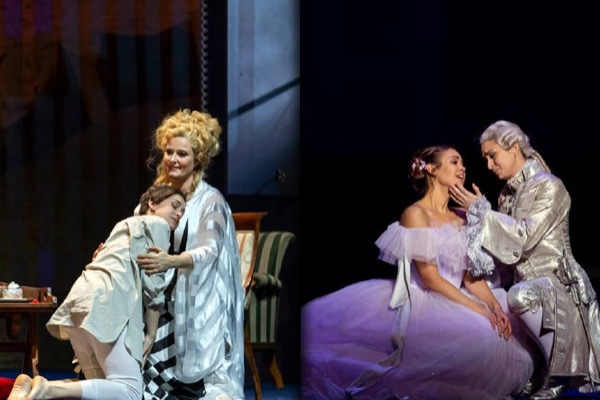
Der Rosenkavalier duos at Staatsoper Berlin (© Ruth Walz)
The waltz further dissolves the boundaries between historical periods. Within an eighteenth-century story, echoes of Mozart, Wagner, and Johann Strauss II intermingle. Thielemann specifically draws attention to the work’s melancholic and ironic appropriation of the waltz Dynamiden: Geheimnisvolle Anziehungskraft. Though no one dances onstage, the music whisks a nineteenth-century bourgeoisie public into an eighteenth-century comedy of mistaken identities (qui-pro-quo): “Der Rosenkavalier is a biting hymn to the courtly capital of Vienna, its intrigues and indignities, its amorous entanglements and thwarted desires, all ending on a bittersweet note.”
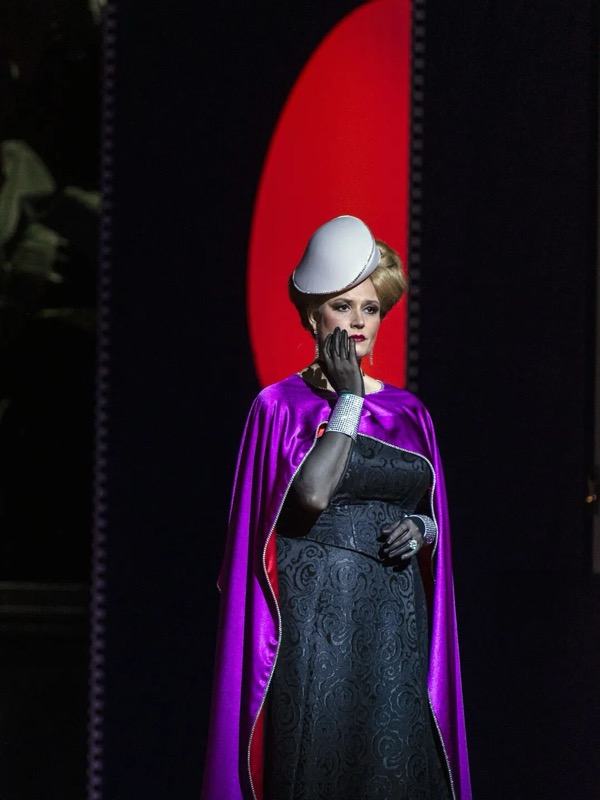
Camilla Nylund as Marschallin at Staatsoper Berlin (© Ruth Walz)
In Thielemann’s view, the Marschallin remains the true centre of Der Rosenkavalier. Though ostensibly a character from Mozart’s The Marriage of Figaro, she possesses the emotional sensibility of an early twentieth-century woman and an almost Freudian degree of self-awareness. In Mozart’s operas, music alone often sees through to the truth. In Strauss’ operas, by contrast, the characters themselves are already highly self-aware. Discussing the role’s recording history, Thielemann expresses particular admiration for the outstanding Marschallin interpreters Elisabeth Schwarzkopf, Gundula Janowitz, Claire Watson (in the Carlos Kleiber recording), and Lisa della Casa (in the Herbert von Karajan recording).
The challenges of conducting Der Rosenkavalier lie not only in balancing Wagner’s dense texture or shaping Mozartian vocal lightness. Thielemann understands the distinctly Straussian art of contradiction: the enormous orchestra must be full of tension while remaining capable of the most intimate expression. The famous trio in Act III, for instance, is marked fortissimo, yet it must never become a contest of volume. Instead, it should convey the inner struggles between competing emotions. As Thielemann puts it: “Strauss’ music revels in thirds and sways in triple metre. The art for us as interpreters lies in walking the narrow ridge between sentimentality and seriousness.”
Christian Thielemann conducts Rosenkavalier Suite
5. A Paradoxical Conclusion
Many more fascinating chapters in Thielemann’s book cannot possibly be covered here: Strauss’ similarities and differences with Schoenberg and Mahler; his relationship with the Nazi regime; the question of whether words or music came first; and analyses of more than twenty symphonic poems and operas, among other subjects.
Thielemann characterises Strauss’ music as follows: “He writes what amounts to sentimental schmaltz, full of saccharine glissandos, yet demands the utmost control and detachment.” Der Rosenkavalier exposes the condition of inauthenticity (Uneigentlichkeit) through parody and artifice. It brings together traces of every historical period, yet belongs to none.
Thielemann describes the experience of conducting Strauss’ music in similarly paradoxical terms: “It’s like landing by plane at night in a gigantic metropolis. Before your eyes stretches an endless, unbelievable spectacle of glittering lights…Can any of this be real?” Perhaps the young Count Octavian was right when he sang: “This is a dream.”
For more of the best in classical music, sign up for our E-Newsletter