A competition result records a moment in a young musician’s development. Years later, the more revealing story may be the repertoire that musician is playing, the teachers they have worked with and the ensembles they have joined. Looking back at Ise-Shima’s earlier young-musician competitions brings those longer journeys into view, as the organisation prepares its third junior edition for 2027.
A history of international exchange
Ise-Shima Art Company’s published history dates its establishment to 2017. Its activities grew out of earlier composition workshops and now include competitions for performers and composers, alongside lyric writing and digital art. The young-musician competition forms part of that wider programme. Across its first two editions, it received at least 700 entries from young musicians around the world.

Ise-Shima Art Company © Ise-Shima Art Company
The people behind the programme bring artistic and organisational experience to different roles. The publicly listed team includes Hajime Kimura as chair of the Competition Executive Committee and Events Management Committee, managers Valeria Makshakova and Irina Yamate, and art director Sumio Kobayashi. Kobayashi is a composer and linguist and an Associate Professor in the Department of Music at Nihon University College of Art. This combination of performance, composition, education and organisation helps explain the breadth of the company’s activities.
Two paths beyond the results list
The first edition’s published results include pianist Maddox Marsollek, a third-prize recipient, and trumpeter Aleksandr Rublev, a first-prize recipient. Their later public records offer two different perspectives on what continued musical development can look like.
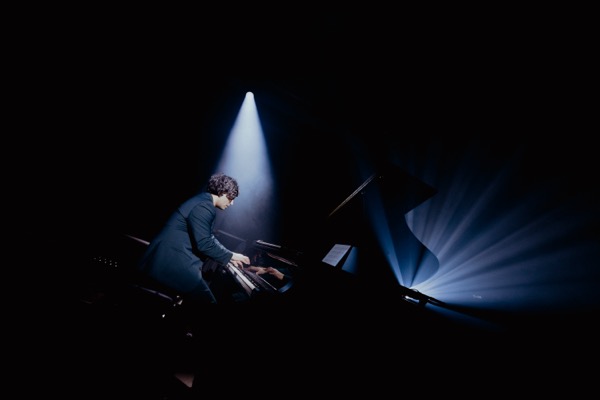
Marsollek’s own account describes piano studies with Elisaveta Blumina from 2019, composition lessons beginning that year and conducting lessons from 2024. A recent concert report from the Patronatskirche in Schulzendorf documents his performance with his violinist brother Miles on 27 September 2026. The programme included Bartók’s Romanian Folk Dances, while Maddox also played a Chopin nocturne. The report describes him both as a solo pianist and as a chamber-music partner: a useful reminder that a young performer’s growth can involve listening and collaboration as much as individual accomplishment.
Rublev’s professional biography at musicAeterna likewise lists his Ise-Shima prize among several international competition achievements. It records his work with the Mariinsky Theatre orchestra in 2024 and his arrival at musicAeterna in 2025, first as a guest and then as a full-time orchestral musician. Here the continuation of a youthful competition record is visible in professional ensemble work.
These are examples of subsequent activity, not evidence that one award caused a career outcome. Teachers, sustained practice and many other musical opportunities belong to each story. Following those activities gives a prize list greater human interest while respecting the limits of what a competition can claim.
How the third edition approaches young performers
The earlier results used ranked prizes within age bands. The 2027 edition uses Gold, Silver and Bronze Awards and an Encouragement Prize for valid entries. Its rules describe an assessment of technique, musicianship, expression, understanding of the work and overall structure, considered in relation to age and the characteristics of the instrument or voice.
Participation is by a continuous, unedited video of one freely chosen piece, lasting from 30 seconds to ten minutes. That format removes the need to travel to Japan and allows musicians to choose repertoire suited to their stage of learning. All instruments, including traditional instruments, and solo voice are eligible. Smartphone recordings are accepted if the performance can be assessed clearly. Jury members with a direct personal connection to an entrant take no part in that entrant’s assessment.
The third edition is open worldwide to musicians aged 3–17 when applying; university students are excluded. Applications close on 31 January 2027 at 23:59 GMT, with results planned for the end of March. Entry costs JPY 5,000 per performance through 17 January, rising to JPY 7,000 for the final fourteen days. Written feedback is optional at an additional JPY 3,000. The official competition page provides the complete rules and application information.
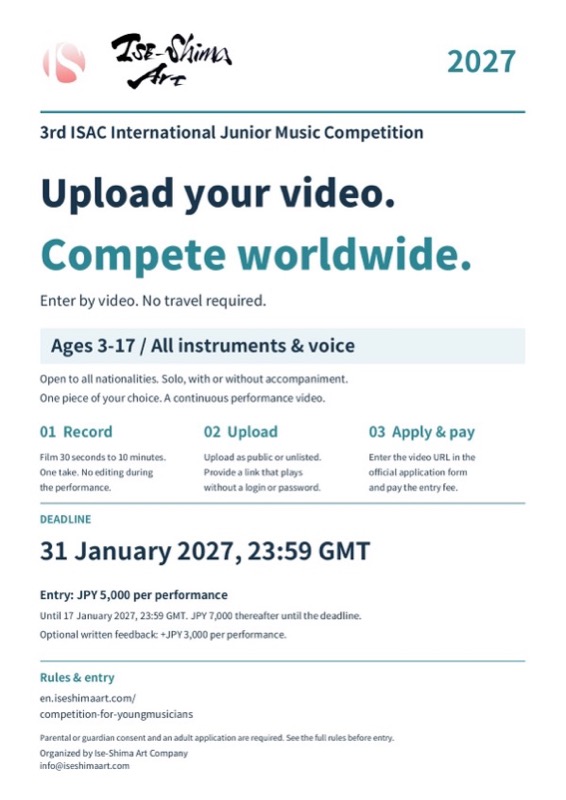
The 2027 junior competition welcomes video entries from young musicians worldwide. © Ise-Shima Art Company
For more of the best in classical music, sign up for our E-Newsletter
Maddox Marsollek (10 y.o.) – Concert at the Berlin State Opera in November 2024
Maddox Marsollek (10 y.o.) – Fantaisie-Impromptu in C sharp minor, op. 66 by Frédéric Chopin
Videos courtesy of Maddox Marsollek (maddox-marsollek.com)