In classical music, it’s rare enough for one composer to become famous, let alone an entire family.
However, there have been a handful of families over the past few centuries who together have had major impacts on the art.
Today, we’re looking at five of the most influential families in classical music history and making a (totally subjective!) list of which ones were most influential.
We’ll be ranking them in reverse order, taking into account the number of noteworthy family members, as well as the nature of their musical talent and accomplishments.
#5: The Strauss Family
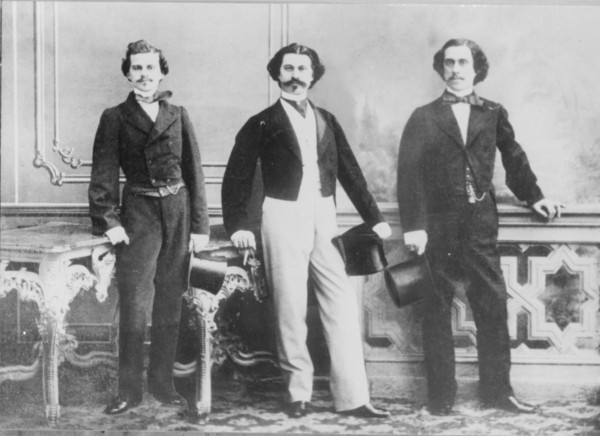
The Strauss family
The Strauss family may not have shaped the very foundations of Western music like some other families did, but they were a big family that had a truly massive cultural impact.
They made waltzes and polkas a European craze and bestowed upon Vienna its musical identity.
Here were some of the players.
Johann Strauss I (1804–1849): Patriarch of the dynasty, violinist, orchestra leader, entrepreneur, and composer of the famous Radetzky March.
He married his wife Maria Anna after she got pregnant in 1825, had five additional children with her, then ruined his relationship with her and his first family by having more children with a mistress.
Johann Strauss II (1825–1899): Johann I’s firstborn son, who was forbidden by his father to study music, enlisted his scorned mother’s help to get violin and composition lessons.
Eventually, he started his own band to compete with his father. After Johann I died of a case of scarlet fever (caught by one of his and his mistress’s young children), Johann II took over his father’s band. Eventually, he wrote the most famous waltz of all time: On the Beautiful Blue Danube.
We covered the story of father and sons in the Waltzing Strauss family.
Strauss’s On the Beautiful Blue Danube
Josef Strauss (1827–1870): Johann II’s younger brother, who initially was an inventor before being drafted into the family business by their mother after Johann II got sick in 1853.
His health declined, and he ended up dying in his forties. His compositions are the most harmonically adventurous of the brothers.
Eduard Strauss (1835–1916): The youngest brother. He directed the Strauss Orchestra and extended the family’s fame into the next century. In a fit of pique toward the end of his life, he also burned many of their papers.
Learn more about the relationship between the three Strauss brothers.
For sheer domination of a single classical music genre, the Strausses were unmatched.
#4 – The Mendelssohn Family
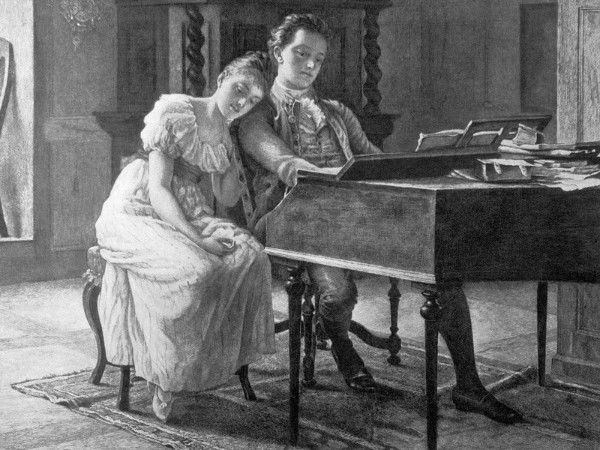
Felix and Fanny Mendelssohn
The Mendelssohn family may not have been particularly large, but it was integral to the artistic development of the two musical siblings, Felix and Fanny Mendelssohn.
Moses Mendelssohn (1729–1786): The self-taught philosopher/theologian grandfather who helped to shape the Jewish Enlightenment of the eighteenth century.
Abraham Mendelssohn (1776–1835): The banker father who invested heavily in his children’s musical education. He made private ensembles available for Mendelssohn to write for and conduct as a child!
Fanny Mendelssohn Hensel (1805–1847): A remarkable child prodigy, virtuoso pianist, and composer of 450 works, despite the fact that she was never allowed to become a professional musician due to her gender. She was her younger brother’s closest creative companion for decades.
Fanny Mendelssohn Hensel’s Overture in C-Major
Felix Mendelssohn (1809–1847): One of the most famous Romantic Era composers; the author of beloved symphonies, concertos, chamber music, and the ever-popular Wedding March.
He was also the man who revived Bach’s St. Matthew Passion (in fact, his maternal great-aunt Sarah Itzig Levy, a student of one of Bach’s sons, was the one who gave him the score).
We wrote about the intense relationship between the Mendelssohn siblings.
The Mendelssohns demonstrate how a single family can make broad impacts not just on classical music, but on wider culture as a whole. Without Moses and Abraham’s drive, success, and wealth, the full range of Fanny and Felix’s genius could never have been developed.
#3 – The Mozart Family
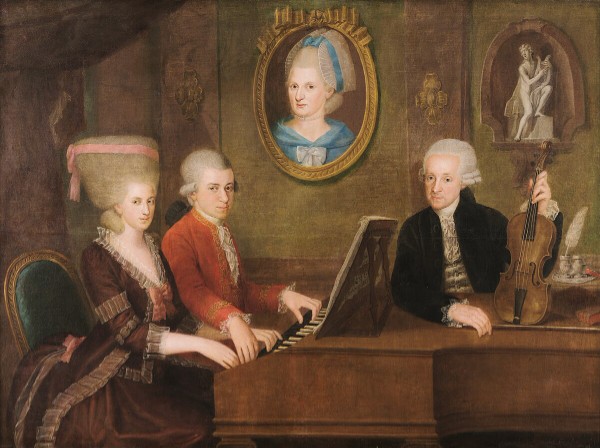
The Mozart family
Although Wolfgang Amadeus Mozart was by far the most famous member of this family, for many years, his life was deeply interconnected with the lives of his father, mother, and sister.
Leopold Mozart (1719–1787): Composer, violinist, author of a famous violin pedagogy treatise. He was the driving (and controlling) force behind his children’s careers, organising their tours across Europe when they were just children, in search of fame and fortune.
Maria Anna “Nannerl” Mozart (1751–1829): A keyboard prodigy and composer (whose works have tragically been lost), her father called her “one of the most skilful pianists in Europe” when she was just thirteen.
She, like Fanny Mendelssohn, was unable to pursue her musical career once she hit marriageable age, solely because of her gender.
Learn more about what happened to Nannerl after she became an adult and was forced to return to being an amateur musician again.
Wolfgang Amadeus Mozart (1756–1791): Her brother, who was her closest friend growing up during their tours, became the archetypal musical wunderkind: composer of operas, symphonies, concertos, and chamber works that remain popular even today.
Trailer to the movie Mozart’s Sister, which traces their childhood
The Mozarts rank so highly on this list because their entire family dynamic was integral to shaping Wolfgang.
Nannerl was one of Wolfgang’s major inspirations as a child. She even helped him to orchestrate his first symphony when he was eight.
Meanwhile, Leopold treated Wolfgang as his own personal pedagogical project until the end of his life. It was a major step for Wolfgang to move away from his family and begin his own freelancing career in Vienna, against his father’s wishes.
#2 – The Wagner Family
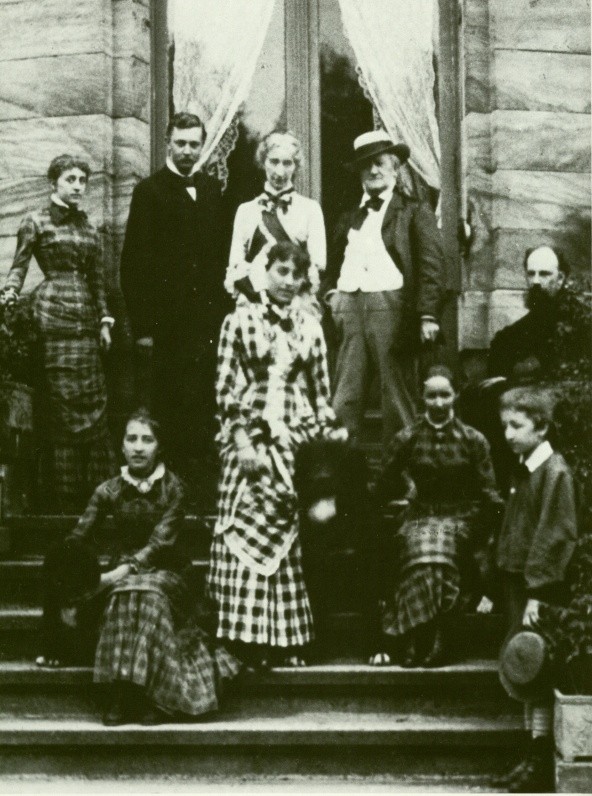
The Wagner family
Arguably, aside from Beethoven, no other composer has had as staggering an impact on culture as Richard Wagner.
After Richard died in 1883, his 46-year-old widow (and Franz Liszt’s daughter) Cosima kept Wagner’s storied Bayreuth Festival alive, and her children and grandchildren have continued the festival to the present day.
Richard Wagner (1813–1883): Composer of Tristan und Isolde, Parsifal, and The Ring Cycle. Also a philosopher, writer, and massively influential anti-Semite.
Cosima Wagner (1837–1930): Franz Liszt’s daughter and Richard’s widow, who supported and journaled about Wagner throughout their marriage, providing priceless insights into his day-to-day thoughts. She ruled Bayreuth with an iron fist until soon before her death.
Learn more about the scandalous start to Richard and Cosima’s relationship.
Siegfried Wagner (1869–1930): Their son, composer of operas and guardian of the family name. He was gay and, after using his position to attract homosexual men to Bayreuth, was pressured in his forties to avoid scandal by marrying a teenage Winifred Wagner. He had four children with her in four years.
Learn more about Siegfried Wagner and his tragic fate.
Wieland (1917–1966) & Wolfgang Wagner (1919–2010): Grandson brothers, sons of Siegfried and Winifred. They reinvented the aesthetic of Bayreuth after World War II with bold stagings of the Wagner operas.
Katharina Wagner (b. 1978): Daughter of Wolfgang, currently co-director of the festival.
The Wagners became curators of a cultural empire, haunted by the ghost of their patriarch in a way that no other present-day classical music family dynasty is.
A documentary about Wagner’s family
#1 – The Bach Family
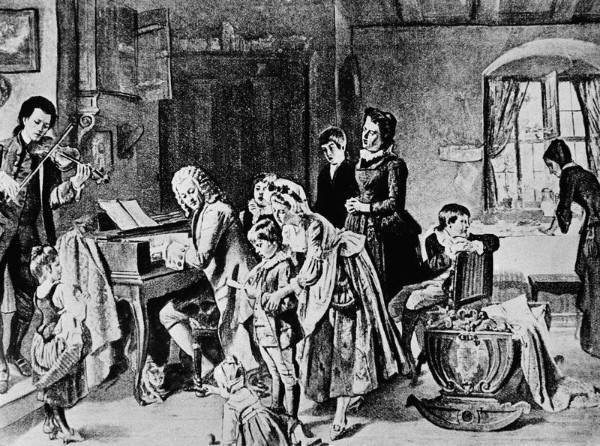
The Bach family
No other family in Western music history can compare to the Bachs for sheer size and influence.
For centuries, the surname Bach was practically a synonym for “professional musician” across Germany.
Johann Sebastian Bach (1685–1750): Composer of the Brandenburg Concertos, the Mass in B Minor, the Goldberg Variations, the St. Matthew Passion, the Well-Tempered Clavier, the Art of Fugue, and too many other masterpieces to list.
He married two women and between them had twenty children. His first wife was his cousin Maria Barbara Bach, who died suddenly at the age of 35. His second wife was a young singer named Anna Magdalena Bach.
A genealogist goes over Bach’s family tree
Wilhelm Friedemann Bach (1710–1784): A son of Maria Barbara, he became a composer, organist, and teacher who worked in Dresden, Halle, Braunschweig, and Berlin (where he taught Mendelssohn’s great-aunt, Sarah Itzig Levy, who we mentioned above).
Carl Philipp Emanuel Bach (1714–1788): Pioneer of the empfindsamer Stil (“sensitive style”), one movement that helped bridge the stylistic gap between the Baroque, Classical, and even Romantic eras.
Johann Christoph Friedrich Bach (1732–1795): Another of the bridge composers between the various musical eras. He got a job in the court of Crown Prince Frederick of Prussia, then later moved to Hamburg. He provided music for royalty, making him musically and culturally noteworthy in European history.
Johann Christian Bach(1735–1782): This son was known as the “London Bach,” who worked in Britain, and whose operas and concertos shaped Mozart’s development. In fact, scholars have described him as “the only true teacher of Mozart.”
Learn more about all twenty of Johann Sebastian Bach’s children.
But here’s the wild thing: this is only two generations of Bachs.
The entire Bach family as a whole consisted of dozens of professional musicians who lived over several centuries. There’s no argument: the Bachs were the most influential family in classical music history, and it seems impossible that anyone could ever dethrone them.
Conclusion
From the dance halls of Vienna to the Festspielhaus of Bayreuth, these families remind us that the great composers didn’t emerge fully formed: they came from families that helped to shape their genius in important ways.
Which musical family do you think was the greatest, taken as a whole?
For more of the best in classical music, sign up for our E-Newsletter