Don Campbell, a music critic and former student of Nadia Boulanger, writes, “To measure the potency of Nadia Boulanger’s influence is impossible. As a tree is rooted firmly to the earth, she was rooted in the history and grammar of Western music.” (Campbell, Master Teacher, 1984)
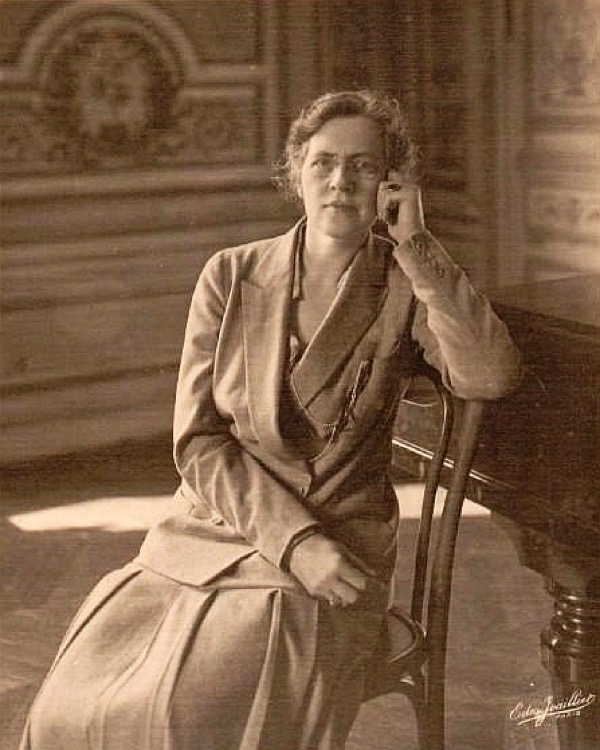
Nadia Boulanger, 1925
Nadia Boulanger, born on 16 September 1887 in Paris, seemed predestined for greatness as she entered the Conservatoire at the age of nine as a student of solfège. Within a couple of years, her musical interests and score reading had developed so well that she studied organ with Alexandre Guilmant, piano accompaniment with Paul Vidal, and harmony with Auguste Chapuis.
Nadia Boulanger: Trois Pièces pour Orgue ou Harmonium, “Prélude in F Minor”
Boulanger Takes the Podium
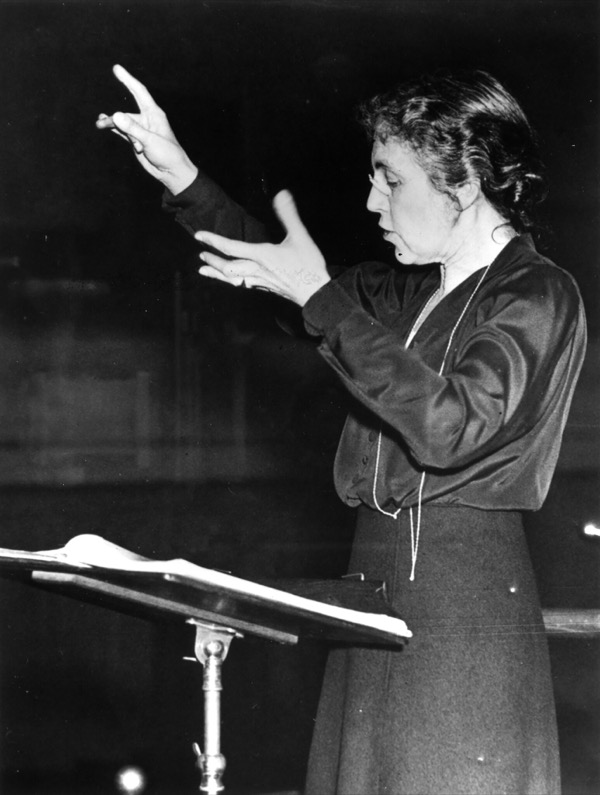
Nadia Boulanger
Not to be outdone, she studied privately with Fauré, Vierne and others, emerging as a true musical polymath who would become of incalculable importance to 20th-century composition, scholarship, and performance.
She was also the first woman to conduct major orchestras in America and Europe, including the London Philharmonic in 1936, the Boston Symphony Orchestra in 1938, and the New York Philharmonic and Philadelphia Orchestra in 1939.
To celebrate her birthday, let’s take a closer look at Boulanger as a conductor and her pioneering, barrier-breaking appearances that revealed her distinct musical vision.
Nadia Boulanger conducts Bach: Christ lag in Todesbanden, BWV 4 (excerpt)
Finding her Voice on the Podium
Throughout her Conservatoire years, conducting was not the principal focus of Boulanger’s studies. However, through her training as a composer, organist, and pianist, as well as her practical music-making, she developed an extraordinary command of orchestral music.
Boulanger actually stepped onto the podium as early as April 1912, when she led the orchestra of the Société des Matinées Musicales in her own La Sirène, two of her songs, and Raoul Pugno’s Concertstück.
More than two decades later, she made her formal Paris conducting debut with the orchestra of the École Normale on 13 February 1934, with a programme that included music by Mozart, Bach, and Jean Françaix. Later that year, she conducted the Orchestre Philharmonique de Paris at the Théâtre des Champs-Élysées in a programme devoted to music by Bach, Monteverdi, and Schütz.
We do get a sense of Boulanger’s conducting style from an observation by Edward Burlingame Hill, who wrote that Boulanger’s conducting “was both competent and inspiring, because of her sympathetic penetration of the music she performed, and her ability to produce a telling interpretation of it.” (Burlingame Hill, The Etude, 1949)
Nadia Boulanger: Fantaisie variée pour piano et orchestre
The Power of Her Hands
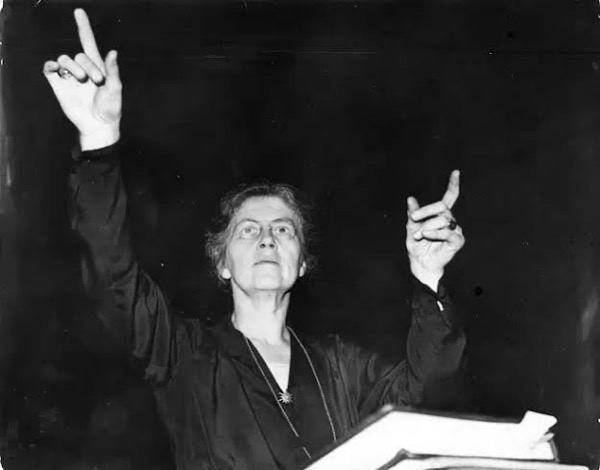
Nadia Boulanger
A more complete assessment dates from 18 February 1938, from a review of her performance of the Fauré Requiem with the Boston Symphony Orchestra. As Evelyn Gilhagen writes in her 1938 article in Independent Woman, here reproduced from a dissertation by Bruce A. Brown, “Mademoiselle Boulanger conducted without a baton, using only her eloquent and beautiful hands, sometimes with a broad sweeping movement, sometimes with a clenched fist.”
So expressive are her hands that she scarcely needs to speak at all. But speak she can and does on occasion. It is whispered that she administered a rather stiff scolding to the orchestra who were inclined to take the Fauré composition as children’s play, but certainly sat up and gave their best after her rebuke. (Brown, Nadia Boulanger: Her Influence on American Music, 1974)
Nadia Boulanger: “It is what the music itself is…”
Boulanger Takes New York
For her debut night with the New York Philharmonic Orchestra at Carnegie Hall, featuring a programme of pieces by her French and Polish students and a section of Monteverdi madrigals, a reviewer in the New York Times from 12 February 1939 writes, “When Mademoiselle Boulanger, a nobly dignified but unassuming figure in white, first came on the stage she was greeted by the first of the many ovations that thereafter followed her endeavours throughout the evening.”
“She conducted without baton, but her every gesture was so sharply defined and significant that the results were admirable in precision, clearness of outline and tonal balance. She was completely the master of style in all she touched, and her insight into the character and needs of the highly contrasted works she set forth was unfailingly deep and penetrating.”
Nadia Boulanger on Teaching and Talent
More Than a Pioneer
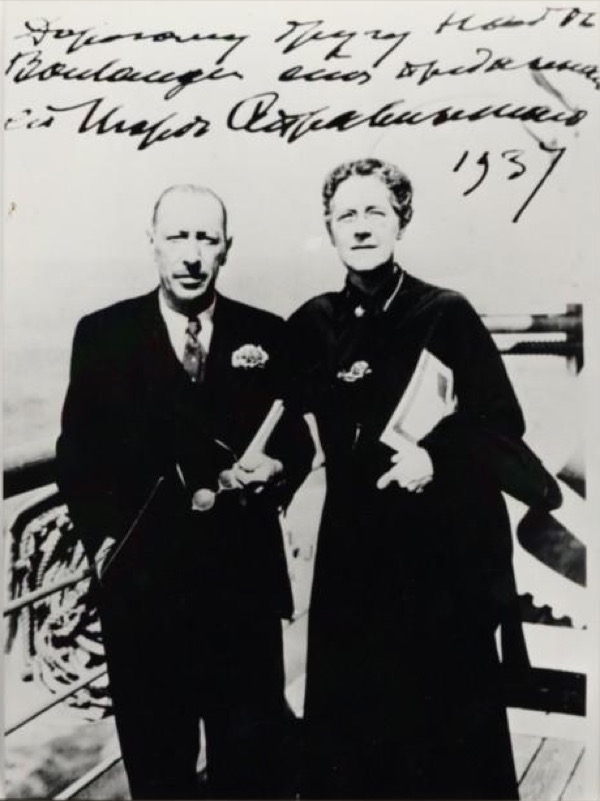
Igor Stravinsky and Nadia Boulanger, 1937
“It was as director of her vocal group that she made a most unforgettable impression. For lack of space it is impossible to go into details here concerning the manifold beauties of the readings she and her splendid little aggregation of singers gave to the several great masterpieces of Monteverdi which formed the highlight of the evening’s contributions. All those present will long remember the flowing line, the sensitive feeling and the evocation of mood and atmosphere produced…” (Nadia Boulanger in Brilliant Debut, New York Times, 1939)
More recent scholarship has suggested that Boulanger’s conducting career was more substantial and musically important than the familiar story of a pioneering woman who broke into a male-dominated domain.
It grew from her extraordinary knowledge of repertoire and a sense of musical responsibility. As Jeanice Brooks suggests, her being a woman conducting major orchestras was unquestionably remarkable, but that was not what made her conducting distinctive. Her authority came from her musicianship, with conducting a natural extension of her deep musical pedagogy. (Brooks, The Journal of Musicology, 1996)
Igor Stravinsky conducts Stravinsky: Dumbarton Oaks Concerto
Music Comes First
Boulanger repeatedly presented herself as a servant of the music. Contemporary descriptions of her conducting never describe a conductor of theatricality or flamboyant ego. She always had precision and clarity in her gestures, communicated through intellectual authority and emotional directness.
Her colleagues and contemporaries valued her for exactly those reasons. When Igor Stravinsky was prevented by illness from conducting the premiere of his Concerto at the Dumbarton Oaks Music Room on 8 May 1938, Nadia Boulanger was called upon to lead the performance. She also conducted the private premiere of Francis Poulenc’s Concerto for Organ, Strings and Timpani, in December of that year.
As a conductor, Nadia Boulanger was central to the rebirth of public performances of pre-Classical music, particularly Renaissance and Baroque works. In one of her last appearances in New York with the New York Philharmonic in 1962, she conducted works by her sister, Virgil Thomson, and the Fauré Requiem. That performance was dedicated to the memory of Bruno Walter, who had died the night before.
For more of the best in classical music, sign up for our E-Newsletter