Over nearly thirty years, Beethoven wrote sixteen string quartets. Each one was unique, but they fall into three groups.
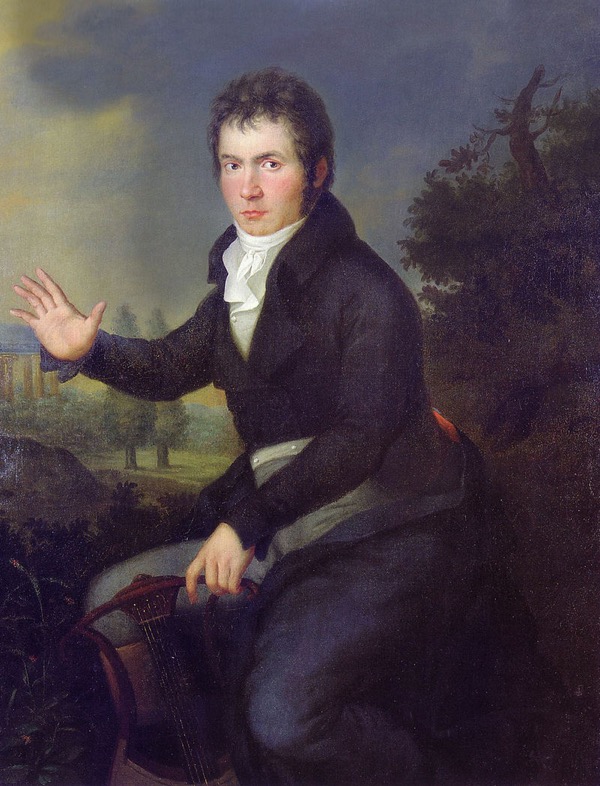
Joseph Willibrord Mähler: Beethoven, 1804 (Vienna Museum)
The early quartets. The six quartets that make up Beethoven’s Op. 18 were written between 1798 and 1800. They are more conservative compared to his later avant-garde works, but there are hints – like in his use of sudden dynamic swings – of his mature style.
The middle quartets. Beethoven’s middle five string quartets – the three “Razumovsky” quartets in the Op. 59 (1806), plus the Op. 74 “Harp” (1809) and Op. 95 “Serioso” (1810) – were longer and more experimental.
The late quartets. These final five quartets – his Op. 127, 130, 131, 132, and 135 – were written in the final few years of Beethoven’s life. By this time, he had gone completely deaf and was writing down what he was imagining in his inner ear. The result was a set of challenging works that stray far from conventional form and harmony.
Beethoven’s quartets are among his most personal works and are worth a listen for every classical music lover. But with sixteen, it can be hard to know where to start.
Today we’re providing a short introduction to each quartet and ranking them. We turned to YouTube, checked the view count of each quartet’s most popular video, and listed them from least to most popular.
Keep reading until the end to find out which quartet is most popular.
String Quartet No. 5 in A major, Op. 18, No. 5
62k views
This is the least popular Beethoven quartet on YouTube.
Beethoven modelled this quartet on Mozart‘s Quartet in A major, K. 464, which in turn had been dedicated to Haydn – making it a double tribute to both men.
The key and movement order copy Mozart’s, and the second movement is a graceful Mozartian minuet, as opposed to the scherzo Beethoven preferred in the other early quartets.
The third movement, meanwhile, is a theme and variations.
String Quartet No. 2 in G major, Op. 18, No. 2
99k views
This quartet is the fifteenth most popular Beethoven quartet on YouTube.
According to musicologist Michael Steinberg, “In German-speaking countries, the graceful curve of the first violin’s opening phrase has earned the work the nickname of Komplimentier-Quartett, which might be translated as ‘quartet of bows and curtseys’.”
String Quartet No. 6 in B-flat major, Op. 18, No. 6
101k views
This quartet is the fourteenth most popular Beethoven quartet on YouTube.
This quartet closes out his early set of six quartets.
Its most memorable moment is a lengthy slow introduction to the finale that Beethoven labelled “La Malinconia” (The Melancholy), which begins at 18:10 in the performance above. It features chromatic harmonies that are wildly forward-looking and even disorienting. It’s the clearest signal of the many innovations and experiments ahead.
String Quartet No. 12 in E-flat major, Op. 127
103k views
This quartet is the thirteenth most popular Beethoven quartet on YouTube.
It is the first of his final set of quartets. It had been over a decade since he’d written one – his longest break from the genre.
At this point, late in his life and career, he was interested in experimentation. He proved it by creating a massive, fifteen-minute-long slow movement, consisting of a spacious theme and variations.
String Quartet No. 3 in D major, Op. 18, No. 3
103k views
This quartet is the twelfth most popular Beethoven quartet on YouTube.
This quartet was the first to be composed, when Beethoven was 27. However, when he published it in 1801, he numbered it as his third.
Given the boldness of his later writing for quartet, the opening movement begins unusually timidly – although it slowly but surely gains confidence as it goes. Some have read this tentative opening as a young composer’s caution before stepping into Haydn and Mozart’s territory.
String Quartet No. 11 in F minor, Op. 95 “Serioso”
132k views
This quartet is the eleventh most popular Beethoven quartet on YouTube.
The nickname is Beethoven’s own. He wrote “Quartetto serioso” on the manuscript himself. “Serioso” in this context refers to the terse character of the piece, not sadness.
He wrote in a letter to English conductor Sir George Smart, “The Quartet is written for a small circle of connoisseurs and is never to be performed in public.”
String Quartet No. 8 in E minor, Op. 59, No. 2
140k views
This quartet is the tenth most popular Beethoven quartet on YouTube.
Supposedly, the slow movement was inspired by stargazing. According to Beethoven’s student Carl Czerny, Beethoven claimed the second movement came to him while he was looking at the night sky and thinking about the music of the spheres.
Beethoven wrote a rare performance instruction directly into the score. In that slow movement, he asked performers to “treat this piece with a great deal of feeling.”
String Quartet No. 16 in F major, Op. 135
152k views
This quartet is the ninth most popular Beethoven quartet on YouTube.
It’s Beethoven’s last completed work in any genre. He finished Op. 135 in October 1826, roughly five months before his death. The only later music he wrote was the replacement finale for Op. 130, which replaced the Grosse Fuge.
He headed the final movement “The difficult decision.” Under the slow chords that open it, he wrote in the manuscript, “Must it be?” Then, where the tempo picks up, he wrote, “It must be!”
String Quartet No. 9 in C major, Op. 59, No. 3
153k views
This quartet is the eighth most popular Beethoven quartet on YouTube.
This is one of the three quartets written for Count Andreas Razumovsky, the Russian ambassador in Vienna. The other two feature Russian themes; this is the only one of the three without a Russian theme – although over the years, commentators have noticed Russian qualities.
The finale builds to what’s often described as an implicit triple fortissimo (fff) – a rare time when Beethoven requested his players to perform as loudly as possible.
String Quartet No. 10 in E-flat major, Op. 74 “Harp”
181k views
This quartet is the seventh most popular Beethoven quartet on YouTube.
The “Harp” nickname was his publisher’s idea, not Beethoven’s. It refers to pizzicato passages in the first movement where pairs of instruments trade plucked arpeggios back and forth, imitating a harp’s sound.
The quartet was written in 1809, the same year Napoleon‘s forces besieged and shelled Vienna. During the bombardment, Beethoven reportedly fled to his brother’s cellar with pillows pressed over his ears, trying to protect what remained of his hearing.
String Quartet No. 13 in B-flat major, Op. 130
190k views
This quartet is the sixth most popular Beethoven quartet on YouTube.
The fifth movement, performed by the Budapest String Quartet, was included on the Voyager Golden Record in 1977. The Voyager Golden Record was sent to interstellar space, where it is hoped it will cross paths with extraterrestrials.
The premiere in March 1826 included the massive Grosse Fuge as the finale. Still, audience and publisher pushback led Beethoven to detach it and compose a shorter, lighter replacement finale. The fugue was then published separately as Op. 133. Today the Fugue is celebrated as one of Beethoven’s great masterpieces.
String Quartet No. 4 in C minor, Op. 18, No. 4
226k views
This quartet is the fifth most popular Beethoven quartet on YouTube.
It’s the only quartet in Op. 18 in a minor key.
It has no traditional slow movement. In place of the usual adagio, Beethoven substitutes a light, fugal “Andante scherzoso.”
The third movement is a minuet and trio. Placing these two movement types side by side was unusual.
String Quartet No. 1 in F major, Op. 18, No. 1
280k views
This quartet is the fourth most popular Beethoven quartet on YouTube.
It wasn’t actually his first string quartet. Despite opening the Op. 18 set, it was the second quartet Beethoven composed. Beethoven likely placed this one first in the set because he considered it the most impressive of the six.
According to Beethoven’s friend Karl Amenda, the Adagio was inspired by the tomb scene from Romeo and Juliet. Surviving sketches also include phrases like “he comes to the tomb,” “despair,” “he kills himself,” and “the last sighs,” lending credence to Amenda’s story.
String Quartet No. 15 in A minor, Op. 132
653k views
This quartet is the third most popular Beethoven quartet on YouTube.
Beethoven titled the third movement “Holy song of thanksgiving of a convalescent to the Deity, in the Lydian mode” after recovering from intestinal illness he feared would be fatal.
Beethoven’s sketches suggest that the theme of the final movement was originally meant to be an instrumental conclusion to his ninth symphony, before he settled on the choral finale we know today.
String Quartet No. 14 in C-sharp minor, Op. 131
719k views
This quartet is the second most popular Beethoven quartet on YouTube.
It consists of seven movements played without a break – an unusual structural choice for a string quartet at the time.
It was Beethoven’s favourite late quartet. He wrote to a friend that he’d found “a new manner of part-writing and, thank God, less lack of imagination than before.”
It was reportedly the last music Franz Schubert wanted to hear – a quartet performed at his bedside five days before he died.
String Quartet No. 7 in F major, Op. 59, No. 1
1.6 million views
Here it is, the most popular Beethoven quartet on YouTube.
It is the first of the three “Razumovsky” quartets. The finale’s “Russian” theme was a specific favour to the dedicatee, Count Razumovsky.
At around 40 minutes, this quartet is more than half again as long as Beethoven’s earlier Op. 18 quartets. The shift in scale left the Schuppanzigh Quartet, which premiered the quartet, overwhelmed – a reaction that was provoked by several of Beethoven’s premieres in this period.
For more of the best in classical music, sign up for our E-Newsletter