Preface / Abstract
The present study articulates a theoretical approach regarding the origin of musical harmony, examining it not only as a mathematical or aesthetic phenomenon, but also as an expression of human communication, language, and spiritual experience. The core hypothesis of this work is that the empirical observation of human vocal behavior and the natural synchronization of voices during states of agreement or disagreement among people may have contributed to shaping the earliest concepts of musical consonance and dissonance, prior to their systematic mathematical foundation by the Pythagorean school.
The study further explores ancient Greek philosophy, Greek prosody, and Pythagorean ratios in shaping musical thought, alongside the historical continuity of the Greek musical tradition from antiquity to the Renaissance. It views music philosophically as a tool for spiritual cultivation. The work offers an interpretative hypothesis rather than a verified historical account, aiming to foster interdisciplinary dialogue.
Keywords: musical harmony, theory of the origin of music, ancient Greek music, Pythagoras, Harmony of the Spheres, ancient Greek philosophy, musical aesthetics, prosody of the Greek language, musicology, history of music, Western musical tradition.
Introduction
The birth of musical harmony reflects both mathematical observation and a deep study of human communication, where human relationships find acoustic expression. As Plato notes regarding musical education and the soul, music actively shapes character and inner order.
The Observation of Human Voices
Philosophers noted that agreement among people produces balanced vocal sounds, whereas disputes lead to cacophony. This empirical link between vocal synchronization and emotional alignment suggests that concepts of consonance and dissonance may have roots in human social behavior before their formal Pythagorean mathematical formulation. Similarly, close personal bonds often lead to a subconscious synchronization of speech, while emotional distance preserves discord. This connects with Aristotle’s view of man as a political animal, where social communication serves as a natural ground for observing acoustic harmony.
Pythagoras and the Mathematical Foundation of Harmony
This empirical observation acquired a scientific basis through the work of Pythagoras. Utilizing the monochord instrument, the great philosopher and mathematician measured the ratios of sounds and demonstrated which relationships produce consonant and which produce dissonant acoustic combinations.
From these mathematical ratios, the following were born:
the octave,
the musical intervals,
the consonant and dissonant chords,
and the entire theoretical structure of Western musical harmony.
Harmony thus acquired not only an aesthetic but also a mathematical foundation. For the Pythagoreans, number was not merely a tool for measurement but the very structure of reality. The famous “Harmony of the Spheres” expressed the notion that the entire universe is governed by mathematical ratios, the very same that govern music. Thus, music was deemed a reflection of the cosmic order.
The Relationship of the Greek Language with Music
The close relationship of the ancient Greek language with music presents particular interest. Ancient Greek speech was prosodic; that is, it was based on the variation of the pitch of the voice, as still occurs today in certain Eastern languages.
The biblical phrase is not accidental:
“In the beginning was the Word” (Logos).
Through ancient Greek speech, prosody developed, featuring short and long vowels, as well as the system of accents and breathings:
The acute accent (oxeia) raised the pitch of the tone.
The grave accent (bareia) lowered it.
The circumflex accent (perispomene) created a characteristic curve of the voice.
The smooth breathing (psile) lightened the articulation.
The rough breathing (daseia) imparted greater weight and fullness to the sound.
The Greek language possesses seven vowels, while the musical octave is organized into seven basic intervals. Through the setting of ancient poetry to music, melody was born, which, combined with consonance and dissonance, constituted the complete harmonic system.
The significance of ancient Greek prosody for the musical setting of ancient dramatic texts has also been an object of my multi-year educational and artistic application, through seminars and presentations in secondary education school units.
Martin Heidegger maintained that “language is the house of Being” (Brief über den Humanismus). If speech constitutes the place within which human existence is revealed, then the musical prosody of the Greek language acquires a special significance as a vehicle not only of meaning but also of acoustic expression.
From Ancient Tragedy to the Birth of Opera
In ancient Greece, music was a sacred art, the privilege of initiates, poets, and philosophers. As mystery-bound knowledge, it was not fully recorded, which resulted in the loss of a large part of the ancient musical tradition.
The sacred dimension of music in ancient Greece is directly linked to mystery worship. In the Eleusinian, Orphic, and Dionysian Mysteries, music, rhythm, and hymn were not simply artistic elements of the ritual, but fundamental means of initiation, purification, and spiritual participation of the faithful. Music functioned as a vessel of transition from the sensory to the symbolic and spiritual world, expressing the deep connection of art with religious experience (Burkert, 1987; Burkert, 1985).
According to the mythological and religious tradition of the ancient mysteries, already in the Cabeirian Mysteries, Prometheus appears as a benefactor of humankind, offering not only fire but also the arts and knowledge that establish human civilization. This tradition symbolically connects music with the divine origin of knowledge and creation.
In the Eleusinian Mysteries, the myth of the abduction of Persephone and her search by Demeter symbolized the cycle of death and rebirth of nature and man. The procession of initiates followed the Sacred Way from Athens to Eleusis under the light of torches, accompanied by hymns and ritual chantings. Within the Telesterion, music constituted an integral element of the mystagogical experience, reinforcing the symbolic and spiritual character of the ceremony.
Under this perspective, music was not treated in the ancient Greek tradition exclusively as a form of aesthetic expression, but also as a means of spiritual cultivation, initiation, and approach to the divine. This conception contributed decisively to shaping the special position that music held in Greek philosophy, education, and religious life (Otto, 1965).
During the Renaissance, in Florence, the effort to revive ancient Greek tragedy led to the creation of opera. Guided by surviving written sources, the Pythagorean musical system, and the mathematics of harmony, the seven-stringed lyre of Apollo acquired new life.
From this musical rebirth emerged the most significant works of Western classical music: operas, oratorios, symphonies, concertos, ballets, and the symphonic creation of supreme composers such as Mozart, Beethoven, Handel, Bach, Verdi, Tchaikovsky, Mahler, and Wagner.
The present study contends that crucial principles of the Western musical tradition can be interpreted as a continuation of the theoretical framework shaped in ancient Greek musical thought, particularly through the Pythagorean theory of numerical ratios.
The Continuity of Greek Music in the Orthodox Tradition
Despite the loss of ancient secular music, the Greek musical tradition did not disappear. It was preserved alive within the liturgical practice of the Greek Orthodox Church.
The structure of the Divine Liturgy presents analogies with ancient tragedy: the priest assumes the protagonist role, while the cantors function as the chorus. The absence of the orchestra preserved the ritual character of worship, preventing the secularization of liturgical music.
Ancient Greek prosody continues to hold a central position. The language of the New Testament and hymnography remains Hellenistic Koine, while Byzantine music utilizes the prosodic characteristics of the Greek language with particular virtuosity, creating a unique melodic universe.
The Absence of Harmony in Byzantine Music
The absence of instrumental accompaniment and vertical harmony limited the development possibilities of Byzantine music into large-scale symphonic works, corresponding to Western oratorios, masses, and requiems.
Thus, works such as the St Matthew Passion by Bach, the Missa Solemnis by Beethoven, the Messiah by Handel, or the Requiems of Mozart, Brahms, and Verdi became possible to create thanks to the evolution of polyphonic and symphonic harmony.
Music Reception and Music Education
The historical evolution of Western music, from the tonal harmony of Mozart and Classicism to the extended harmonic structures of Scriabin and the atonal twelve-tone method of Schoenberg, reflects the continuous expansion of the aesthetic and expressive possibilities of musical creation. Each historical period introduced new ways of organizing musical discourse, gradually widening the boundaries of the acoustic experience.
The reception of different musical idioms by the public is not uniform, but is influenced by factors such as music education, familiarity, cultural habits, and personal aesthetic preferences. Simpler melodic and rhythmic forms are usually perceived more immediately, whereas more complex harmonic works often require greater acoustic experience and familiarity with the art music tradition.
My experience as a composer and opera creator leads me to the empirical observation that during lyric theater performances, a portion of the audience responds more intensely to works with strong dramatic and orchestral climaxes, while more lyrical or extended melodic sections presuppose a different manner of listening and greater concentration. This observation does not constitute a general rule, but indicates that the aesthetic reception of music is closely linked to the cultivation of musical listening.
Under this light, the Platonic position that musical education holds a prominent position in the formation of man acquires particular significance. The gradual cultivation of acoustic perception allows the listener to approach deeper levels of musical structure and expression, beyond immediate melodic or rhythmic pleasure.
The theory of musical modes developed in ancient Greece and the Pythagorean conception of numerical ratios constituted fundamental elements of European musical thought. The ancient modes, such as the Dorian, Phrygian, Lydian, and Aeolian, exerted a significant influence on the subsequent evolution of Western music theory, either directly or through their theoretical reception during the Renaissance and modern times.
The Evolution of Dissonance: From Extended Tonality to Avant-Garde Fragmentation
In examining the trajectory of Western art music, a crucial distinction must be made between the intentional expansion of harmonic boundaries and the ultimate fragmentation of musical discourse. As contemporary musicologists have noted, the early modernist transition did not inherently sever ties with the past. A paradigm of this organic evolution is Arnold Schoenberg’s early masterpiece, Verklärte Nacht (1899), which represents the zenith of late-Romantic extended tonality, operating within a deeply expressive and continuous harmonic framework before his later systemic development of the twelve-tone technique.
However, the subsequent post-war avant-garde movement pushed these boundaries into a radical rupture. Within high-modernist avant-garde textures, traditional melodic syntax, structural continuity, and vertical harmony are frequently replaced by systemic discontinuity and acoustic fragmentation. From the perspective of an active composer rooted in classical principles, such radical fragmentation risks appearing incoherent, as it dismantles the foundational communicative link between the artwork and the listener. While early modernism proved a profound engagement with traditional harmonic resonance, the extreme alienation found in late 20th-century avant-garde experimentation stands in direct opposition to the ancient Pythagorean and Platonic concept of harmonia—which seeks not the dissolution of structure, but a cohesive, teleological synthesis that elevates the human psyche.
The Timelessness of Music
The evolution of symphonic music was also accompanied by the gradual popularization of musical theater through operetta, dances, and lighter musical genres. However, the core of musical creation still resides in the Pythagorean system of the “Harmony of the Spheres,” where music functions as a means of connecting man with the divine.
Modern developments in astrophysics, such as the detection of gravitational waves originating from the merger of black holes and the study of the primordial gravitational wave background, demonstrate that the universe is characterized by dynamic oscillations and mathematical regularities. Although gravitational waves are not acoustic waves in the physical sense of the term, the conversion of their signals into an auditory format for scientific analysis recalls the timeless Pythagorean idea of a cosmic harmony governed by ratios and rhythms. Under this philosophical prism, music can be understood as an aesthetic expression of the human search for beauty and order, functioning as a bridge between human experience and the idea of harmony attributed to cosmic reality.
In the works of the great ancient Greek creators—Homer, Aeschylus, Sophocles, Euripides, and Plato—the spiritual dimension of music is preserved, according to this specific view.
The seven notes of music have given birth to countless and unique melodies over millennia and continue to constitute an inexhaustible source of creation. The music of Apollo’s Muse remains timeless and eternal, because eternity resides within melody.
Heraclitus reminded us that “from things that differ comes the fairest harmony”. Harmony is not the absence of differences but their creative synthesis. This same principle characterizes music as well, where tension and resolution, consonance and dissonance, are not opposite concepts but complementary forces of artistic expression.
Schopenhauer considered music to be “the immediate expression of the will,” meaning the deepest essence of the world. Correspondingly, Nietzsche wrote that “without music, life would be a mistake”. Although these views belong to different philosophical systems, they converge in recognizing music as a primary form of human experience.
Conclusion
This theory approaches musical harmony not only as a mathematical or aesthetic phenomenon, but as an expression of human communication, language, and spirituality. Ancient Greek thought, the prosody of language, Pythagorean mathematical theory, and the timeless evolution of Western music compose a unified historical and philosophical journey that continues to inspire musical creation to this day.
Epilogue: The Theory as a Source of Contemporary Musical Creation
The idea of light as a symbol of knowledge runs through the entire history of Greek civilization, from ancient Greek mythology to the Christian tradition. In modern physics, light constitutes a fundamental form of interaction and a basic element of the structure of the universe, which imparts a special philosophical dimension to its symbolism. Under this perspective, the path of light can be interpreted as a timeless journey of knowledge, civilization, and the spiritual evolution of man.
This conception also formed the ideological axis of my compositional creation in the “Greek Tetralogy”, a cycle of four musical dramas that deal successively with the transmission of knowledge and spiritual tradition. In Prometheus Bound, based on the tragedy by Aeschylus, light symbolizes the knowledge offered to man. In the opera Olympic Flame – Trachiniae, inspired by Sophocles, the Olympic flame expresses the reconciliation and unity of man with the divine. In Alexander the Great, based mainly on Arrian and Johann Gustav Droysen, light functions as a symbol of the dissemination of Greek civilization and the Greek language to the wider known world of that time. Finally, in the work Light of Christianity, inspired by the Gospels of the New Testament, the symbolism of light is transformed into an expression of spiritual rebirth, love, and the salvation of man. In this manner, the artistic creation attempts to render musically the timeless continuity of an idea that connects ancient Greek thought with the Christian tradition through the common symbolism of light.
PROMETHEUS BOUND IN THE NATIONAL OPERA OF BULGARIA
This staging of my opera “Prometheus Bound” at the National Sofia Opera exemplifies how modern symphonic and operatic harmony organically evolves from the dramatic rhythm, prosody, and emotional inflection of ancient Greek tragedy.
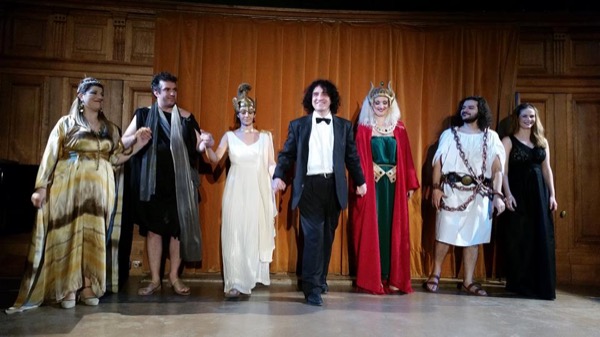
Performance photo from the 2016 staging of “Prometheus Bound” at the Richelieu Amphitheatre of the Sorbonne University in Paris. Featured from left to right: Vanessa Kalkanis, Philippos Modinos, Kassandra Dimopoulou, composer Panagiotis Karousos, Irini Konsta, Vasilis Asimakopoulos, and Victoria-Fioralba Kiazimi.
Irini Konsta – Io’s aria from Prometheus Bound by P. Karousos
This aria performed at the Megaron of the Old Parliament in Athens demonstrates the lyrical application of the Pythagorean melodic foundation, showcasing how cosmic harmonic ratios guide the vocal and orchestral structure.
Bibliography
Primary Sources
Aristotle. Politics.
Aristotle. On the Soul (De Anima).
Plato. Republic.
Plato. Timaeus.
Plato. Laws.
Aristoxenus. Harmonic Elements.
Claudius Ptolemy. Harmonics.
Nicomachus of Gerasa. Manual of Harmonics.
Modern Bibliography
Barker, Andrew. Greek Musical Writings. Cambridge University Press.
Burkert, Walter. Lore and Science in Ancient Pythagoreanism. Harvard University Press.
West, M. L. Ancient Greek Music. Oxford University Press.
Mathiesen, Thomas J. Apollo’s Lyre. University of Nebraska Press.
Levin, Flora (ed.). The Harmonics of Nicomachus and the Pythagorean Tradition.
Sachs, Curt. The Rise of Music in the Ancient World.
Grout, Donald J., & Palisca, Claude V. A History of Western Music.
Taruskin, Richard. The Oxford History of Western Music.
Burkert, Walter. Ancient Mystery Cults. Cambridge, MA: Harvard University Press, 1987.
Burkert, Walter. Greek Religion. Cambridge, MA: Harvard University Press, 1985.
Otto, Walter F. Dionysus: Myth and Cult. Bloomington: Indiana University Press, 1965. (First German edition 1933)
Levin, Flora R. The Harmonics of Nicomachus and the Pythagorean Tradition. University Park: The Pennsylvania State University Press, 1975.
Taruskin, Richard. 2010. The Oxford History of Western Music. Vol. 4, The Early Twentieth Century. Oxford: Oxford University Press.
Philosophical Sources
Schopenhauer, Arthur. The World as Will and Representation.
Nietzsche, Friedrich. The Birth of Tragedy.
Heidegger, Martin. Letter on Humanism (Brief über den Humanismus).
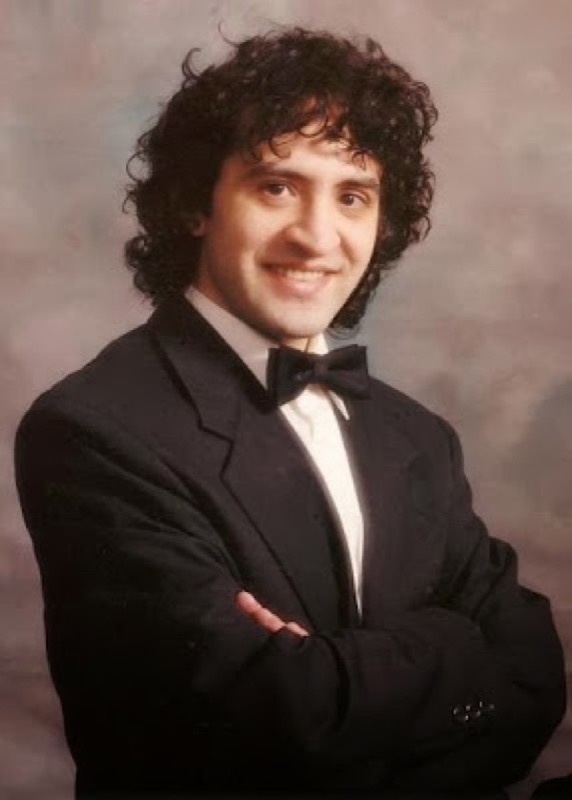
Portrait of Panagiotis Karousos
Panagiotis Karousos is an opera and classical music composer with multi-year international artistic activity. During the last twenty years, his works have been presented in the United States, Canada, Argentina, and European countries, in prominent concert and academic venues, including Lincoln Center (New York), Place des Arts (Montreal), the Royal College of Music (London), the Sofia National Opera and Ballet, the Amphithéâtre Richelieu of the Université Paris-Sorbonne, the Basilique Notre-Dame de Montréal, the Little Theatre of Ancient Epidaurus, the Ecclesiastes (Odeon) of Ancient Messene, the Veakeio Theatre, and the United Nations Headquarters in New York.
His compositional work encompasses operas, symphonic works, oratorios, concertos, and chamber music pieces. Among these are the operas Prometheus Bound, Trachiniae – Olympic Flame, Alexander the Great, as well as the Liberty Symphony, Symphony No. 4 “Of the Earth”, the Concerto for Piano and Orchestra, the Montreal Suite, and the oratorio The Song of the Nations. In 2014, the Athens Symphony Orchestra presented Symphony No. 4 “Of the Earth”, while his works have been broadcast by the Third Programme of the Hellenic Radio.
In parallel with his compositional activity, he develops systematic educational work. During the last decade, he presents educational programs in secondary education school units based on his operas Iliad, Prometheus Bound, and Olympic Flame – Trachiniae. The presentations are accompanied by the educational seminar “Prosody as a connecting link of opera with ancient Greek literature,” which examines the role of ancient Greek prosody in the musical setting of ancient dramatic discourse and in contemporary lyric creation.
His compositional and theoretical work focuses on investigating the relationship between ancient Greek philosophy, musical harmony, the prosody of the Greek language, and contemporary symphonic and lyric creation.
For more of the best in classical music, sign up for our E-Newsletter