When one of the most famous performance spaces in America came under threat in the 1960s, it was one violinist who marshalled support and stopped the imminent destruction of Carnegie Hall.
Located at the corner of 57th Street and 7th Avenue, Carnegie Hall has become synonymous with the best performances in America.
It was the standing joke: A passerby on 57th Street asks a musician getting out of a cab, ‘How do you get to Carnegie Hall?’ Musician says ‘Practice’. The punchline has been attributed to Jascha Heifetz and Artur Rubinstein, and even cab drivers. It first shows up in printed jokes from the Catskills Resorts from the 1950s and is still told today, although with the current punchline of ‘Practice, practice, practice’.
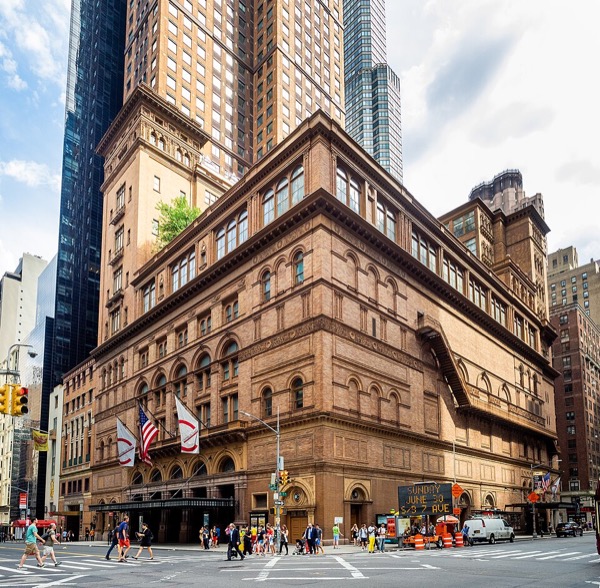
Carnegie Hall, 2015 (photo by Ajay Suresh)
Built by architect and amateur cellist William Tuthill, the Hall was known from the first for its impeccable acoustics. It’s in a modified Italian Renaissance style, which has been expanded over time. The original building holds the Isaac Stern Auditorium, which seats 2,790. Originally called simply the Main Auditorium, its name was changed in 1997 in honour of Isaac Stern, but more about that later.
The first work to receive its world premiere at Carnegie Hall was Antonín Dvořák’s From the New World, performed on 16 December 1893 by the New York Philharmonic, conducted by Anton Seidl.
Antonín Dvořák: Symphony No. 9 in E Minor, Op. 95, B. 178, “From the New World”: IV. Allegro con fuoco (New York Philharmonic Orchestra; Leonard Bernstein, cond.)
In the basement of Carnegie Hall is Zankel Hall, named for Judy and Arthur Zankel, who funded a renovation of the venue. From its beginning, it was a multi-function hall, serving as a 1,000-seat oratorio hall or a banqueting hall, with full kitchen facilities. As the Carnegie Lyceum, it was leased to the American Academy of Dramatic Arts in 1896, and in 1961, it became the Carnegie Hall Cinema. With its restoration as a performance space in 1997, it was renamed Zankel Hall and still retains its multi-purpose functions. The stage can be placed at either end of the room or in the middle. There are two levels for seating for a total of 600 people.
The Weill Recital Hall is original to the building and seats 268. Originally called Chamber Music Hall, then the Carnegie Recital Hall, it took its current name in 1986, named after Joan and Sanford I. Weill. Mr. Weill was the former chief executive of Citigroup and chairman of the Carnegie board. The hall seats 250 and is perfect for small solo performances.
Above all, the performance halls are rooms originally intended as ‘assembly rooms’, for ‘lectures, reading, and receptions’ or for meetings of secret societies or fraternal lodges. Now that area holds rehearsal rooms and studios.
The whole reason behind Carnegie Hall was the needs of the Oratorio Society and the New York Symphony Society. They both needed concert venues with stages large enough to hold the performers and seating enough for their ticket-buyers.
In 1891, the corner of 57th and 7th wasn’t the heart of mid-town as it is today; it was nearly in the country. When Carnegie Hall opened in 1891, it was the tallest building on the street.
Jazz came to Carnegie Hall as early as 1912, but it was Benny Goodman‘s 1938 concert that really put Carnegie on the jazz map.
“SING, SING, SING” BY BENNY GOODMAN
So how does Isaac Stern come in?
Isaac Stern was born in Poland on 21 July 1920 and came to the US when he was just over a year old. His family was Jewish and moved from Krzemieniec, Poland (now part of Ukraine), to San Francisco. His mother had musical training at the St Petersburg Conservatory and taught him piano. At age 8, he was enrolled in the San Francisco Conservatory, where he studied until 1931. San Francisco was the source of all his musical training. In San Francisco, after leaving the conservatory, he also studied with Louis Persinger (who had taught Yehudi Menuhin) and with his main teacher, Naoum Blinder (1932-37).
He was not a child prodigy on the violin but an extremely accomplished player. His early performances had critics noting him as ‘promising’. It wasn’t until his Carnegie Hall debut in 1943 that he caught the attention of critics. In his review in the New York Herald Tribune, critic Virgil Thomson called him ‘one of the world’s master fiddle players’.
In 1925, after the death of benefactor Andrew Carnegie, the hall was sold to realtor Robert E. Simon, who promised Mrs. Carnegie he would do nothing to the hall for 5 years. By the 1950s, the hall, now in the hands of Simon’s son, was in danger. The announcement of Lincoln Center at 65th and Broadway immediately put Carnegie Hall in danger. Simon, Jr., offered the hall to the New York Philharmonic for $4 million, since they were the primary renter of the stage, but they declined. They were anticipating a new hall of their own in Lincoln Center.
Simon put the building up for sale in 1956, and it was bought by a consortium of developers who planned to build a 44-story office tower on its prime site. That deal fell through, but Simon, Jr., couldn’t afford the building anymore, and demolition was scheduled to start on 31 March 1960.
Isaac Stern headed a new Citizens Committee for Carnegie Hall to raise funds to save the hall. With special state legislation, $5 million was raised, and the Hall was bought by the City of New York. The hall was not only saved, but it was also now managed by a public trust. The new Carnegie Hall Corporation would not only rent out the hall as it always had done (the New York Philharmonic alone rented it for 100 nights a year) but also would be free to present its own events. No longer tied to the New York Philharmonic alone, the Hall now began with an International Festival of Orchestras, featuring 15 orchestras across 4 subscription series.
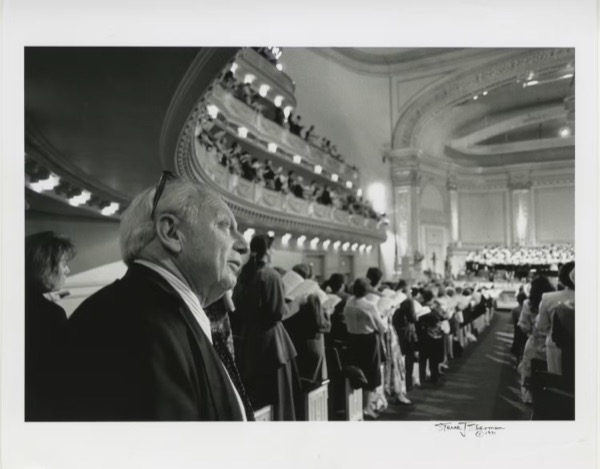
Stern at Carnegie Hall, 1991 (Carnegie Hall Archives)
Its first major gala was the Stern-driven Concert of the Century, celebrating Carnegie Hall’s 85th anniversary. This 1976 event brought together a stellar group of international classical artists, including Stern, Yehudi Menuhin, Mstislav Rostropovich, Dietrich Fischer-Dieskau, Leonard Bernstein, and Vladimir Horowitz.
The lineup for something as simple as a piano trio could be breathtaking.
Pyotr Ilyich Tchaikovsky: Piano Trio in A Minor, Op. 50: I. Pezzo elegiaco: Moderato assai – Allegro giusto (Isaac Stern, violin; Mstislav Rostropovich, cello; Vladimir Horowitz, piano)
With Menuhin and Stern as violinists and Bernstein on harpsichord, the Bach Concerto for 2 violins was in extremely capable hands!
Johann Sebastian Bach: Concerto for 2 Violins in D Minor, BWV 1043: III. Allegro (Isaac Stern, Yehudi Menuhin, violins; New York Philharmonic Orchestra; Leonard Bernstein, cond.)
Ten years later, a massive restoration project kicked off to bring the hall back to its original glory. Later accretions, such as a barbershop and a nightclub, were removed. Long-desired spaces, such as backstage, were added, the seating was replaced, and the interior space was repaired and renewed.
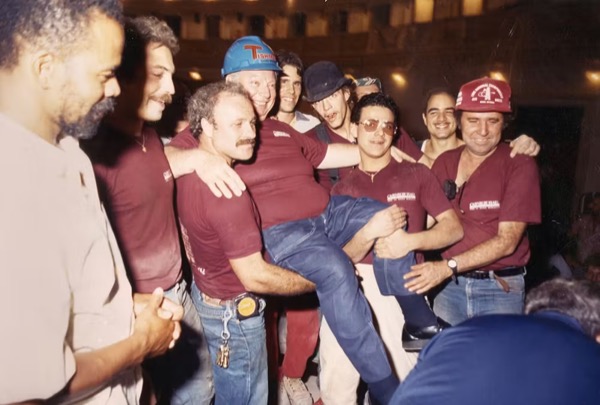
Stern with workers during the 1986 renovation (Carnegie Hall Archives)
The Gala Reopening concert was held on 15 December 1986, with artists that included Isaac Stern, Vladimir Horowitz, Yo-Yo Ma, Marilyn Horne, and Frank Sinatra. Leonard Bernstein and Zubin Mehta lead the New York Philharmonic.
Without Stern spearheading the drive to save Carnegie Hall, New York would lack a performance space with the capabilities of the building’s 3 halls. It’s still the city’s premiere recital hall, the city’s leading concert hall, and the name destination for up-and-coming stars.
Stern’s first appearance at Carnegie Hall was his debut recital on 8 January 1943, where he played works ranging from Bach’s Violin Sonata No. 1, BWV 1001, to Szymanowski’s Violin Concerto No. 2, which had been written only 10 years earlier.
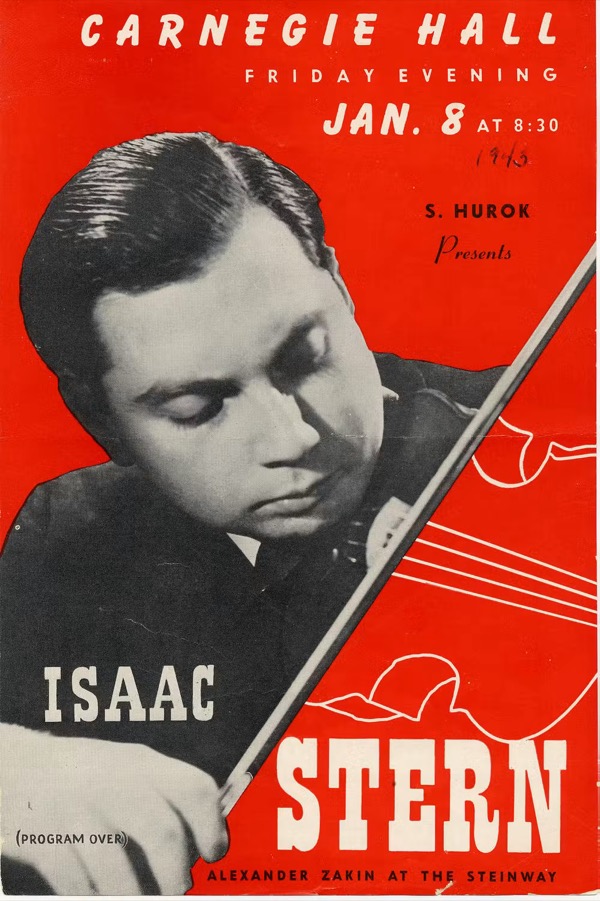
Flyer for Stern’s Carnegie Hall recital debut, 1943 (Carnegie Hall Archives)
His last appearance at Carnegie Hall was on 9 June 2001; he died 3 months later on 22 September 2001. In those 58 years, he went from child star to senior statesman in music.
Isaac Stern loved Carnegie Hall, saying once, ‘Everywhere in the world, music enhances a hall, with one exception: Carnegie Hall enhances the music’.
For more on Isaac Stern in Interlude, see
https://interlude.hk/on-this-day-21-july-isaac-stern-was-born/
https://interlude.hk/isaac-stern-born-21-july-1920-shaping-a-century-of-music/
For more of the best in classical music, sign up for our E-Newsletter