For most in the world, it is Nikolai Rimsky Korsakov’s 1888 symphonic suite Scheherazade that brings the stories of The Arabian Nights tales (collected as One Thousand and One Nights folktales) to the musical stage. The framing device for the book is that of the ruler Shahryar and the nightly stories told by his wife Scheherazade, each night’s tale ending in a cliff-hanger that would prolong her life.
Azerbaijan composer Fikret Amirov (1922–1984) created a ballet based on the stories, evoking a very different musical world than Rimsky-Korsakov’s. The ballet was written to a libretto by Maksud and Rustam Ibragimbekov.
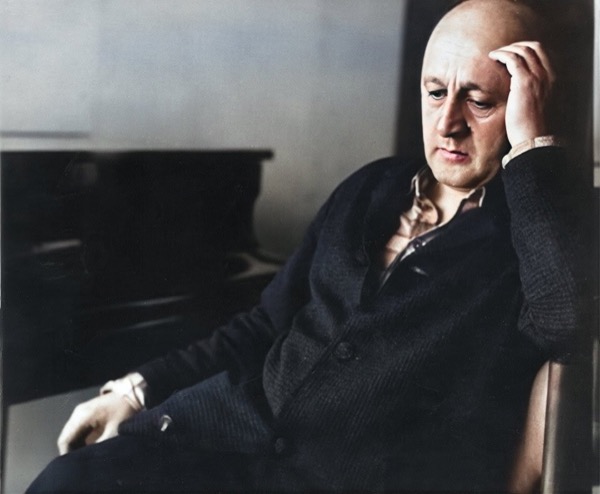
Fikret Amirov
As a ballet, it was given its premiere in Baku, Azerbaijan, at the Azerbaijan Opera and Ballet Theatre in 1979. As a composer, Amirov was a national hero. His works were part of the international symphony concerts, conducted by Bernstein and Stokowski, and his operas and ballets told stories of Azerbaijani history. Amirov wanted Azerbaijani music to be on the concert stages of the world, and ‘boldly wove Oriental melodies into European classical forms, imitating a folk orchestra’s sound he remembered from his childhood’. In One Thousand and One Nights, Amirov sought to showcase the music of not only the Azerbaijani tradition but also music from all over the Arab world. Before beginning composition, he did tours of Iraq, Iran, Turkey, Egypt, Syria, Morocco, and India and studied their local musical traditions. He said that he aimed to delve deeply into Arab musical culture, the Arab sense of rhythm, and the beauty of Arab musical rites. …[and] studied historic and architectural landmarks. …[to make] a synthesis of the national and the panhuman.
The highlights of the ballet were arranged into a suite by Farhad Badalbeyli and conductor Dmitry Yablonsky in 2017.
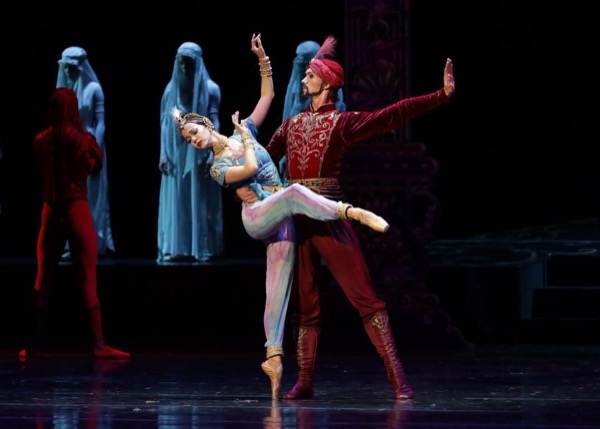
Nurida and Shahriar, 2022 (St Petersburg: Mariinsky II)
The suite opens with a highly rhythmic Orgy, beginning in the percussion. The entry of the orchestra takes us immediately into a larger world.
Fikret Amirov: One Thousand and One Nights Suite: I. Introduction: Orgy (Kyiv Virtuosi Orchestra; Dmitry Yablonsky, cond.)
Shahriar returns from his hunt early and finds his wife, Nurida, in the middle of her orgy, and he blazes with fury. Angered by Nurida’s infidelity, he takes his revenge on all women by killing Nurida, then marrying a new virgin each night and killing her in the morning before she can betray him.
Fikret Amirov: One Thousand and One Nights Suite: II. Shahriar’s anger (Kyiv Virtuosi Orchestra; Dmitry Yablonsky, cond.)
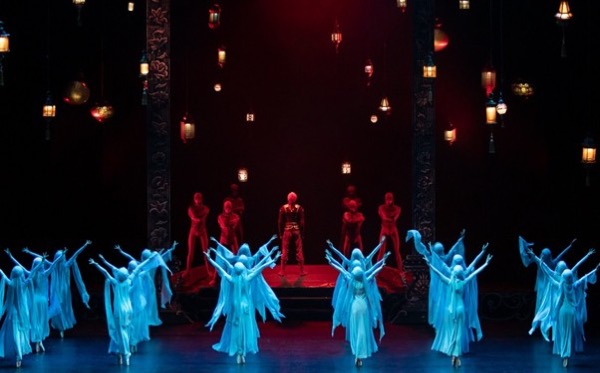
The Virgins and the Executioners, 2025 (Mariinsky)
Fikret Amirov: One Thousand and One Nights Suite: III. Execution (Kyiv Virtuosi Orchestra; Dmitry Yablonsky, cond.)
These two brief scenes set up the rest of the story and the urgency, particularly in Execution, that drives Scheherazade’s actions. The Celebration following Execution still seems more fraught than happy. All is not well in the kingdom of Shahriar.
Fikret Amirov: One Thousand and One Nights Suite: IV. Celebration (Kyiv Virtuosi Orchestra; Dmitry Yablonsky, cond.)
It all changes with Scheherazade’s entry. Her love theme starts romantic and then, through an ostinato, becomes hypnotic as she begins to tell her tales.
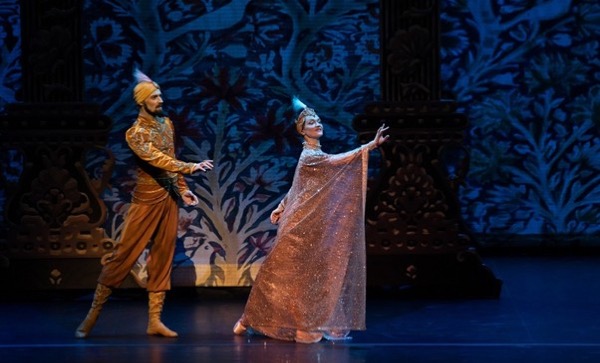
Shahriar (Sergei Umanetc) and Scheherazade (Anna Samostrelova), 2025 (Mariinsky)
Fikret Amirov: One Thousand and One Nights Suite: V. Sheherazade’s Love Theme – Fairy Tales (Kyiv Virtuosi Orchestra; Dmitry Yablonsky, cond.)
Scheherazade’s Triumph in living through the dawn gives us music of true celebration.
Fikret Amirov: One Thousand and One Nights Suite: VI. Sheherazade’s Triumph (Kyiv Virtuosi Orchestra; Dmitry Yablonsky, cond.)
Next, Scheherazade begins one of the most famous tales in the collection: Ali Baba and the Forty Thieves. Two other stories, those of Sindbad and Aladdin, are part of the ballet but were omitted from the suite.
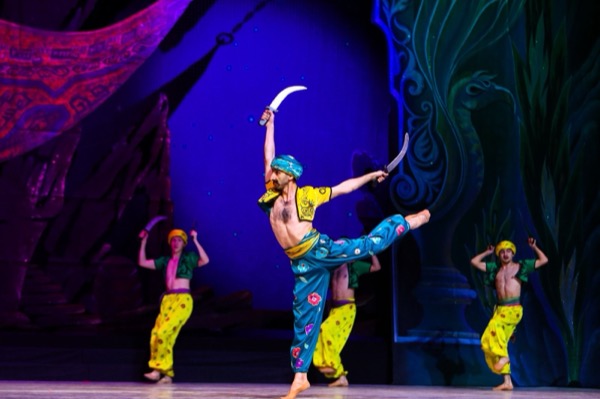
Ali Baba and the Forty Thieves, 2026 (Baku, Heydar Aliyev Palace)
Fikret Amirov: One Thousand and One Nights Suite: VII. Ali Baba and Forty Thieves (Kyiv Virtuosi Orchestra; Dmitry Yablonsky, cond.)
A slow section follows, as Scheherazade reflects on her future and how she is staving off death one night and one story at a time. The violin solo is strongly reminiscent of Rimsky-Korsakov’s use of the instrument in his own Scheherazade.
Fikret Amirov: One Thousand and One Nights Suite: VIII. Sadness of Sheherazade (Kyiv Virtuosi Orchestra; Dmitry Yablonsky, cond.)
The Chase movement is quite filmic in its sound, befitting Amirov’s experience as a film composer.
Fikret Amirov: One Thousand and One Nights Suite: IX. Chase (Kyiv Virtuosi Orchestra; Dmitry Yablonsky, cond.)
In the Interludium, Shahriar comes to realise that he can forget the transgressions of one woman through the love he finds in Scheherazade. Her stories of how men and women save each other (Sindbad saves the Girl from her capture by the deadly Rukh, Aladdin saves the Princess Budur from the evil wizard, and Ali Baba is saved by the wisdom of his maid, Mardjana) teach the Sultan a lesson.
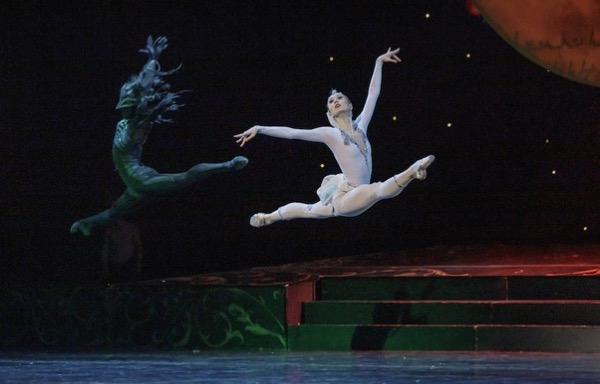
Girl (Ksenia Adulkarmiova) and the Rukh, 2025 (Mariinsky)
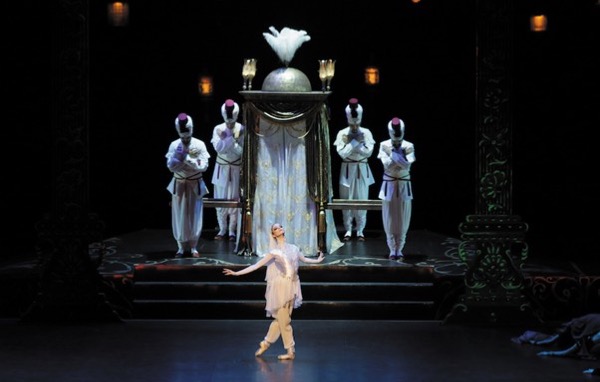
Princess Budur (Daria Tikhonova), 2025 (Mariinsky)
Fikret Amirov: One Thousand and One Nights Suite: X. Interludium (Kyiv Virtuosi Orchestra; Dmitry Yablonsky, cond.)
The triumph of Scheherazade and the redemption of Shahriar blaze forth in a brilliant, then tender, vision.
Fikret Amirov: One Thousand and One Nights Suite: XI. Shahriar and Sheherazade (Kyiv Virtuosi Orchestra; Dmitry Yablonsky, cond.)
The Finale brings back the pulsing percussion from the opening scene, but now it doesn’t depict an orgy scene; instead, it celebrates the triumphal restoration of Shahriar’s court and Scheherazade’s power.
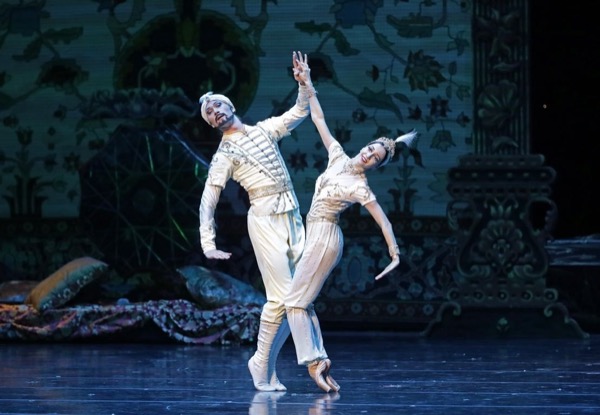
Shahriar and Scheherazade, 2022 (Mariinsky II).
Fikret Amirov: One Thousand and One Nights Suite: XII. Finale (Kyiv Virtuosi Orchestra; Dmitry Yablonsky, cond.)
In the ballet, Scheherazade tells the Sultan 3 stories: Sindbad, Aladdin, and Ali Baba. Both the Sindbad and Aladdin stories end with marriage to their beloveds, and Ali Baba is saved by his wise servant Mardjana. In all the stories, the emphasis is on women’s saving power through their best qualities: beauty, love, and wisdom. Despite its title, Rimsky-Korsakov’s Scheherazade isn’t about her but her stories. Amirov’s ballet, despite its title One Thousand and One Nights, pulls the focus back to the story behind the stories: first, the deception of Nurida, and then the redemption of all women by Scheherazade.
For the full ballet, performed by the Mariinsky Theatre Primorsky Stage Ballet Company in St. Petersburg, see:
Fikret Amirov’s A Thousand and One Nights ballet from Mariinsky Theatre Primorsky Stage
Unusual for a ballet, the performing forces include a full choir, which is used periodically to great effect.
For more of the best in classical music, sign up for our E-Newsletter