
The waltz began life in the 18th century as a triple-meter dance popular in impoverished Austrian towns.
No one could have predicted that it would become a metaphor for imperial glamour, psychological instability, and even civilizational collapse.
Today, we’re looking at the evolution of one of the most beloved genres in classical music: the waltz.
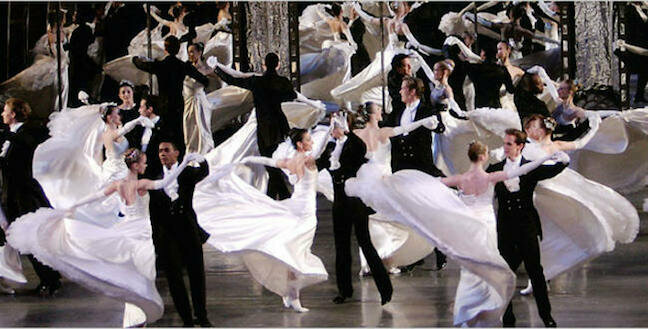
The Waltz
Tracing its generations-long transformation reveals how composers turned a social dance into one of the most symbolically charged genres in European music.
Beethoven – 6 Ländler, WoO 15 (1802)
The Ländler – a rustic Austrian dance in triple meter – was a direct ancestor of the waltz.
This set of six ländlers by Beethoven, dating from 1802, remains firmly grounded in the genre’s nascent conventions.
The result is a set of communal dances with regular rhythms and conventional harmonies that are pleasant and easy to dance to.
Weber – Invitation to the Dance (1819)
We see a change with Weber.
His piece Invitation to the Dance is not simply a waltz; it’s an entire narrative scene.
The introduction depicts a gentleman approaching a lady and asking to partner with her. She accepts. The waltz proper portrays their dance, and the coda their farewell.
Importantly, this piece was written for the concert stage, not the ballroom. Here, the dance becomes part of a broader narrative: Weber has moved beyond writing dance music and has begun writing music about dancing.
Schubert – Waltz in G-flat Major, D.Anh.I/14 (1826)
By the 1820s, the waltz had begun spreading beyond communal spaces. It became refined, aestheticised, and increasingly divorced from its folk origins, evolving into music meant to be played in domestic spaces at the family piano.
Schubert‘s version of the waltz is intimate and elegant, and much less rustic than its predecessors, with a new and striking poignancy.
In this slender piece, a listener can hear how the waltz genre is coming into its own as something separate from – and more sophisticated than – the ländler.
Berlioz – “Un bal” from Symphonie fantastique (1830)
In his Symphonie fantastique, composer Hector Berlioz tells the fictional story of a gifted young artist who becomes obsessed with an unattainable love interest.
In the second movement of the symphony, the protagonist attends a glittering ball and imagines seeing his beloved there.
The beloved’s theme – known as idée fixe – interrupts the swirling waltz, revealing the young artist’s single-minded obsession.
Here, the waltz becomes a tool for a composer to use while crafting a programmatic, extramusical narrative.
Chopin – Waltz in C-sharp minor, Op. 64, No. 2 (1847)
Chopin‘s waltzes are harmonically adventurous, emotionally volatile – and famously undanceable. These aren’t works meant to accompany physical movement; they’re vehicles for emotional expression, not dance music.
This waltz is beautiful, but also tinged with bitterness and a touch of ennui.
It is magnetic listening, but its tempo is tugged around so much that it would be impossible for amateur dancers to actually dance a waltz to.
Johann Strauss II – Tales from the Vienna Woods (1868)
Johann Strauss II – Emperor Waltz (1889)
As a young man, Johann Strauss II took over his composer father’s dance orchestra. As he became successful, his orchestra grew in size, popularity, and prestige – and so did his waltzes.
As his waltzes gained popularity among the elite, they became potent symbols of Austrian wealth and power, solidifying Vienna’s reputation as the capital of 19th-century European elegance.
Tales from the Vienna Woods includes a zither part, a reference to the dance’s folk roots, especially those found in the zither-playing rural population that lived in the Vienna Woods, just outside the capital city.
Two decades later, he wrote the Emperor Waltz, composed to celebrate a friendly, politically important visit between the emperors of Germany and Austria-Hungary: a diplomatic event between imperial powers, about as far removed from the dance’s humble rustic origins as it is possible to get.
Strauss helped to broaden and cement the extramusical connotations of the waltz. By the late 19th century, waltzes were no longer merely soundtracks for a population’s social life; they were also celebrations of wealth, political power, and imperial identity.
Gustav Mahler – Symphony No. 5, Movement 3 (1902)
In the third movement of his Fifth Symphony, Mahler took the waltz and turned its grandeur into something darker than it had ever been before.
Here, the triple meter lurches, with accents landing awkwardly. The joy feels manic, the nostalgia strained.
One gets the impression of aristocratic musicians determined to keep playing their dance, even as something strange and sinister lurks just outside their door.
Richard Strauss – Der Rosenkavalier Waltzes (1910)
In 1910, composer Richard Strauss (not to be confused with Johann Strauss) wrote a comic opera called Der Rosenkavalier (The Knight of the Rose), starring aristocratic Viennese characters from the 1740s.
For this work, Strauss wrote lush, nostalgic, theatrical waltzes that were more emotionally evocative than historically accurate.
In fact, the music is knowingly anachronistic, given that the story is set half a century before waltzes became popular. It’s all winking historical fiction.
These waltzes aren’t just beautiful music. They also give us, as modern listeners, a glimpse into how Viennese audiences of the early 20th century perceived themselves and their culture.
Maurice Ravel – La valse (1920)
During World War I, French composer Maurice Ravel drove an ambulance on the front lines as his country fought against Austria and Germany.
After the war ended, one of the first major pieces he completed was the ballet La valse, employing a famously Austrian genre for his own creative purposes.
The work begins with a misty mood. Fragments eventually coalesce into a glittering Viennese waltz before spiralling out of control in truly apocalyptic fashion.
Many listeners hear in La valse a metaphor for the 20th-century collapse of Old Europe after the conflagration of World War I. Ravel denied this interpretation, writing that it was his homage to Johann Strauss and that he envisioned the piece set in 1855, long before the war.
Regardless of the interpretations that the composer or his listeners have brought to the table, it’s clear that this is not a normal waltz. We have come a long and dizzying way from the genre’s humble beginnings in the early 19th century. The waltz is now a symbol for something bigger than itself.
Conclusion
Over a single century, the waltz became a musical genre beloved the world over – and one weighed down by a variety of fascinating extramusical connotations.
Of course, the waltz didn’t take on all that baggage in just one go with one work. Instead, that change relied on a long line of great composers to build on each other’s work, until the dance could no longer be effectively separated from the connotations surrounding it.
What began in rural Austrian villages as a communal dance ended, a century later, as music haunted by nostalgia, empire, and ruin.
Few genres in Western music have taken on so much cultural meaning in so little time.
For more of the best in classical music, sign up for our E-Newsletter







I wrote a book on the waltz in French ” Éloge de la Valse ” if you are interested. I show how the first waltz was in Don Giovanni of Mozart, a very european mix between the landeler, the menuet and the allemande.