Few works in the orchestral repertoire have had a stranger journey to the concert hall than Franz Schubert’s Symphony No. 9 in C major, often nicknamed the “Great” C-major Symphony. For one, it started with composer Robert Schumann rediscovering the obscure manuscript – and rushing the score to his friend, Felix Mendelssohn.
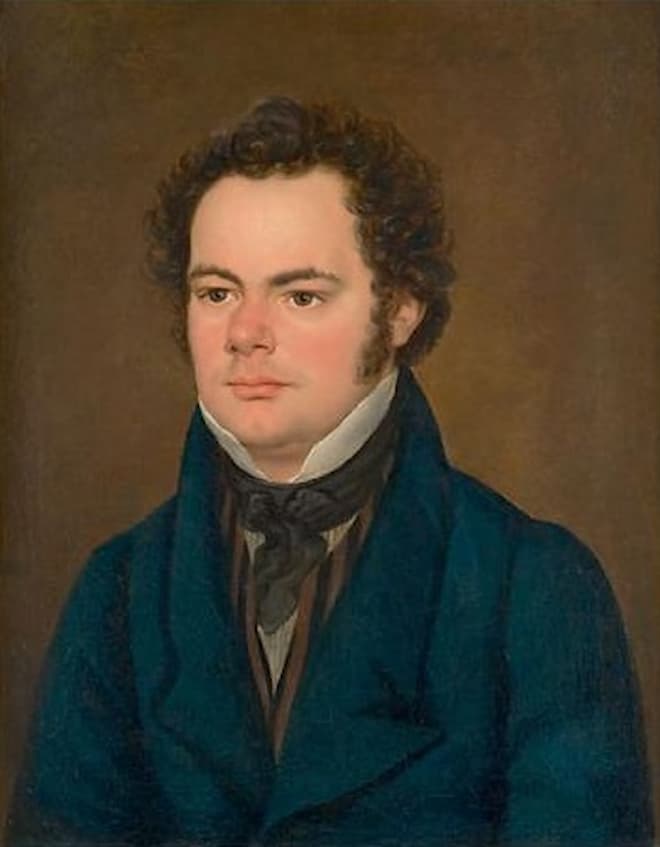
Franz Schubert, c. 1827
Today, thanks to the intervention of Schumann and Mendelssohn, it is regarded as one of the most ambitious symphonies of the early Romantic era: an expansive, hour-long work whose sweeping melodies and monumental scale pushed the symphonic tradition beyond Beethoven.
Written in the mid-1820s when Schubert was nearing the height of his creative powers, the work was never publicly performed during his lifetime, and its manuscript lay buried for years after his death.
Today, we’re looking at the story of Schubert’s Ninth Symphony – and how it was saved and rediscovered by some of the giants of classical music history.
The Origin Story of the Ninth
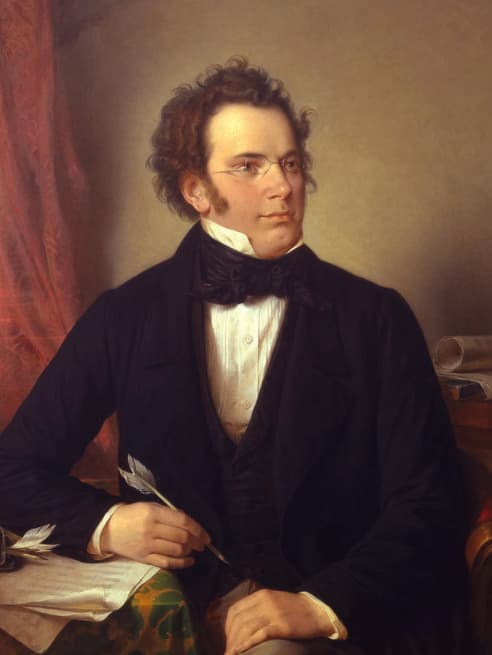
Franz Schubert
In March 1824, Schubert wrote a letter to his friend Leopold Kupelwieser saying that he wanted to compose chamber music that could “pave his way to the grand symphony.”
Weeks later, in May 1824, he attended the premiere of Beethoven’s Ninth Symphony.
He made good on the course he’d suggested to Kupelwieser.
Over the next few years, he wrote a string of chamber music masterpieces: the “Rosamunde” string quartet, the Octet in F major, the Arpeggione Sonata, and the “Death and the Maiden” string quartet.
It was an astonishing trajectory, made poignant by the fact that, despite his youth, he’d be dead in a few years.
Franz Schubert Octet in F Major, D 803
Musicologists believe that Schubert began sketching out the work that would become known as his “Great” symphony in the summer of 1825.
That year, he toured Austria as a pianist with his friend, the baritone Michael Vogl, enjoying a rare period of both artistic confidence and relative financial stability.
The work he put into composing chamber music, combined with the satisfaction from the tour, gave him the income and confidence he needed to finish drafting and scoring his ninth symphony, which he did around the spring or summer of 1826.
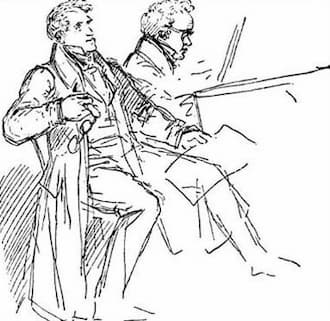
Franz Schubert and Johann Michael Vogl
The composition date has long been debated because the manuscript bears a handwritten date of March 1828.
Musicologists believe that the date may have been added later, possibly to make the work appear more recent when Schubert was seeking a publisher.
The Dead Ends In Bringing the Ninth to Life
Schubert: Große C-Dur-Sinfonie ∙ hr-Sinfonieorchester ∙ Andrés Orozco-Estrada
Schubert had crafted a massive hour-long symphony, but, being a relatively poor composer in his late twenties without a court position, didn’t have an ensemble lined up to perform it.
The most promising opportunity for a performance came after Schubert savvily dedicated the work to the Gesellschaft der Musikfreunde (Society for the Friends of Music), an organisation of musicians and music lovers founded in Vienna in 1812.
The society had recently helped facilitate the premiere of Beethoven’s Ninth Symphony, and it was also helping to educate musicians.
The Gesellschaft accepted the gift. They sent him a small payment as a thank-you and even made arrangements to copy the orchestral parts.
Historians believe that amateur players associated with the Gesellschaft even attempted a private read-through of the score, but it wasn’t given the rehearsal time the music’s length and complexity warranted, and it was never performed publicly.
Schubert didn’t have the money to hire an orchestra to play it, so it remained an undiscovered gem in his papers.
The Death of Franz Schubert – And How the Ninth Survived
Schubert’s Symphony No. 9 – John Eliot Gardiner, Wiener Philharmoniker
By late 1828, Franz Schubert was terminally ill, possibly with syphilis or mercury poisoning from the treatment for syphilis.
He died on 19 November 1828 in the apartment of his brother Ferdinand. Ferdinand ended up inheriting his brother’s papers and becoming the primary advocate for his music.
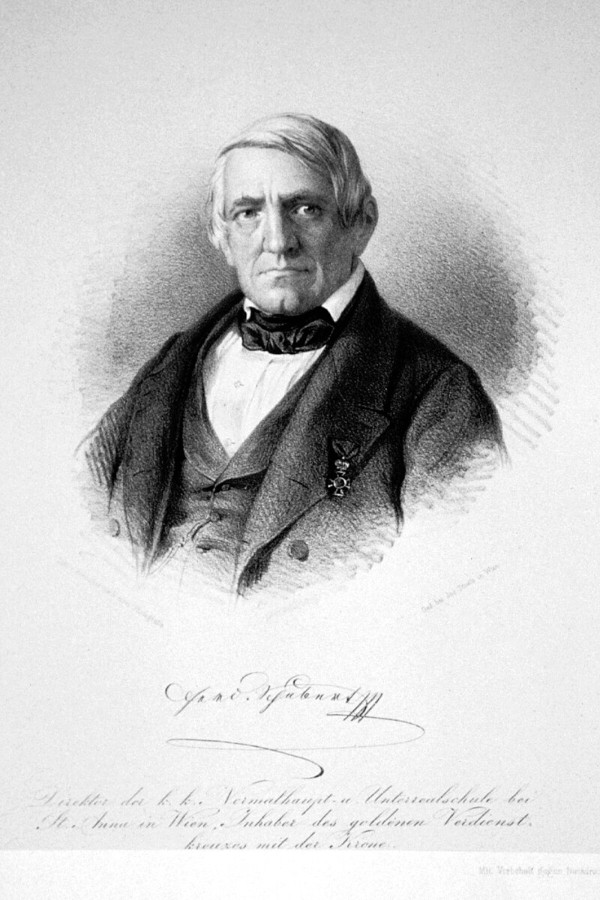
Ferdinand Schubert
Ferdinand was also a composer (albeit a far less successful one than Franz), and he made attempts at popularising his late brother’s work.
In 1835, advertisements appeared in newspapers in Vienna, Leipzig, and Paris, offering the performing rights to some of Franz’s works. The income from these performances went to Ferdinand.
The following year, he attempted to arrange a performance of the ninth symphony’s final movement, but it seems it never materialised.
The Dramatic Rediscovery of the Ninth
Schubert: Große C-Dur-Sinfonie ∙ hr-Sinfonieorchester ∙ Manfred Honeck
A decade after Franz Schubert’s death, composer Robert Schumann visited Vienna and met up with Ferdinand. During his stay, he rediscovered several works, including the Ninth Symphony.
Schumann immediately recognised the importance of the discovery – and he became determined to succeed where Ferdinand had failed.
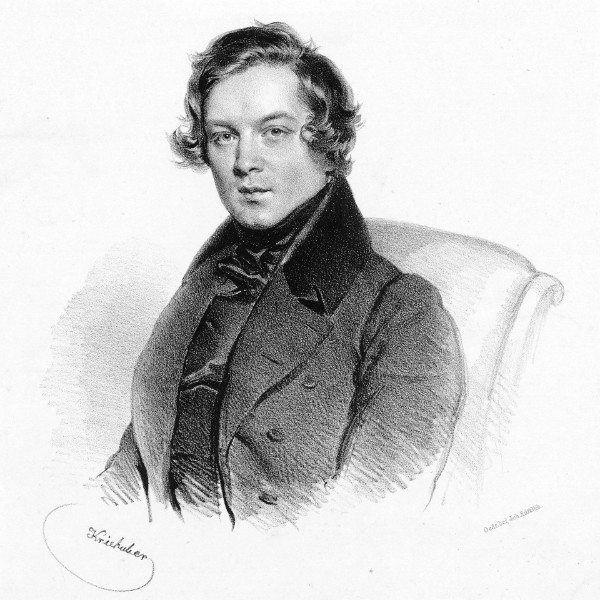
Robert Schumann, 1839
Schumann took a copy of the score with him back to Leipzig and rushed it to his friend Felix Mendelssohn, who was conducting the prestigious Gewandhaus Orchestra.
Mendelssohn was the right man to contact. In addition to his career as a composer, he also had a reputation for reviving great music of the past.
As a teenager, he began studying Bach‘s St. Matthew Passion, a passion project that culminated in his famous 1829 revival, given when he was just twenty. That performance reshaped how 19th-century audiences understood Bach.
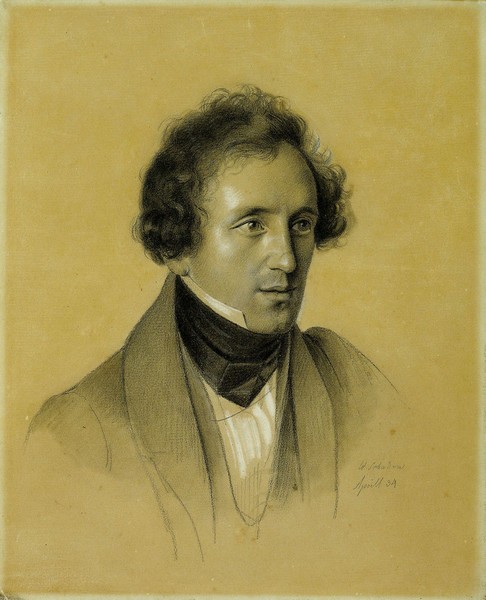
Felix Mendelssohn
In 1844, Mendelssohn would also conduct Beethoven’s violin concerto, helping to reintroduce it to new audiences after its lacklustre initial premiere.
Between Bach and Beethoven, in March 1838, Mendelssohn rescued this symphony by Schubert. Robert Schumann was delighted, raving about the rehearsal to his future wife, pianist and composer Clara Wieck.
“Today I have been in seventh heaven. If only you had been there! For I cannot describe it to you; all the instruments were like human voices, and immensely full of life and wit… and the length, the divine length, like a four-volume novel…”
Schumann also wrote a glowing review of the rediscovery in his music journal, the Neue Zeitschrift für Musik. There he famously described the symphony as having a “heavenly length.”
How Schumann, Mendelssohn, and Brahms Saved Schubert’s Ninth Symphony
Schubert: Symphony in C major “The Great” / Munich Philharmonic Orchestra
An interesting historical tidbit: when this symphony first began making waves, it was nicknamed the Great – not because of its “heavenly length”, to quote Schumann, but because it needed to be differentiated from Schubert’s other shorter symphony in C major, now known as his sixth.
The fact a nickname was bestowed at all demonstrates how buzz around this work grew during the mid-nineteenth century.
Mendelssohn shared Schumann’s enthusiasm for it. He brought the score of the “Great” with him in the early 1840s when he toured as a conductor in Paris and London.
Unfortunately, the musicians couldn’t – or didn’t want to – perform it, finding it too long and too strange. According to one anecdote, the British musicians actually erupted into laughter during rehearsal.
Fortunately for future listeners, the next generation of composers and music lovers was more receptive to music of the past.
Johannes Brahms, for one, became one of Schubert’s most passionate champions, advocating Schubert’s music to his famous colleagues, editing Schubert’s works for publication, and even composing pieces overtly inspired by him and his musical language.
From there, fellow Viennese composers Anton Bruckner, Gustav Mahler, and others championed Schubert’s output, including the Ninth Symphony, until it became a part of the standard repertoire.
It remains a treasured part of the repertoire even today, despite its unusual path to prominence.
Conclusion
Today, Schubert’s Ninth Symphony stands as one of the great achievements of the Romantic symphonic tradition.
Its expansive architecture, rhythmic drive, and seemingly endless melodic invention helped bridge the world of Beethoven with the monumental symphonies that would follow later in the century.
A symphony that once seemed impossibly long and unusual is now celebrated for those same qualities, and Schumann’s famous phrase about the symphony’s “heavenly length” has become one of the most enduring endorsements in music history.
Few masterpieces have travelled a stranger path: from an unperformed manuscript in Schubert’s desk to one of the most beloved symphonies in the orchestral repertoire. It is both heartbreaking and quietly inspirational that Schubert died believing the symphony would never be performed, without knowing how hard future music lovers would fight for his work to be heard.
This story is also proof that the classical music canon isn’t set in stone – and can inspire us to ask: what great works are sitting in drawers, unplayed and unappreciated today, waiting for their own champions?
For more of the best in classical music, sign up for our E-Newsletter