Hong Kong-born pianist Aristo Sham, winner of the 2025 Van Cliburn International Piano Competition, has rapidly become one of the most sought-after young pianists on today’s concert stage. As he prepares to appear with the China NCPA Orchestra in a pair of concerts featuring the piano concertos of Tchaikovsky and Grieg, I had the opportunity to speak with him.
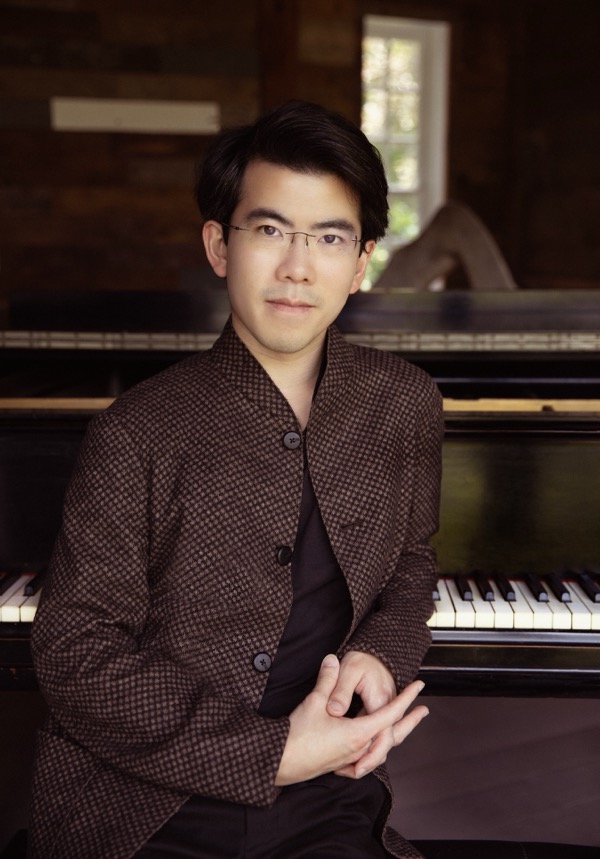
Aristo Sham © Lisa-Marie Mazzucco
Piano Schools and Economics
Sham’s educational and artistic path has been unusually rich and multifaceted: he pursued a dual degree, earning a Bachelor of Arts in Economics from Harvard University alongside a Master of Music from New England Conservatory, before studying at the Ingesund School of Music and later completing an Artist Diploma at The Juilliard School.
Long before his Cliburn triumph, Sham had already established himself on the international competition circuit, winning prizes at the Viotti International Music Competition, the Dublin International Piano Competition, and the Gina Bachauer International Piano Competition, among others, following first prizes at the Ettlingen and Gina Bachauer Junior competitions at the ages of ten and twelve, respectively.
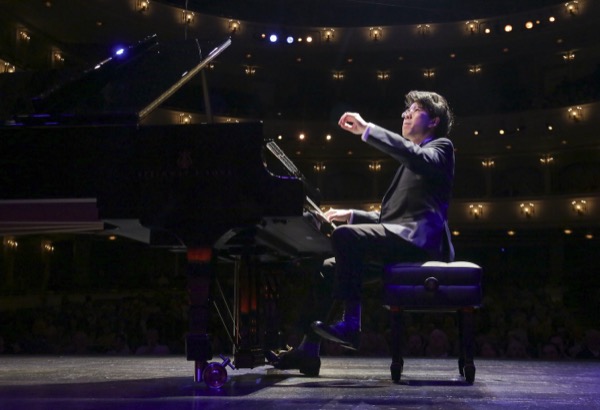
Aristo Sham at the Van Cliburn Competition semifinal
Sham described himself as having always been “a very naturally curious person since childhood”, someone who desires “to get to the bottom of how everything works.” “In music and life in general,” he said, “we should immerse ourselves in as many different environments as possible, and make something of them.”
That background has undoubtedly given him uniquely broad artistic perspectives, shaped by a remarkable variety of pedagogical traditions. Sham readily admitted that his playing is, in many ways, a synthesis of different schools: “Whatever works, or what I try to express in the moment in music, I use all these elements in my daily work.” Indeed, when discussing his teachers and influences, he spoke with striking clarity and precision about what each had contributed to his development.
At the Hong Kong Academy for Performing Arts, his first major teacher was Eleanor Wong. “She came very much from the French School: from her I learned the sort of ‘fine’ finger technique, a very detailed, minuscule style.”
His next teacher, Victor Rosenbaum at NEC, was a master of the German-Austrian repertoire. “From him I learnt about the language of this music, which is a very subtle thing to grasp. I’m still realising lessons from ten years ago, because back then I was too young to understand the subtleties of Schubert or Brahms.”
One teacher who continues to exert a profound influence on him is Julia Mustonen-Dahlkvist. “She was educated around the world, but her foundation is in the Russian School — the Heinrich Neuhaus school. That forged a huge part of my pianism, and also my musicality: how we interpret, how we decode a score, how we deliver the sentences and the meaning of music as a mode of expression. We still work together very closely. I was her teaching assistant in Sweden during Covid; I still play for her sometimes when I have a new programme. We know each other so well — we had lunch yesterday, by the way. She almost has a magic wand: with just two words, she can immediately get to the core of something and make the entire piece better — some systematic change in my brain and how I operate within the music. This is a relationship that I value very much.”
His final music degree came at Juilliard, where he studied with Robert McDonald and Orli Shaham. “They were vaguely Taubman* School, but not strictly. At that point, I already had a very developed personal system for approaching the instrument, but they gave me the final motivation to put everything together and lifted me to a level of professionalism and seriousness that the industry requires. They were instrumental in helping me figure that out.”
(*Dorothy Taubman, the American piano pedagogue who developed the so-called Taubman Approach, which became foundational to a major strand of American piano pedagogy.)
I was also curious about Sham’s interdisciplinary background in economics, which seems deeply connected to the analytical temperament one senses in the way he speaks about piano playing and interpretation. Sham considers himself “a very holistic person”, someone who believes that everything ultimately connects to everything else.
“Everything we learn comes into how we express ourselves in music. If we don’t understand anything about ourselves, about the world, about society, how are we to have anything to express? And when we express, how is it going to resonate with people and with the world?”
“Specifically with economics — a subject at the intersection of humanity and science — I find it very similar to my work in music, especially as a pianist and conductor, because we deal with so many structural problems: the facts of the music, how the music is built. To me, that’s very similar to models and graphs in economics. We build these models, but in the end, they are completely worthless unless we interpret them. It’s exactly the same in music: we have to interpret it in our own way, and in constantly changing ways. That parallel is very valuable to me.”
Developing Through Competition
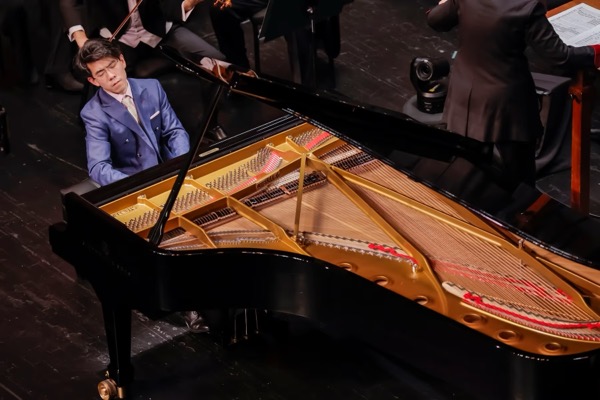
At the Seventeenth Van Cliburn International Piano Competition
A pianist, of course, is educated not only in schools but also on stage — perhaps nowhere more intensely than in competitions. Sham knows that world intimately, having participated in numerous competitions since 2006 on his journey to where he is today.
“Competition is never the goal — the goal is to have a career, but for me the real goal is to share music.” Sham sees competitions as extraordinarily important learning experiences, pushing contestants beyond their limits through the sheer volume and intensity of repertoire preparation.
“It’s not a prize just for the playing in the competition — it’s a prize for the investment in our future. After every major competition, I feel like I’m on a different level. A few months later, once you’ve digested and crystallised everything you’ve learned, you realise how much you’ve grown. I would value competitions for that alone. It’s only through playing so many concerts, so much repertoire, and facing different situations on different continents that we can really grow as artists.”
Sham is candid about the practical realities of the profession. “Competitions, at the moment, are by and large the most reliable way into this path. The attention given to important competitions means there’s really no replacement. There are other options for people with unusual profiles — through social media or management, perhaps — but it’s hard to argue with the statistics.”
Sham has also developed strong opinions about the culture surrounding competitions themselves. “The most important thing for me is the atmosphere they create.” He believes contestants should be treated respectfully as “artists,” and given the space necessary to focus fully on music-making. When asked whether there were competitions he particularly admired or disliked, he admitted that “a few competitions” — including some among the world’s most prestigious — had left him unimpressed.
“There’s one important competition where I felt everything they did was designed to make the contestants’ lives miserable. Every prizewinner I knew said it was among the worst few weeks of their lives. The moment you land at the airport, you feel like an animal in a circus. It’s like the Hunger Games all the time — fighting for resources and attention, with people judging you to your face constantly.”
By contrast, he spoke warmly and enthusiastically about the Cliburn. “I may be biased, but the Cliburn does a very good job of taking care of its contestants. I think everyone would agree. From the moment you arrive until the end, you don’t feel like you’re in a competition, but rather an artist invited to a festival. You genuinely feel their respect for the contestants. There was also a wonderful atmosphere between the competitors themselves — we shared our experiences as friends.” He also praised the Gina Bachauer and Honens competitions, and said he had a good time at the Clara Haskil as well — though I was fortunate to have a wonderful host family at Haskil — I don’t think everyone necessarily did.”
Aristo Sham: 2025 Cliburn Preliminary Recital (Bach-Busoni, Montero, Ravel)
The Luxury on Stage
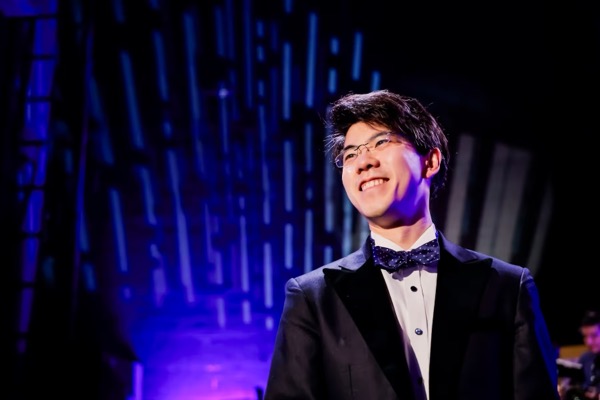
At the Seventeenth Van Cliburn International Piano Competition
The day of our conversation marked exactly one year since his first round at the Cliburn. The competition has, unsurprisingly, transformed his career — not least in the scale and intensity of his concert schedule.
“For me, the past year has been very much about developing music through our voice on stage. It’s never a linear path — there are always ups and downs — but overall it’s been a very positive trajectory. I’ve basically enjoyed every challenge; they’ve all been exciting. A way of experiencing new experiences.”
One particularly memorable period came in November 2025, during an intense stretch of performances in Asia. Sham was touring mainland China with two separate recital programmes; two days later, on November 20, he was in Hong Kong performing Ravel‘s Piano Concerto in G major with the Orchestra dell’Accademia Nazionale di Santa Cecilia and Daniel Harding, stepping in for Beatrice Rana. That same evening, he boarded a “red-eyed flight” to Korea to give a recital at the Seoul Arts Center on the following day.
Aristo Sham – Busoni: 10 Variations on a Prelude by Chopin, BV 213a (1922 Version)
It was the first time he experienced a schedule that intense, but Sham ended up enjoying it, “because of the challenge and the importance of the moments” –– the Seoul recital was later streamed on Stage+. “Given the pressure, I found myself playing better than ever. The occasion brought a new kind of energy and commitment. I relish moments like that. I’m always affected by the cultural and geographical environment around me, and by the way people behave around me. New valves opened within me for music to flow even more freely — to have the maximum amount of fun on stage, to improvise and experiment.”
Having already collaborated with many major musicians and orchestras, I asked which experiences had left the deepest impression on him. Sham immediately mentioned his performances with the Santa Cecilia Orchestra and the Swedish Chamber Orchestra.
With the Swedish Chamber Orchestra, he performed Grieg’s Piano Concerto in A minor. “I don’t usually perform Grieg with a chamber orchestra. In a chamber orchestra, there’s a different level of personal connection between the players. It was an interesting way to experience the piece.”
Grieg: Holberg Suite, Op. 40: IV. Air. Andante religioso
With Santa Cecilia, he returned to Ravel’s concerto — a work he had not performed for nearly a decade. “Coming back to the piece and bringing it to a level that made me very proud was incredibly rewarding.” He also described an immediate chemistry with the orchestra that made everything feel unusually natural. “I recorded the rehearsal: we only rehearsed once in the morning — for twenty-seven minutes.”
What particularly struck him was the orchestra’s sound — their sense of timing, or what he called “the luxury of space.” Sham described this “luxury” as “a certain freedom in their language”: “The music is still moving forward — it’s not static or lifeless — but it moves with exactly the right amount of space.”
“For me, the challenge is finding the exact balance where everything is in place: all the details, all the connections between different elements. But they’re correct without you even realising it, not because of any single detail. The music simply sounds like what it should sound like. It feels natural — but the process of getting there is not necessarily natural. We have to think through every single perspective. In the end, it should feel effortless.”
Modes of Music on and off
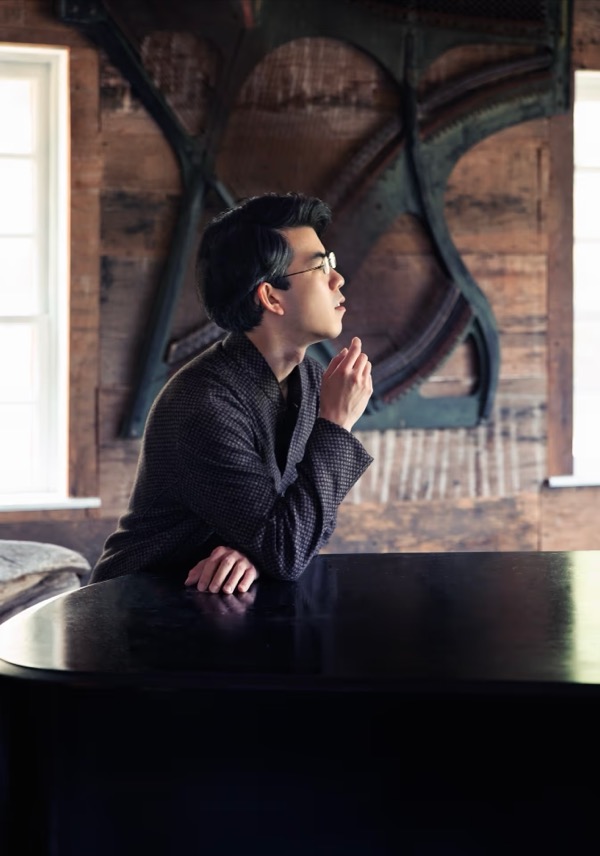
Aristo Sham © Lisa-Marie Mazzucco
Inspiration, for Sham, comes not only from collaborators but also from listening to other pianists. He remains, above all, an endlessly curious learner who tries to “absorb as much as possible.” Beyond his teachers, he particularly admires musicians “who take their work seriously, and who have a personal voice.”
“If I were to name some favourite pianists from the past, two who come to mind recently would be Rachmaninoff himself and Alfred Cortot. Among living pianists, Arcadi Volodos would certainly be one. He’s pushing the limits and exploring what can still be done with music that has been played for centuries, through a very personal approach. Sometimes it works, sometimes it doesn’t — but that deserves attention and respect.”
I suggested that Sham seemed the type of pianist who constantly analyses the playing of others, which he readily acknowledged. “Well, I teach myself. I have to be very aware all the time whether I’m in the mode of simply enjoying the music, or in the mode of analysing and teaching. In recent years, I’ve learned how to switch that on and off.”
The pianist, who had also studied economics, went on to explain the three different “performance modes” through which he adapts himself to different situations. “On stage, the ideal is simply to speak — to get fully inside the material and say whatever it is asking to be said, together with all the circumstances: the piano, the hall, the audience, the connection.”
“But in practice, there’s also the analytical mode — what I call the ‘laboratory.’ That means understanding what every note is, how each note relates to those around it, and building from there: the phrase, the harmony, each progression, then the larger sections and architecture.”
His other mode of practice is the “performance practice”: “I record myself as though I were in a concert. Of course, it’s never a true emulation because there’s no audience, but it’s the closest I can get. Then I adjust from there. On stage it will inevitably be different, but by that point I already know very well what the music is made of, so I can have the freedom to operate within it — and to say whatever I want to say in that moment.”
For more of the best in classical music, sign up for our E-Newsletter