For Irish composer Raymond Deane, Scintillae spans more than fifty years of piano music, from the youthful Orphica to works completed in recent years. The album offers listeners a chance to experience his evolving musical language as a single artistic journey. German pianist Moritz Ernst brings these works to life, and his passion for contemporary music and for rediscovering overlooked composers has made him an ideal collaborator for the project.
Ernst’s career has been defined by a curiosity that extends beyond the traditional piano canon. Alongside championing living composers, he has recorded the music of neglected twentieth-century figures including Viktor Ullmann, Norbert von Hannenheim, Arthur Lourié, Walter Braunfels, and, most recently, Karel Reiner. As artistic director of the Badenweiler Musiktage in southwest Germany, he continues to promote adventurous programming that places contemporary music alongside rediscovered repertoire.
Scintillae: IV. Wandering Rocks
Although Scintillae presents works composed over five decades, Deane says that assembling them into a single recording did not fundamentally change how he views his creative life. What the recording did reaffirm, however, were ideas that have remained constant throughout his career.
“The desire to ‘evade the tonal/atonal opposition’, Ligeti‘s phrase, is there from the start,” he explains. “But also, the sense that this goes beyond pitch structure and affects temporality too. I only became aware of this at a later stage, and I think that everything on this CD confirms it in different ways.”
That continuity is one reason the album feels remarkably cohesive despite the decades separating the compositions. Rather than consciously embedding layers for listeners to uncover, Deane believes that discovery is simply part of the nature of music itself.
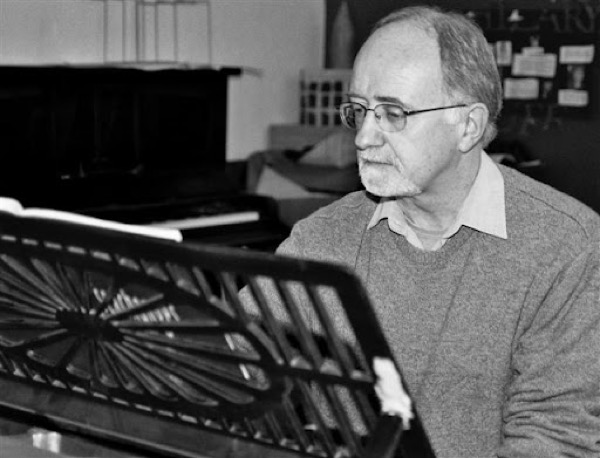
Irish composer Raymond Deane
“It never occurred to me that there could be any other way of composing or listening,” he says when asked whether he intentionally leaves room for repeated exploration.
For Ernst, the project grew out of a relationship that developed gradually over several years. After Ernst recorded another Irish composer’s music, he was introduced to the pianist and composer through musicologist Dr. Axel Klein. The pianist and composer remained in close contact as Ernst began performing Deane’s works in concert. When the idea of a complete recording finally emerged, selecting the repertoire became a collaborative process.
One work Ernst particularly wanted to include was Orphica, written when Deane was still a teenager.
“I find it absolutely astonishing what he achieved at the age of sixteen or seventeen,” Ernst says. “When most people are still in high school, he wrote these highly energetic pieces.”
While the album captures both the earliest and most recent stages of Deane’s compositional journey, its centrepiece is undoubtedly Triarchia, a work that both the composer and the pianist describe as the heart of the recording.
Unlike the other pieces, Triarchia had previously existed almost exclusively through Deane’s own performances. Its extraordinary technical complexity and intricate musical layers demanded an unusually close collaboration between composer and performer.
“For me, that was the piece that changed the most during the preparation,” Ernst recalls. “With all the contemporary music I’ve performed, it’s not very often that working with a composer changes my understanding of a work so dramatically.”
The discussions extended far beyond technical accuracy. Voicing, articulation, pedalling, rhythmic flexibility, and the relationship between the music’s many layers all became subjects of detailed exploration.
“There are things in the piece that can’t really be written down,” Ernst explains. “You have to create the illusion of strict rhythm while allowing the music to breathe naturally.”
What surprised him most was discovering the expressive world beneath the score’s formidable complexity.
“In the end, it was actually quite a romantic approach that was needed,” he says. “It’s a very contemporary piece, but at the same time it’s deeply human.”
The collaboration also prompted Deane to reconsider aspects of the score itself. Having composed Triarchia primarily for his own performances, he realised that certain musical intentions, perfectly clear to him as both composer and performer, could be communicated more explicitly to another pianist.
For Deane, hearing someone else perform music he had long associated with his own playing proved both illuminating and reassuring.
“I’ve never assumed that other pianists would interpret my works in the same way,” he says. “The composer is also, in a sense, an audience member.”
Rather than seeking faithful imitation, he welcomed Ernst’s distinctive musical personality.
“Moritz’s individuality as a performer is powerful, and I appreciated it greatly in his interpretations.”
He even admits that Ernst’s interpretation of Triarchia may have been closer to the score than his own.
“The only slight shock came with Triarchia, an excruciatingly difficult piece to play, but I concluded that his interpretation may well have been more faithful than my own!”
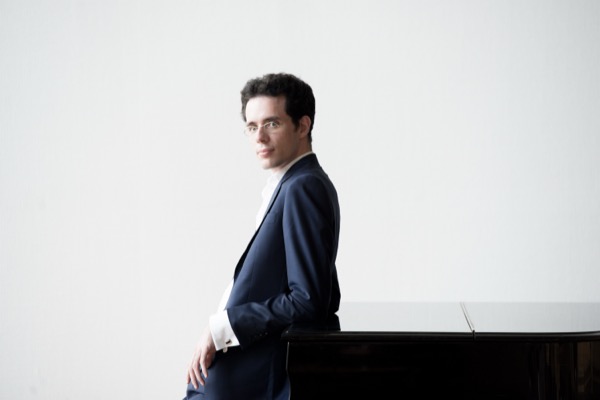
German pianist Moritz Ernst
Their collaboration also dispelled one of Deane’s long-held concerns. Because many of his earlier piano works had originally been written for himself to perform, he had occasionally wondered whether other pianists might find them inaccessible.
“Moritz proved reassuringly that this wasn’t the case,” he says, “even with the very thorny Triarchia.”
When asked whether the recording process itself transformed any of the works, both immediately point to Triarchia. Deane jokes that he has “censored the memory of how we thrashed it out,” while Ernst remembers countless conversations that gradually reshaped his understanding of the piece.
For him, the experience reinforced the special importance of working with a living composer, not to obtain final answers, but to participate in a continuous artistic conversation.
As listeners approach Scintillae, Deane offers only one request: leave expectations behind.
“Please be open-minded,” he says. “Don’t approach this with any preconceptions of what ‘contemporary’, ‘experimental’, ‘avant-garde’, or, for that matter, ‘conservative’ music is or should be.”
He points out that Irish musical life has long embraced a diversity of compositional voices, while elsewhere listeners can sometimes be constrained by stylistic labels.
“In this way, potential listeners may well be depriving themselves of a variety of possible musical experiences.”
That sentiment perhaps best captures the spirit of Scintillae. More than a document of works spanning half a century, it is a meeting of two musicians united by curiosity: one revisiting a lifetime of compositions, the other discovering new depths within them. Together, Raymond Deane and Moritz Ernst remind us that contemporary music is not defined by labels or chronology, but by the conversations it continues to inspire between composer, performer, and listener.
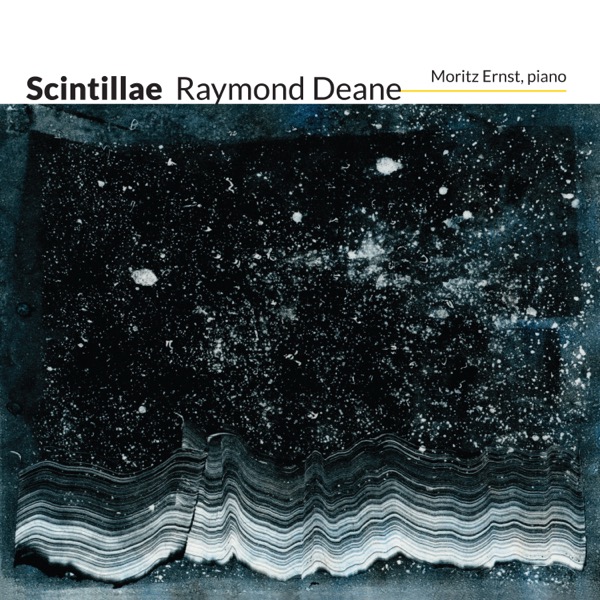
Scintillae (Farpoint Recordings)
Scintillae
Composer: Raymond Deane; Performed by Moritz Ernst
Label: Farpoint Recordings Catalogue Number fp112
Release date: 18th June 2026
For more of the best in classical music, sign up for our E-Newsletter