
Most orchestra lovers know who Harriet Smithson was, even if they don’t know her name.
She was the inspiration behind Hector Berlioz’s Symphonie Fantastique: a brilliant, era-defining actress who rose from obscurity in Ireland to bewitch the sophisticated Parisian audiences of the 1820s.
However, her broader story isn’t nearly as well-known. Today, we’re looking at the full life of Harriet Smithson: actress, muse, and doomed Romantic Era icon.
Harriet Smithson’s Childhood
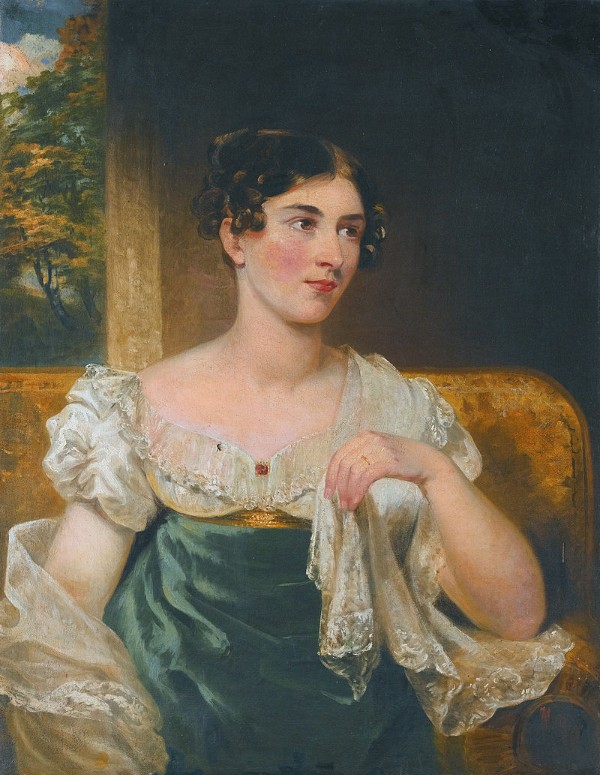
Harriet Smithson
Harriet Smithson was born on 18 March 1800 in County Clare, Ireland, to a theatrical family. Her mother was an actress, and her father was an actor and theatrical manager.
In the nineteenth century, traveling actors had limited options when it came to childcare: either you left your child with someone, or you carried a baby from town to town.
When Harriet was just nineteen months old, her parents chose to leave her with an elderly priest from the Church of Ireland. He was determined to provide the girl a religious upbringing far from the world of the theater, but he died in 1808.
From there, Harriet was sent to a boarding school in Waterford, Ireland.
Taking to the Stage as a Teenager
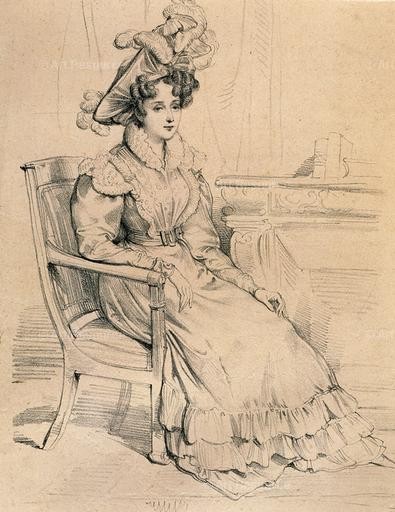
Harriet Smithson
The priest’s training didn’t take: Harriet Smithson’s family business was in her blood.
In 1814, just a couple of months after her fourteenth birthday, she made her stage debut at the Theatre Royal in Dublin.
From that point forward, she became a professional working actress. The following year, she replaced her parents in the acting company of Montague Talbot in Belfast.
Soon she was traveling across Ireland, performing dozens of roles.
Her London Debut
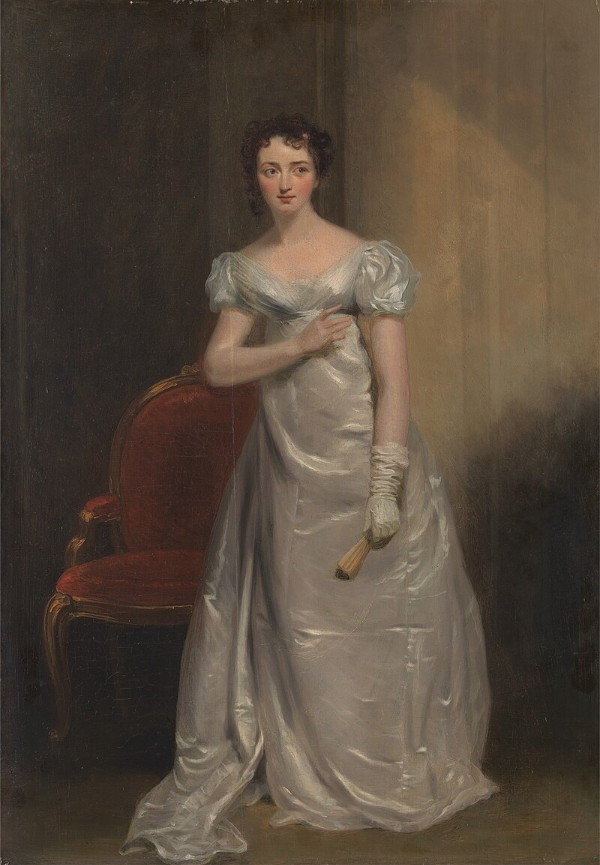
Harriet Smithson
Harriet Smithson made her London debut in January 1818, at the age of seventeen.
She played the lead in a romantic comedy called The Belle’s Stratagem, written by woman playwright Hannah Cowley, and famous for its strong-willed female characters.
Over the next decade, her career was only modestly successful, relatively speaking.
The Times wrote of her that she had “a face and features well adapted to her profession” but that she was “not likely to make a great impression on a London audience, or to figure among stars of the first magnitude.”
Sensation in Paris
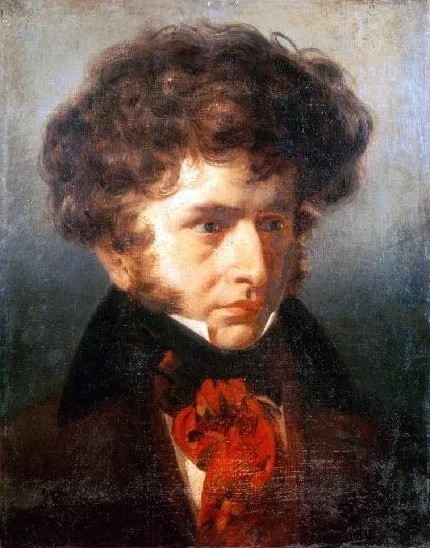
Hector Berlioz in 1832
As she entered her late twenties, she decided that the time was ripe for a career pivot. She traveled to Paris and starred in a few plays there.
Her first appearances – in Richard Brinsley Sheridan’s The Rivals and Oliver Goldsmith’s She Stoops to Conquer – were, again, only modestly successful.
But in 1827, lightning struck.
On 11 September, she appeared in a production of Hamlet, appearing as Ophelia. An up-and-coming 23-year-old composer named Hector Berlioz was among those in the audience.
She made a sensation. Critics were dazzled by her treatment of the mad scene:
“The most remarkable feature of her acting is her pantomime; she adopts fantastic postures; and she uses the dying fall in her inflections, without ever ceasing to be natural…”
The physicality of her performance must have been truly extraordinary, because the play was given in English!
Just four days later, on 15 September, she appeared in a performance of Romeo and Juliet as Juliet. Most earlier productions had emphasised Romeo’s storyline, but Smithson’s approach elevated the character of Juliet to co-lead.
One critic wrote:
Miss Smithson could not have been more graceful upon the balcony; her posture was full of truth, grace, and love… In her strong moments, she is no longer a woman, but a Fury or something approaching that…
Her exhausting week continued with a performance of Othello on 18 September. Her interpretation of Desdemona did not make the same impression as her Ophelia or Juliet had, but by that point, it didn’t matter. She was famous.
The Allure of Harriet Smithson
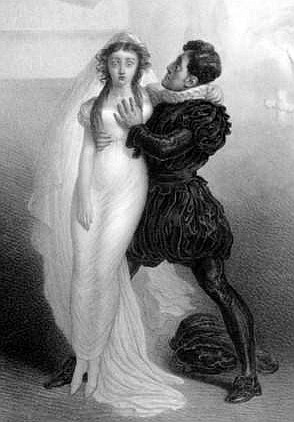
Harriet Smithson in Romeo and Juliet
So what was so gripping about Harriet Smithson?
For one, she was at the cutting edge of the movement toward a more natural style of acting.
Simultaneously, renowned singer Wilhelmine Schröder-Devrient, just four years Smithson’s junior, was exploring similar ideas onstage in Dresden.
Like Smithson, Schröder-Devrient also used her whole body to tell a character’s story. (Also like Smithson, Schröder-Devrient would go on to inspire music by a major Romantic Era composer. Wagner wrote several roles for Schröder-Devrient and would later write about his creative debt to her approach.)
Smithson’s approach was deeply appealing to French Romantics like Hector Berlioz, just as Schröder-Devrient’s approach was to Wagner.
The Symphonie Fantastique
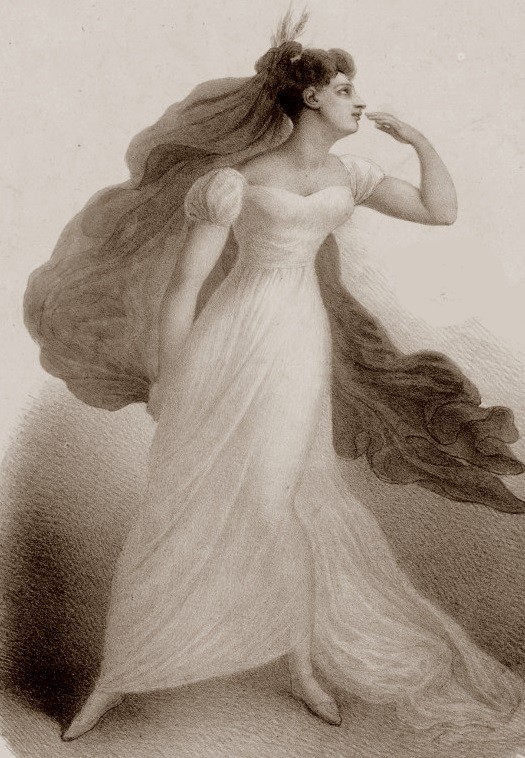
Harriet Smithson as Ophelia
However, Berlioz wasn’t just creatively inspired by Smithson. She – or rather, her onstage persona – became an erotic fixation for him.
Learn more about Berlioz’s obsession with Harriet Smithson.
Nowadays, we’d refer to Berlioz’s behaviour as stalking. He sent her love letters and even, horrifyingly, rented an apartment across the street from hers so that he could see her comings and goings. She did not answer his letters.
Berlioz ended up writing a gripping, innovative symphony inspired by his unsettling obsession: the Symphonie Fantastique.
Berlioz’s Symphonie Fantastique
This music tells the story of a young male musician who falls in love with “a woman who unites all the charms of the ideal being of which his imagination dreamed.” She is symbolised in the music by a melody known as the idée fixe.
Throughout the symphony, the artist imagines this woman wherever he goes, whether he’s at a ball or in the countryside.
Finally, the musician character takes a large dose of opium, and in his dreams, kills his beloved and witnesses his own guillotining.
Afterwards, the woman appears at a witches’ sabbath: a gathering of “ghosts, sorcerers, and monsters of all kinds… She joins in the diabolical orgy.”
An Interlude in Berlioz’s Love Life
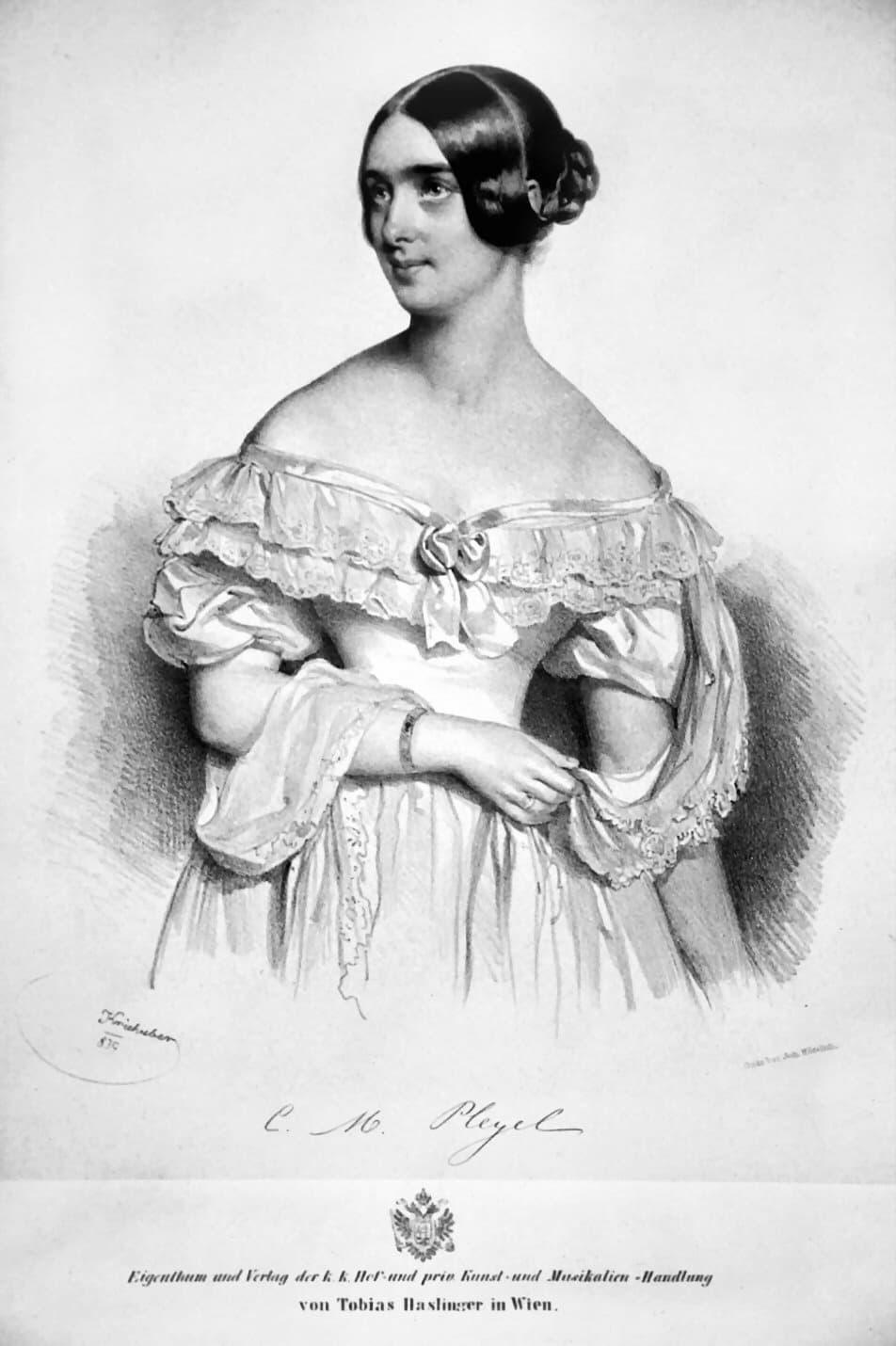
Marie Moke-Pleyel (lithograph by Josef Kriehuber, 1839) © Wikipedia
The work was premiered at the Paris Conservatoire in December 1830. However, by that time, Berlioz’s Smithson fever had broken.
That spring, Berlioz proposed to virtuoso pianist Camille Marie Moke instead. Unfortunately, in the spring of 1831, her engagement would ultimately fall apart in spectacular style.
Meanwhile, while Berlioz was writing the Symphonie Fantastique and hooking up with Moke, Smithson spent time working in London trying to duplicate her Parisian successes.
Unfortunately, she failed to do so. Reviews were mixed, ranging from “her voice, from a peculiarity in its intonation, has a monotonous effect” to “she is the best tragic actress now in London.”
In 1830, she spent some time in Paris trying to establish an English theater, but that venture failed, too.
Things really began unraveling for her in 1831, when she broke her leg coming out of a carriage. She was now 31, unable to work, and unmarried…and family members were relying on her to support them.
Finally Falling In Love with Berlioz

Hector Berlioz, 1845
As her career began to deteriorate, Berlioz’s began to accelerate.
In December 1832, he presented a spiritual successor to the Symphonie Fantastique called Lélio, or the Return to Life.
It was written for massive forces: an orchestra, piano, mixed chorus, two vocal soloists, and even a narrator.
Berlioz’s Lélio
He’d originally written it to process the breakup with Moke, but ended up claiming that Smithson had been its muse.
Harriet Smithson was in Paris at the time and went to the Lélio premiere. She was impressed by what she heard and finally got in touch with the composer.
The two began meeting up, and soon they fell in love. Although their friends and family were not particularly thrilled by the match, they ended up marrying on 3 October 1833.
One tidbit of music history trivia is that after their wedding night, Berlioz immediately wrote a letter bragging to Franz Liszt, declaring that, contrary to everyone’s expectations, Smithson was a virgin. It’s unclear how exactly Berlioz came to this conclusion, or whether either husband or wife was lying for their own reasons…or why Liszt needed to be told this gossip in the first place!
Harriet Smithson and Motherhood
In August 1834, after a difficult pregnancy and a forty-hour labour, Smithson gave birth to her one and only child, a son named Louis.
She found motherhood to be a mixed bag. She loved her child dearly, but she couldn’t shake her desire to return to the stage. Unfortunately, due to a variety of reasons, including her lack of fluency in French, her options to do so were limited.
Liszt’s partner, Marie d’Agoult, and Chopin’s future partner, George Sand, exchanged letters discussing a proposition from Hector: a play written by Sand meant to spotlight Smithson. However, Sand was cool to the idea, and the discussed work never materialised.
In late 1838, the family’s financial pressures were eased after Niccolo Paganini, who had been hugely impressed by Berlioz’s Harold in Italie, sent Berlioz the astronomical sum of 20,000 francs. This gift was arguably the last unalloyed bright spot of Smithson’s life.
Berlioz’s Harold in Italie
Increasing Pressures at Home
Unfortunately, the respective trajectories of the couple’s careers continued. Smithson gave her final performance as Ophelia in 1836, but then retired from the stage.
She became increasingly unhappy at home. She wasn’t suited for housekeeping; Berlioz’s family still hadn’t warmed to her, and Louis, struggling with the language barrier between them, began preferring the company of Hector.
She also struggled with deteriorating health, including dental issues, alcohol addiction, and other illnesses that sapped her physical and mental strength.
Berlioz’s Mistress Marie Recio
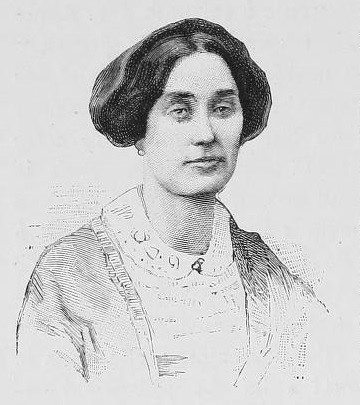
Marie Recio Berlioz
Around 1840, Berlioz met mezzo-soprano Marie Recio, who was fourteen years Smithson’s junior. He began supporting her career, but ultimately, stage fright kept her from becoming as influential as Smithson had been.
Berlioz continued to provide for his wife financially, but emotionally, he had checked out of the relationship.
He wrote to his sister about Smithson:
It isn’t just that she can’t even keep an account of our expenses. She gets up in the middle of the night when she knows me to be asleep, comes into my room, shuts the doors, and starts shouting abuse at me for three hours on end sometimes till daybreak; the next day she asks me to forgive her, swears she loves me, that I could trample her under foot without affecting her love; and in the evening it all begins again. Truly, it’s unbearable.
Berlioz moved out of the house in 1843.
Harriet Smithson’s Tragic Final Years
Smithson’s final years were a grim parade of disasters.
In 1848, a bandit shot at Smithson in the garden, nearly killing her.
Then, in October of that year, she suffered the first of what would be many strokes. They disabled her and made her physically unable to speak French. She lay in bed for years, barely able to communicate.
At one point, Berlioz came to visit her with a portrait from her youth. She cried bitterly seeing it.
Finally, on 3 March 1854, after unimaginable suffering, she died. Berlioz wrote:
I had been out of the house for two hours when one of the women looking after her came to fetch me and hurried me home. It was all over: she had just breathed her last. A sheet already covered her. I drew it back and kissed her pale forehead for the last time. Her portrait, which I had given her a year before and which, painted in the days of her splendour, showed her as she had been in all her radiant beauty and genius, hung beside the bed on which she lay inert, disfigured by disease.
For more of the best in classical music, sign up for our E-Newsletter





Me acuerdo que una vez le pregunté a mi papá si era verdad éso de que Berlioz había traicionado a Harriet con Marie Recio y me respondió que éso no es más que una calumnia, es más su relación empezó después de la muerte de Harriet. Y sinceramente, creo que Berlioz nunca pudo amar a Marie y olvidarse de Harriet, ella fue su gran amor, su musa, su Ofelia.