Playing an instrument is physically as well as mentally taxing. We’re the small muscle Olympians who challenge our every sinew and are disappointed when our bodies let us down. Today, we musicians are more aware that an injury can occur—sometimes even if you’re doing everything right.
The causes of an injury can occur due to our body size and build. People used to tell me. “You’re too petite to play the cello!” At barely five feet tall and with tiny hands, I set out to prove them wrong. On the way to becoming a successful professional, I encountered several serious setbacks of the physical kind, and I’m certainly not alone. A musician’s body size and build may predispose him or her to injury. Teachers and parents should take body size and build into consideration when recommending an instrument to youngsters. Physical traits such as small hands, long necks, lung capacity, slender wrists, long fingers, double-jointedness or joint laxity, long arms, and a slender build can affect us.
Conditioning is important. An untoned body is more injury-prone as it is less resilient. When your muscles are tight and weak, you are at greater risk than if you are strong and flexible.
Muscle fatigue and overuse can lead to chronic pain. When we don’t take sufficient breaks, the resulting tension and reduced blood flow can eventually lead to microscopic tears in the muscle, which could lead to scar tissue.
Some repertoire is dangerous to your health! Difficult repertoire or repertoire that one isn’t ready for can cause additional tension and trigger using more force. Remember that in a group setting such as in the orchestra or band, you have less control over everything—
the tempo—it may be unplayably fast or much too slow.
your stage placement, whether you have enough room to bow or breathe and lighting so you can see.
the chairs, which may be too low, slope backwards, are unsteady, or are moulded.
thoughtless conductors who may be demanding, start or stop frequently and suddenly, or repeat difficult passages over and over.
Many taxing techniques are written into the repertoire with no respite, and we tend to give our all to play these passages. Pages of tremolo, col legno, triple tonguing, thousands of repeated notes, or long, softly held notes are common in orchestral music, but they do occur in chamber music and, especially, contemporary music. I can give you endless examples!
Bruckner, Tchaikovsky, Sibelius, and others are notorious for writing pages of tremolo.
Bruckner Symphony No. 4 has 565 bars of tremolo for the violins.
Oceanides by Sibelius has 589 bow strokes (triplets) in 22 bars in the cello part that is only one and a half minutes of music!
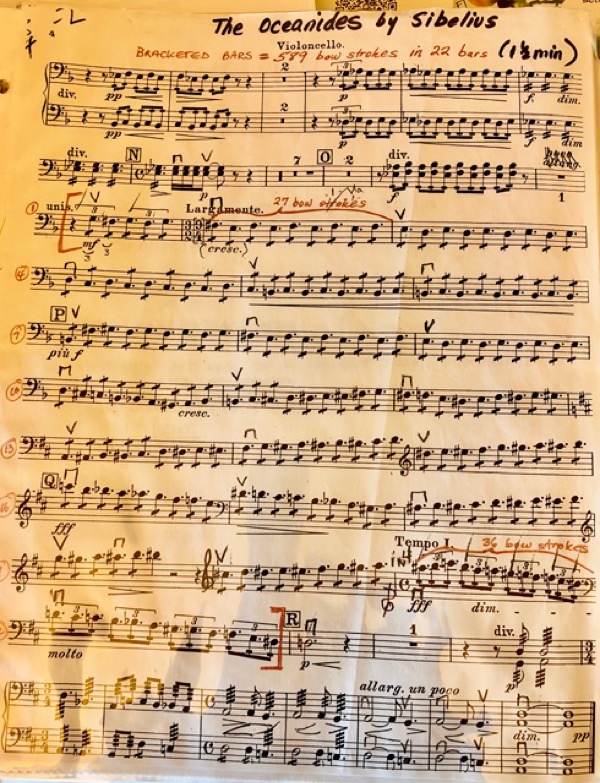
Cello part of Sibelius’s The Oceanides
Shostakovich Symphony No. 11 “1905”, one of my favourites, is an hour-and-12-minute symphony. In movement II, “The 9th of January”, there are pages of continuous pp in the strings. While the right-hand bow moves extremely slowly and unperturbed, the left hand has a full 4–6 minutes of trills (depending on the tempo).
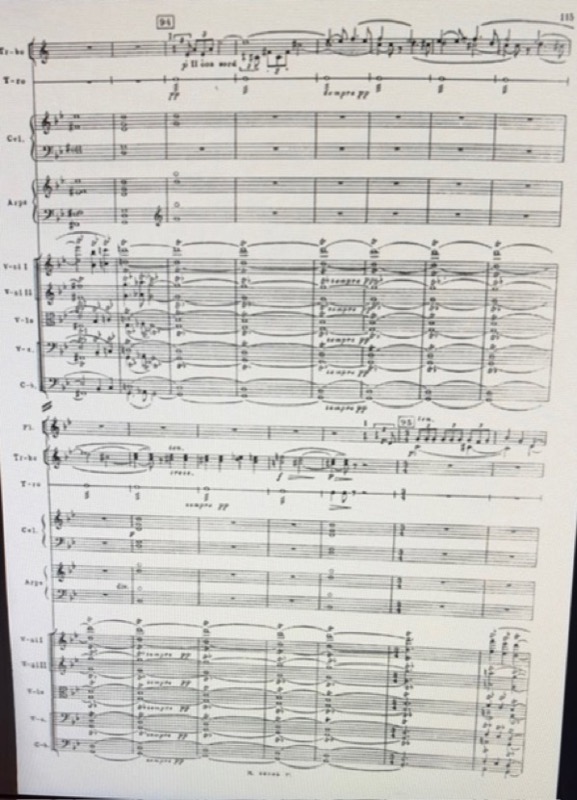
Page from the score of Shostakovich’s Symphony No. 11, second movement
I can attest to feeling like my right arm might fall off. The devastating battle begins at 13 minutes, followed by the deathly silent aftermath at 14 minutes, with murmuring trill passages with celeste and muted trumpets. It moves attacca to movement III, and the finale has loads of notes. No rests in between. The symphony is rewarding to play if you are in shape and can stay loose.
Dmitri Shostakovich: Symphony No. 11 in G Minor, Op. 103, “The Year 1905”: II. The 9th of January (Berlin Philharmonic Orchestra; Semyon Bychkov, cond.)
In Ravel’s popular piece Bolero, the snare drum player repeats a 24-note pattern over two bars. There are 430 bars in the piece. That means 5,144 snare drum strokes, not considering the unwavering rhythm required and the control of the dynamics: beginning the piece extremely softly and building to a huge ff climax. Did I mention we sometimes played the piece twice in one day?
Lest you think the woodwinds are exempt:
John Adams‘ Harmonielehre (Adams anything) is beautiful but has incredible repetition for the winds. The first 94 bars of part three have 976 eighths for flute, piccolo, piano, harp and clarinet.
John Adams: Harmonielehre: III. Meister Eckhardt and Quackie (City of Birmingham Symphony Orchestra; Simon Rattle, cond.)
Pianists should be wary of extreme repetition too. A study indicates that playing Rachmaninoff’s Piano Concerto No. 3 is like shovelling three tons of coal! Yuja Wang makes it seem effortless, especially the last 15 minutes.
Yuja Wang: Rachmaninoff Piano Concerto No. 3 in D minor Op. 30 [HD]
To guard against injury there are things you can do.
First, Five Practice Rules:
Always warm up before playing: first away from the instrument with gentle movement to get your circulation going, then on the instrument. Initially, play not too high, not too low, not too fast, not too slow.
Take breaks. Limit a session to two hours, with a 10-minute break per hour, and take a day off a week.
Vary your repertoire. Different pieces will tax different muscles. Don’t get stuck on one passage.
Increase your practice load gradually.
Reduce your practice intensity prior to performance.
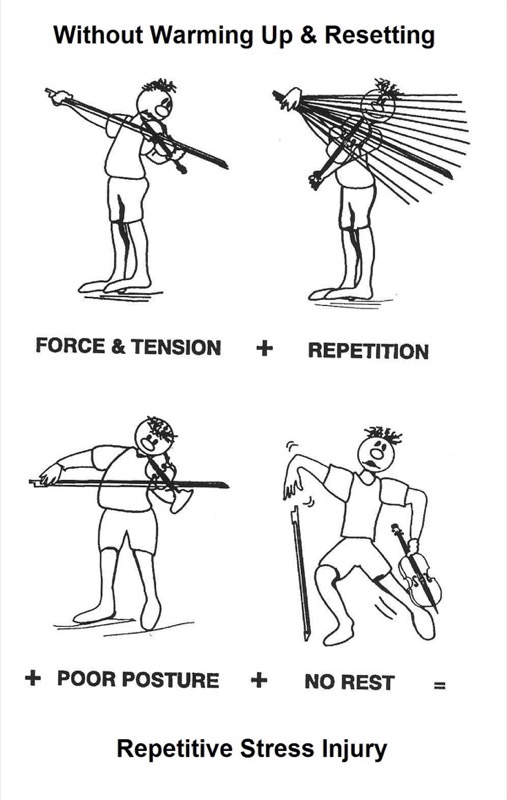
Without warming up and resetting: force and tension, repetition, poor posture and no rest lead to repetitive stress injury
Try the following gently if you are injury-free before practice, during practice, and before performance to release tension. Never stretch to the point of pain and don’t bounce. Use slow, gentle, steady pressure and keep breathing.
Try nodding. Then, with your chin tucked, look side to side, tilt your head (left ear to left shoulder, right ear to right shoulder), shrug your shoulders, do shoulder circles, gently reach to the sky, clasp your hands, then clasp your hands behind your back to open your pectorals. Try standing against a wall with your back on the wall, your head and shoulders touching the wall. Are you able to? Although this is a test for natural posture, it’s a good idea to consult with a physical therapist to check if your shoulders need attention if this is even a bit of a strain.
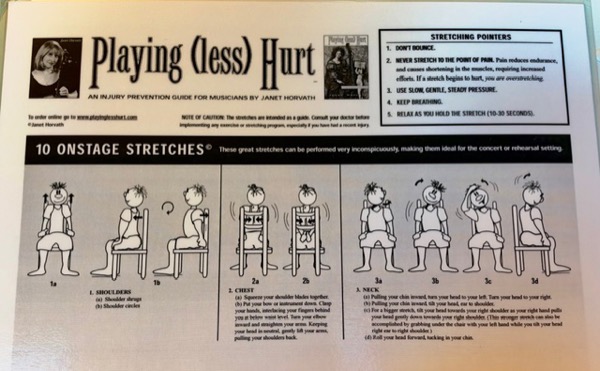
10 Onstage Stretches (1–3), from Playing (Less) Hurt by Janet Horvath © Janet Horvath
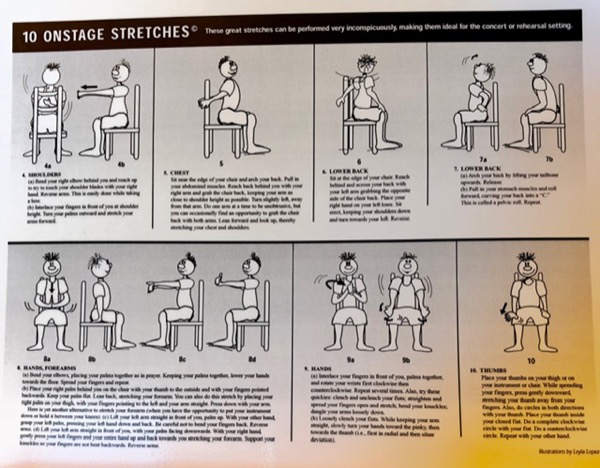
10 Onstage Stretches (4–10), from Playing (Less) Hurt by Janet Horvath; illustrations by Leyla Lopez © Janet Horvath
Remember to keep moving to release tension even while seated: wiggle, move your hips and feet, do a big shoulder roll, and take several deep breaths. Here are a few additional hints from a previous article: https://interlude.hk/cancellations-and-returns-to-the-stage-why-musicians-are-susceptible-to-injury-and-what-to-do-when-it-happens/.
Beware of changes that affect your technique—a new instrument, set up, or technique you’re trying to master, and sudden increases in your playing time or intensity. Don’t take on too much too soon. Make comfort your priority. When you’re nervous, pay more attention to breathing deeply and to reducing tension.
Read more in my book Playing (Less) Hurt – An Injury Prevention Guide for Musicians.
For more of the best in classical music, sign up for our E-Newsletter