When George Frideric Handel arrived in London in 1710, the English stage for Italian opera was largely defined by creative confusion. Early productions suffered from mixed languages, haphazard pasticcios assembled from disparate sources, and a persistent lack of clear artistic direction. This chaotic period—often characterised by early music historians as a “reign of nonsense”—only began to end in 1719 with the founding of the Royal Academy of Music. Backed by King George I and wealthy aristocrats who had returned from their European Grand Tours hungry for top-tier Italian opera, the Academy set out to establish London as an international operatic capital.
Handel was promptly dispatched to Continental Europe to recruit the finest singers, culminating in the Academy’s inaugural spring season of 1720. The signature work of this debut was Handel’s Radamisto, which premiered at the King’s Theatre on April 27, 1720. The occasion carried immense political and cultural gravity. King George I and his son, the Prince of Wales, who had been locked in a bitter three-year political feud, chose the opening night to make a public show of reconciliation. Handel personally dedicated the score to the King, expressing genuine appreciation for the monarch’s refined musical judgment. The production proved an overwhelming triumph, drawing such passionate, overflowing crowds that contemporary observers reported well-dressed patrons fainting in the stifling heat and desperate theatregoers offering extravagant sums to secure a spot in the upper gallery.
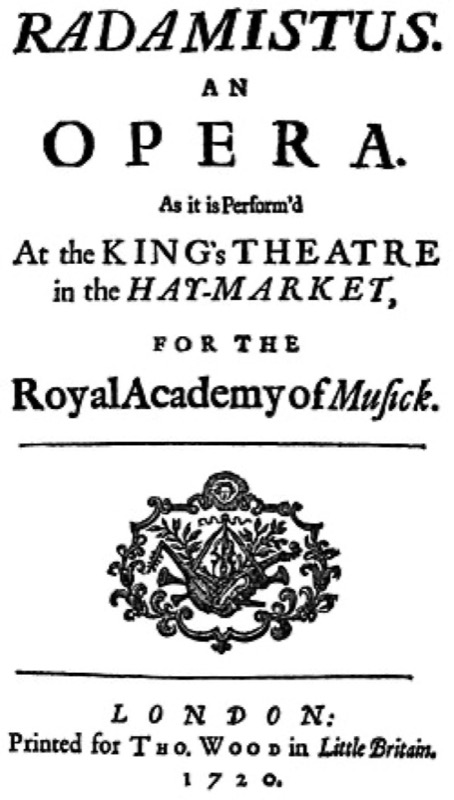
Title page of the libretto
Classical History Meets French Drama
While the opera’s printed libretto claimed inspiration from Tacitus’s Annals—which documented real first-century power struggles, forced unions, and military betrayals in ancient Armenia—the actual historical connection is remarkably thin. In Tacitus, the real Radamisto and his pregnant wife, Zenobia, flee a battlefield, leading to a grim moment where Zenobia begs her husband to kill her rather than leave her to the enemy; he wounds her and casts her into the Araxes River, where she is saved by locals.
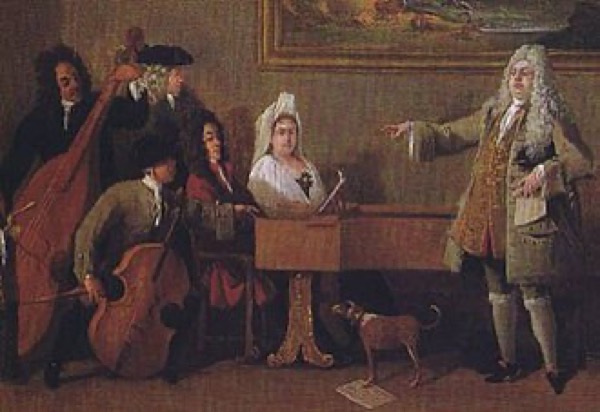
Marco Ricci’s ca. 1709 painting of Nicola Francesco Haym at the harpsichord
However, Handel’s librettist, Nicola Francesco Haym, adapted an earlier Italian text by Domenico Lalli titled L’Amor tirannico. Lalli had secretly borrowed his entire plot structure from a 1638 French tragedy of the same name by Georges de Scudéry. Scudéry’s play explored how unchecked, obsessive passion could warp a ruler’s mind and drive an entire kingdom toward ruin. In adapting this French source, Lalli introduced historical names like Radamisto, Zenobia, and Farasmane, but shifted the geographical setting to Thrace and Armenia, creating a dramatic narrative centred on the clash between tyrannical obsession and unwavering moral loyalty.
Driven by an obsessive lust for his sister-in-law, Zenobia, the Armenian tyrant Tiridate invades Thrace, takes King Farasmane captive, and demands that Prince Radamisto trade Zenobia for his father’s life. Farasmane urges defiance, prompting Radamisto and Zenobia to flee as the city falls. Cornered at the Araxes River, Zenobia begs for death to escape capture; Radamisto lightly wounds her, and she leaps into the torrent. Fraarte rescues her and brings her to Tiridate’s camp. Believing her dead, Radamisto surrenders to the sympathetic General Tigrane and infiltrates the palace disguised as a servant. Upon discovering Radamisto’s survival, Tiridate demands Zenobia marry him or witness her husband’s execution at the sacred altar. At the climax, Tiridate’s neglected wife, Polissena, turns against him, joining Tigrane and Fraarte in leading a popular military uprising. Disarmed and defeated, Tiridate receives a magnanimous pardon from Radamisto and Polissena, inspiring his genuine repentance and restoring peace to both realms.
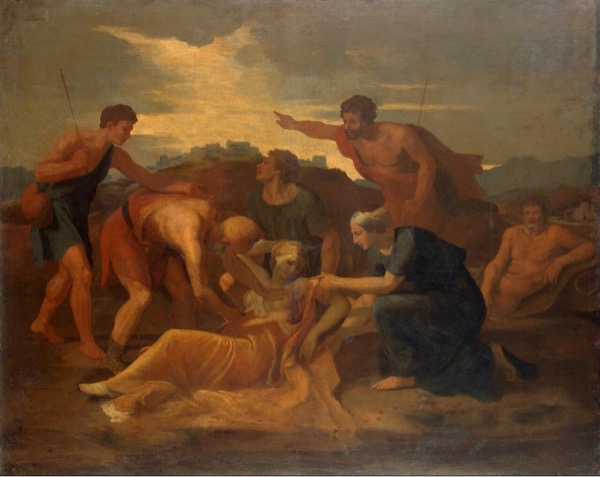
Nicolas Poussin – Queen Zenobia Found on the Banks of the Araxes
Orchestral Brilliance and Musical Strategy
Musically and dramatically, Radamisto stands as one of George Frideric Handel’s most sophisticated achievements, marking a transformative moment for early 18th-century opera on the London stage. Rather than relying on superficial vocal athletics or mechanical structural formulas, Handel engineered a score of deep psychological complexity. He achieved this through dense contrapuntal weaving, daring chromaticism, and an extraordinarily rich orchestral palette that directly served the emotional narrative. For the premiere, Handel significantly expanded his instrumental forces to include pairs of horns, oboes, and bassoons. Rather than treating these instruments as mere dynamic reinforcement, he used their distinct timbres to establish a stark contrast between public turmoil and private grief. The regal brass and aggressive woodwind colours evoke the siege’s grand, violent machinery. In contrast, delicate solo woodwinds and muted strings surround the main characters during their most intimate confessions.
The score contains some of the most emotionally devastating music Handel ever composed for the British public. The absolute centrepiece of this psychological realism is Radamisto’s profound Act II lament, “Ombra cara.” Written in the dark, heavy key of F minor, the aria uses agonising, slow chromatic steps that creep over a relentless, pulsing string accompaniment, perfectly capturing the crushing, paralysing weight of a husband mourning his lost wife. In sharp contrast, Zenobia’s steady moral resilience is painted through broad, noble vocal lines. In her defiance of death during “Son contenta di morire,” the music eschews hysterical ornamentation for a grounded, unwavering melodic dignity that asserts her refusal to yield to tyranny. Meanwhile, the despotic Tiridate is musically characterised by volatile, unbridled energy; his vocal lines feature explosive, wide interval leaps and jagged rhythms, accompanied by virtuosic string passagework and blazing brass flourishes that expose his complete lack of emotional self-control.
Handel: Radamisto, HWV 12: “Ombra cara di mia sposa”
George Frideric Handel: Radamisto, HWV 12a: Act I Scene 5: Son contenta di morire (Zenobia) (Maite Beaumont, mezzo-soprano; Il Complesso Barocco; Alan Curtis, cond.)
Although Handel revised the score late in 1720 and in subsequent revivals to accommodate high-profile stars like the castrato Senesino and the rival divas Francesca Cuzzoni and Faustina Bordoni, the original April 1720 version possesses an exceptionally tight dramatic economy. By seamlessly synthesising the vocal warmth of Italian opera, the tight narrative momentum of French theatre, and the intricate contrapuntal craftsmanship of the German tradition, Handel crafted a timeless musical portrait of human endurance, proving that moral integrity can disarm the most ruthless despotism.
For more of the best in classical music, sign up for our E-Newsletter