There is something rather extraordinary about discovering a pianist who, despite having enjoyed an international concert career, seems to have disappeared from the history of her own country. Maria Carreras (1877–1966) was an Italian-born pianist who appeared as a soloist with the New York Philharmonic under the baton of Arturo Toscanini. Yet her name is scarcely known today.
I first came across her a few years ago, while exploring historical piano-roll recordings. Having grown up in Italy, immersed in classical music, I was baffled by the fact that I had never heard of her.
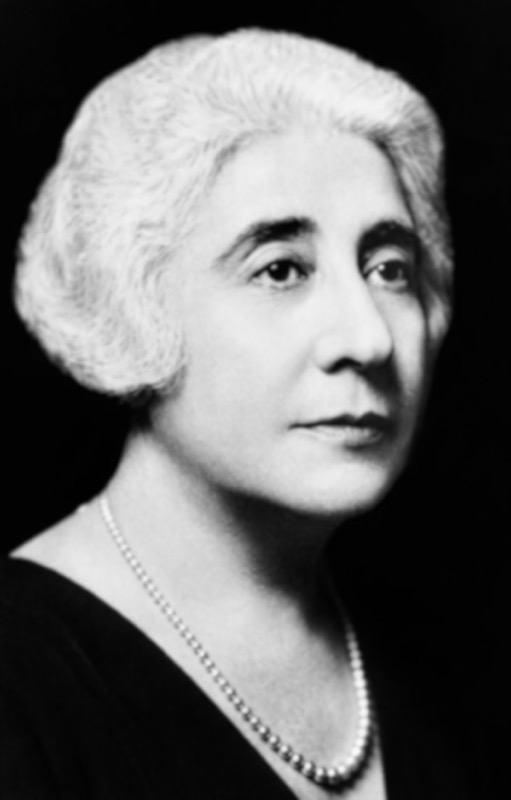
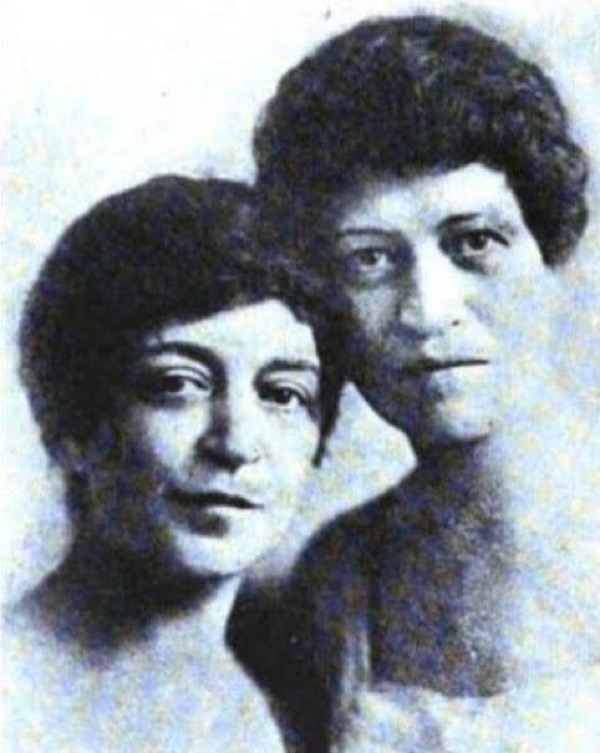
Maria Carreras
The little information that survives about this pianist makes researching her career something of a detective exercise. Even basic biographical details are elusive, and her early life is barely documented. The most widely cited records give her birth as 19 February 1877; others give 1872.
Carreras studied in Rome with Giovanni Sgambati and in Berlin with Ferruccio Busoni. These were hardly insignificant credentials: Sgambati had been a pupil of Liszt, while Busoni was establishing himself as one of the leading pianists and musical thinkers of his generation.
By 1909, she was already pursuing a concert career: an engagement is documented in La Spezia, where she performed for the Amici della musica. A programme preserved by the Società dei Concerti di Parma records her appearance there in January 1910, alongside the Finnish cellist Lennart von Zweygberg.
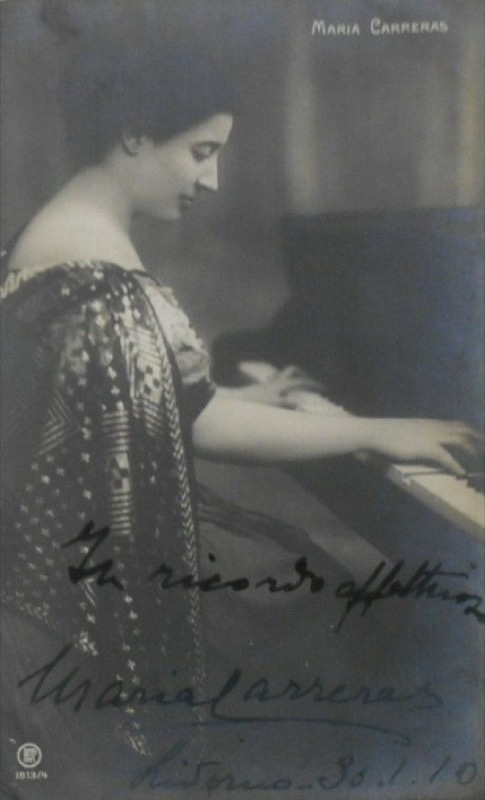
Maria Carreras (1910)
Later that year, she travelled to Portugal from Berlin, having been engaged for two performances by the Orpheon Portuense. The Portuguese journal Arte Musical, in its issue of 15 December 1910, describes her as a distinguished pianist and lists an ambitious programme including Bach-Busoni, Beethoven, Schumann, Chopin and Liszt. It also mentions a piano transcription by Michael Zadora of a Bach organ concerto (itself a transcription by Bach of a concerto by Vivaldi).
Bach: Concerto in D Minor • Maria Carreras
Her Portuguese engagements continued into the following year. On 9 December 1911, the Gazeta de Coimbra announced her arrival from Berlin, advertising two forthcoming concerts in Lisbon and one in Coimbra. The newspaper described the Coimbra concert as an important event for local music lovers. These notices offer a glimpse of a performer moving between European musical centres.
Another Italian appearance took place shortly afterwards: on 5 January 1912, Carreras gave a solo recital in Brescia at the Sala Apollo, Palazzo Martinengo, for the Società dei Concerti. The retrospective account of the concert, published in connection with the centenary of the Società dei Concerti, contains an interesting observation: giving an entire solo piano recital was still something of a novelty in Brescia, and audiences could be somewhat reluctant to attend such programmes – nevertheless, Carreras attracted a sizeable audience. The same account identifies her as “Maria Carreras, nata (née) Avani” and describes her as “a Roman pianist”. Carreras, therefore, appears to have been her married name.
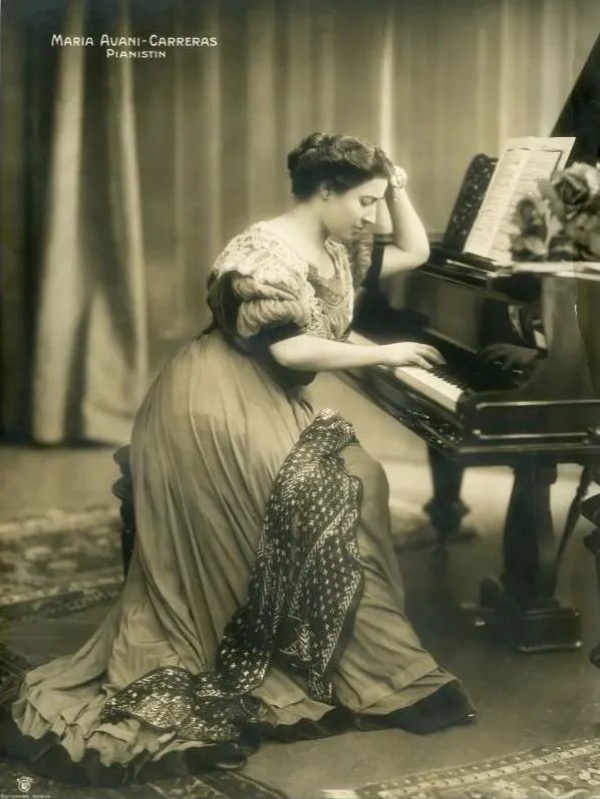
Maria Avani-Carreras
A further archival trace appears in Florence. The historical archive of the Lyceum Club Internazionale di Firenze, founded in 1908 as a cultural and intellectual association for women, preserves an invitation listing Carreras for 16 April 1916. Unfortunately, the surviving documentation does not establish what she performed, and the invitation alone cannot confirm that the event went ahead. However, the reference places Carreras within the musical life of Florence during the First World War.
In 1914, she was invited to perform in Russia on the occasion of the 20th anniversary of Anton Rubinstein‘s death. She subsequently established herself in the US, making her New York debut in 1923. Her performances attracted favourable critical attention. The New York Herald Tribune, for instance, described her as possessing “interpretative authority”, while other reviews praised the imagination and beauty of her playing. In November 1925, The Etude listed an interview with her. The feature was titled “Italian Aspect of the Art of Pianoforte Playing”.
One particularly remarkable episode in her American career was her appearance with the New York Philharmonic under Arturo Toscanini: in April 1933, she took part in Beethoven’s Triple Concerto, alongside violinist Mishel Piastro and cellist Alfred Wallenstein.
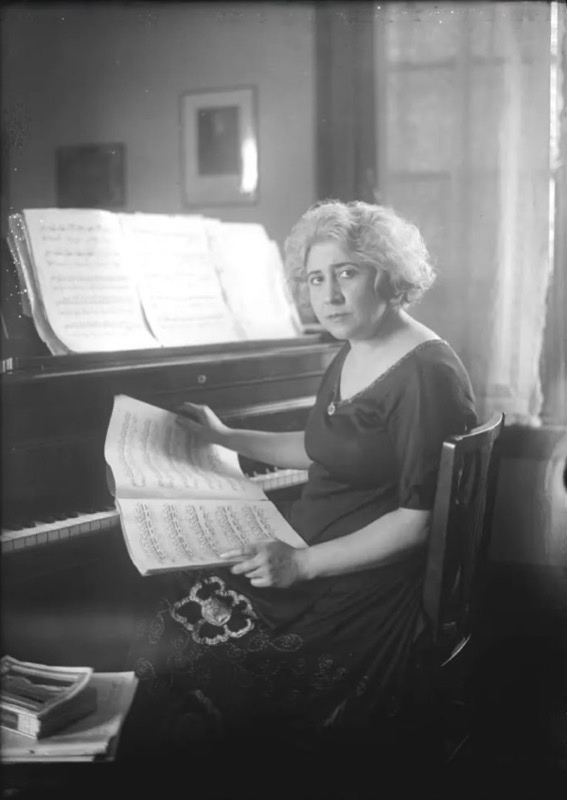
Maria Carreras
Like many pianists of her generation, Carreras made recordings on piano rolls, notably for the Duo-Art system. These preserve her performances of works by Bach, Beethoven, Chopin, Liszt, Schubert, Grieg and others. Contemporary reviews of her rolls in The New Yorker show that her interpretations were being heard and discussed in musical circles during the 1920s.
Chopin: Allegro de Concert, Op. 46 • Maria Carreras
Carreras was also active as a piano teacher. A 1945 issue of The Etude described her as a “Teacher of successful concertising pianists”, suggesting that teaching had become an established part of her activity. One of her pupils was Aileen Fealy, subsequently a concert pianist, who was identified as having studied with Carreras in a 1930 article in Broadcast Weekly.
It is tempting to compare Maria Carreras with some of her contemporaries, such as Fannie Bloomfield-Zeisler and Rosina Lhévinne, or the somewhat younger Myra Hess and Guiomar Novaes – all active concert pianists whose careers overlapped with hers – but there isn’t enough surviving evidence to assess Carreras’s artistic standing against that of these better-remembered performers. Even among these women, however, the extent to which their names have survived in music history varies considerably. So the question arises: why have some pianists been incorporated into the historical narrative while others have virtually vanished from it?
The answer is probably not a single one. The survival of recordings, the availability of biographical documentation, the influence of pupils and the willingness of institutions to preserve an artist’s legacy all play a part. Gender may also have contributed: women pianists of this generation had to negotiate professional worlds in which recognition and lasting visibility were far from guaranteed.
There may also be something peculiarly Italian about this case. Italy is, after all, one of the great historical homelands of Western classical music, with a musical heritage so vast that individual contributions can easily become submerged beneath its accumulated riches – not unlike the country’s landscape, where extraordinary historical remains often stand neglected or half-forgotten, not because they lack significance, but because there are so many of them. Maria Carreras’s obscurity might be, in part, another manifestation of this paradox of abundance.
I believe it is important to revisit artists such as Carreras, not simply to add another name to an already crowded list of historical pianists, but also to question how that list came to be. Music history is not an exhaustive record of those who composed, performed or achieved distinction in their time: it reflects what was documented, preserved and subsequently deemed worthy of remembering.
Maria Carreras’s piano rolls offer us the opportunity to hear the pianist herself. More than a century after some of those recordings were made, her outstanding playing provides a window onto the musical world in which she lived and worked. That she should be remembered, if only by a relatively small number of listeners, is surely better than allowing her to disappear altogether.
For more of the best in classical music, sign up for our E-Newsletter