
The piano as we know it today, an 88-key behemoth in black, is the result of innovation upon innovation since the first invention of the ‘fortepiano’ by Bartolomeo Cristofori in 1700.
The fortepiano (meaning ‘loud soft’) was the next development after the harpsichord. Like a harp, the harpsichord was played by plucking strings; in this case, by touching a key, it released a goose quill to pass the string, plucking it as it went by. Harpsichords could not be dynamically altered – they produced the same sound no matter how hard or soft you played. In fact, because of its plucking motion, you had to use quite a bit of force on the key. You could muffle it by keeping the lid closed, but that was about all you could do for dynamics.
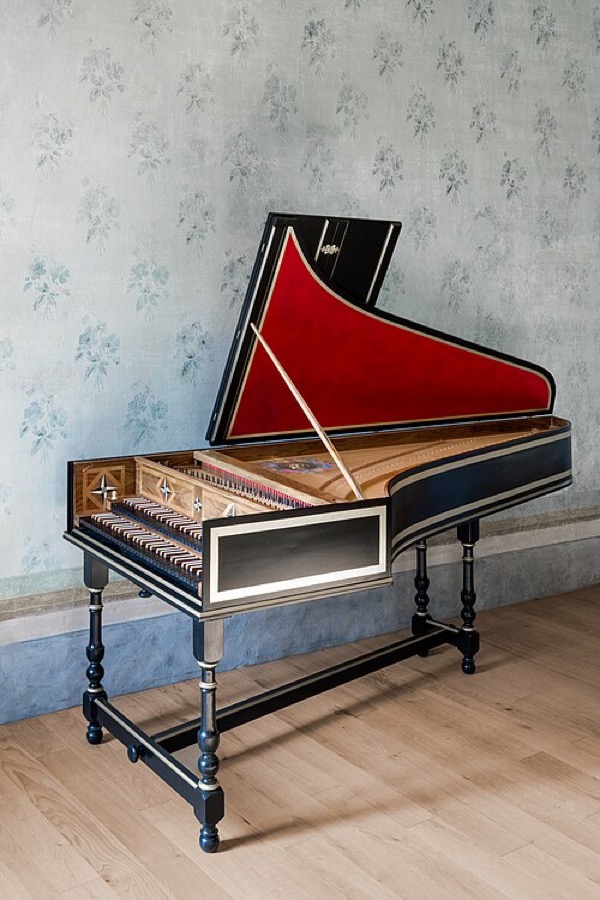
Colzani: Harpsichord, 2021 (photo by Andrea Bastoni)
The sound was quite small and thin. Its great advantage over the instrument it replaced, the lute, was the ability to play multiple notes at once.
Henry Purcell: Suite No. 1 in G Major, Z. 660: I. Prelude (Terence R. Charlston, harpsichord)
Cristofori’s fortepiano advertised its great innovation in its name. By calling it ‘Loud-Soft’ (fortepiano), he told his customers what it could do.
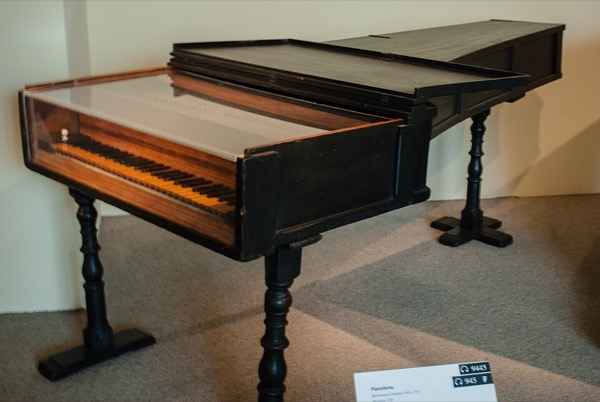
Cristofori: Fortepiano, 1720 (Metropolitan Museum of Art) (photo by Shriram Rajagopalan)
The new hammer mechanism developed by Cristofori meant that a string could sound for longer. The fuller sound and the ability to play a note loudly or softly gave composers a greater range of sound possibilities.
Listen to the richer sound of this fortepiano, compared to the earlier harpsichord.
Antonio Rosetti: Fortepiano Sonata in B-Flat Major, E. 3/K.V:3: I. Allegro (Christoph Hammer, fortepiano)
It wasn’t until the 1760s that the fortepiano really found its market, with music specifically for the instrument being sold and concerts featuring it being advertised.
Every musical instrument maker tried to make their own innovations to the instrument, adding pedals for sustaining the sound, for cutting off the sound, for adding percussion effects, for changing the sound, and for changing the action to be as light as possible (a speciality of the Viennese makers).
The modern piano comes in a variety of forms: upright (with the strings at a 90° angle to the keys) and grand (more like the fortepiano in general design, but much more robust).
The new pianos were built around an iron frame that could stand much greater tension than the earlier fortepianos. Where the range of the fortepiano had been about 4 octaves (48 keys), the range of the piano was established at 88 keys (7 1/3 octaves).
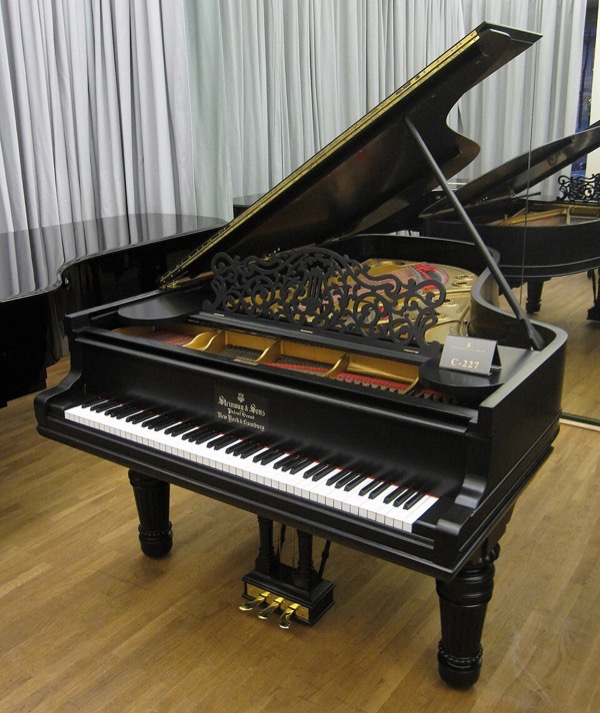
Steinway & Sons grand piano (photo by Gryffindor)
Some speciality pianos include the toy piano, made for children but used by grown-up composers for a different keyboard sound. Instead of strings, the notes are played by hammers hitting tuned rods.
John Cage: Suite for Toy Piano: I. — (Xenia Pestova, toy piano)
A pedal piano is like an organ in that there is an additional keyboard to be played by the feet (Mozart owned one, as did the French composer Alkan). There are two ways for the strings to be sounded: one involves a mechanism that runs connectors up to the piano case and the other, the Doppio Borgato, brings in a second piano case.
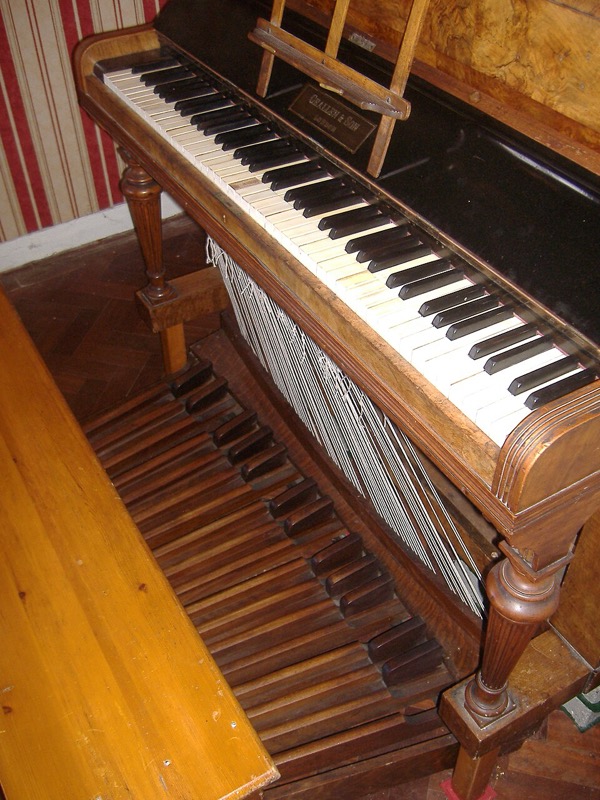
An upright pedal piano, 2007
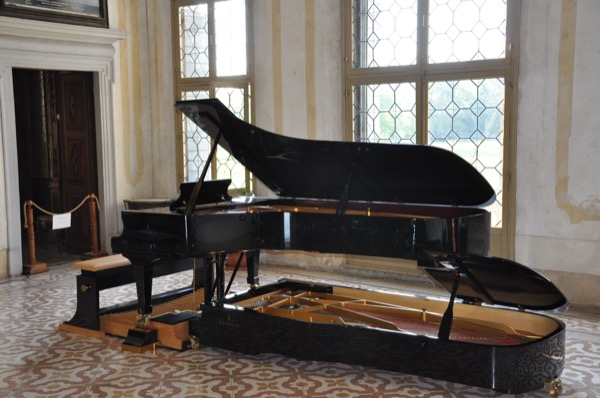
Doppio Borgato, 2011 (photo by Loretta Doro)
Jean Guillou DOPPIO BORGATO pedalpiano – Concerto Teatro Olimpico Vicenza
Other piano makers extended the keyboard. Bösendorfer added 9 extra bass keys, bringing the total from 88 to 97. To ensure players won’t get confused, all the keys are coloured black, and some versions even have a little cover, so you don’t hit them by accident. Busoni was the first to write for it, and Bartók, Debussy, and Ravel followed him. The Australian piano makers Stuart & Sons have created 108- and 112-key pianos.
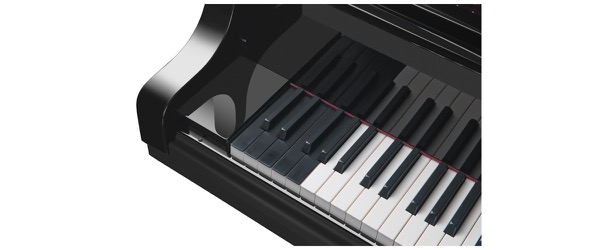
Bösendorfer Concert Grand 290 Imperial extra keys
Carlo Grante plays Debussy on Bosendorfer Imperial – Estampes – 1. Pagodes
Other piano innovators didn’t seek to change the mechanism, but rather how the whole piano was set up.
Some players wanted more ergonomic, curved keyboards so that the lowest keys were as far from the player as the centre keys. This wasn’t a new request; the idea had come up in the late 18th century, and various examples have been built.
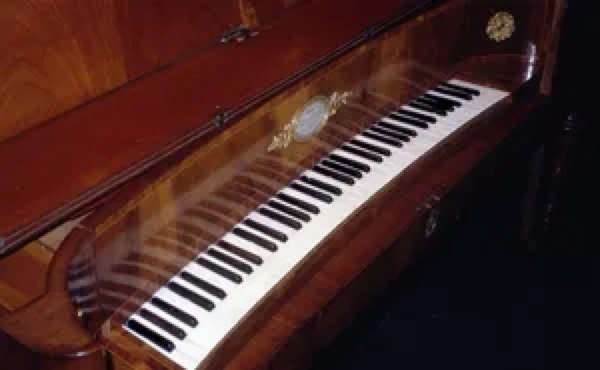
Granfeldt piano with a curve, 1827 (Turku, Finland. Sibelius Museum)
One composer who was in favour of the curved piano was Ernst von Dohnányi. In the early 20th century, Dohnányi used a curved piano made by Bösendorfer, known as the Clutsam-Bösendorfer, designed by the Australian pianist, composer, and inventor George H. Clutsam in 1907. Bringing the far reaches of the keyboard into easy reach meant that the performer didn’t have to move his body from side to side. Dohnányi loved it, but other performers found it difficult to adjust their learned body movements to a keyboard where they could sit still.
Ernő Dohnányi: Suite in the Olden Style, Op. 24: III. Courante: Vivace (Sofja Gülbadamova, Clutsam-Bösendorfer)
Another curved piano that combines two ideas at once is the Maene-Viñoly Concert Grand Piano, which has both a curved keyboard and is ‘straight-strung’, i.e., all the strings go out directly from the keys. In contrast, in normal grand pianos they are ‘overstrung’, i.e., the bass strings cross the tenor strings at an angle.
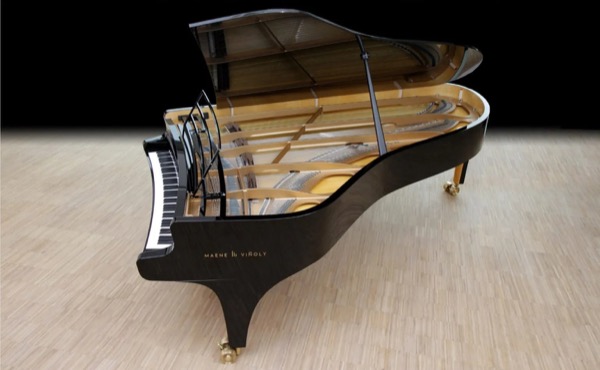
Maene-Viñoly Concert Grand Piano
One of the great advocates of Maene’s straight-strung grand pianos has been Daniel Barenboim. Barenboim had originally asked Steinway & Sons to build him a straight-strung piano, and they referred him to Chris Maene.
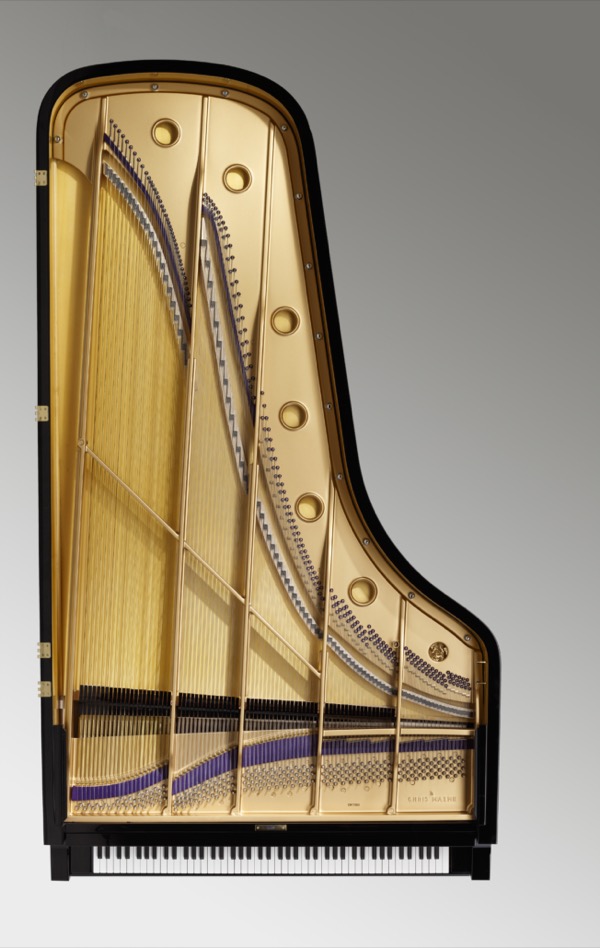
Maene Straight Strung Grand
Daniel Barenboim – Chopin: Étude Op. 25 No.1 in A flat Major (Live from Pierre Boulez Saal, 2020)
Barenboim describes the piano coming from what he heard when he played Liszt’s restored grand piano in 2011. Each of the different registers of the piano (treble, middle, tenor, bass) takes on individual voices and colours, all of which are lost in a modern cross-strung piano, where the ideal is a sound that is concentrated in the middle of the keyboard. It’s been described as a ‘homogeneous’ sound. Other pianists who play 19th-century straight-strung pianos, such as those made by the French maker Érard, describe their pianos as possessing ‘superior clarity’.
One very special piano was the one-off piano built by Adrian Mann in New Zealand. It weighs more than a ton, is 5.7 m (18 feet) long, and has truly impressive bass strings. You will note in the overview in the video below how long the keys are.
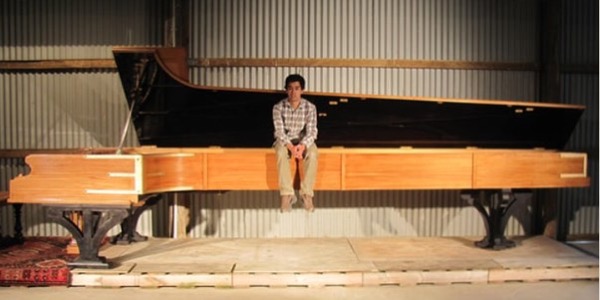
Adrian Mann and his Alexander piano, 2017 (photo by Adrian Mann)
Alexander piano recording
From toy pianos with fewer than 2 dozen keys to Stuart & Sons 102-keyboard monsters, from a petite grand of just 4’5″ to 4’10” in length (137 to 146 cm) to Adrian Mann’s monster at 18 feet long (5.7 m), there’s a world of pianos out there.
For more of the best in classical music, sign up for our E-Newsletter





Dear Maureen,
How come there is no mention of Stretto Pianos which the major manufacturers of pianos, upright and grands, choose to ignore?
Gladys
Unusual Keyboards, an unusual offering much enjoyed.