Pianist Khatia Buniatishvili regularly performs works by Schubert, Chopin, Liszt, Satie, and Bach. Like her albums Motherland and Labyrinth, her recital strives for a narrative arc—from the meditation on mortality in D. 960 to the joyful, almost poignant dance of the Hungarian Rhapsody. In this interview, she enlightened me with her perception of scores as composers’ love letters, thereby liberating interpreters from the tyranny of authoritative dictates. If it hadn’t been for time constraints, we could have meandered for another hour, talking about Dostoevsky, Chekhov, Kafka, Jean-Jacques Sempé, and Winnie-the-Pooh, as Khatia genuinely thinks through both serious concepts and superfluous comments.
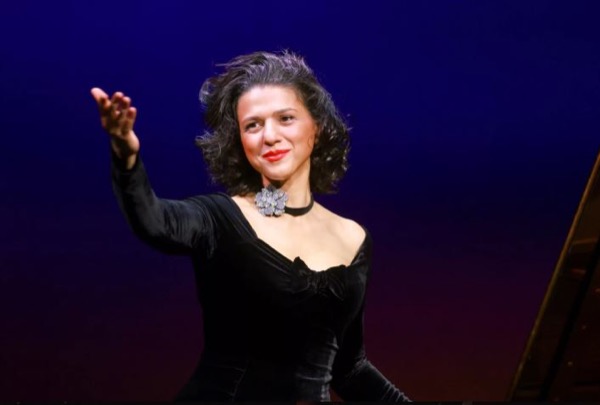
Khatia Buniatishvili at Verbier 2026 (© Anne du Chastel)
From Schubert’s last sonata to Liszt’s Hungarian Rhapsody, what is the storyline of your recital?
I always try to shape each recital into a narrative arc. Take Schubert’s second movement, for instance: I sensed a reflection on death in it even before I read the composer’s autobiography. My tempo can sometimes seem slow, but that is simply how I feel the music. At the same time, I usually end a recital with an energetic, optimistic conclusion. Liszt’s Hungarian Rhapsody is a wonderful choice for this purpose: it is a joyful dance, full of vitality, yet beneath its surface lies inner pain. That duality makes it all the more moving.
Khatia Buniatishvili plays Hungarian Rhapsody No. 2
Liszt seems like an important composer, as one of your early recordings focused on his works.
Liszt was a composer of extraordinary innovation. Even in a short piece like La Lugubre Gondola, one encounters remarkably new sounds, tonality, harmony, and form. His approach to musical dramaturgy, whether in this piece or his sonatas, was profoundly original. One also senses the edge between which life and death seem almost inseparable.
When you turn to his Hungarian Rhapsodies, with their exuberant dances, you discover another side of the man: his moments of lightness, joy, and even forgetfulness. Liszt possessed an extraordinary philosophical mind. He embraced many different facets of existence, yet they were never contradictory. Rather, they formed a remarkable harmony.
He embraced both the spiritual and the earthly, the philosophical and the deeply human. This is what makes Liszt so richly multifaceted: his music encompasses the full spectrum of human experience, from transcendence to joy and pain.
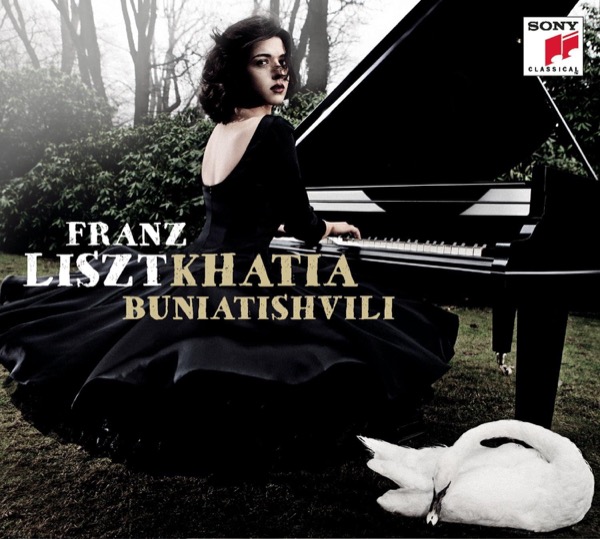
Khatia Buniatishvili’s Liszt Album
Can you talk about the stories behind your albums Motherland and Labyrinth?
I dedicated Motherland to my mother, to every mother, and also to women who are not mothers, because I believe there is a maternal potential in every woman, regardless of whether she has children. This quality can also exist in men. To me, it represents a form of femininity expressed through protection, warmth, understanding, acceptance and the willingness to do anything for someone you love. Motherhood brings fearlessness and courage, but also vulnerability. A mother’s love makes her vulnerable, and I see that vulnerability as an enormous strength.
I created a deeply personal album exploring the many dimensions of womanhood, from childhood to old age. It was also the first time I brought together different epochs and composers, showing that genres and classifications lose their boundaries when music creates an emotional connection. From Baroque to film music and contemporary works, everything can coexist. Music from the eighteenth century, today or even the future can speak the same language. When emotion connects us, time disappears.
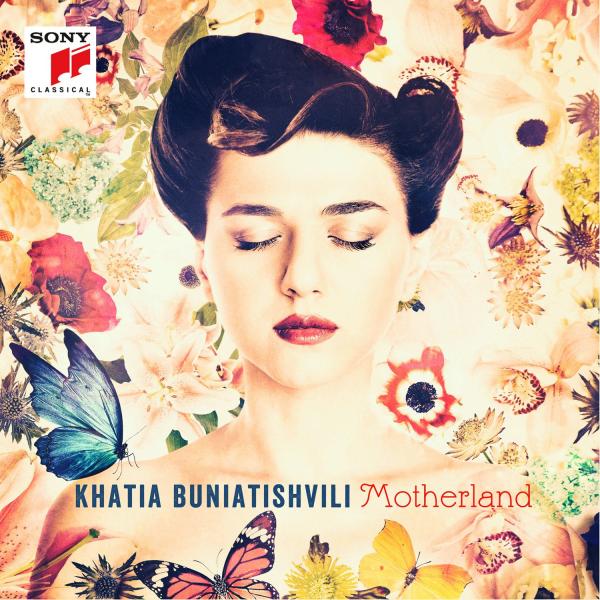
Khatia Buniatishvili’s Motherland Album
Labyrinth explores the experience of being trapped within our own minds, surrounded by intellectual thoughts, emotions, memories and fragments of experience. We become lost in our imagination, moving between the past, present and future, searching for answers without knowing where to find them. Perhaps the way forward is to surrender to our emotions and allow them to guide us. They may not show us the exit, but they can bring a sense of relief, even if only for a moment.
The idea of Labyrinth was partly inspired by Kafka’s The Trial, a book I love and highly recommend. I conceived the project before COVID, and we recorded it before the pandemic began. Yet, when COVID happened, the concept became unexpectedly relevant. We suddenly found ourselves confined to our own spaces and minds, experiencing that very feeling of being lost within a labyrinth.
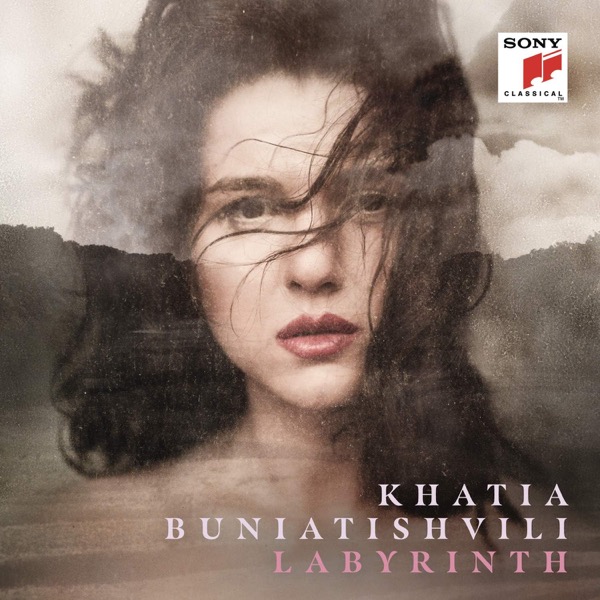
Khatia Buniatishvili’s Labyrinth Album
How do you approach the score, which we often regard as a kind of Holy Bible, dictated by the genius of great composers?
I wouldn’t call the score a Bible; I would call it a love letter. Composers, especially great composers, put everything they have into their music. Even when they have a love-hate relationship with a piece, they give so much of themselves that it becomes an expression of who they are. I feel that this music is written with love, not as a set of instructions or commands, but as an invitation to share.
My responsibility as a pianist is to open this letter with great care and respect, while also following my own feelings, intuition and understanding. For me, reading a score is very much like reading a book. The interpretation is inevitably personal. We cannot separate ourselves from who we are, nor should we. I see myself as an intermediary, someone who brings the composers’ loving words to life through sound. Every performance, every new breath and interpretation gives the music, and in a sense the composer, a new life.
Love and respect are essential, not only in human relationships but also in art. When I speak of love, I don’t mean only romantic love. It can be the love between a parent and a child, between friends, or any other form of deep human connection. The composer gently leads me somewhere, offering a subtle emotional direction rather than dictating what I should do. My task is to follow that invitation while remaining true to my own voice.
Khatia Buniatishvili plays Liszt’s Liebestraum No. 3
As a musician, what do you mean when you quote Dostoevsky that “beauty will save the world”?
For me, Dostoevsky’s phrase is not just about aesthetic beauty, although I find the aesthetic dimension of art equally fascinating. I am talking about a deeper kind of beauty, something we see in children: a pure approach to life rooted in love, joy, curiosity and even sadness. I want to believe that this beautiful part of being human exists within everyone.
It is a beauty grounded in understanding, love, empathy and the ability to listen to and appreciate others. It is about being in dialogue and connecting with something profound. When I listen to music I love, it awakens emotions within me, whether happiness, sadness, joy, love or even anger. These feelings connect us to our deepest human values. That is the beauty I believe we need to nurture and share.
Of course, when I see so many terrible things happening in the world, I sometimes feel desperate and powerless. I wonder what one person can possibly do to change things. But then I remind myself that I must remain optimistic and continue bringing the beauty that composers create through their music into the world. I believe optimism and idealism are essential, alongside the youthful belief in what humanity can become.
Khatia Buniatishvili plays Pictures at an Exhibition – The Great Gate of Kiev
Can you recommend literary works that are important to you?
Dostoevsky has been one of my favourite authors since childhood. I first read one of his books when I was nine, which might seem a little unusual for someone that age. It was The Gambler, my first encounter with his writing and the beginning of a lifelong love. Another book I would particularly recommend is The Idiot. I would also recommend Chekhov’s novels and plays. These writers have shaped the way I perceive life, pain, patience, and human relationships. Their worlds can be very dark, but there is always a light that reminds us not to lose our love of life.
I also love lighter works and children’s literature. For example, I adore Winnie-the-Pooh and Karlsson-on-the-Roof for their gentle, playful warmth. I love a certain naïveté in art, including painting and illustration. One of my favourite artists is the French illustrator Jean-Jacques Sempé, whom I consider a painter. His work is wonderfully human, delicate, sweet and full of innocence. I am very eclectic in my tastes and enjoy exploring completely different artistic worlds, from darkness to lightness, humour, simplicity and tenderness.
Are music and words ways to investigate our so-called soul?
I am not a religious person, although I deeply respect all religions and everyone’s right to believe in what they choose. When I speak about the soul, I mean something broader: you can call it the soul, the mind or humanity. We have feelings that go beyond our physical existence. I think we all want to be more than simply mortal; we want to feel connected to life and, in some way, to overcome the limits of our mortality.
Literature and music explore this in different ways. When children read, they encounter ideas and psychological experiences that can shape their perceptions and values from an early age. Music, however, works primarily through our emotions. It can also influence us psychologically, but above all, it makes us feel. Those feelings can be beautiful or painful, but they remind us that we are alive.
For me, that feeling often becomes gratitude. People sometimes ask whether I feel competitive towards other artists or colleagues. My answer is no. When I hear a performance that moves me, or experience something powerful through music, literature, cinema, acting or painting, I feel grateful. Something inside me that might have become rigid or frozen suddenly melts. I feel alive, and my response is simply to say thank you.
Khatia Buniatishvili and Yuja Wang play Brahms’ Hungarian Dance No. 1
How do you achieve the sound you envision?
I don’t approach sound as something purely technical or something I practise in isolation. For me, sound is like a pianist’s voice, even their soul. It distinguishes one interpreter from another through the way we touch the instrument, shape phrases and express our feelings. Touch is deeply connected to who we are and how we experience the world.
I think of my relationship with the piano almost as a relationship between two people. Sometimes there is discomfort or dissonance, and I have to find a way to understand the instrument and feel united with it. Once that connection is established, the sound comes naturally. I allow the music to guide me towards the sound I need, following what I hear in my mind. I like to think of this as the composer’s voice, although ultimately it becomes part of my own interpretation.
Of course, technique is essential. As a professional musician, you need to practise, warm up and maintain your physical condition. But I believe the most important thing is the connection between the emotional and intellectual dimensions of music. When you understand and feel what you want to express, your fingers become receptors of your mind. They follow your musical imagination, and sound and technique emerge from that connection.
Khatia Buniatishvili plays Bach’s Schafe können sicher weiden
How do you resist oversimplification when media tends to rely on labelling and stereotyping?
When I was in my twenties, I worried about being categorised or being reduced to a particular image or artistic direction. I think this is natural when you are young. I understand that mainstream media often needs to categorise things, and that doesn’t particularly bother me. What I found more difficult was when journalists reduced me to one simple category. I felt this was limiting and overlooked everything I wanted to express through music.
At first, I disagreed with these descriptions and eventually stopped reading articles because I didn’t want them to influence my thinking. Compliments can be difficult to interpret too because you might wonder whether people are simply being kind, whereas negative criticism can stay with you for a long time. Today, I worry much less about these things. Ultimately, I see these as two separate worlds. Journalists should be free to write what they think for their readers, just as I, as a musician, should be free to pursue my artistic path without being defined by what others write about me. We can each do what we believe in, in our own way.
Khatia Buniatishvili plays Schubert’s Impromptu No. 3, D. 899
I first discovered you through your Schubert album, featuring an imitation of Ophelia drown in the water. I remember thinking: what a beautiful pianist you must be! Female pianists are often judged by their physical appearance as much as by their musical performance. How do you respond to such perceptions?
It’s interesting that many people interpreted my Schubert album cover as Ophelia, and I completely understand. Shakespeare’s Hamlet is one of my favourite plays. However, my original inspiration was Schubert’s Death and the Maiden. For me, the image symbolised leaving behind my youthful innocence, almost like the symbolic death of the girl I had been as I entered womanhood. It was about femininity, maturity and becoming a woman. The image was rooted in Schubert’s world of Lieder, although Ophelia is also a very fitting interpretation. When I create album covers, I usually have a very specific idea that I want to communicate.
Khatia Buniatishvili plays Schubert’s Ständchen
The same applies to my stage clothes. I see concerts as special occasions, almost like an evening soirée, and I enjoy wearing beautiful evening gowns. When I first fell in love, I became more interested in feeling attractive, and I think this coincided with my transition from girlhood to womanhood. People sometimes interpreted my stage appearance as a marketing strategy, but it was never that. I enjoy beautiful, glamorous and so-called superficial things in life, just as many of us do. My mother, who loves fashion, has also been my stylist for many years.
Of course, there are moments when, at the last minute, I question my choice of dress or wonder whether I feel comfortable being so exposed. Sometimes, as many pianists do before a concert, I would rather be cosy at home than dress up and go on stage. But once I walk on stage, bow, sit down and play the first note, everything changes. I forget my body, my clothes and all the physical details. They simply disappear.
What matters then is the sound, the silence and the music that takes us somewhere beyond the material world. I hope the same happens for the audience. People may notice my dress at first, but once the music begins, it should no longer matter. They can even close their eyes and follow their own imagination. For me, a concert is ultimately about sharing silence, emotions and a musical journey. The clothes and preparation are part of the occasion, but what truly matters is the music and the feeling of being united through it.
For more of the best in classical music, sign up for our E-Newsletter