It’s a perfect assortment of situations for the summer: running in wild water, mediating at night in a difficult situation, and then flying above it all.
American composer Mark Edwards Wilson (b. 1948) describes the works as ‘my latest approach to orchestral writing and the use of dramatic narrative’, and he’s successful in putting his ideas out in music.
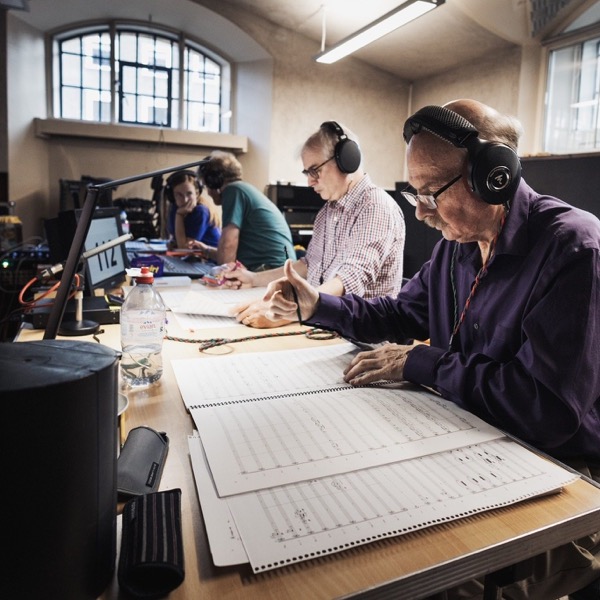
Mark Edwards Wilson at the LSO recording session, 2025
Wilson is on the faculty of the University of Maryland and started his career in California, where he first worked in film music. He was awarded the Henry Mancini Prize and the Mancini Production Award for film scoring while still a student at UCLA.
His work in orchestral music has always been motivated by his enthusiasm for the medium and his concern for its survival. This is a serious concern, because as he goes on to note, ‘Although not all conductors readily perform new works, composers nevertheless must not give up on the orchestra as a medium that is both vital and relevant to a living culture. It would be a tragic loss if the role of the symphony orchestra were to be restricted solely to the musical equivalent of a museum. The talented creative artists who constitute a symphony orchestra should have a purpose beyond that of being curators of the great art of another era’. He proposes that American composers lead the way in a ‘renaissance in the field of music for symphony orchestra—a music that will capture the imagination of audiences…’.
His most performed work to date has been The Phoenix, about the mythical bird that is reborn from fire. It’s joined by Meteora, which was awarded first prize in the New Orchestral Repertoire Project, an international competition to foster new music for orchestra sponsored by the Minneapolis Pops Orchestra. Now, in Dangerous Journeys, he pushes the orchestral envelope again.
White Water immediately puts us out in the stream of a river in a torrent. We’re watching a brave small craft go by and see it bobbing and fighting to remain upright, get caught in eddies, have unexpected waterfalls splash it, and all the other travails of headlong racing. In the end, the boat goes beyond our view and we can only speculate on its final fate.
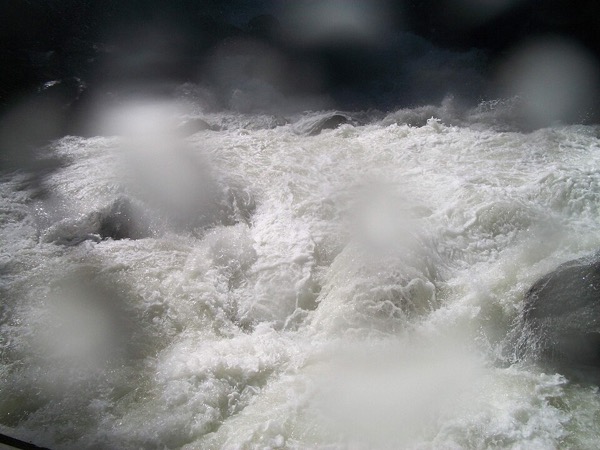
Whitewater at Yosemite (photo by WalkingRadiance)
Mark Edwards Wilson: Dangerous Journeys: I. White Water (London Symphony Orchestra; Robert Ziegler, cond.)
As a tribute ‘to the heroic people of Ukraine and their struggle for existence against the brutal forces arrayed against them’, as the composer writes in his notes, he has chosen the eloquent nightingale, a native of Ukraine, to be symbolic of ‘the Ukrainian people’s resilience in the face of murderous adversity’. We know what the ruins are: the civilization of Ukraine, the second-largest country in Europe after Russia. And yet the nightingale, still active amidst the destruction, provides a note of more than hope, it’s a note that will be carried around the world.

Nightingale
Mark Edwards Wilson: Dangerous Journeys: II. Among the Ruins the Nightingale Sings (London Symphony Orchestra; Robert Ziegler, cond.)
And then we take to the skies. A run up to the jump and we’re in the air. The structure is based around a single theme, filled with life, that is constantly being transformed. It’s full of energy and, at the end, the theme emerges triumphant in the light.
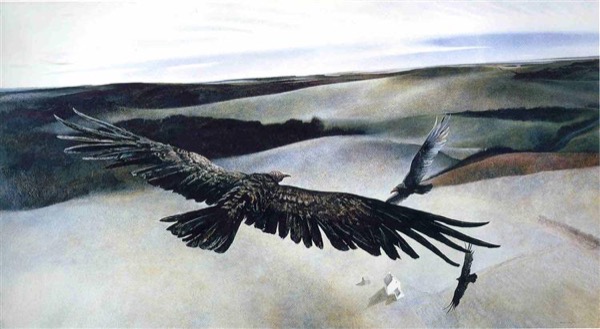
Andrew Wyeth: Soaring 1942–1950 (Shelburne Museum)
Mark Edwards Wilson: Dangerous Journeys: III. Soaring (London Symphony Orchestra; Robert Ziegler, cond.)
The orchestral world of Mark Edwards Wilson promises much for the future of symphonic music.
For more of the best in classical music, sign up for our E-Newsletter