The story of composer Robert Schumann’s life contains a number of Romantic archetypes: musical genius, alter egos, literary obsessions, artistic manifestos, mental illness, and a tragic early death.
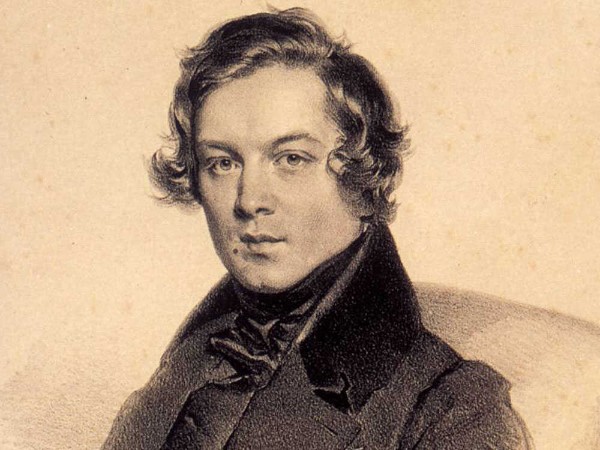
Robert Schumann
He was also at the centre of classical music’s most famous love story. As a young man, he fell in love with his piano teacher Friedrich Wieck’s prodigy daughter, a teenager named Clara. She would eventually become his wife – and one of the most influential pianists of her generation. But her father forbade them from marrying, and the couple had to wait for years before they could be together.
Over time, these dramatic stories have hardened into cliché. The real Robert Schumann – disciplined, ambitious, daring – is often buried under the story of his fatal illness.
Here are five of the most persistent myths about Robert Schumann, and what the historical record suggests the truth might be.
1. Schumann ruined his hands with a finger-strengthening device.
Schumann’s Symphonic Etudes, Op. 13
Here’s a romantic origin story: as a young man, Robert Schumann dreams of becoming a virtuoso pianist. He uses a mechanical contraption to strengthen his fingers. He damaged his hand permanently. The dream dies, and he becomes a great composer instead.
It’s neat. It’s tragic. It’s also probably wrong.
Yes, Schumann experimented with mechanical aids. Yes, he developed problems with his right hand, but there is no definitive evidence that one device catastrophically “ruined” him.
Modern scholars have suggested other potential causes, including overpractice, nerve damage, focal dystonia, or even side effects from common mercury-based medical treatments of the 1830s.
The injury narrative survives because it offers a clear-cut reason for Schumann’s turn away from performance and toward composition.
But in reality, his shift from pianist to composer was gradual, and it may have been as much about his temperament as any traumatic injury.
2. Schumann didn’t like Liszt and Wagner because he was jealous of them.
Schumann’s song “Widmung”
Liszt’s transcription of “Widmung”
Schumann’s complicated relationships with Franz Liszt and Richard Wagner are often reduced to feelings of inferiority or jealousy on Schumann’s part.
The legend goes something like this: Liszt dazzled Europe with his piano virtuosity – Wagner reinvented opera – and the more introverted Schumann resented them both and focused on chamber music.
However, Schumann’s aesthetic priorities were consistent long before Liszt, and Wagner rose to dominance.
As founder of the music journal Neue Zeitschrift für Musik, he routinely championed priorities like a poetic style, sensitivity and inwardness, and artistic seriousness over virtuoso spectacle and display.
He even praised Wagner’s early works before ultimately growing sceptical of the direction Wagner’s music was taking.
That late-in-life scepticism toward Wagner and Liszt wasn’t borne of jealousy; it was a philosophical difference.
His widow, Clara, with staunchly anti-Wagnerian tastes and ideals, also likely reinforced the narrative of a personal rivalry.
3. Schumann never mastered writing in large forms.
Schumann’s Symphony No. 4
For decades, his critics claimed Schumann was a miniaturist at heart: brilliant while tossing off piano works and song cycles, but weaker at writing in larger forms like symphonies and concertos.
Conductors have been especially critical of his orchestration, feeling that it is unbalanced.
However, it’s worth listening to his larger works with an open mind.
Take his fourth symphony, for instance. That work’s cyclical integration, featuring themes that return across all four interlocked movements, is both cohesive and innovative.
Wagner was doing similar work with his operatic leitmotifs around the same time, but Wagner’s were programmatic, whereas Schumann’s embrace of cyclical ideas was structural and based in absolute music.
Critical opinions of the balance issues in his orchestration have also been less harsh since the rise of historically informed performance practice, which tends to employ a more historically accurate ratio of instruments in the ensemble.
4. Schumann mainly wrote sentimental Romantic schlock.
Schumann’s Träumerei
Because Schumann specialized in writing intimate piano miniatures and some of the most beloved art songs in history, he’s often caricatured as soft and sentimental.
But beneath the seemingly simple lyricism lies a complicated and unexpected volatility.
In works like Kreisleriana and Carnaval, rhythms fracture. Harmonies destabilize. Schumann’s alter egos – Florestan and Eusebius – appear in the scores not as a cutesy device, but as dramatisations of emotional duality.
Yes, there can be a tender simplicity to Schumann, but there are also mania, irony, and unsettling fragmentation.
If you had to classify him, his work is psychologically closer to the probing works of late Romantics like Strauss or Mahler than a composer tossing off easily digestible piano bonbons.
5. Schumann’s last works were of low quality due to his mental health issues.
Schumann’s Violin Concerto
In 1854, Schumann attempted suicide and was admitted to an asylum, where he died two years later. It’s tempting to map that tragedy directly onto his final compositions.
For decades, pieces like the violin concerto were dismissed as evidence of his deterioration.
This view was shared by Robert’s widow Clara, as well as their mutual friend Johannes Brahms and violinist Joseph Joachim.
In fact, they worked to suppress several major works, including the violin concerto, and they weren’t heard publicly until 1937.
Part of the reason for this suppression may have been that they brought up painful memories for the people who cared about Robert, rather than being any kind of verdict on their actual musical worth.
In recent years, critical reassessment of these later works has been kinder – and arguably more accurate.
The final works are spare, concentrated, and sometimes austere. They may lack his youthful verve, but they also possess an unnerving, eerie clarity.
The “Gesänge der Frühe” (“Songs of Dawn”) are particularly restrained and haunting, and not badly written at all. They’re especially striking after you realise they were written in the final period of his life, when he was reportedly experiencing auditory hallucinations.
As modern listeners, we must be careful not to confuse difference with decline.
Conclusion
These myths about Robert Schumann have proven to be remarkably durable. At times, his biography – the forbidden love story with his wife Clara Schumann, combined with the tragic decline of his health – has threatened to overshadow the quality of his musical output.
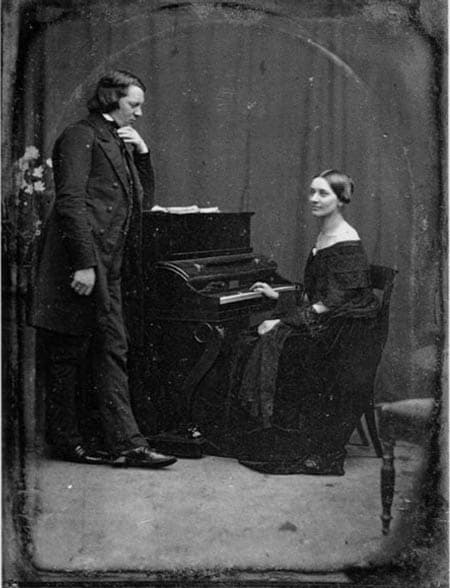
Clara and Robert Schumann
But the reality is more interesting. Schumann’s music is restless, layered, and psychologically daring. It often defies easy categorisation.
Maybe that’s why the myths persist: complexity is harder to absorb than an archetypically tragic or traumatic biography.
But if you listen closely and widely to Robert Schumann, you’ll hear something far more compelling than those myths: a composer writing in a deeply personal voice that still feels startlingly modern today.
For more of the best in classical music, sign up for our E-Newsletter