Between his ROH performances in Parsifal, baritone Christian Gerhaher finds time to share his erudition on Lieder. In March 2027, he will lead a masterclass and symposium on Winterreise in Tuscany. Perusing his book “Lyrical Diary: Lieder from Franz Schubert to Wolfgang Rihm”, I marvelled at how this professorial performer could verbalise and categorise two centuries of Lieder in just a few minutes.
How does Gerhaher summon the agony and anger needed to portray Amfortas in Parsifal? Why should we defamiliarise Schubert’s canon through Othmar Schoeck’s Elegie, regrettably absent from the otherwise encyclopedic Oxford Song site? Beyond his expertise in Schumann, we also explored Brahms, Bruckner, and Britten. If German art song seems daunting, listen to Gerhaher’s concerts or his recordings. To paraphrase Schumann’s “Mein Herz und deine Stimme,” his voice understands your heart.
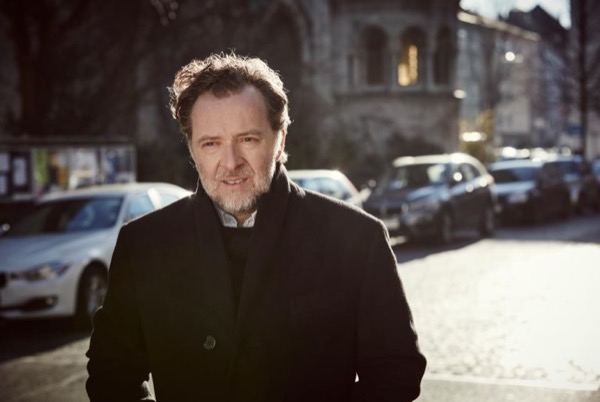
Christian Gerhaher (Photo by Gregor Hohenberg)
How does this Regietheater production at the Royal Opera House differ from your previous Parsifal, such as at Bayerische Staatsoper?
Both productions carry a distinct darkness even in the first act, a tone Wagner might not necessarily have intended. However, contemporary operatic criticism no longer judges staging by strict adherence to the composer’s original intent. Directors now routinely take the liberty to alter a work’s substance, as is the case toward the final scene of the London production.
Until then, the production remains remarkably faithful to the original, without being disruptive or deconstructive. In Act I, Gurnemanz’s lengthy narrative is well shaped, sustaining the opera’s story arc without becoming overly illustrative or weary. The more dramatic Act II is inherently less problematic—well executed, visually appealing, and aligning closely with the operatic scenes. At the end of Act III, however, the staging counteracts the intensely Christian atmosphere of the Bühnenweihfestspiel. This term characterises the entire opera but applies especially to this final act.
For me, Parsifal is not a Christian work, despite its many Christian motifs, including the Grail, the spear, and the Eucharistic chants. Rather, it concerns the perpetuation of earthly life, not the Christian mysticism of eternal life after death. I would call it a syncretistic work, incorporating Buddhist elements and Schopenhauer’s pessimistic philosophy. Its misogyny and rejection of women as human beings are indeed repulsive. Overall, the opera expresses a profound Lebensüberdruss and a negation of everything human, reflecting Schopenhauer’s influence.
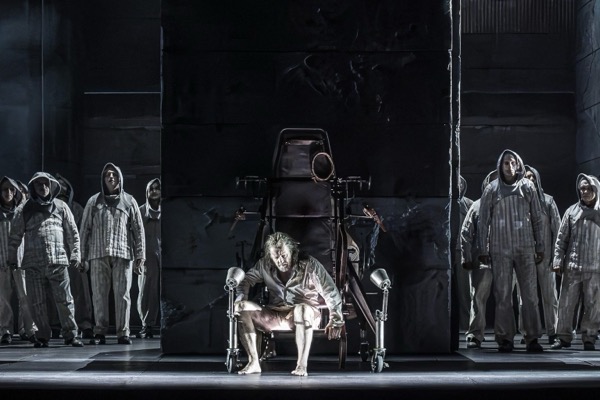
Christian Gerhaher as Amfortas in Parsifal at Royal Opera House (Photo by Marc Brenner)
What I mean is that, in this London production, Amfortas is not healed by the spear as predicted. Instead, the healing fails, and a panicking Parsifal accidentally stabs and kills Amfortas while trying to force the wound shut. This is certainly not what Wagner prescribed, but I find two aspects of this modification compelling. First, the belief that the spear can heal relies entirely on the narrator Gurnemanz’s repetition of a prophecy with no successful precedent. Second, because the spear is fundamentally a weapon, questioning why an instrument of violence should possess healing powers is entirely justified.
Although Amfortas’ death makes little dramaturgical sense, since he is not supposed to die, the change has a positive aesthetic effect. The Christian glorification, particularly in the Bühnenweihfestspiel—with the baptism, the washing of the feet, and all these somewhat unsettling rituals—is neutralised at the end. After three acts totalling five and a half hours, the resulting open ending is, I think, remarkably effective.
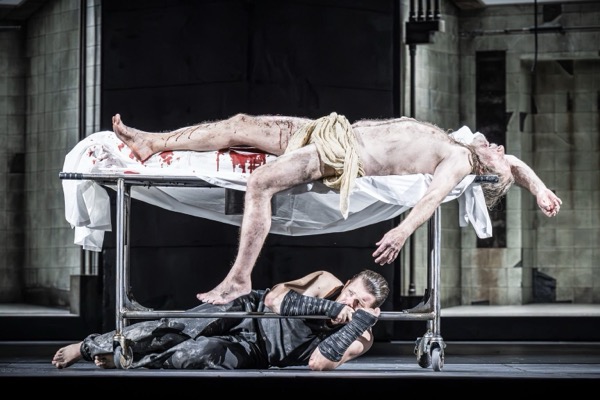
Stanislas de Barbeyrac as Parsifal and Christian Gerhaher as Amfortas (Photo by Marc Brenner)
Where do you get the inner sources or cultural references to embody Amfortas’ anger, shame, and suffering?
I try not to understand or portray roles through my own life, so my experience is not the source. Performers must be capable of this separation. Similarly, audiences can engage with art in an impersonal, abstract manner. I consider this detached approach more desirable. And the thing is, if you look at the character himself, at how he develops and expresses himself, you can understand quite well what makes Amfortas who he is.
Wounded by the sacred spear, Amfortas carries dual guilt for his actions against Klingsor and his yielding to Kundry’s seduction. This moral failure results in the loss of the spear, his debilitating injury, and the subsequent decline of the entire Grail community. This explains the terrible physical strain of his first appearance. His second appearance is driven by the obligation to uncover the Grail, which he resists. As a source of strength, the Grail sustains everyone present, but it also intensifies Amfortas’ life—and therefore his wound—causing it to reopen in pain.
In this expansive, highly expressive monologue, Amfortas voices his unwillingness to unveil the Grail, declaring that he prefers death to enduring this relentless pain. Then he remembers how magnificent and abundant the Grail’s gift of life felt when he happily served as its healthy guardian. It reminds him of the blood Christ shed. So he is trapped in a constant seesaw: on the one hand, the memory of the Grail’s tremendous power; on the other, the stark reality of his own continuous suffering.
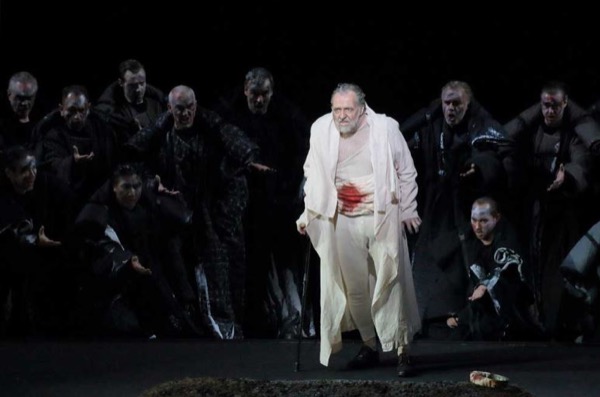
Christian Gerhaher in Parsifal at Bayerische Staatsoper in 2018 (Photo by Wilfried Hösl)
In the final act, the Grail community is falling apart. Many knights have died without the Grail’s life-giving power, and Amfortas’ father, Titurel, is also dead. When the knights physically try to force Amfortas to uncover the Grail finally, his response is unprecedented in operatic history for its sheer fury, rage, and cynicism. He tells them, in effect and excuse me for the strong language, “You cannot force me. You can kill me, which is exactly what I want. But think about it carefully: once I am dead, you can unveil your damned Grail yourselves. Except you cannot, because you are not the reigning king. So you are not only horrible; you are also unbelievably stupid.”
The hatred and fury that erupt here, perhaps within a single minute, are explosive and almost wild. This makes the role extremely dangerous, as it risks losing control. I have often wondered where this comes from. It stems from anger, but also from an unusual combination with extreme physicality. The role is strenuously physical, involving pain, bodily suffering, death, and an enormous expansion of vocal volume. Yet its subject matter concerns existential opposites: death, annihilation, nothingness and perhaps eternal life. The combination of almost ontological themes with an intensely physical mode of performance, inherent in the role itself, is extraordinary. I know of no other role quite like it.
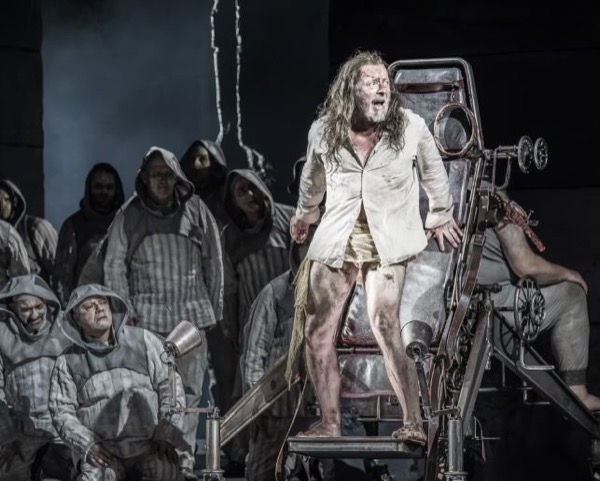
Christian Gerhaher as Amfortas at Royal Opera House in 2026 (Photo by Marc Brenner)
Let’s move on to another topic: your upcoming masterclass on Winterreise, which also portrays pain. Why would you perform and teach Schubert along with Othmar Schoeck’s Elegie, as listed in the program?
There are two reasons. First, Othmar Schoeck’s Elegie consists of 24 songs, an unusual number shared with Schubert’s Winterreise and Ernst Krenek’s Reisebuch aus den österreichischen Alpen. Secondly, beyond this numerical parallel lies a profound thematic affinity rooted in the poetry of Weltschmerz. Wilhelm Müller’s Winterreise poems belong to this tradition, later stylised by scholars from the melancholic, ironic writings of Jean Paul, who also inspired Schumann. Nikolaus Lenau’s poetry shares this life-weariness; his work comprises 75 per cent of Schoeck’s cycle, with the remaining six Eichendorff songs being equally melancholy, closely binding the dark atmospheres of both Elegie and Winterreise.
I often pair the two in concert, singing Schoeck’s Elegie with piano in the morning and Schubert’s Winterreise that evening or the following day. I consider Elegie a brilliant twentieth-century Swiss Winterreise, rendering a more distanced perspective on Winterreise itself. Since Fischer-Dieskau’s 1992 retirement, Winterreise has been heavily instrumentalised, primarily as a vehicle for extreme and exaggerated emotionality. Personally, I feel that the reception of Winterreise over the past 30 years has somewhat distorted the work.
Audiences now routinely expect Winterreise to deliver total emotional self-exposure over an intense, 75-minute existential experience, which isn’t actually inherent in the work itself. I believe it would be a positive development to restore a more distanced approach to Winterreise. That is why my pianist, Gerold Huber, and I generally try to associate Winterreise with alternative repertoire, such as Schoeck’s Elegie, to foster a detached, intellectual engagement with the piece.
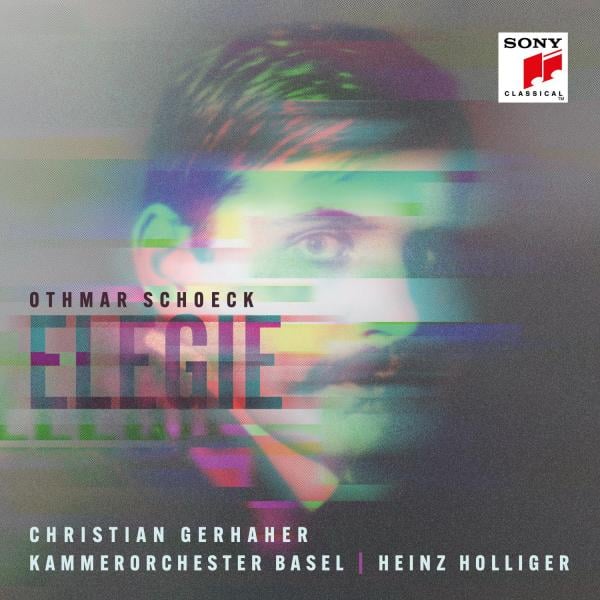
Othmar Schoeck’s Elegie by Christian Gerhaher
I reread the chapter on Winterreise in your book Lyrical Diary. Why do you consider the song Im Dorfe vital?
Because it contains a particularly wide range of emotional states; throughout Winterreise, we encounter anger, irritation, sadness, longing for death, and self-pity. No other poem in the cycle represents as many psychological states as Im Dorfe, which makes the cycle’s fundamental situation clear.
It also presents a vivid image. Out in the cold, which represents the danger of death, the wanderer also stands outside the community. He passes a village that you can almost visualise before your eyes, with smoke rising from its chimneys and snow and ice all around. The wanderer is out in the cold and cannot enter the community because he has been cast out of it, for whatever reason.
The fundamental situation of Winterreise is therefore portrayed very vividly in this song, and it is easy to understand despite the very few words used. The emotional situation arising from these circumstances is conveyed with particular subtlety and variety, making Im Dorfe central to the cycle, though not necessarily aesthetically. Many songs could be considered central in this respect, including Der Lindenbaum, Wasserflut, and Die Krähe. Ultimately, every song in Winterreise is its own world and a masterpiece in its own right.
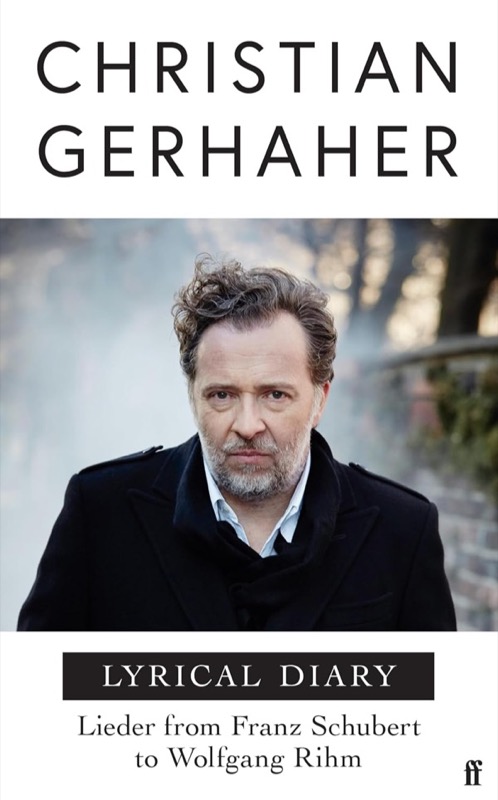
Christian Gerhaher’s Lyrical Diary
What does Der Leiermann represent?
Before encountering the hurdy-gurdy man, our protagonist finds himself in a life-threatening situation, as in Im Dorfe, where he is out in the cold with nowhere to stay. But he also seems to enjoy toying with this mortal danger. He speaks almost playfully about letting himself die, as though threatening suicide. He plays with the idea without ever truly acting on it. There is something adolescent about this attitude, which makes me question whether his longing for death is entirely genuine.
I believe Winterreise has a narrative framework formed by its first and last songs. The first explains what has happened and the situation that follows; in the last, the wandering finally halts. In Der Leiermann, the focus shifts away from the protagonist for the first time. Until then, it is always “I, I, I”: my suffering, my terrible life, my injury, the people who treat me badly. Now the focus shifts to someone else: the hurdy-gurdy man.
Many interpretations identify the hurdy-gurdy man with death or the skeletal figure of a danse macabre. I find this neither convincing nor necessary. Not a single word in Winterreise establishes him as a personification of death. Although this interpretation can be powerful and fascinating, I consider it a total overinterpretation.
I would suggest a different reading. The winter traveller, in a profound crisis, encounters someone in an even worse position: a genuine social outlaw with no place in society and no inclination to regain one. My impression is that the protagonist begins to recover somewhat through this encounter. Confronted with someone whose circumstances are so utterly miserable, he gains distance from himself. Perhaps that distance frees him from his own predicament.
Franz Schubert: No. 24. Der Leiermann (Christian Gerhaher, baritone; Gerold Huber, piano)
You have performed Winterreise in its “original” sequence. Would you recommend that students try it?
I can’t recommend it, as everyone can do as they please. But it is important to clarify that this is not the “original” sequence, merely a reconstructed order, essentially for the first half. We know that Schubert set the first twelve poems as they were published, in a sequence different from that of the complete 24-song cycle. I don’t know the alternative sequence for the second part—songs 13 through 24. But, personally, that makes no difference.
What matters to me is that the narrative framework must remain intact, with Gute Nacht and Der Leiermann serving as bookends. The 22 poems in between have no real narrative function. Each song is a multifaceted station or situation with its own distinctive emotional world. Still, none needs to occupy a particular position for us to understand the cycle as a whole. Performing the reconstructed compositional order demonstrates that Winterreise can work differently without losing its essential substance. It also disrupts listeners’ habits and expectations about the sequence, encouraging them to discover Winterreise anew.
Otto Erich Deutsch vividly documents, through Schober’s recollections, the effect Winterreise had on Schubert’s friends. Schubert reportedly described it as something entirely new, an aesthetic expression he had never achieved before. He then performed it himself, singing and playing the piano. Schober recalled that listeners were so unsettled they hardly knew what to make of it. Today, such an extraordinary impact is difficult to recapture, given the work’s familiarity and established place in the repertoire.
I think an alternative sequence can restore some sense of surprise, as can pairing Winterreise with a companion work such as Schoeck’s Elegie. Encountering this unfamiliar piece, which remains unfortunately so for many, listeners discover something so powerful, strange, and dark that they may think, “Perhaps Winterreise once felt like this, too.” Rather than experiencing the familiar sequence and its expected, pleasantly shuddering effect, we gain a point of comparison that reveals just how radical Winterreise might once have seemed.
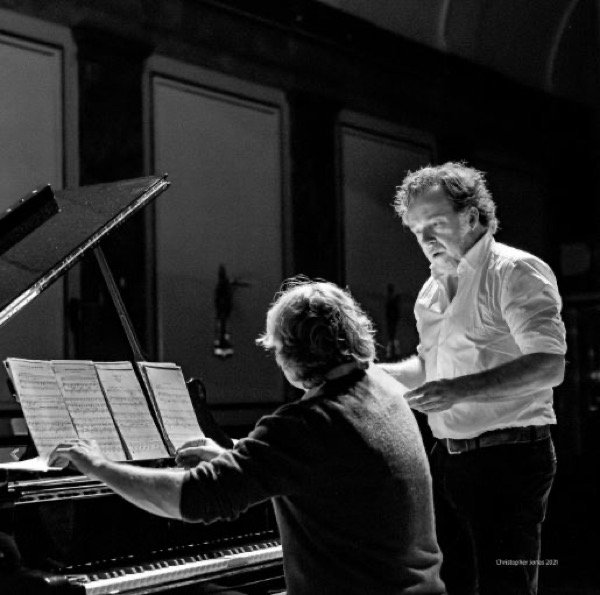
Christian Gerhaher and Gerold Huber (Photo by Christopher Jonas)
Returning to Schoeck’s Elegie, how do you approach the long melodies, recurring motifs, and possibly other technical difficulties?
I don’t find the recurring melodies particularly different from those in other vocal music, nor do I see them as a special difficulty. The real challenges lie elsewhere. Elegie ranges from highly modernistic songs to nostalgically harmonious ones. Bringing these contrasting styles together is a remarkable feature, not a problem.
The most immediate challenge is performance practice. Schoeck orchestrated Elegie a year or two after composing the original piano version. The orchestral scoring is dense for a chamber ensemble and can be relatively loud. Because the expression is generally quiet and the vocal line lies low, the orchestra must constantly restrain itself to keep the singer audible. Singing louder to compete would not make the work more beautiful; it must retain its quiet character. In contrast, the piano version better captures the grey—or greyish-brown, as I perceive it—quality of this world. Though beautiful, the orchestral version misses the piano version’s woodcut-like character.
The vocal range is also important. Like almost all—or at least very many—of Schoeck’s songs, these songs were written for his friend Felix Loeffel, a Swiss bass-baritone who sang virtually everything. As a result, the vocal range is relatively low. However, a well-known anecdote about Schoeck comes from toward the end of his life. He attended a performance of the orchestral song cycle Lebendig begraben by Fischer-Dieskau and was moved to tears, saying, “I didn’t know one could sing like that.” One can imagine that Schoeck might have written differently had he known that a voice like Fischer-Dieskau’s existed.
In any case, I think this experience demonstrates that a work written for bass-baritone can also be performed successfully by a regular baritone whose range does not extend quite as low as the cycle requires. What is interesting is that the variety of vocal colours needed for expressive purposes remains possible even in such a low register. The palette may be narrower, but the distinctions between colours must be all the more refined and defined. For this reason, I consider it an extremely difficult work to perform. Nevertheless, I love it so much that I perform it as often as possible.
Othmar Schoeck: No. 10. Kommen und Scheiden (Christian Gerhaher, baritone; Basel Chamber Orchestra; Heinz Holliger, cond.)
Next June, you will be giving Brahms song recitals in several cities, including New York and Boston. How do you distinguish between the different stylistic schools of Lieder composers?
This is, of course, a fundamental problem with all art song: different stylistic schools exist within the German-language Lied tradition, and it is very difficult to combine them. Personally, I would group Schubert and Wolf, and Schumann and Mahler. In my view, Brahms is an absolute outlier.
Brahms had a very different approach to composing music based on poetry. He was extraordinarily well-read and owned a huge library. A specific poem would inspire him, and that inspiration would lead to a compositional idea. He would then develop that idea in a way that I find almost always formally conservative. Broadly speaking, although there are exceptions, he would first write a formal piece of music—much like an instrumental composition—inspired by a text or poem. Only afterwards would he fit the words to the pre-existing music. As a result, the declamation in Brahms’ songs can often be somewhat difficult, awkward, or clunky. The syntax, too, can be hard for a singer to convey, because the music was not necessarily composed to follow the natural flow and structure of the sentence.
Johannes Brahms: 8 Lieder und Romanzen, Op. 14: No. 8. Sehnsucht (Christian Gerhaher, baritone; Gerold Huber, piano)
With Schubert, by contrast, things are rather different. At the beginning of the art-song tradition, Schubert had to establish the Lied as a genre. Schubert’s approach—and this is not a criticism, but rather a defining characteristic—was to seek a deep understanding of the poem, not in an overly complex way, but by developing a plausible musical interpretation.
Wolf repeated this process in his own way. His songs give the impression that he grasps the poems he sets completely. There seems to be only one way to sing Wolf’s songs. Of course, one can sing them well or poorly, but I believe there is not much room for interpretative freedom. As a singer performing Wolf, you are almost “executing” the music rather than interpreting it. One might even argue that this represents a step backwards compared to what Schumann achieved in the interim.
Schumann possessed an incredibly nuanced understanding of the poems he set to music. He was exceptionally well-read in literature and, as a writer himself, remarkably skilled and artistically adept in his command of language. This literary education and talent also helped him recognise something important: poems need not be pinned down to a single, definitive meaning. Instead, he recognised that they offer a multiplicity of content that can be interpreted in vastly different ways.
I think this is how Schumann composed his songs throughout his career, most strikingly in the latter half of his creative life, around 1850, during what is often called his second song year. He did not treat the poems he set as self-contained entities that precisely depicted a specific situation, emotion, or meaning; rather, he always placed them within a broader context. Indeed, except for two ballads—Der Handschuh and Belsatzar—all of Schumann’s Lieder are cyclical in nature. Every song is re-evaluated within a cyclical framework; the underlying poetry is situated within a different, larger context. In effect, the poetry being set is rendered more complex than it was in its original form.
Christian Gerhaher sings Schumann’s Sehnsucht nach der Waldgegend
This is not the case with Schubert, for example. If you look at Die schöne Müllerin, you find a cycle of 25 poems from which Schubert selected 20. If you include the remaining five poems and recite or read them, you realise how much more complicated the psychological structure of the miller’s apprentice becomes. Or consider Hugo Wolf: he does not construct cyclical connections; his works are essentially individual compositions or collections—such as Italienisches Liederbuch or Spanisches Liederbuch—without a broader dramatic, thematic, or narrative cohesion connecting all the songs.
In this sense, I believe that Schumann’s approach of setting poems as deliberate cycles represented an immense aesthetic and conceptual advancement. Brahms, despite his many connections with Schumann, did not adopt this approach. As you mentioned Schumann and Brahms together, that distinction is important. Brahms, however, did not intend to create “song cycles”. He consistently presented his works as mere collections, as bouquets or arrangements. Essentially, Brahms did not seek to reflect or further complicate the thematic substance of the original poems through his musical settings. Instead, he wanted to translate the inspiration he had received from a poem into music, then fit the poem to the composition. In a sense, this translates inspiration into sound. That is fundamentally different from Schumann, whose approach is always deeply rooted in words, texts, and poetry.
I group Schumann and Mahler because Mahler treated the underlying poems with extraordinary freedom. He once remarked that he viewed the poems he set to music as “quarries”—except for the cycles based on Friedrich Rückert (Rückert-Lieder and Kindertotenlieder). Beyond those, Mahler exercised complete creative liberty, most notably in his settings from Des Knaben Wunderhorn, which I consider central to his body of Lieder. The same is true of Lieder eines fahrenden Gesellen. The songs are based on six poems from Des Knaben Wunderhorn, which Mahler adapted and compiled himself. But unlike Schumann, who imbues the poems with a nervous, intricate complexity through cyclical relationships, Mahler takes fragments from this poetic quarry and turns them into something akin to a collage. This is a very modern approach, but it goes far beyond the original poems’ possible meaning.
Christian Gerhaher sings Mahler’s Ging heut’ morgen über’s Feld
Benjamin Britten also composed art songs. This winter, you will perform his War Requiem in Brussels, Luxembourg, Luzern, and Vienna. How would you describe your relationship with Britten’s music?
I consider Britten a wonderful composer. While some may elevate Purcell, Handel, or Elgar as the greatest English composers, Britten matters more to me, despite the complicated reception of some of his works. His masterpieces are War Requiem, Peter Grimes, and Billy Budd. Beyond his famous tenor repertoire, I frequently perform his Songs and Proverbs of William Blake, folk-song arrangements, and Purcell realisations. I appreciate these magnificent arrangements, as they preserve the original material’s character while remaining unmistakably Britten.
That is also why I haven’t written much about him in my book. As a native German speaker, although I speak English well, I have always felt the deepest respect for the challenge of singing in English. English pronunciation is almost as difficult as German, featuring a variety of vowel sounds that are considerably more complicated than those of Romance languages. French and Italian must be learned, of course, but they are manageable. Singing in English, however, is almost impossible for non-native speakers.
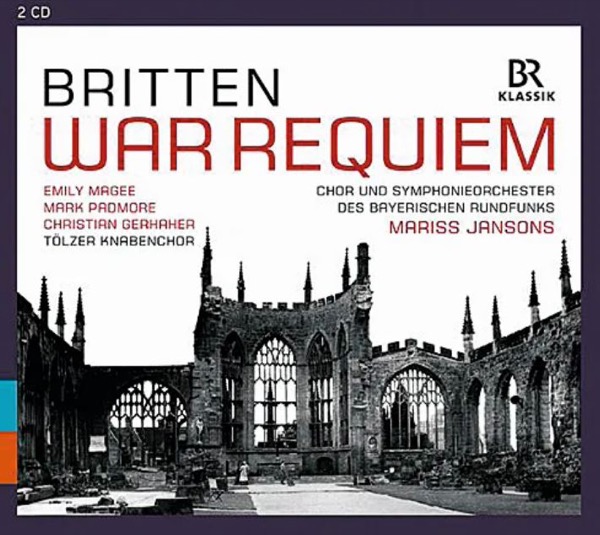
Christian Gerhaher’s 2013 War Requiem
One spontaneous question: do you like Anton Bruckner’s music?
I love Bruckner above all. Even a thorough musicological analysis of his works cannot explain what they truly mean. His sixth is one of my favourite symphonies; its first movement feels like a spaceship journey into the unknown. Every Bruckner symphony is a completely new world. While I can follow the harmonic developments, I cannot fathom why they unfold as they do.
I feel a strong affinity for Bruckner’s world, having grown up along the Danube near the Bavarian Forest. Bruckner lived just downriver in Linz, close to the Bohemian Forest. This landscape is particularly meaningful because it evokes home alongside a profound, expansive ambiguity.
Like Anton Bruckner’s symphonies, the writer Adalbert Stifter’s immense novels feature unhurried and magnificent descriptions of Nature. They unfold slowly over a long period of time. That is the world I come from, and I still feel I belong to it. I feel that Stifter and Bruckner perhaps reflect my own upbringing and identity more closely than anyone else.
You have performed Schumann’s Kerner and Eichendorff songs in China and gave a lecture at Fudan University. When might you return?
I particularly enjoyed that trip. In Shanghai, a full house listened with incredible attentiveness to a challenging program that we would have to justify in Germany. Even a German audience might say, “I don’t understand these strange, abstract Schumann songs.” And that is precisely why I find them so appealing.
The Shanghai audience, despite having no original cultural connection to this music, was incredibly respectful and attentive. Performing such a challenging program and watching them follow it with genuine enthusiasm was one of the most fulfilling moments of my life. Interest in classical music is booming in China. That moves me deeply. I would very much like to return soon.
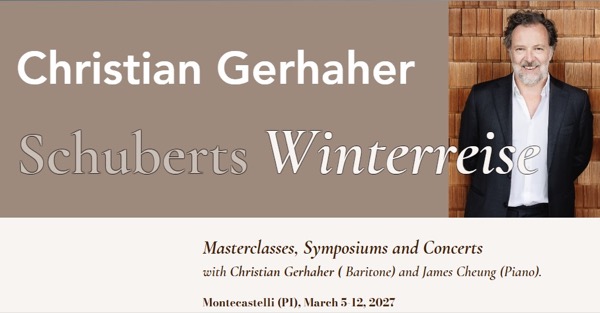
Christian Gerhaher masterclass information
See Gerhaher’s masterclass info at https://www.pr-alliance.art/news/christian-gerhaher-and-james-cheung-lead-masterclass.
For more of the best in classical music, sign up for our E-Newsletter