There was a great deal of anticipation in Carnegie Hall this past October weekend. The illustrious Berlin Philharmonic was onstage. They’d already tuned for the 2:00 pm performance, opening with the magnificent and massive Brahms Concerto No. 1 in D minor Op. 15. The audience was hushed. Still, no one entered from the wings—not the maestro Kirill Petrenko nor the featured Icelandic pianist Víkingur Ólafsson, a replacement for the ailing Daniil Trifonov. As the minutes ticked by, the delay made the musicians fidget and the audience titter. Nearly thirty minutes later, the musicians were still waiting patiently and silently on stage. A terse announcement came from the public address system calling for an impromptu intermission, allowing the musicians to leave the stage. The presenters explained that an older gentleman had fallen, and emergency personnel were on the way.
Did I mention there was a deluge in the streets of Manhattan from the tail end of the terrible storm from Hurricane Isaias? And that 57th Street was closed, Central Park Avenue was closed, and 5th Avenue was closed? When might emergency vehicles manage to arrive at Carnegie Hall, if at all?
Audience members aimlessly wandered the corridors, and one can only imagine what the soloist was doing, wringing his hands, no doubt. Not an unimportant appearance for him. Finally, after an hour, the emergency medical technicians arrived on the scene, and the man was stabilised, strapped into a wheelchair, and taken to the hospital. After 3:00 pm, the musicians shuffled back onstage, and the concert began at 3:15.
By way of introduction, if you haven’t heard him yet, Víkingur Ólafsson is in high demand. He recently won a Grammy for his album of J.S. Bach’s Goldberg Variations and reached a billion streams. Here is a fascinating interview. Ólafsson is playing Glenn Gould’s piano, the great Canadian artist who made the Goldberg Variations famous.
Víkingur Ólafsson, the pianist with more than a billion streams
And a short excerpt from the album:
Johann Sebastian Bach: Aria (Víkingur Ólafsson, piano)
Johann Sebastian Bach: Variatio 1. a 1 Clav. (Víkingur Ólafsson, piano)
Johann Sebastian Bach: Variatio 2. a 1 Clav. (Víkingur Ólafsson, piano)
The concerto that night in Carnegie Hall was a huge success. According to friends who attended the concert (I was so jealous), the orchestra and soloist highlighted Brahms’ massive, dark, velvety, intense sound even in the very softest sections. The soloist played with beautiful phrasing and a muscular tone, and the musicians and conductor of the Berlin Philharmonic effortlessly matched his breakneck tempo in the finale.

Víkingur Ólafsson
The second half featured Richard Strauss’s tone poem Also Sprach Zarathustra, which deals with grand themes from Nietzsche’s philosophical novel. The orchestra is pushed to its technical and dynamic limits, with rich colours and the piece’s bravura style. Zarathustra is known for brilliant solos for the concertmaster and a famous, very exposed, treacherous lick for the trumpet. It’s known for the explosive beginning and for the juxtaposition of two disparate keys: C and B. It’s known for the quiet, ambiguous ending where Strauss alternates the highest woodwinds playing a B-major chord with the double basses playing a low C. The reports I heard indicated it was magnificent playing.
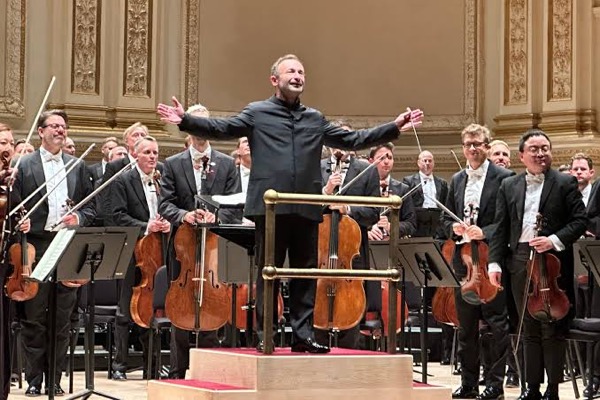
Berlin Philharmonic (Photo: AP/Ron Blum)
Perhaps some of you know the Brahms Concerto has had its share of controversies? Famously, when pianist Glenn Gould appeared with Leonard Bernstein and the New York Philharmonic. It was April 6, 1962, coincidentally enough, here at Carnegie Hall. During the rehearsal, Gould astonished Bernstein with his extremely slow tempos and eccentric approach. Bernstein, who admired Gould’s artistry and genius, addressed the audience before the performance to prepare them for the interpretation, a rare occurrence, by saying, “This is going to be different, folks. And it’s going to be very special.” If you haven’t heard this famous clarification, it is worthwhile.
Pre-Performance Remarks: Don’t Be Frightened, Mr. Gould Is Here
When Brahms premiered his concerto in 1859, at age twenty-five, the reception was decidedly cool. The first performance took place at the Royal Court Theatre, with Brahms as soloist and his friend violinist Joseph Joachim conducting. What a disaster. The audience thought it was too massive, too symphonic, and far from the flashy virtuoso showpiece they expected. Where was the glittering vehicle to show off the soloist? Instead, the critics disdainfully called it “a symphony with piano obbligato.” The piece is, after all, longer than many symphonies at almost fifty minutes. Five days later Brahms repeated the performance at the Leipzig Gewandhaus and the reviews were brutal. As Brahms put it, the concerto was a “brilliant and decisive failure.” At the end of the piece, only a handful of people clapped, and the audience soon silenced them with hissing.
The concerto underwent many changes and a metamorphosis over the several years Brahms worked on the piece. Feeling the huge burden of the past, Brahms was always quite self-critical.
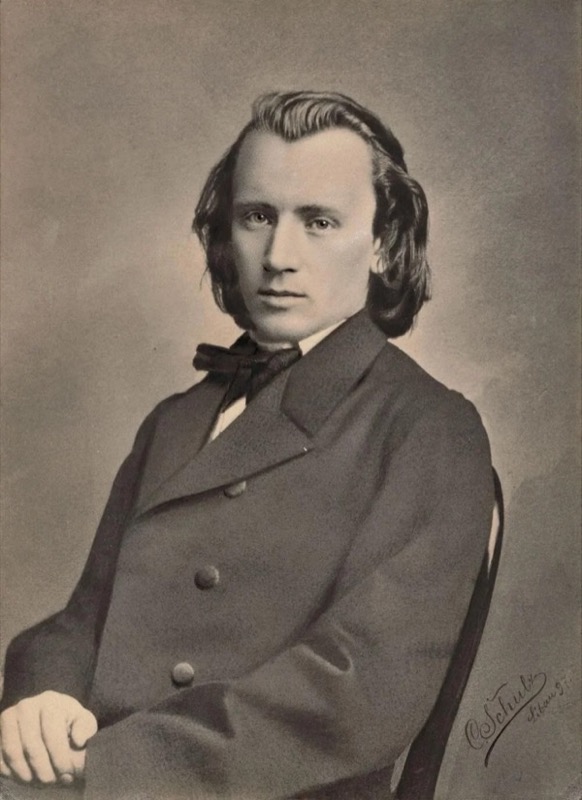
Johannes Brahms as a youth
At this time, Brahms was a young man, not the heavily bearded octogenarian we have become accustomed to. Brahms was an unknown at the time and was introduced to the Schumanns by violinist Joseph Joachim. Robert, a composer, writer, and music critic, was convinced that Brahms was a wonderful talent who would make his mark. Brahms frequently consulted Clara, a brilliant pianist and his muse, for her thoughts on his music. He became very close to Robert and Clara Schumann, the music scene’s power couple, as mentors and friends. When Schumann suffered a mental breakdown and attempted suicide, he was committed to an asylum and tragically died there. Brahms was devastated.
On the cusp of these events, and breaking totally with tradition in his concerto, Brahms begins the work with thunderous timpani and a tempestuous, long orchestral tutti. Several moments pass, almost five minutes, before the piano enters with a melancholy theme.
Johannes Brahms: I. Maestoso (Arthur Rubinstein, piano; Israel Philharmonic Orchestra; Zubin Mehta, cond.)
The second movement of the concerto, an Adagio, so intimate, serene, and affecting, is in 6/4, as is the first movement. It’s an homage to Schumann, and as Brahms indicated, “a tender portrait” of Clara.
Johannes Brahms: II. Adagio (Arthur Rubinstein, piano; Israel Philharmonic Orchestra; Zubin Mehta, cond.)
For the last movement, Brahms looks to Beethoven Piano Concerto No. 3, last movement, Allegro Rondo. Brahms writes in a similar character—proud and decisive, following the form and structure of the Beethoven concerto.
Brahms Piano Concerto No. 1 is considered a pinnacle of the piano repertoire today. It always brings the house down for the demanding virtuosity required of the pianist and the dramatic, lush sounds of the orchestra. With a history like this, we are grateful that Brahms took the time to write this masterpiece. We musicians and audiences know it’s a piece worth waiting for.
For more of the best in classical music, sign up for our E-Newsletter