A century after his death, Erik Satie remains one of classical music’s most intriguing and influential figures. Eccentric, irreverent and often deliberately provocative, he was a composer who challenged musical conventions and rejected the grand gestures and emotional excesses of late Romanticism in favour of simplicity, clarity and economy of expression. But beneath the apparent simplicity of his music lies a distinctive and often elusive musical personality, by turns melancholic, playful, enigmatic and absurd. While his Gymnopédies and Gnossiennes are familiar to audiences and pianists, Satie’s influence extends well beyond these beguiling miniatures, reaching into minimalism, experimental music and the work of successive generations of composers.

Erik Satie
John Cage wrote that “Satie is indispensable to the development of contemporary music”, recognising Satie’s influence on composers of the twentieth and twenty-first centuries. D’après Satie: Music Towards a Future Past, a fascinating recording by pianist Duncan Honeybourne on the Prima Facie label, celebrates this enduring influence through an imaginative dialogue between Satie’s own piano music and newly commissioned works by contemporary composers. The project was conceived by British composer David Lancaster to mark the centenary of Satie’s death in 2025. Lancaster invited a group of composer colleagues to write short piano pieces inspired by Satie, encouraging them to look beyond the familiar Gymnopédies and Gnossiennes, and respond instead to the wider range of his musical ideas, his eccentric personality and his singular approach to composition. The resulting works are not intended as pastiches or exercises in imitation, but as individual reflections on a composer whose originality continues to resonate a hundred years after his death.
The album brings together music by seventeen contemporary composers, interspersed with Satie’s own works, including the Gnossiennes, Pièces froides and Gymnopédies. The contemporary pieces range from the contemplative to the whimsical, their titles alone suggesting something of Satie’s mischievous spirit and fondness for the unexpected, while their miniature scale reflects Satie’s fondness for musical aphorisms. This juxtaposition of old and new is central to the recording’s appeal, inviting us to hear familiar music afresh while discovering the many different ways in which Satie’s ideas have been absorbed, reinterpreted and transformed.
The piano miniature was a form in which Satie demonstrated that brevity need not imply a lack of substance or expressive depth. The challenge for both composer – and performer – is to create a complete musical world within a very small space.
Some of the pieces on this intriguing album closely reflect the idioms, melody or rhythm of specific pieces by Satie. Ruth Lee’s Memory Thread, for example, echoes the bassline rhythm and sinuous melody of the Gnossienne No. 1 (which opens this album), and if one were not listening attentively, one might mistake it for Satie. Yet it has a distinctive harmonic language of its own, and it feels like an affectionate tribute. Other works, such as Philip Grange’s Knossienne, which sits between the opening track and the second of Satie’s Gnossiennes, invite a direct comparison with the pieces which bookend it. David Lancaster’s Montmartre vividly portrays the bohemian district of Paris where Satie lived from 1887–98, a hub for the fashionable artists and writers of the time (Toulouse-Lautrec, van Gogh, Francisco Pissaro, Émile Zola, Jules Vallès and Paul Verlaine, for example).
Meanwhile, Frederick Viner’s Sarabande combines French Baroque sensitivities with Satie’s quirky harmonic language; Simon Hopkins’s Vexopedie No. 1 (An Ostracised Beetle) appears to bring together Satie’s musical legacy and his fondness for absurdist titles; and Sarah Thomas’s Un morceau en forme de chou de Bruxelles is an unmistakably playful nod to Satie’s Trois morceaux en forme de poire.

Duncan Honeybourne
Pianist Duncan Honeybourne is well-suited to revealing the individual character of each piece, and brings his distinctive, broad musical palette to these miniatures, illuminating each with close attention to the details of dynamics, rhythm, harmony and articulation.
Classical music can often take itself far too seriously, while Satie was frequently mischievous, irreverent and deliberately absurd. This recording celebrates those qualities without overlooking his more contemplative side and his ability to make a significant artistic statement in miniature.
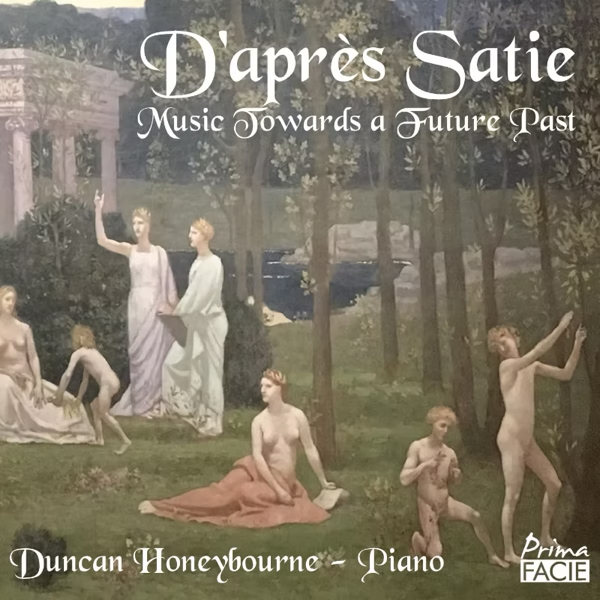
D’après Satie: Music Towards a Future Past is released on the Prima Facie label and is available on CD and streaming.
For more of the best in classical music, sign up for our E-Newsletter