Franz Liszt (1811–1886) was the original piano superstar. He had the looks and the locks, all paired with theatrical flair and fingers that moved at blazing speed. He was the prototypical musical showman, but behind his flamboyant public demeanour was a serious musician and artist.
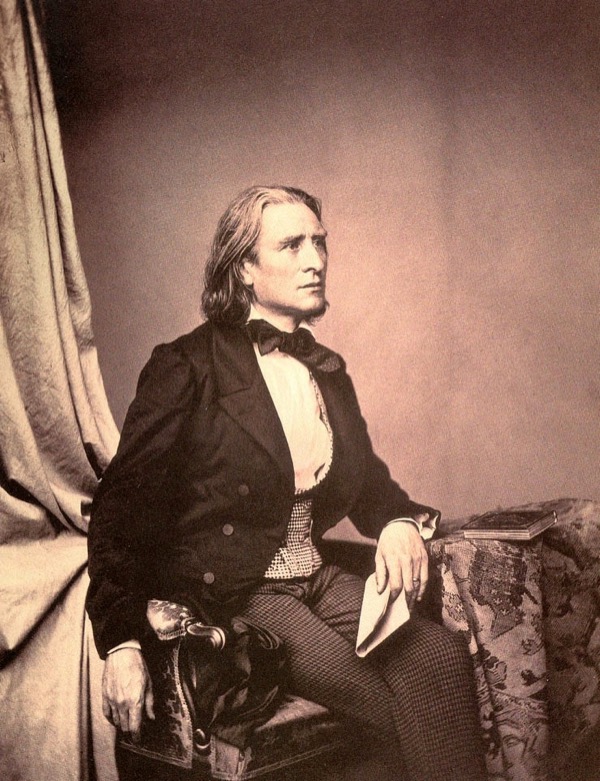
Franz Liszt (1858)
A restless and generous spirit, Liszt constantly pushed the piano beyond its limits. Under his hands, the piano could sing like an opera diva or whisper like a poet. Of course, it could also unleash torrents of virtuosity so jaw-dropping that you might think he had three hands.
To celebrate his birthday on 22 October, let’s take a closer look at La Campanella (The Little Bell), one of his most famous and jaw-dropping piano showpieces, and explore the earlier versions that led to this dazzling masterpiece.
Liszt/Paganini: Grandes études de Paganini, No. 3, La Campanella, S. 141/3
Franz Liszt in the Audience
First things first. Liszt didn’t write the melody of “La Campanella”. Rather, it comes from the third movement of Paganini’s Violin Concerto No. 2. Written in 1826, it seems the perfect blend of lyrical charm and technical wizardry.
In the playful opening, set in the upper register and supported by the triangle, Paganini mimics the chime of a little bell. And then come the fireworks. We hear delicate harmonics, unbelievable speed, and intricate bow work that captures the magic of Paganini’s “Devilish Fiddler” reputation.
Paganini first came to Paris in 1831, and he already had quite a reputation. His playing elicited stunned wonder, but critics called his compositions childish and lacking in taste.
Paganini returned to Paris in April 1832 to play a benefit concert for victims of a cholera epidemic raging in the city. At the time, a pianist named Franz Liszt was in the audience.
Niccolò Paganini: Violin Concerto No. 2 in B minor, Op. 7 “La Campanella”
Virtuosity with a Purpose
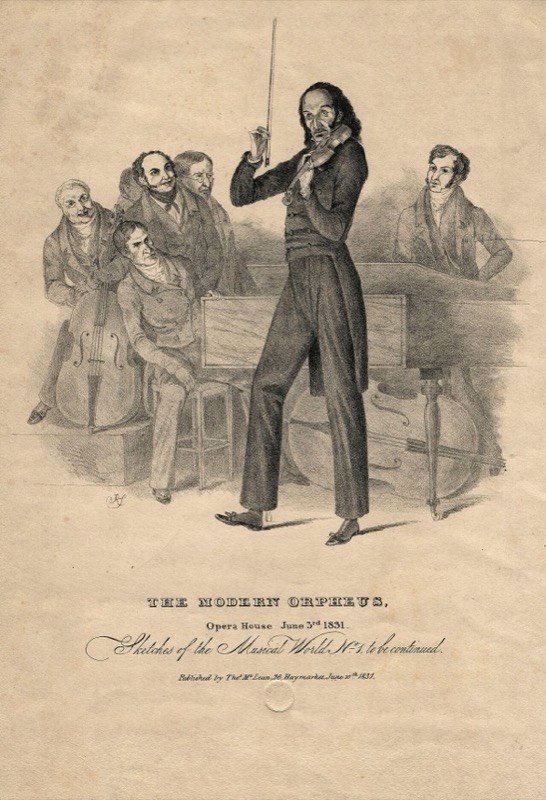
Niccolò Paganini by Richard James Lane
On hearing Paganini, Franz Liszt was stunned. He even called it, paraphrasing, a miracle the kingdom of arts has seen but once. This performance also provided a flash of insight. Nothing the piano virtuosos who made Paris their home had produced was comparable.
Liszt actually tells us, “For a whole fortnight my mind and my fingers have been working like two damned spirits… I practice four to five hours of exercises (thirds, sixths, octaves, tremolos, repetition of notes, cadenzas, etc.). Ah! Provided I don’t go mad, you will find in me an artist! Yes, an artist…such as is required today.”
For Liszt, this talk of a modern artist did not rely exclusively on virtuosity. In fact, he subsequently articulated his vision by placing artistic genius under special obligations to serve the rest of humanity. “May the artist of the future decline to play the conceited and egotistical role which we hope has had in Paganini its last brilliant representative.”
With Paganini in mind, Liszt began creating a completely new kind of piano repertoire, transferring some of Paganini’s most spectacular effects to the keyboard. The immediate result was the Grande fantaisie de bravura sur La Clochette de Paganini, a gigantic fantasy with the reworked and expanded “La Campanella” melody at its heart.
Franz Liszt: Grande fantaisie de bravura sur La Clochette de Paganini, S420
A Bravura Fantasy
He published this work in 1834 as Opus 2, but he may have completed it as early as 1832. It is structured like an old-fashioned bravura fantasy, opening with a slow section that hints at the principal theme.
A cadenza follows this, and finally a theme and variations interspersed with pseudo-orchestral ritornelli and a flashy grand coda. The principal theme, as you can clearly hear, is “La campanella,” transposed to A minor.
The introduction isn’t very original, as Liszt does not yet explore his wonderful harmonic originality. The cadenza is then based on the middle section of Paganini’s theme. Liszt takes his time to present the “La campanella” theme, which concludes with the ritornello.
Then come the fireworks as Liszt follows up with variations that focus on wide keyboard leaps in a thankfully moderate tempo. The finale showcases a vast, freer variation followed by the ritornello, both at a reduced tempo. The coda features plenty of repeated notes, and finishes with a series of descending chords.
Liszt/Paganini: “La Campanella” Études d’exécution transcendante d’après Paganini, No. 3, Campanella, S. 140/3
Beyond the Ordinary
Franz Liszt kept returning to the little bell melody in his six-study collection Études d’exécution transcendante d’après Paganini, written in 1838 and published in 1840. He dedicated this set to Clara Schumann and drew on the Paganini 24 Caprices for Solo Violin, as well as his violin concertos, for his studies.
Here, Liszt clearly signals in the title his intention to push piano performance beyond ordinary technical limits. “La Campanella,” the third study in the set, is scored in A-flat minor, which makes the nastier leaps between black notes easier to target.
This étude draws on the finale of Paganini’s Second Violin Concerto. It also incorporates material from the finale of the First Violin Concerto, Op. 6. We first hear the repeated-note elaboration from the First Concerto, followed by the now-familiar “La Campanella” melody.
It’s a somewhat boisterous affair as Liszt rethinks the musical material itself. With material from two concertos, the question becomes how to distribute it across the keyboard and how to shape the climaxes. In the famous 1851 version, Liszt dropped the First Concerto material and enharmonically respelled “La Campanella” to G-sharp minor.
Franz Liszt: Grande fantaisie sur des thèmes de Paganini, S700i/R231 (Leslie Howard, piano)
Unfinished Experiments
Before we arrive at the famous 1851 version, however, Liszt experimented with two different versions in his Grande fantaisie sur des thèmes de Paganini, dated Lisbon, 1845. I say completed because that’s what the manuscript says; however, it needed some editorial help before it was published in 1989.
Liszt crossed out some measures, and he never considered these two versions complete; hence, they remained unpublished during his lifetime. Much seems related to the Clochette Fantasy from 1834, yet the melody is treated differently, with variations alternating with developmental passages.
At the beginning, both versions are identical as they introduce the theme, partly taken from the published fantasy, all in A minor.
The theme appears in the left hand with the leaping accompaniment in the right, and Liszt follows with a tutti fragment from the original concerto, which does not appear in the earlier fantasy. Only then do we hear the familiar ritornello.
Once the little bells return, they accompany Le Carnaval de Venise. Several variations follow, and the bells return briefly to set up another variation on Le Carnaval.
We find many different transpositions; the first version completes a lengthy variation on La Clochette and concludes with a grand octave passage in the coda, recalling the earlier fantasy. The second version also continues with a lengthy variation on La Clochette before continuing with a long group of variations on Le Carnaval. The little bells then return for a short variant in the coda.
The Final Bell
As you can tell, things are a bit complicated, and I am not sure I got it all 100 per cent correct. But what I do know is that next comes the famous La Campanella. It’s shorter and more concentrated, and the focus shifts exclusively to the little bell.
From the sprawling fantasy of 1834 and the experimental studies of the 1840s to the polished masterpiece of 1851, Liszt did what he did best. And that is taking an idea and transferring it to the piano as if it had always belonged there. So the next time you hear La Campanella, you will understand that behind this famous piece lie nearly two decades of delicious musical experimentation.
For more of the best in classical music, sign up for our E-Newsletter
Franz Liszt: Grande fantaisie sur des thèmes de Paganini, S700ii/R231 (Leslie Howard, piano)