Before her sold-out Mozart Concerto concert, Elisabeth Leonskaja strolled across the street to greet the autumnal sun and my earnest questions. Astonishingly, she recalled not only the masterclass students she taught months earlier at the Oxford Piano Festival, but also my quiet presence a year and a half ago, when she spoke to journalists about her journey from Moscow to Vienna.
Leonskaja’s Shanghai recital serves as a meeting point between her London and Paris programs: she recently performed Schubert’s D. 850 at Wigmore, and in November she will bring Beethoven’s Fantasy in G minor and Shostakovich’s Piano Sonata No. 2 to France and beyond. Just talking to her feels like watching a legend at work, made even more profound by her connections to Yakov Milstein, Heinrich Neuhaus, Sviatoslav Richter, among other everlasting stars.
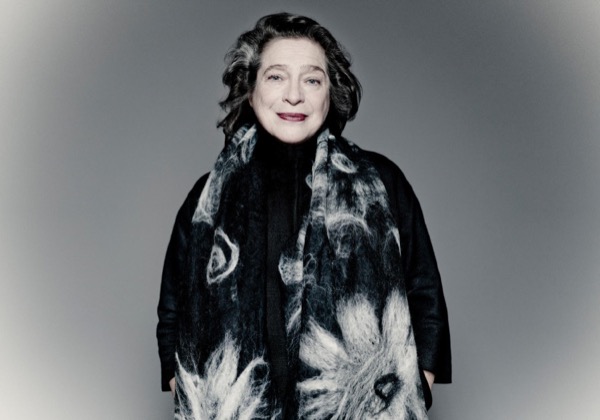
Elisabeth Leonskaja (Photo by Marco Borggreve)
What is special about the cadenza you played for Mozart’s Piano Concerto No. 22 in E-flat major, KV 482?
Mozart did not leave a cadenza for this piano concerto. Britten wrote the one I play for my close friend Richter. The friendship between Britten, Richter, and Rostropovich was profound. Many interesting videos show them playing concerts together in Britten’s hometown of Aldeburgh. Richter always looked straight at the piano, while Britten often glanced at him to stay in sync.
When they were playing four hands, Richter probably said, “Benjamin, can you please write a cadenza for this concerto?” And that is how we got this wonderful cadenza. It is a little long, but for me, it is the concerto’s crown. Britten could immediately see what he needed in the score. Already in the first-movement cadenza, he uses material from the second and third movements. For example, he takes a theme from the last movement and uses it as a bridge theme. In the second part of the cadenza, he completely changes the tonality. The effect is strange, but absolutely brilliant.
How would Richter approach Mozart?
He said the timing must be exactly right in Mozart. Not here, not here, but precisely at that point. With other composers, there may be more room for flexibility. This is really very difficult, but necessary. For pianists, Mozart is always a huge challenge. Legato, staccato, dynamics—everything has to be worked out.
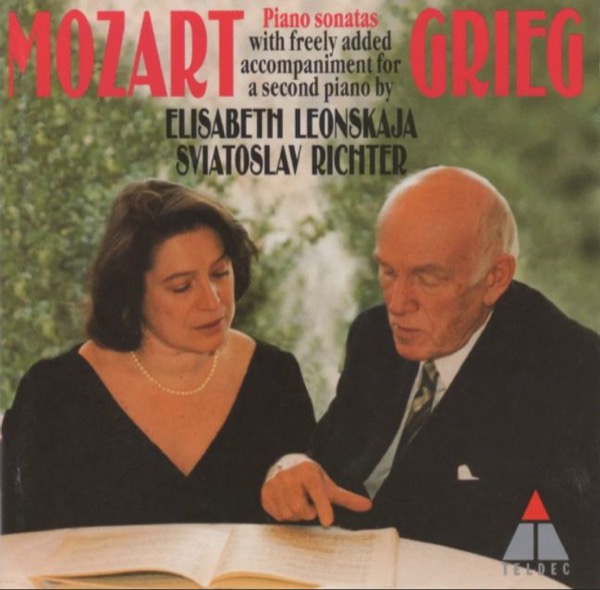
Leonskaja and Richter
Are you ever bothered by imperfection when you play Mozart?
What is perfection? For me, it is almost impossible to play Mozart even close to perfection, because the demands are too high. Many years ago, I had a short lunch conversation with Yehudi Menuhin. He said, “Bach was religious. We know where he takes us. And Mozart was so sad, but he had the sky in his pocket.”
That is the problem. None of us can easily carry the sky in our pockets. Mozart’s thoughts came with enormous speed, like playing cards, and like cha-cha. When I play his repeats and decorations, I feel he knew something that we can never completely reach through reason or emotion alone. I see this in nature. On the surface, it seems like nothing, but everything is inside there.
Leonskaja plays Mozart K. 284: II. Rondeau en polonaise
Do you have any special memories of the conductor Charles Dutoit, who will collaborate with you this time?
He is a wonderful, happy maestro—a real gentleman. I have played Beethoven’s Choral Fantasy and the Grieg Concerto with him. I had actually forgotten that I played this Mozart concerto with him at the BBC Proms in 2015. Two weeks ago, some of my young friends from London reminded me. They remembered it.
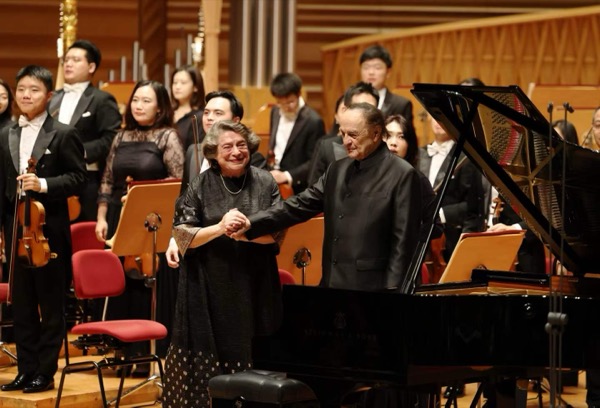
Leonskaja and Dutoit (Photo by Shanghai Symphony Orchestra)
Dutoit conducted the Chinese premiere of Wozzeck last year, and he has also recorded works by Alban Berg.
Berg’s music is difficult. He wrote only one sonata for solo piano. Many young pianists make mistakes and perform it as if it were Scriabin—very emotional and exciting. But for me, Berg represents the German spirit and the Austrian school. So we have to approach his music in a very classical way. Harmonic structure, polyphony—these are no less important than expression.
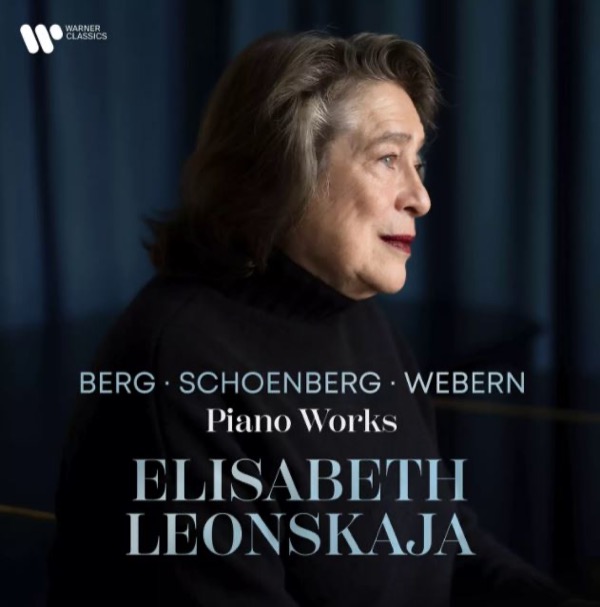
Leonskaja’s Berg Recording
Could you talk about the rarely performed Beethoven Fantasy in G minor, Op. 77?
I have had it in my repertoire for a long time. This autumn, the theme of my recital in Paris is Si, Si, Tout est en Si. So I was looking for pieces in related tonalities. I also chose this Beethoven work for a very practical reason: it is seldom heard on stage. The Schubert D-major Sonata in the second half is just the right length, while the Shostakovich Piano Sonata No. 2 in the first half is something I sure want to play this year. September 25th marks Shostakovich’s 120th birthday. So, putting Beethoven at the beginning, the length and the tonality are just right.
Last May, you played Schubert’s incredibly moving last sonata D.960. Why did you choose the unusually sunny, somewhat “shallow” sonata D. 850 this time?
“Shallow”, that’s right. Many ideas in this work feel like the beginnings of a symphonic piece. Schubert’s brain was probably always working. An idea came to him during the night, perhaps, and he woke up, put on his glasses, and wrote down what he had in his mind. To really understand this sonata and to hold it in equilibrium—this is very difficult in performance.
Funnily enough, each time I come back to the sonata, I try to find the right tempo for the first movement, Allegro vivace. I often say to young pianists in my masterclasses: Allegro vivace, Allegro moderato, Allegro con brio—it means something. Allegro has different levels of joy. But Presto is always driven by something outside.
Richter said everybody plays the first movement of Schubert’s last sonata too fast, even though the score clearly says Molto moderato. The last movement, Allegro ma non troppo, is full of energy. Schubert keeps coming back to the note G, and each time it has a different effect.
We still don’t work enough with harmony or the composer’s ideas. Neuhaus said, “Look at the score. Everything is written there.” But we probably see only 60 per cent of it. Each time I return to the score, I discover something I hadn’t realised before.
Leonskaja plays Schubert D.850
You mentioned the connection between Schubert and Bruckner in last year’s interview.
It is hard to explain exactly why I like Bruckner. I believe in this music. I feel him when I hear this music. Bruckner was very religious. For me, he was like a small sound, a sound coming from everyone, trying to break free, trying to rise. He takes one step, and perhaps it is not enough. So he starts again. But that is only my very personal feeling as a listener.
I think the conductors who understand the length of the line, but do not try to show themselves, are on the right side. Good orchestras know how to do it anyway. The Vienna Philharmonic, of course, because this is Bruckner’s home. And Schubert—if he had lived longer, I am sure he would have written music like this.
You met Shostakovich several times as a student. Did he ever comment on his own piano works?
He was always there, but he spoke very little. He was very, very modest. We were students, and none of us ever criticised him. Sometimes he would come over, take a look, and leave. But he never said anything harsh. For him, music, for people who can hear it and understand it, does not need to be explained. It is like a painter. If the painter has to stand next to the painting and explain to the public what he has painted, then it becomes unnecessary.
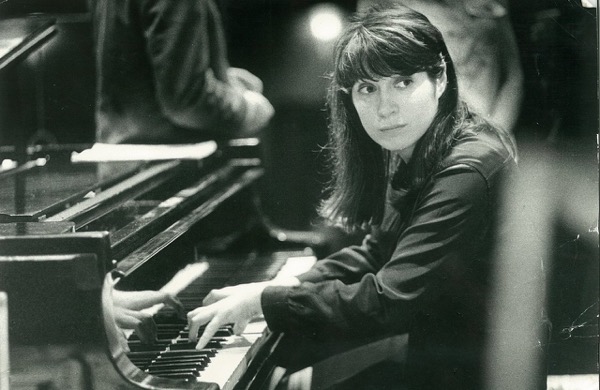
Leonskaja in East Berlin in 1971 (Photo by Evelyn Richter)
How would you describe Shostakovich’s Piano Sonata No. 2?
Shostakovich was 21 and still a student when he received an honorary mention at the first Chopin Competition in Warsaw. So he was a good pianist. This sonata is still less performed on stage. It is a very tragic piece. Long, unspectacular, and deep.
For example, the last movement is a Passacaglia, simply a set of variations. The theme takes only a few lines on one page of the score, with a single voice and no accompaniment in the left hand. And each variation moves from pianissimo to an explosion.
Also, the colours, the harmonies, the language of this sonata are so unusual. The first movement is like perpetual motion. It keeps moving non-stop. The second movement is like a late-autumn or winter landscape. Sometimes I hear only the air standing still, cold. You have to keep this tension, as if the air itself were about to freeze.
He dedicated this work to his teacher, Leonid Nikolayev, who had died by then.
Yes. But dedications are often accidental. Prokofiev has a funny story. When he was six, he composed an opera. His mother came to him and said, “You know, this aunt’s husband has just died so that you can dedicate this work to her.” With a dedication, you never really know why. It is probably just the moment.
Have you ever listened to Shostakovich playing the piano himself?
Only on recordings and in historical videos. I can hear his thoughts in his playing. There is a wonderful video from the Soviet Union of Composers. It shows Shostakovich playing the second movement of the First Piano Concerto. Khachaturian and Khrennikov were sitting there. You can see Khachaturian—he was very friendly, and he really enjoyed it.
Documentary on Elisabeth Leonskaja: Mit der Musik sich selbst geben
Do you have a Shostakovich symphony that you especially like?
Each one of his symphonies is so different. I would probably say Symphony No. 1, which he wrote when he was 19. He was probably still green, but it was absolutely his voice. From the very beginning, his instrumentation was so perfect. You never hear anything in the wrong place in Shostakovich. Even in this early symphony, or in his early piano works. He was a born genius.
You recently received the Shostakovich Prize in Germany.
What could I do? The jury decided it. I said, “Please give it instead to the Danel Quartet.” They were the quartet I had played with. They studied with the Borodin Quartet, and they recorded all of Shostakovich’s quartets.
Leonskaja and Quatuor Danel play Shostakovich’s Piano Quintet
You have also spoken very highly of the pianist Piotr Anderszewski, who will be coming to Shanghai soon.
The last time I heard him was during the pandemic. He played Bach in Madrid—twelve Preludes and Fugues. He is a real musician with a very special style. Maybe this also comes from his Hungarian and Polish heritage. Both countries have rich musical cultures and a classical approach to artistic expression. But such a mixture is probably not always easy for the artist himself.
Do you also play Bach?
Yes. Sometimes I think about playing Bach as an encore. But sometimes, even after I have decided, I still haven’t learned it. As for the encore after Schubert, we will see!
See Leonskaja’s upcoming concerts: https://www.leonskaja.com/calendar
For more of the best in classical music, sign up for our E-Newsletter